






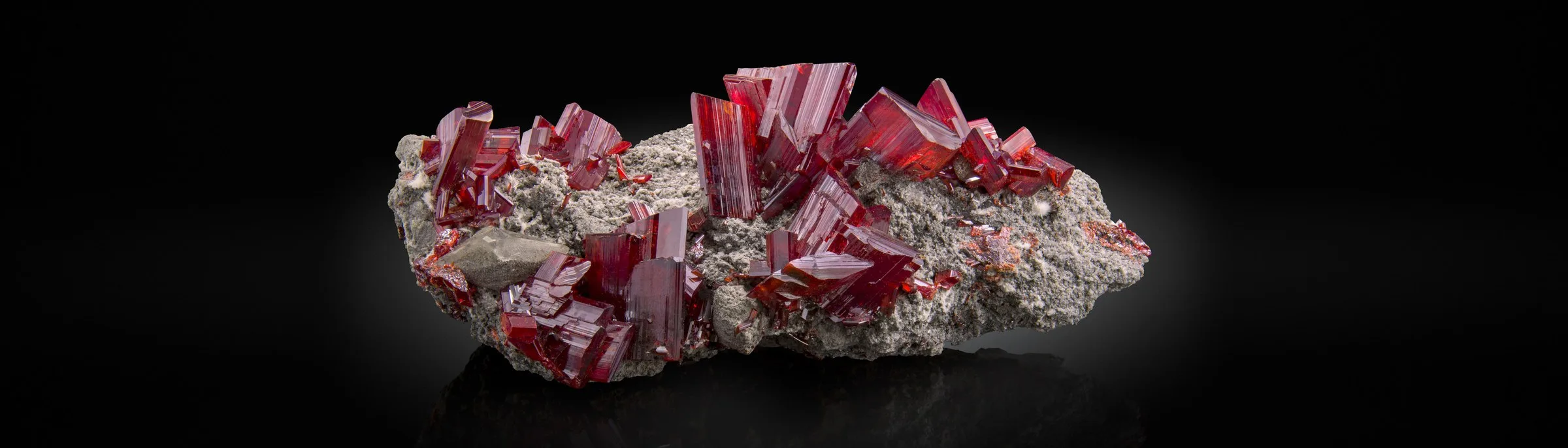
Most "dangerous" minerals are safe to own. The real risks are dust, radon from uranium minerals and true asbestos fibers, not touching a cinnabar crystal or keeping a small eudialyte. Here's which species need care, how to store radioactive pieces, why arfvedsonite usually isn't asbestos, and what never goes in an aquarium.
Most "dangerous" minerals are safe to own, display and handle with a few simple habits. The real risks come from three things: dust you swallow or breathe, radon gas from uranium minerals, and fibers from true asbestos. A cinnabar crystal on a shelf or a galena cube in your hand is not the problem. Grinding, heating, licking, keeping uranium minerals in a bedroom and dropping specimens into a fish tank are.
For everyday care (dusting, humidity, light and which cleaners to avoid), start with our mineral specimen care guide. This post covers only what's specific to toxic and radioactive pieces. Hazard depends on how a mineral could get into your body, not on how frightening its chemistry sounds.
Radioactive minerals: torbernite, autunite and uraninite
Uranium minerals expose you in three ways. Direct radiation falls off quickly with distance, to roughly a quarter each time you double the gap. Radon, a radioactive gas produced as uranium decays, seeps out of the specimen into the room. Dust is the one people forget: a crumb inhaled or swallowed matters far more than one sitting in a box.
Uraninite, the uranium ore itself, is usually the most active piece in a hobby collection. Torbernite and autunite, the bright green and yellow "uranium micas", lose water in dry air and turn into meta-torbernite and meta-autunite. The crystals often keep their shape but can turn flaky inside, which makes them the main dust risk. A glow under UV is not a sign of radioactivity: plenty of harmless minerals fluoresce, and many radioactive ones don't.
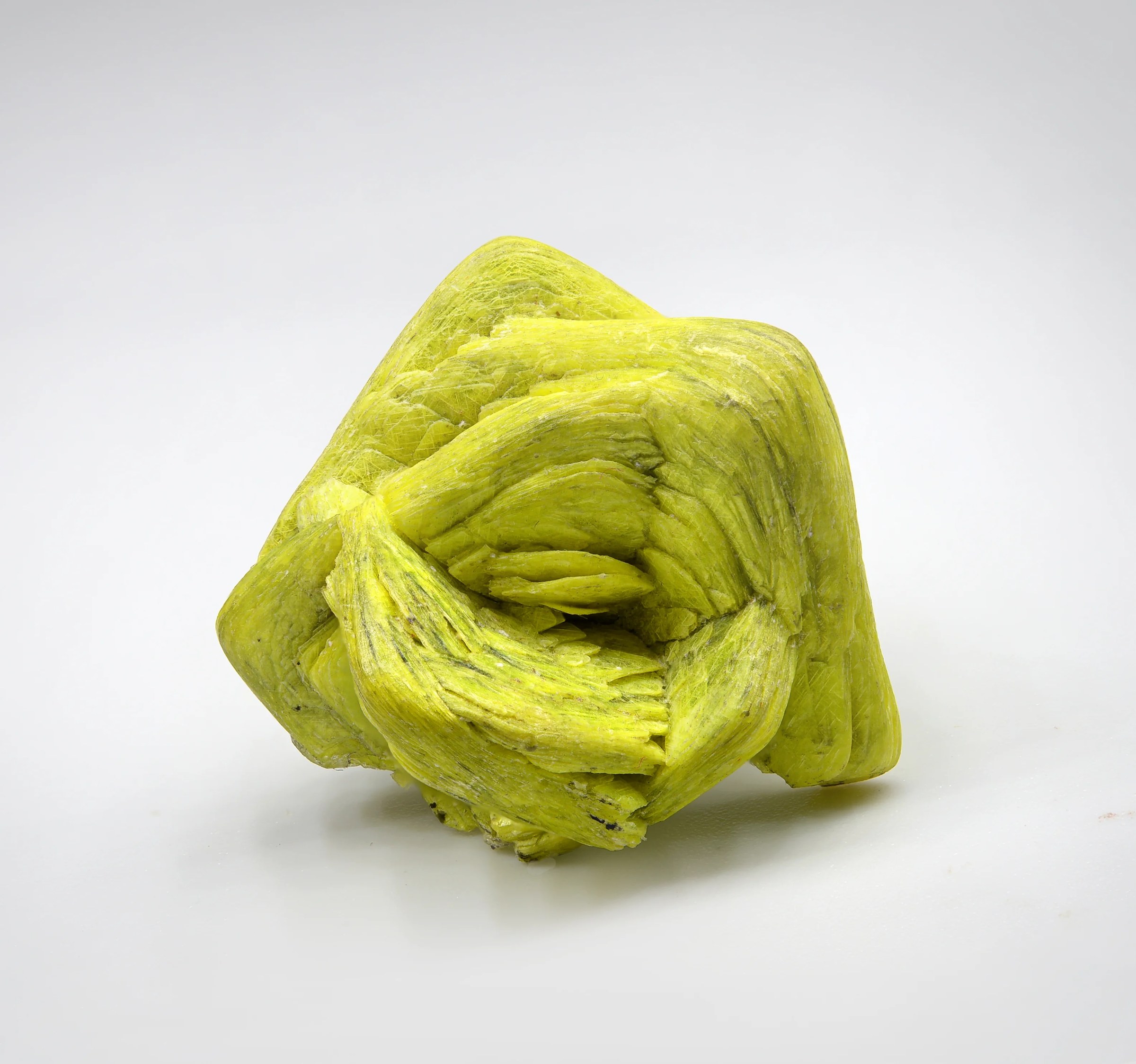
Autunite rosette from the Faria mine, Minas Gerais, Brazil, in the collection of Tama Higuchi on EarthWonders. The listing notes it has been coated to slow dehydration, a detail worth asking about whenever you buy uranium micas. View the specimen.
How much does a collection add? A 1989 Swiss study in Health Physics measured radon in 35 homes of mineral collectors. The room holding the collection averaged about 98 Bq/m³ more radon than a control room on the same floor. For scale, the World Health Organization recommends a reference level of 100 Bq/m³ for homes, and the US EPA's action level is 4 pCi/L, about 150 Bq/m³. A couple of thumbnails is not a full cabinet, but the lesson is clear: keep radioactive pieces out of the rooms where you spend your time.
How to store radioactive specimens
- Use a closed box for each piece. A lidded plastic box catches flakes and slows dehydration. Don't brush or blow dust off torbernite or autunite.
- Keep the boxes where you don't sit or sleep. A ventilated spare room, garage or outbuilding is ideal. Never a bedroom.
- Open boxes somewhere airy. Radon builds up inside a closed box, so open it by an open window or outdoors, and don't put your face over it.
- Handle briefly, by the box where you can, and wash your hands before eating or touching your face.
- Label everything. Put "radioactive" on the box and in your catalog, so the warning survives a sale or an inheritance. Old labels often say nothing, so check an inherited collection with a Geiger counter. Our guide to storing and displaying a collection covers boxes and labels.
- Keep it small. If you collect seriously, put a radon monitor in the storage room.
⚠️ Never cut, grind, sand or wet-polish a radioactive mineral. Wet work keeps dust out of the air while you work, but the slurry dries into the same fine powder on your bench, tools and clothes.
Eudialyte and other weakly radioactive minerals
Eudialyte, the raspberry-red zirconium silicate from Greenland, the Kola Peninsula and Mont Saint-Hilaire, often carries traces of thorium and uranium. A Geiger counter may tick a little above background, and that is all. Ordinary eudialyte specimens, whatever their size, don't need radioactive-style storage. The same goes for some zircon and other thorium-bearing minerals. If a piece gives a strong reading, treat it like the uranium minerals above.
Toxic minerals: the dust is the danger
For mercury, arsenic, lead and copper minerals, solid crystals are low risk to hold. Powder, fumes and swallowing are what matter. Brief handling with clean, dry hands is fine as long as you wash them afterward. Disposable nitrile gloves make sense for crumbly pieces that shed powder. Never lick a specimen to bring up its color, keep these pieces away from food, and never sand or grind them. Acids on sulfides and arsenic minerals can release toxic gases, which our guide to cleaning minerals by type lists in full.
Cinnabar and mercury
Cinnabar is mercury sulfide, and it is far less dangerous to handle than most people assume. As a solid it is insoluble and poorly absorbed if swallowed, according to a review in Experimental Biology and Medicine. The serious hazard is heat, which releases mercury vapor. In one Korean case report, five members of a family inhaled mercury vapor while burning cinnabar charms, and one died of respiratory failure.
Pieces with droplets of native mercury, which evaporates slowly at room temperature, belong in a sealed case.
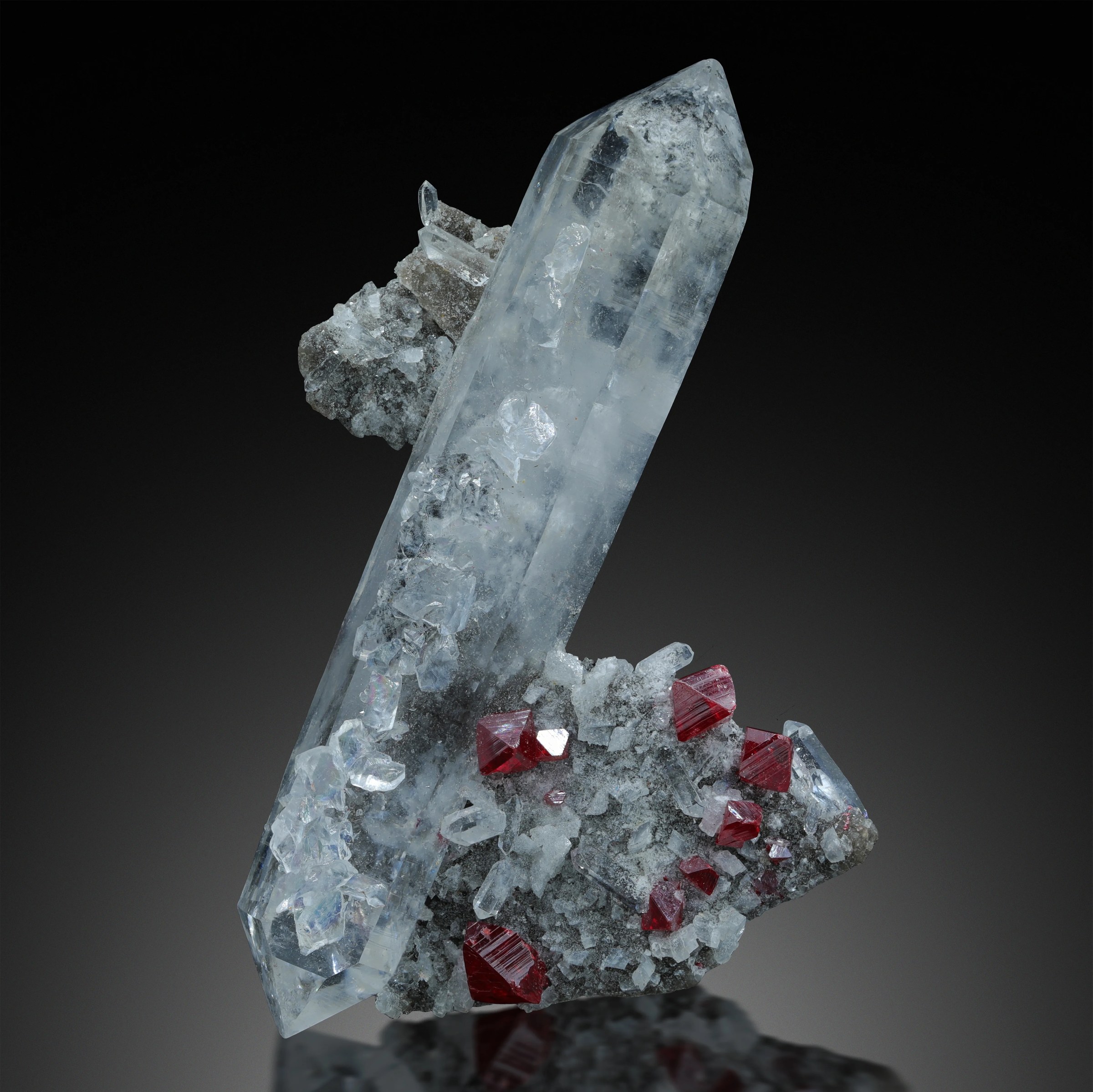
Cinnabar with a doubly terminated quartz crystal, 3.9 cm, from the Tongren mine, Guizhou, China, in the collection of Tom Zhang on EarthWonders. Cinnabar is mercury sulfide. It is safe to keep and handle as a solid if you wash your hands afterward, but heating it releases toxic mercury vapor, so it should never be heated. Photo: Jingnan (Tom) Zhang. View the specimen.
Realgar, orpiment and the arsenates
Realgar and orpiment are arsenic sulfides, and they need more care than cinnabar because they make their own dust. Light turns realgar's surface into crumbly yellow-orange pararealgar, which comes off on fingers and drawer linings. Keep them in lidded boxes in the dark, handle them as little as possible and hold the matrix, not the crystals. Our guide to light-sensitive minerals explains why even LED light harms realgar.
Arsenates such as adamite, mimetite, erythrite and olivenite don't powder in light, so the general rules above are enough.
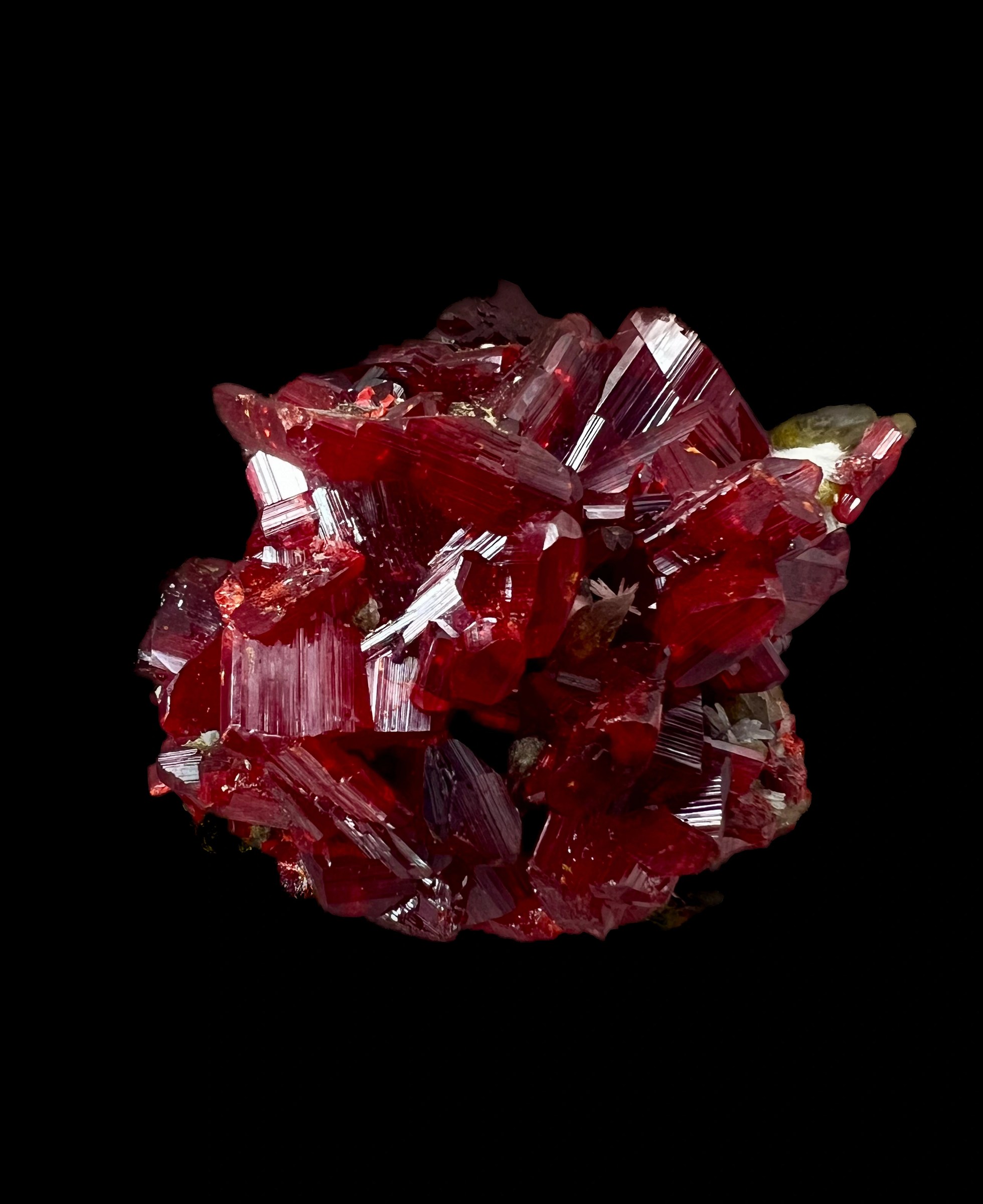
Realgar from the Shimen mine, Hunan, China, in the collection of Rose on EarthWonders, who keeps it in the dark because of its light sensitivity. Dark storage also slows the arsenic-bearing powder that forms on the surface. View the specimen.
Lead and copper minerals
Galena, vanadinite, wulfenite, pyromorphite and crocoite are among the most popular species in any collection, and a solid crystal is low risk to hold. Lead becomes a hazard when it is swallowed or inhaled as dust, especially repeatedly, so never let a child mouth one.
Chalcanthite is copper sulfate, and most of the vivid blue crystals sold at shows are lab-grown. Either way it dissolves in water and is harmful if swallowed, so keep it dry and sealed. Malachite, azurite and chrysocolla don't dissolve like this, but their dust is copper-rich.
Asbestos minerals: is arfvedsonite asbestos?
"Asbestos" is a regulatory term, not a mineral species. US regulations cover chrysotile plus the asbestiform habit of five amphiboles: tremolite, actinolite, anthophyllite, riebeckite (crocidolite) and cummingtonite-grunerite (amosite). The same species in coarse, prismatic crystals is not asbestos.
Arfvedsonite, a sodium amphibole related to riebeckite, is not on the list, and the black prismatic or massive material in most collections doesn't shed fibers. Chunky green actinolite is fine too, while byssolite, the felted, hair-like form of actinolite or tremolite, deserves caution.
So judge by habit, not by name. If a specimen is made of fine, flexible fibers that can be teased apart, treat it as potentially asbestiform: keep it in a sealed clear case and don't handle, break or brush it. Fibrous minerals outside the regulated six, such as erionite, can also be hazardous, as the UK Natural Sciences Collections Association notes in its guidance on asbestiform minerals.
Aquariums, terrariums and pets
Never put a mineral in an aquarium unless you know it is inert. Fish and invertebrates are far more sensitive to dissolved metals than we are.
- Usually inert: quartz, undyed agate, granite and slate.
- Changes water chemistry: calcite, limestone, marble and other carbonates raise hardness and pH.
- Avoid entirely: copper, lead, arsenic and mercury minerals, sulfides like pyrite that break down into acid, soluble minerals like chalcanthite and halite, anything radioactive, and dyed, coated or glued pieces.
For pets and small children the risk is chewing and licking, so keep toxic and crumbly specimens out of reach.
Quick reference: hazards by mineral
| Mineral | Main hazard | Handling | Storage | Aquarium |
|---|---|---|---|---|
| Uraninite, torbernite, autunite | Radon, radiation, dust | Brief, by the box, wash hands | Closed box, ventilated room, labeled | Never |
| Eudialyte | Weakly radioactive | Normal, wash hands | Normal display | No |
| Cinnabar | Mercury vapor if heated | Normal, wash hands | Away from heat; seal native mercury | Never |
| Realgar, orpiment | Arsenic powder | Minimal, wash hands; gloves if crumbly | Lidded box in the dark |
The short version
Most toxic and radioactive minerals are safe to own if you control dust. Wash your hands after handling, never lick, heat, grind or wet-polish these species, and keep them away from food, children, pets and aquariums. Uraninite, torbernite and autunite go in closed, labeled boxes in a ventilated room you don't live in. Eudialyte needs no special storage. Realgar and orpiment want darkness and minimal handling, and fibrous amphiboles belong in a sealed case.
This is general guidance for collectors, drawing on museum collections guidance and published research. It is not a substitute for professional advice. For large radioactive collections or suspected asbestos, contact a radiation protection professional or a qualified asbestos surveyor.