
Calcite on sphalerite, Elmwood mine, Tennessee. Two minerals, two sets of rules: the calcite cannot take acid, and the sphalerite releases toxic hydrogen sulfide with strong acid. Photo: Parent Géry, Public domain, via Wikimedia Commons.
Look at the specimen above: honey calcite on dark sphalerite, with a brown iron stain you'd love to lose. A dip in hydrochloric acid would dissolve the calcite. Most popular rust removers would etch it. Strong acid on the sphalerite would release toxic hydrogen sulfide. A careful wash in room-temperature water would probably be fine.
That's mineral cleaning in one picture. No product is "safe for minerals". Every cleaner suits some species and harms others, and a single specimen often carries several. This guide covers what each cleaner does, how to treat the main mineral groups, and when to stop.
- Treat the piece by its most sensitive mineral. If you can't identify everything on it, stop at dry cleaning. Our dust removal guide covers that.
- Clean, don't "develop". Museums define cleaning as removing dust, grease and dirt. Dissolving away associated minerals to make a piece prettier is irreversible and erases part of its story. If you do it anyway, record it, and disclose it if you sell the piece (see how to sell a mineral collection).
- Test first, on a hidden spot or a low-value specimen of the same species from the same locality.
- Write it down: the date, product, strength and time. A note on the specimen's catalog record tells every future owner exactly what was done.
| Cleaner | Good for | Where it fails or is dangerous |
|---|
| Tap water | General washing of robust minerals | Soluble and porous species; thermal shock if not at room temperature; fibrous crystals mat |
| Distilled water | Mixing recipes; final rinses | Can turn slightly acidic and etch calcite, so hard tap water is better for calcite |
| Mild detergent (a drop of washing-up liquid) | Grease, light clay | Frosts gypsum; attacks malachite, azurite, chrysocolla, phosphates, okenite; dulls stibnite |
| Anhydrous alcohol or acetone | Rinsing water-sensitive or fibrous pieces; faster drying | Can dehydrate highly hydrated sulfates; partly dissolves native sulfur and orpiment; flammable |
| Oxalic acid ("wood bleach") | Iron stains on quartz and other acid-resistant silicates | Toxic and absorbed through skin; never boil it (toxic fumes); leaves insoluble calcium oxalate crusts on calcite, fluorite and other calcium minerals; attacks carbonates, micas, turquoise, cavansite, proustite; poor rinsing leaves yellow stains |
| Dithionite products: Iron Out, Waller solution, pure sodium dithionite | Iron stains, including on minerals that can't take oxalic acid | Unstable, so mix fresh; gives off sulfur dioxide, so work outdoors; ; the citrate or EDTA in Iron Out and Waller solution etches calcite, fluorite, gypsum and dolomite (pure dithionite is gentler on those); by depositing metallic copper |
⚠️ Chemical safety. Work outdoors or with strong ventilation, and wear chemical-resistant gloves and eye protection. Label every container, keep children and pets away, never mix products, and add acid to water, never the other way round. Most specimens never need acid. If you're unsure, don't.
Halite, sylvite, hanksite, borax, trona, nitre, chalcanthite, melanterite and epsomite all dissolve in water, and impure halite can draw moisture out of humid air.
- Safe: a blower bulb, then a dry soft brush. If you must go further, a very brief rinse in a saturated solution of the same salt (saturated brine for halite) or in anhydrous alcohol, then dry quickly.
- Avoid: water, damp cloths, humid rooms and ultrasonic baths. Salt brine can alter hanksite, so use its own mother liquor or anhydrous alcohol. Pure alcohol can dehydrate highly hydrated sulfates, so specialist references suggest brief acetone for melanterite instead.
- Borates: compact ulexite tolerates a quick cold rinse, but hot water decomposes it and fibrous "TV rock" mats when wet. Clean borax dry only.
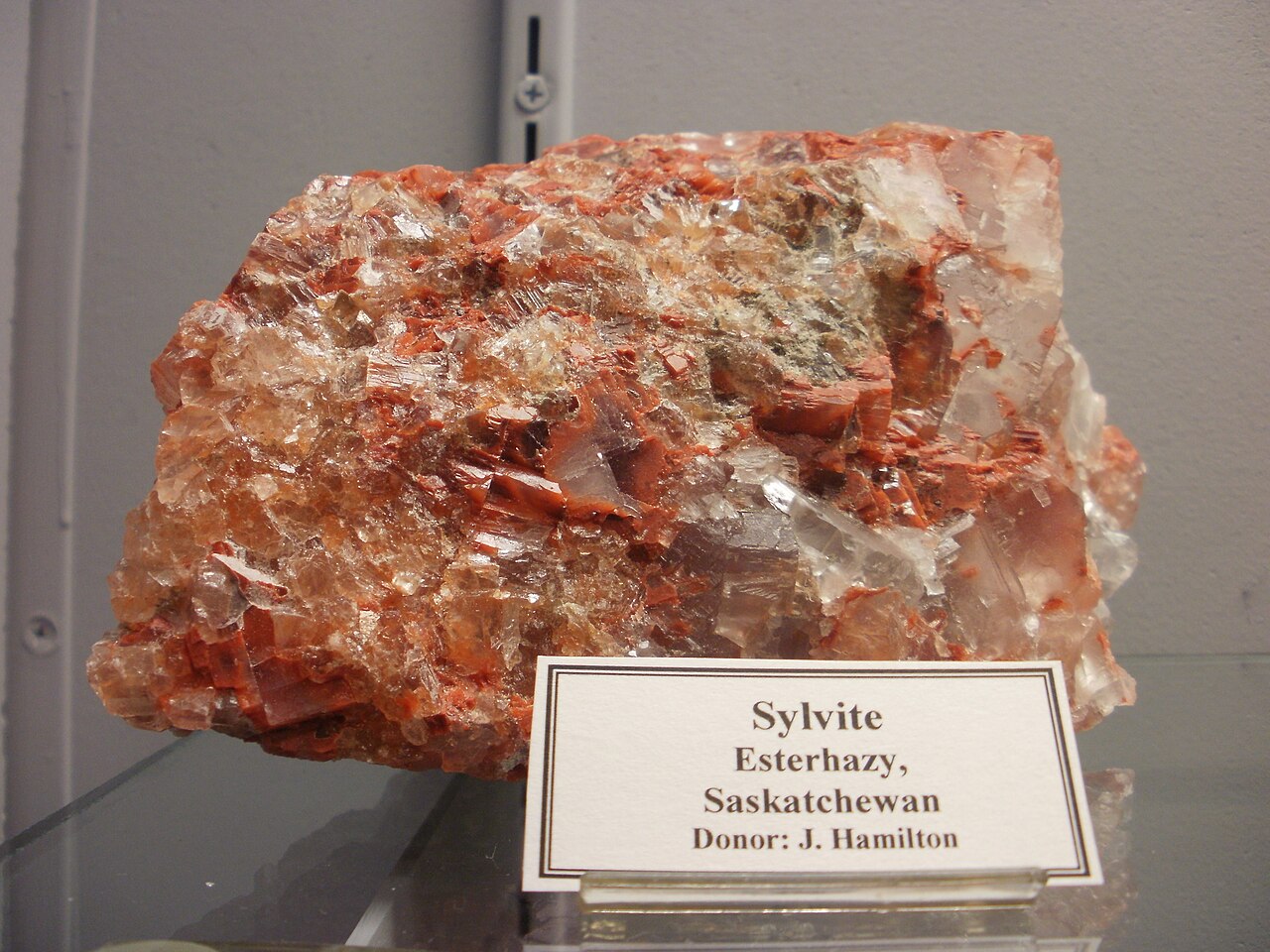
Sylvite (potassium chloride), Esterhazy, Saskatchewan (A. E. Seaman Mineral Museum). Water-soluble and hygroscopic. Photo: Chris857, CC BY-SA 3.0, via Wikimedia Commons.

Fibrous ulexite from Boron, California (Sorbonne University collection). Slowly attacked by water; fibres mat when wet. Photo: Marie-Lan Taÿ Pamart, CC BY 4.0, via Wikimedia Commons.
- Gypsum (selenite, desert rose): Mohs 2 and slightly soluble (about 2.6 grams per litre), so a soak rounds its edges and detergent can frost it. Use a blower and a very soft brush, a brief cold rinse at most, and slow air-drying.
- Native sulfur: so sensitive to temperature that dipping it in any liquid at a different temperature is too risky, and even a warm hand can make it crackle. Use a blower only.

Gypsum var. selenite cluster, Sandoval County, New Mexico. Mohs 2 and slightly water-soluble (about 2.6 g per litre). Photo: Bryan Barnes, CC BY-SA 4.0, via Wikimedia Commons.
Calcite, aragonite, dolomite, rhodochrosite, smithsonite, siderite, cerussite, malachite and azurite. Assume a carbonate is acid-sensitive until proven otherwise, which rules out vinegar, citric-acid descalers, acidic bathroom sprays and hydrochloric acid.
- Calcite: room-temperature, preferably hard, tap water with a drop of mild detergent and a soft nylon brush. No acids, no Iron Out or Waller solution, no metal brushes, no hot water. For iron stains, experienced collectors use pure sodium dithionite, tested first and used outdoors.
- Rhodochrosite and smithsonite: same rules. Both are attacked by acids (rhodochrosite even by cold dilute acid), and both are soft enough to bruise.
- Malachite and azurite: the trickiest of the lot. Acids (vinegar included), ammonia and detergents attack them, and every dithionite rust remover turns them dark with a film of metallic copper. With Iron Out it can happen within minutes. One specialist reference states there's "no known chemical method to derust [azurite] without damage". Use cold distilled water with at most a trace of wetting agent, and let them dry naturally.

Malachite and azurite from Morenci, Arizona (MNHN Paris; given by J. Pierpont Morgan in 1903). Acids, ammonia, detergents and dithionite rust removers all damage them. Photo: Marie-Lan Taÿ Pamart, CC BY 4.0, via Wikimedia Commons.

Smithsonite (zinc carbonate) from the Kamariza mines, Lavrion, Greece. Effervesces in dilute acid. Photo: Didier Descouens, CC BY-SA 4.0, via Wikimedia Commons.
Opal, chrysocolla, turquoise, autunite and torbernite hold water in their structure or pores. Some opal and chrysocolla crack or shrink as they dry, and autunite and torbernite dehydrate and crumble.
- Safe: blower, soft brush, or a damp cloth or brief lukewarm rinse with mild soap for solid opal, then slow drying.
- Avoid: heat, steam, ultrasonic baths, acids, alkalis, rapid drying and silica gel. Treat chrysocolla as both acid- and alkali-sensitive.

Chrysocolla with quartz (MNHN Paris). Porous, attacked by acids and alkalis, and some pieces shrink or crack as they dry. Photo: Marie-Lan Taÿ Pamart, CC BY 4.0, via Wikimedia Commons.
Many zeolites and apophyllite dissolve in hydrochloric acid or turn to gel, and a dull, frosted face is the classic sign of the wrong cleaner. Blocky stilbite and apophyllite tolerate a gentle room-temperature rinse. Sprays, needles, okenite puffs and cavansite rosettes get the blower, or anhydrous alcohol at most. Keep oxalic acid away from cavansite and mesolite.

Apophyllite with stilbite, India. Both are quickly attacked by hydrochloric acid; dull frosting is the typical result of the wrong 'cleaner'. Photo: Parent Géry, Public domain, via Wikimedia Commons.
Vanadinite, wulfenite, cerussite, anglesite, pyromorphite, mimetite, crocoite and galena.
- Vanadinite is attacked by hydrochloric and other mineral acids but tolerates a gentle room-temperature rinse.
- Bleach discolours anglesite and cerussite and leaves a coating on wulfenite.
- Galena tolerates vinegar for removing calcite, though it may dull.
- Safety: wear gloves or wash your hands afterwards, and never sand or grind lead minerals. The dust is the hazard.

Vanadinite (lead vanadate) from the ACF mine, Mibladen, Morocco. Acid-sensitive, toxic if ingested, and some red samples darken in strong sunlight. Photo: Ivar Leidus, CC BY-SA 4.0, via Wikimedia Commons.
⚠️ Never put hydrochloric acid on manganese oxides such as romanèchite ("psilomelane") or pyrolusite. Manganese dioxide reacts with hydrochloric acid to release chlorine gas.
Massive romanèchite tolerates water and gentle brushing. Goethite is attacked by hydrochloric, oxalic and citric acids, so make sure an "iron stain" isn't actually goethite crystals before you try to remove it. Needle-like goethite mats in water.

Romanèchite from Marquette County, Michigan (Smithsonian NMNH display). Manganese oxides react with hydrochloric acid and can release chlorine gas. Photo: Sanjay Acharya, CC BY-SA 3.0, via Wikimedia Commons.
Pyrite, marcasite, sphalerite, galena, chalcopyrite, stibnite, cinnabar, realgar and proustite.
- Acids on sulfides can release toxic hydrogen sulfide (the rotten-egg smell).
- Pyrite and marcasite: stick to dry methods. Water can feed decay that has already started, and bleach can start it. Leave a stable dull or brown tarnish alone, because it can act as a protective film. See our guide to pyrite decay.
- Stibnite: dry methods or anhydrous alcohol only. Soap, detergent and ammonia dull it, and its blades bend.
- Arsenic minerals (realgar, orpiment, arsenopyrite): never use acid, because of the risk of arsine gas. Clean realgar in dim light, since it's light-sensitive too.
- Cinnabar: water is fine, hydrochloric acid attacks it, and it must never be heated (mercury vapour).
Quartz (including amethyst, gwindels and rutilated quartz), beryl, tourmaline, topaz, garnet, euclase and most feldspars take the most punishment. Oxalic acid is the classic cure for iron stains on quartz. Use it cold or warm, never boiling, wear gloves, and rinse very thoroughly so no yellow iron stain is left behind. Remember the matrix: oxalic acid crusts calcite and fluorite and attacks mica.
The real risks for this group are physical. Use only room-temperature liquids, take care with cleavage in topaz and euclase, and watch for the cross-fractures common in tourmaline. Emeralds are often oil- or resin-filled, so keep solvents and ultrasonic baths away from them.

Rutilated quartz. Quartz and its rutile needles tolerate water, mild detergent and oxalic acid; the risk is thermal shock, not chemistry. Photo: Didier Descouens, CC BY-SA 3.0, via Wikimedia Commons.
An ultrasonic bath shakes dirt loose through cavitation, as tiny bubbles form and collapse against the surface. The same force can open cleavages and cracks, which is why conservators say ultrasonic cleaning should never be used on well-cleaved, cracked or porous minerals. Chemicals belong in a beaker inside the bath, never in the tank itself.
Experience with individual species is mixed. Some preparators clean apophyllite, fluorite or tourmaline ultrasonically all the time, while others report damage that may really come from thermal shock or cracks that were already there. Our rule: no ultrasonic for cleaved, cracked, included, porous, fibrous, water-sensitive or valuable specimens. Use it only on small, hard, sound crystals in room-temperature water.

A laboratory ultrasonic cleaner. Useful on hard, uncracked crystals; dangerous for cleaved, cracked, porous, fibrous or water-sensitive specimens. Photo: Hannes Grobe, CC BY 3.0, via Wikimedia Commons.
- Chlorine: hydrochloric acid on manganese oxides.
- Hydrogen sulfide: acids on pyrite, sphalerite, galena and other sulfides.
- Arsine: acids on arsenic minerals.
- Hydrogen selenide: acids on selenides and tellurides.
- Sulfur dioxide: dithionite products, especially if mixed with acid.
- Toxic fumes: hot oxalic acid.
Work outdoors, use one product at a time, and rinse thoroughly between steps.
Ask an experienced preparator if the piece is valuable, rare or old, carries an important label, contains minerals you can't identify, is actively decaying, or needs anything beyond water, mild detergent, or oxalic acid on quartz.
| Mineral | Safe cleaning (gentlest first) | Never use |
|---|
| Quartz, amethyst, gwindel, rutilated quartz | Water + detergent; oxalic acid for iron | HF; thermal shock |
| Beryl, tourmaline, euclase | Water + detergent; oxalic acid | Ultrasonic on fractured or filled pieces |
| Kunzite | Water + mild detergent | Sunlight; heat |
| Fluorite | Room-temperature water; vinegar for calcite | Hot water; oxalic acid; Iron Out; ultrasonic on cracked pieces |
| Calcite | Hard tap water + mild detergent | Any acid; Iron Out; hot water |
| Rhodochrosite, smithsonite | Water, soft brush | Acids |
| Malachite, azurite | Cold distilled water |
For dusting, see How to Remove Dust from Mineral Specimens. For light, see Light-Sensitive Minerals. For storage and display, see How to Store and Display a Mineral Collection.
Identify everything on the piece and clean for its weakest mineral. Most specimens need nothing stronger than room-temperature water and a drop of detergent, and many need no water at all. Save oxalic acid for quartz and tough silicates, never use rust removers on copper carbonates or chelating ones on calcite and fluorite, and keep acids away from carbonates, manganese oxides, sulfides and arsenic minerals. Work outdoors, one product at a time, and write down what you did.
This is general guidance for collectors, not a substitute for training. Follow product safety data sheets and local disposal rules.







_2.jpg)


.jpg)


