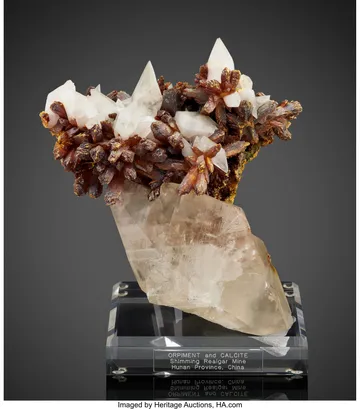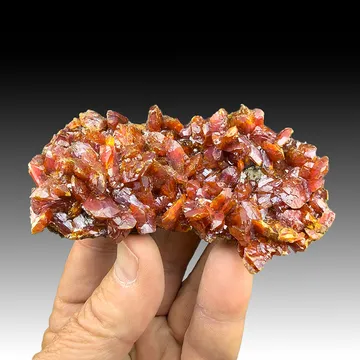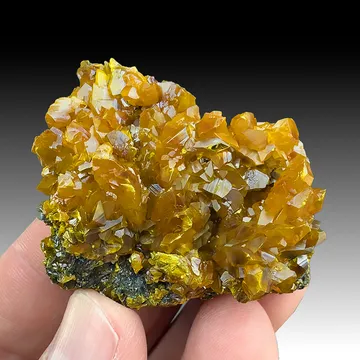
Orpiment — lemon-yellow arsenic sulfide with silky luster and foliated crystals; prized for color and dramatic display, with notable localities in Nevada, Huna…
Key facts
Orpiment (As2S3) is a classic arsenic sulfide best known for its rich lemon-yellow to golden color and silky to resinous luster. It typically forms as foliated, bladed crystals and radiating fans, sometimes in tight rosettes or layered crusts. Transparent, gemmy lamellae can glow with a warm honey tone, while thick fans display a satiny sheen. It commonly occurs with realgar, stibnite, calcite, barite, and quartz in low-temperature hydrothermal veins and sediment-hosted deposits.
Despite its softness (Mohs 1.5–2) and perfect cleavage, orpiment can be extraordinarily aesthetic. Iconic finds from Nevada (USA) produced large, luminous fans and bright golden aggregates that redefined the species’ potential. China’s Hunan Province and Peru’s Quiruvilca District have also yielded beautiful pieces, ranging from sharp golden laminae to intricate, feathery sprays. Collectors prize orpiment for its color, luster, and display impact—especially when paired with contrasting white barite or quartz. Because it is both soft and light-sensitive, it requires careful handling and thoughtful display, but in return offers a uniquely vivid presence in any cabinet.
Orpiment has intrigued humans for millennia—historically used as the golden “auripigment” pigment and studied by early alchemists. In modern mineral collecting, its popularity surged with the legendary orpiment/realgar discoveries at Nevada’s Getchell and Twin Creeks mines, which brought museum-scale, intensely colored specimens to market. Chinese material from Shimen and classic Peruvian specimens cemented its stature.
While beginners may start with smaller, affordable sprays, advanced collectors pursue large, undamaged fans with top luster and translucency from benchmark localities. Its combination of beauty and fragility adds to the mystique: acquiring a superb orpiment is one challenge—preserving it long-term is another. As a result, pristine, well-documented pieces continue to command strong interest and prices.
Twin Creeks is the modern standard-bearer for orpiment. Late-1990s pockets produced extraordinarily bright, lemon-gold fans and sheaves, from miniature rosettes to cabinet-sized, room-dominating clusters. Many crystals show silky to resinous luster and partial translucency; some fans are several centimeters thick with finely striated blades. Contrasts with white barite or quartz matrix can be striking. Because pieces were often extracted from friable ground, careful repairs or stabilizations are not uncommon—unrepaired, damage-free specimens carry a premium. These finds set the bar for size, color saturation, and overall presence, making Twin Creeks orpiment a cornerstone for focused arsenic-sulfide collections.
Shimen is one of the world’s best-known arsenic deposits, producing superb orpiment alongside realgar. Classic specimens show limpid, thin lamellae and bright golden-yellow sprays with a silky sheen. Aesthetic combinations include orpiment with sharp realgar crystals, calcite, or quartz for dramatic color contrast. Because arsenic sulfides are light-sensitive (realgar more so than orpiment), Shimen pieces are treasured but demand careful storage. Top examples display excellent translucency and fine, undamaged blade tips.
A historic Peruvian district that yielded attractive orpiment in sprays, layered crusts, and clustered fans, often associated with realgar, pyrite, barite, and quartz. Quiruvilca pieces range from bright lemon to warm golden hues, with a slightly satiny surface and excellent contrast on pale matrix. Older finds are increasingly scarce; well-preserved, undamaged specimens with balanced compositions are sought after as South American classics.
Orpiment is both soft and arsenic-bearing, and it can be sensitive to light and heat. Proper care is essential.
With mindful care—low light, gentle handling, and stable conditions—orpiment can retain its magnificent golden color and luster for decades, remaining a highlight of any fine mineral collection.