Mimetite: lead arsenate chloride crystals from canary yellow to orange; hexagonal prisms and campylite forms showcase color, variety, and localities.
Key facts
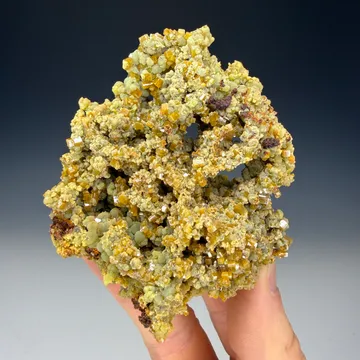
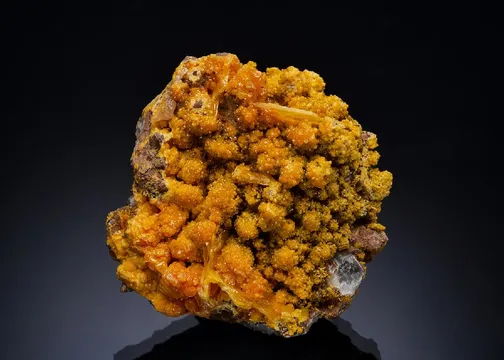
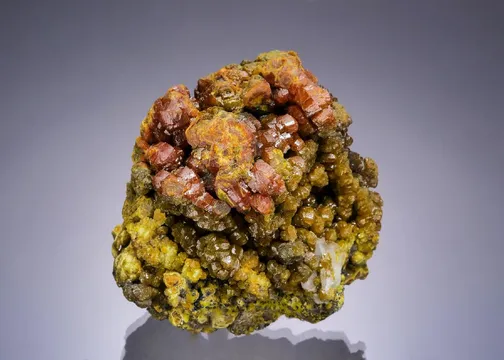
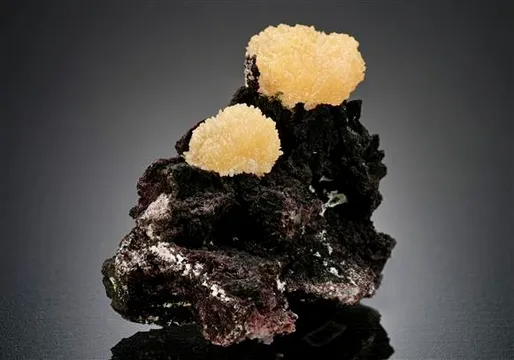
Mimetite is a lead arsenate chloride, Pb5(AsO4)3Cl, a member of the apatite supergroup and part of the “pyromorphite–mimetite–vanadinite” solid-solution series. It is beloved by collectors for its joyful palette—canary yellow, honey, orange, and occasionally greenish hues—paired with diverse habits: sharp hexagonal prisms, classic barrel-shaped “campylite” crystals, acicular “pom-pom” sprays, botryoidal coatings, and drusy carpets. Luster ranges from resinous to adamantine, often with a wet, glowing look that makes even small pieces pop in the case.
Crystals commonly occur in the oxidized zones of lead deposits, associated with wulfenite, cerussite, smithsonite, vanadinite, pyromorphite, anglesite, calcite, and limonite. The best examples rank among the most cheerful display minerals: vivid sprays from Morocco, bright orange prisms from Mexico, lustrous gemmy crystals from Tsumeb, and historic campylite from England. Hardness is modest (3.5–4), and the species is brittle; careful handling is essential. Because it contains lead and arsenic, sensible hygiene is advised.
Pricing spans widely: fine thumbnails from classic localities can be affordable, while museum-level cabinet pieces with top color and form from Tsumeb, Ojuela, or Tiger (Mammoth) can command strong five figures. A bonus for collectors: the species is wonderfully varied—assembling a suite that shows multiple habits, colors, and key localities is both feasible and highly rewarding.
Mimetite has been a collector favorite since the 19th century. English “campylite” from the Caldbeck Fells introduced the habit of curved barrel crystals and became a Victorian classic. Later, Tiger, Arizona gained fame for sharply formed barrel prisms with rich yellow-orange color, a benchmark for the species in North America. Twentieth-century production at Tsumeb in Namibia elevated mimetite to “super-classic” status, with lustrous, gemmy crystals and exquisite associations. Moroccan discoveries at Touissit added aesthetic sprays and sculptural clusters, while Mexico’s Ojuela Mine continues to deliver vibrant orange crystals on brown iron oxide matrix with huge contrast.
Interest remains strong because mimetite combines:
Tsumeb is the gold standard for mimetite. The best pieces show luminous honey-yellow to orange crystals, often gemmy with glassy luster, perched on dolomite, calcite, or sulfide matrix. Habits range from sharp hexagonal prisms to lustrous rounded barrels and drusy coatings. The contrast and clarity are superb—many crystals glow with backlight. Tsumeb also produced unusual associations (e.g., with smithsonite or wulfenite) and attractive, balanced compositions that display from multiple angles. Production ended decades ago, so top examples carry historic prestige and scarcity premiums.
Ojuela (Mapimí, Durango) is a modern workhorse for vibrant orange mimetite on chocolate-brown limonite. Crystals are typically sharp, lustrous, and richly colored, from micro-drusy to robust prisms, often forming striking, evenly distributed carpets or radiating clusters. Aesthetics are driven by color and contrast: orange on dark iron oxide matrix is a show-stopper under LED lighting. While most pieces are not gem-clear like Tsumeb, the brightness and composition are outstanding, and good specimens are widely appreciated and more affordable than comparable classics.
Tiger is the classic US locality for mimetite, famed for thick, barrel-shaped crystals with rich yellow to orange color and a highly desirable resinous luster. Many occur with wulfenite or on limonitic matrix, creating historically important American showpieces. The crystals are often robust and well-terminated, making Tiger material a benchmark for the barrel habit. Production is long past; pristine, unrepaired, well-composed pieces are scarce and heavily collected.
Dry Gill is the historic source of “campylite,” a rounded, barrel-like habit of mimetite sometimes showing gently curved faces. Colors range from warm honey and ochre to orange-brown, often as thick, lustrous crystals nestled in vuggy matrix. These specimens are quintessential old-European classics—sought for pedigree, distinctive habit, and their role in the species’ collecting history. Fine thumbnails and small cabinets are prized, especially with multiple complete barrels and minimal peripheral damage.
Color and Saturation:
Crystal Habit and Form:
Luster and Clarity:
Size and Aesthetics:
Condition:
Provenance:
Repairs:
Treatments:
Safety:
Handling and Display:
Light and Temperature:
Cleaning:
Storage:
With thoughtful selection and careful care, mimetite offers one of the most joyful color-and-form combinations in mineral collecting—from historic English campylite and American Tiger barrels to the glowing oranges of Tsumeb and Ojuela, and the exuberant Moroccan sprays.