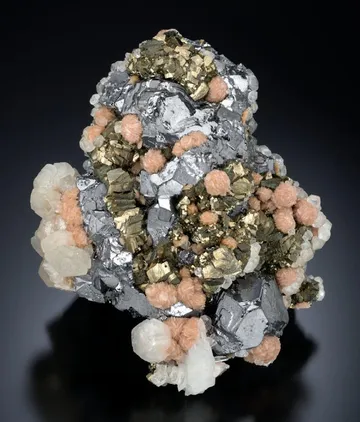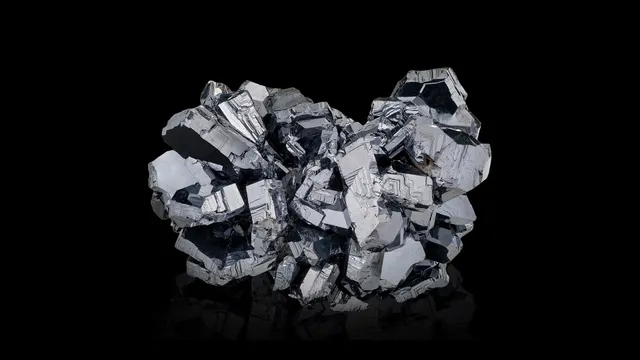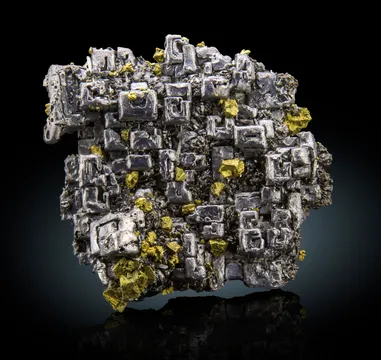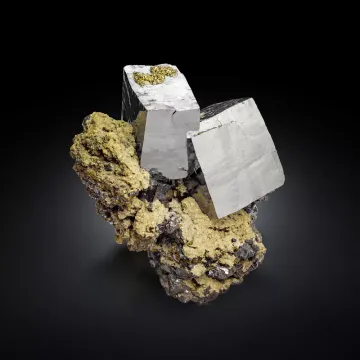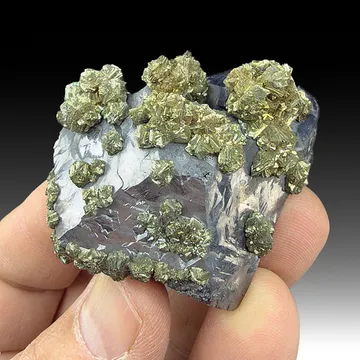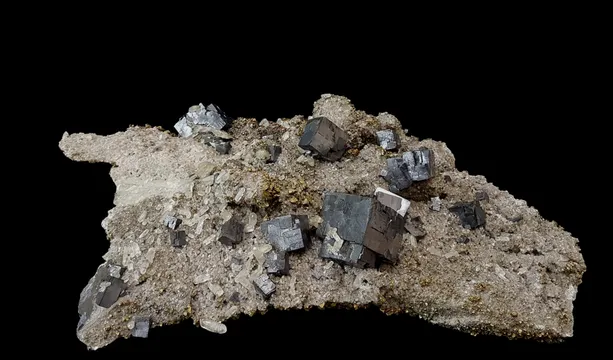
Galena - metallic luster with cube and cuboctahedral crystals, often twinned; sharp cleavage reveals reflective planes, a standout sulfide for collectors.
Key facts
Galena (lead sulfide, PbS) is the quintessential metallic mineral: brilliant, silvery-gray, and satisfyingly heavy. Its textbook habit is the cube, often modified by octahedral faces into sharp cuboctahedra; less common are octahedra and striking spinel-law twins that can appear as flattened “discs,” cogwheels, or complex stellate forms. Freshly exposed crystals display an exceptional metallic luster—nearly mirror-like—while older surfaces may take on a soft gunmetal sheen or natural iridescence. With perfect cubic cleavage, galena breaks cleanly, revealing reflective internal planes; this beauty comes with fragility, making pristine edges a key premium. A classic in sulfide suites, galena often accompanies sphalerite, quartz, calcite, fluorite, barite, and pyrite, and it anchors some of the most storied mining districts on Earth. For collectors, it ranges from affordable cabinet cubes to world-class twinned masterpieces with elite provenance.
As humanity’s primary lead ore since antiquity, galena is woven into mining history from Europe’s Freiberg and Příbram to the Tri-State District in the United States, Broken Hill in Australia, and Dalnegorsk in Russia. Its enduring appeal lies in three pillars:
Major 20th-century finds in the Tri-State District, the Illinois–Kentucky Fluorspar District, Romania, Bulgaria’s Madan field, and Dalnegorsk set the benchmark for aesthetic specimens. While galena is common as a species, fine large crystals with sharp edges, bright luster, attractive matrix, and minimal damage are far scarcer than the abundance of ore suggests. Twinned or architecturally complex crystals can command strong prices, especially with classic locality labels.
Below are renowned sources known for distinctive, collectible galena styles. Each locality has produced benchmark pieces valued for crystal form, luster, matrix associations, or unique twinning.
Dalnegorsk’s polymetallic deposits yielded crisp galena crystals with superb metallic luster and complex modifications, often in association with quartz and calcite on bright white to snowy matrix for strong contrast. Cubes and cuboctahedra can reach impressive size, and pockets occasionally produced spinel-law twins and hoppered faces. Many specimens are exceptionally sharp, with the bright, fresh look collectors prize. Pieces from classic levels remain sought-after, especially balanced matrix examples with minimal cleavage damage.
Příbram is a European classic for galena, famous for elegant spinel-law twins and fine modified cubes, often perched with quartz, siderite, or calcite. Historic mining produced myriad forms, from razor-sharp mirror-luster cubes to flattened, twinned “cogwheel” morphologies. Colorful patinas sometimes decorate older surfaces. Specimens with documented mine names and levels are coveted by locality collectors and historians alike.
The Tri-State District (Missouri–Kansas–Oklahoma) is one of the most iconic galena sources. Classic specimens show sharp cubes and cuboctahedra, frequently hoppered or with stepped growth. Associations with brassy chalcopyrite, sphalerite, dolomite saddles, and quartz created visually rich combinations. Historic Joplin pieces, often from early-to-mid 20th century workings, represent quintessential “textbook” galena and remain staples in American mineral collections.
Bulgaria’s Madan district is renowned for sculptural galena—sharp cubes, complexly modified crystals, and spectacular spinel-law twins—often with metallic black sphalerite, brassy pyrite, and quartz. The interplay of forms and metallic colors can be dramatic, with sculptural, three-dimensional clusters. Many specimens from 1990s–2000s mining are modern classics: crisp, bright, and well composed, with relatively good availability yet strong demand for top-tier pieces.
Famous for gigantic selenite crystals, Naica also produced excellent galena. Expect lustrous cubes and cuboctahedra on calcite or gypsum-rich matrices, often with acanthite, sphalerite, or chalcopyrite. The brightest pieces reflect like mirrors, and well-contrasted matrix clusters are particularly aesthetic. Production ebbed and flowed, and fine classics are increasingly prized as mine access changed.
Within the Illinois–Kentucky Fluorspar District, the Annabel Lee Mine produced classic galena on purple to blue fluorite and sparkling calcite—an iconic Midwest look. Cubes can be hoppered or modified, with sharp edges and a strong metallic sheen. The best pieces balance color contrast and geometry: bright galena set off by colorful fluorite and white calcite makes for irresistible display specimens.
Cavnic is a classic Maramureș locality producing diverse galena habits—sharp cubes, complex twins, and stepped hoppered faces—frequently with calcite, quartz, and sphalerite for contrasting textures. Distinguished collections feature Cavnic’s sculptural groupings where metallic geometry meets delicate carbonates, often with a distinctive European aesthetic and strong historic appeal.
Freiberg’s centuries of silver mining cemented its place in mineral history. Galena here occurs as well-formed cubes and modified crystals with quartz, calcite, and siderite, often carrying historical labels from famed mines and collectors. While not always the largest, Freiberg pieces carry weighty pedigree—museum-caliber specimens exemplify classic European sulfide aesthetics.
Galena is robust chemically but mechanically fragile, with perfect cubic cleavage and high density. With sensible care, it remains stable for decades.
With smart selection—crisp form, bright luster, sound edges, and strong locality—and careful storage, galena can anchor any sulfide suite, ranging from historically important classics to modern masterpieces with sculptural geometry and metallic brilliance.