






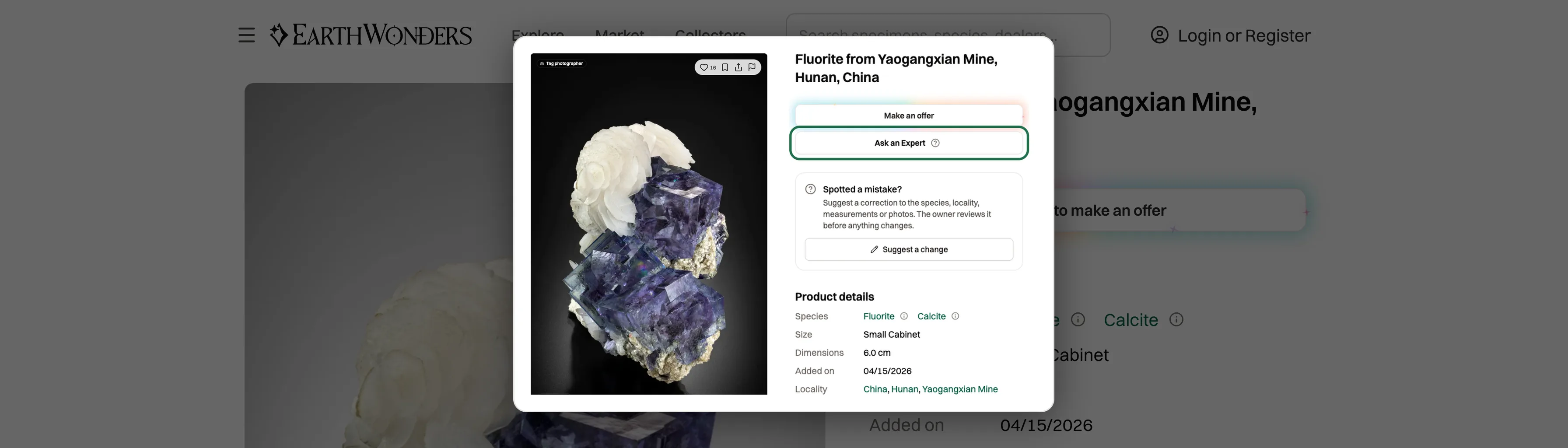
Introducing Ask an Expert, where you can put your questions about minerals, crystals, geology and collecting to our panel of experts. Plus a collector spotlight on Freddy Marty from France, a feature from moderator Tom Zhang, how to post your latest find, and a special report on the Munich show by collector Matthew Parshchikov.
The mineral world never really slows down, and neither does this community. A warm welcome to everyone who has joined EarthWonders since our last issue. We are so happy to have you here among a growing crowd of passionate mineral and crystal enthusiasts. Whether you are cataloging your first thumbnail or managing a cabinet collection built over decades, there is now a home for it here. In this issue, Ask an Expert launches on Monday, and at the end you'll find a special report from the Munich Show by collector Matthew Parshchikov.
Ask an Expert
Have a question about a mineral, a crystal, a locality or your collection? From Monday, November 16, you can put it to our experts with Ask an Expert, a new feature on EarthWonders. Community members can ask questions about minerals, crystals, geology and collecting, and we pass them through a group chat to our panel of experts and EarthWonders moderators, including Tom Zhang and Freddy Marty. The panel is growing, with new moderators joining as they come on board. You will find Ask an Expert in your left-hand menu, in the navigation bar on the Explore page, and on any specimen on EarthWonders. When you ask from a specimen page, that specimen is attached to your question, so the experts can see exactly what you are asking about.
Watch the video in the Help Center
Collector Spotlight: Meet Freddy Marty, from France
This month, say hello to Freddy Marty, a collector from the south-west of France who has been collecting since 1960. Curious by nature, he discovered mineralogy at the age of 12, later became a geologist, and came to know crystallography, the mineral families, twins and pseudomorphs, driven from then on by what he calls "the sacred fire." His attention also turned to French minerals of heritage interest, such as fluorite, pyromorphite and baryte, and to the rare earths of Trimouns in Ariège.
734 of his pieces are on EarthWonders, and they lean proudly French: blue fluorite from Le Burg, Peyrebrune and Mont-Roc, green pyromorphite from Saint-Salvy and Les Farges, and rare-earth minerals such as hydroxylbastnäsite and allanite from Trimouns. Beyond France you will find crocoite from Tasmania's Adelaide Mine, tourmaline from Brazil's Cruzeiro mine and rhodochrosite from the Sweet Home Mine. Explore Freddy's collection and see six decades of collecting in one place.
Crocoite from Adelaide Mine, Tasmania, Australia
Size: Large Cabinet, 24.0 x 10.0 cm
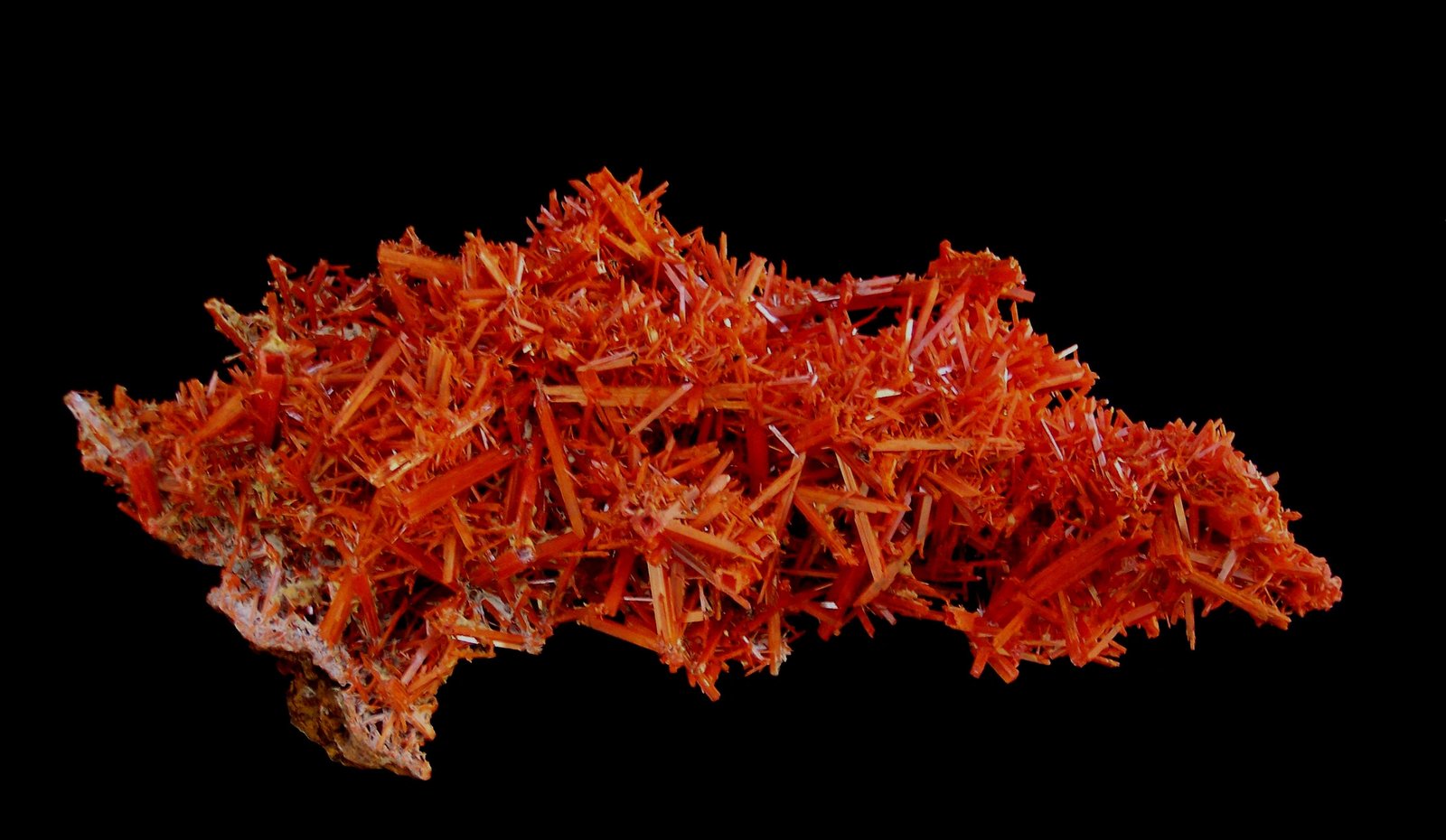
Photo: Freddy Marty
From the Tom Zhang Collection (EarthWonders Collector & Moderator)
When encountering an attractive blue mineral, it’s often a good guess that it might be one of the many secondary copper minerals. Aurichalcite, (Zn,Cu²⁺)₅(CO₃)₂(OH)₆, is a striking example of a highly colored, copper-bearing mineral. It typically forms in the oxidation zones of zinc–copper deposits. Aurichalcite crystals are acicular to fibrous and frequently occur in aggregates. Although generally considered rare, aurichalcite is widespread in occurrence and often found alongside other collector-favorite minerals, including malachite, azurite, cuprite, smithsonite, hemimorphite, hydrozincite, and rosasite. While it can be modestly priced and accessible from numerous localities, its vibrant color and form make it a staple in many mineral collections. Aurichalcite is also a traditional favorite among micromounters due to its delicate and intricate crystal forms.
This was photographed in the early 2020, the first close-up photo I have taken!
Aurichalcite with Wulfenite FOV=15mm
79 Mine, Chilito, Hayden area, Banner Mining District, Gila County, Arizona, USA
Size: Small Cabinet, 5.9 cm
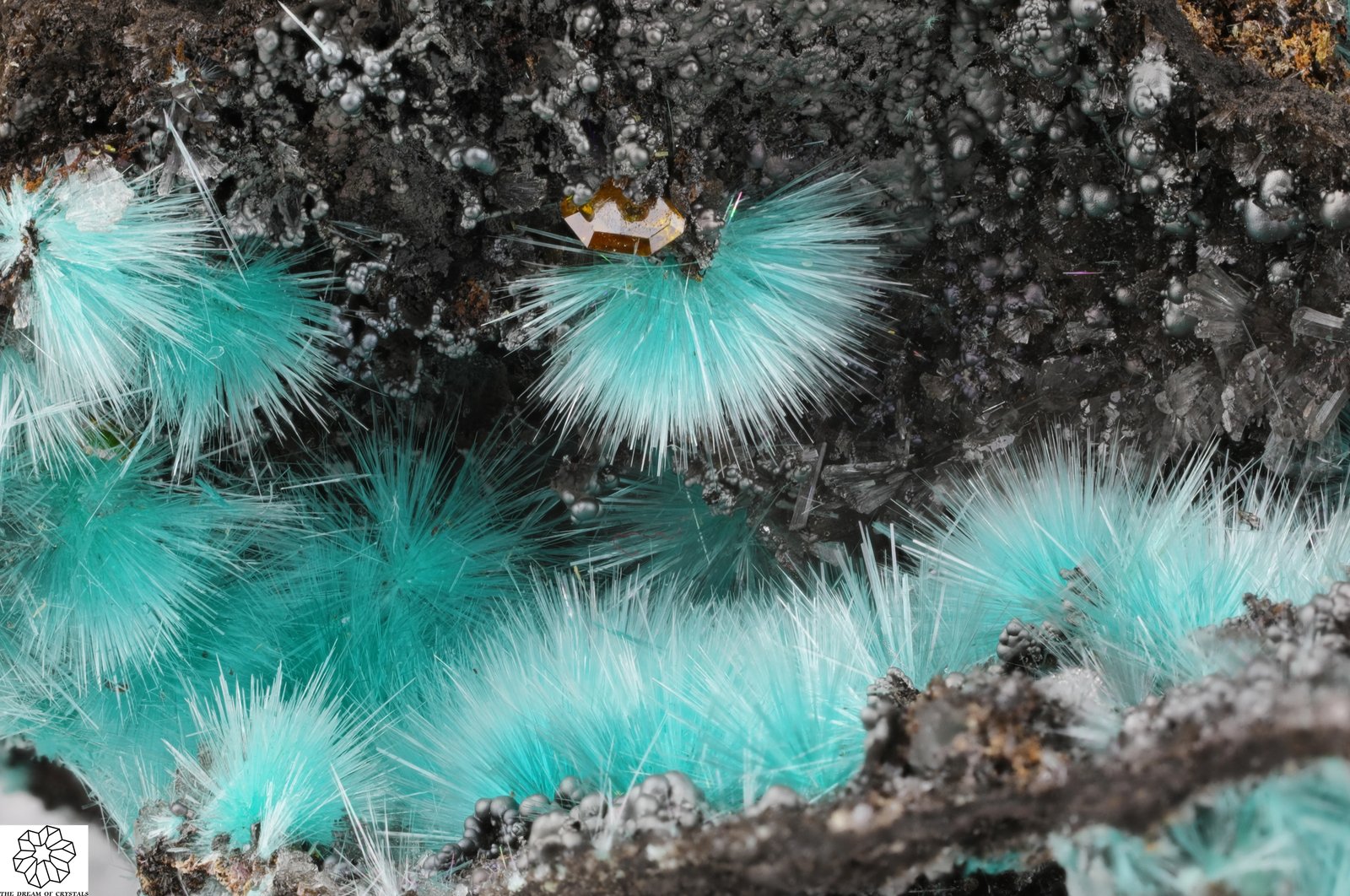
Photo: Tom Zhang
See Tom's Collection on EarthWonders
Post Your Latest Find
Collecting is more fun when you have people to share it with, and the EarthWonders Feed, on iOS and on the web, is where that happens. Tap "Create a post" and you can share an update with your followers in a moment: a new arrival, a show haul, a piece you have finally tracked down after years of hunting. You can add links, updates, and stories to your posts too, pointing people to a locality guide, a species you are researching, or anything worth passing on. And you can like, drop an emoji reaction, and join the conversation on everyone else's finds too.
Not sure where to start? This short video shows how quick it is: click the + button, choose Create a post, write a few lines, add a photo, and share it with the community.
Watch the video in the Help Center
Better still, new acquisitions surface on their own. Every specimen you add to your collection lands in your profile's activity feed, so following a collector means never missing their latest piece. Follow the collectors whose taste you admire, share what you are excited about, and let the community in on your finds at EarthWonders.
Pioneers and Legends: A Glimpse Into the Munich Show 2026 Cases
Written by Matthew Parshchikov, a young mineral collector on EarthWonders.
For more than 50 years, the Munich Show has been Europe's largest mineralogical event. Every year, a special exhibition is created at the center of the main hall. Over the past decade, Christoph Keilmann, CEO of the Munich Show, refined the concept of a special exhibition that can be seen for only four days. Each year, the phoenix is reborn, greater and more impressive than the last. Themes range from marvelling at Earth's treasures themselves to acknowledging the people involved and the progress of collecting culture. Annually, a museum-level display is assembled from specimens provided by private collectors, museums, and dealers.
Pioneers and Legends is the theme of the 2026 Munich Show. It was time to highlight the human cornerstones of the hobby: The innovators who have shaped and driven the collecting scene forward, showcasing their mineralogical achievements in all the forms and facets this passion allows.
In this spirit, historical items such as crystal models from Krantz, the oldest still-active mineral dealer based in Bonn, Germany, made understanding crystallography simpler. Modern mineral dealers, such as Rock Currier, whose self-written book World's Most Incredible Mineral Specimens was also on display, connected distant countries to the mineral market and helped make collecting more accessible. Jolyon Ralph, creator of Mindat.org, the cornerstone of research for mineral collectors worldwide, proudly displayed his very first mineral specimen to mark his beginnings. These exhibits honored the pillars of mineral knowledge. Magazines such as Lapis, which celebrated its 50th anniversary this year, displayed both its very first and latest editions alongside the specimens featured on their covers. Another pioneer in mineral-related media, show reporting, and documentary storytelling is Bryan Swoboda of BlueCap Productions. His hat that he wore while making his documentary about the rubies of Mogok, also shared a showcase with beautiful rubies.
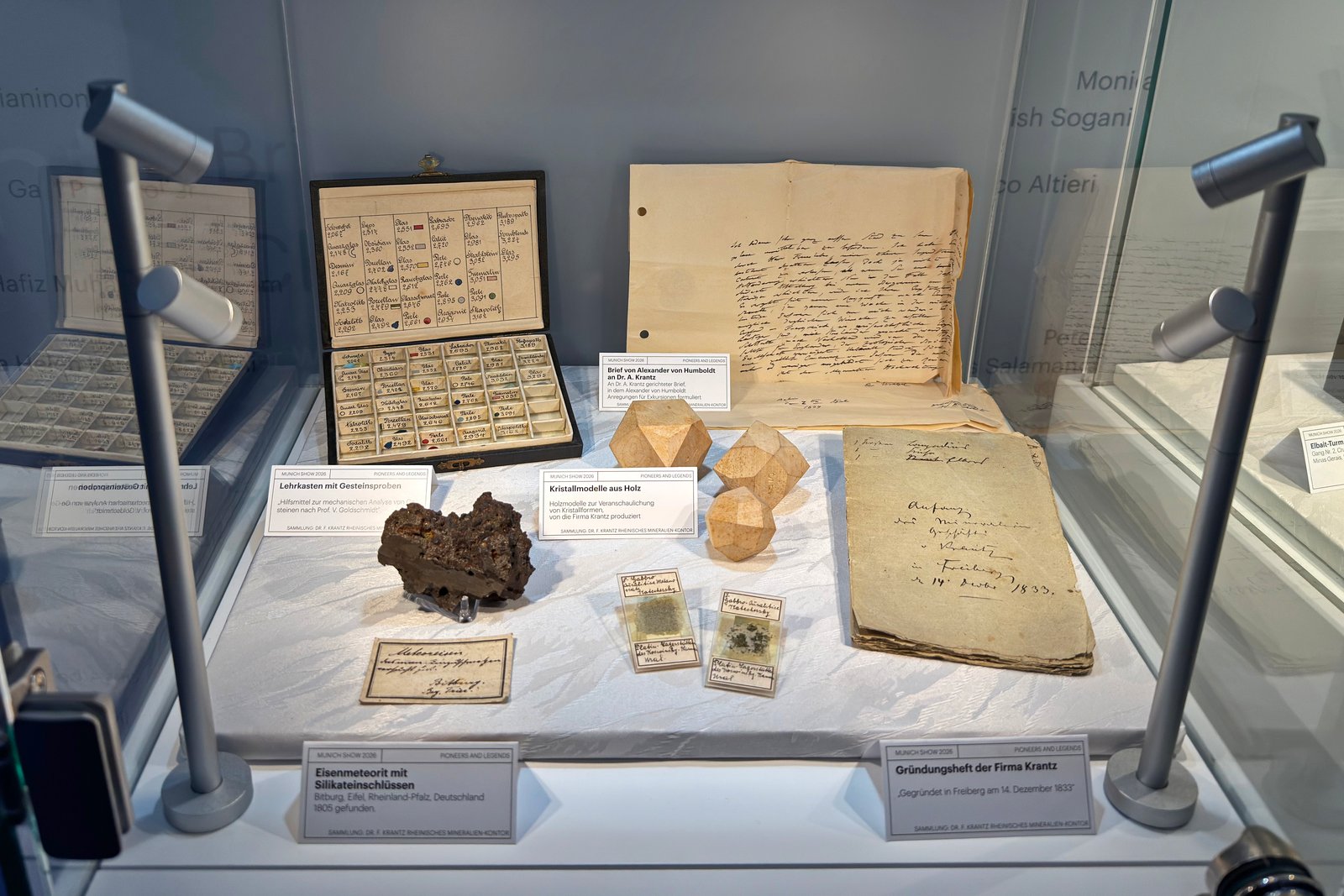
Photo: Franziska & Wolfgang Waeger
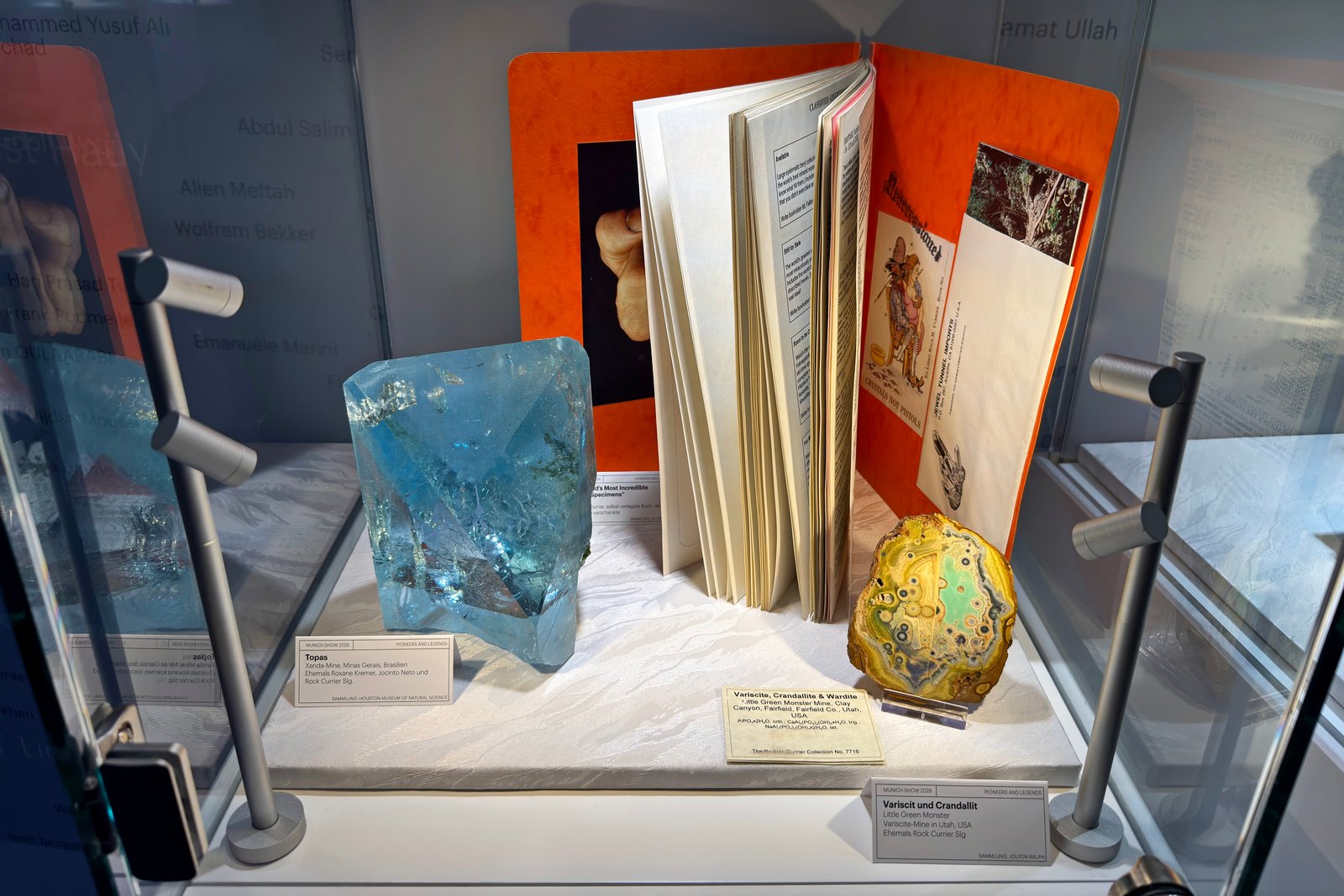
Photo: Franziska & Wolfgang Waeger
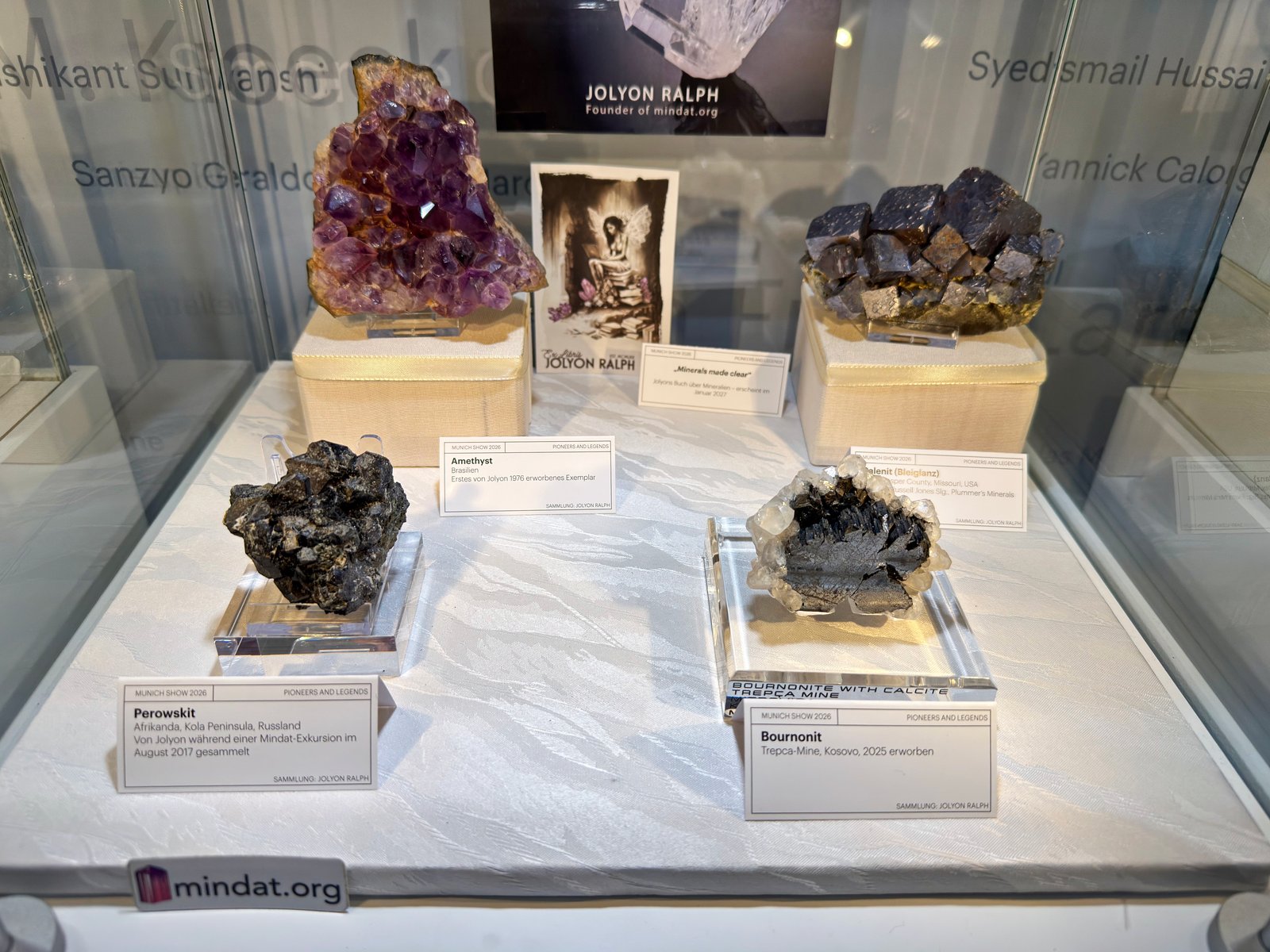
Photo: Franziska & Wolfgang Waeger
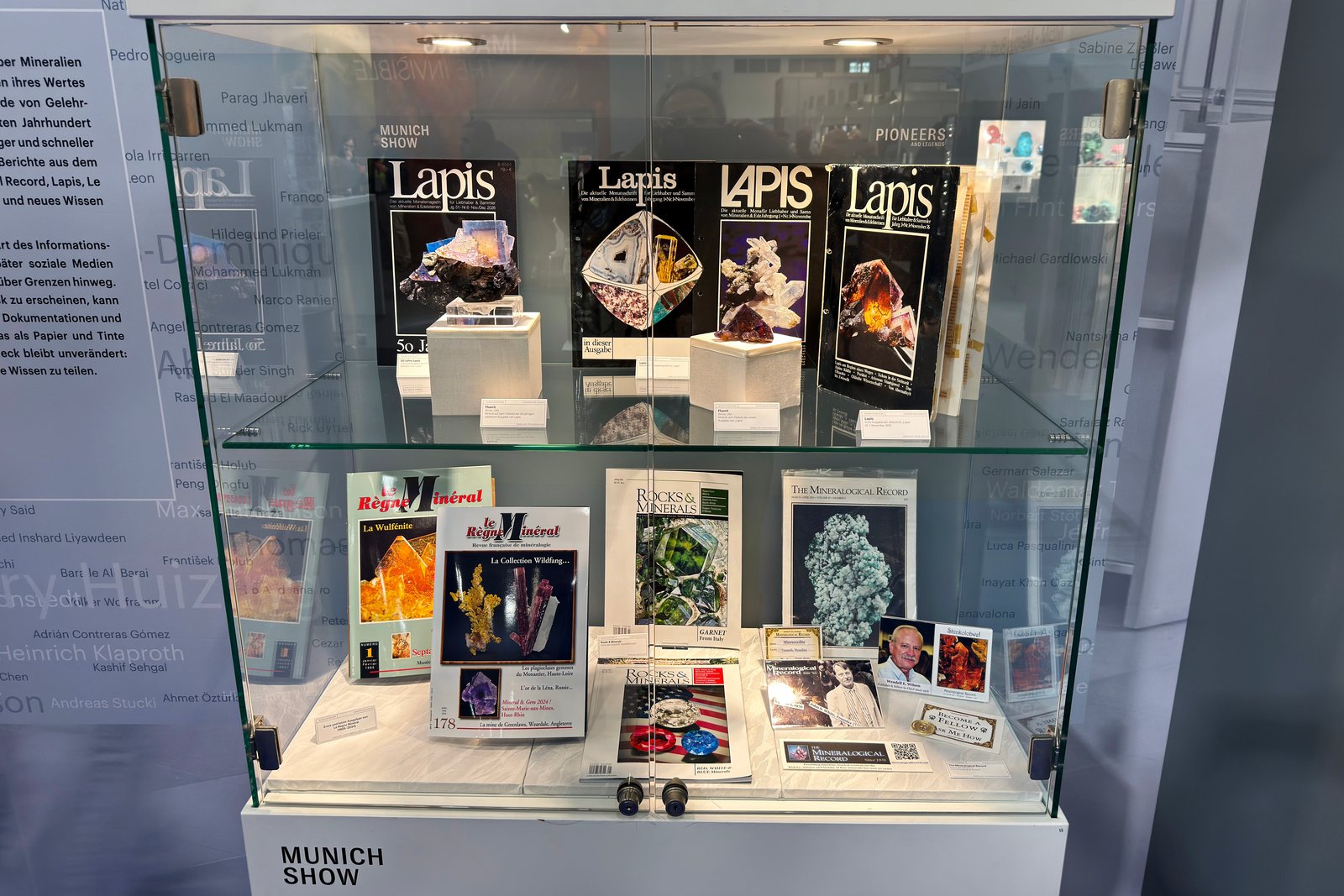
Photo: Franziska & Wolfgang Waeger
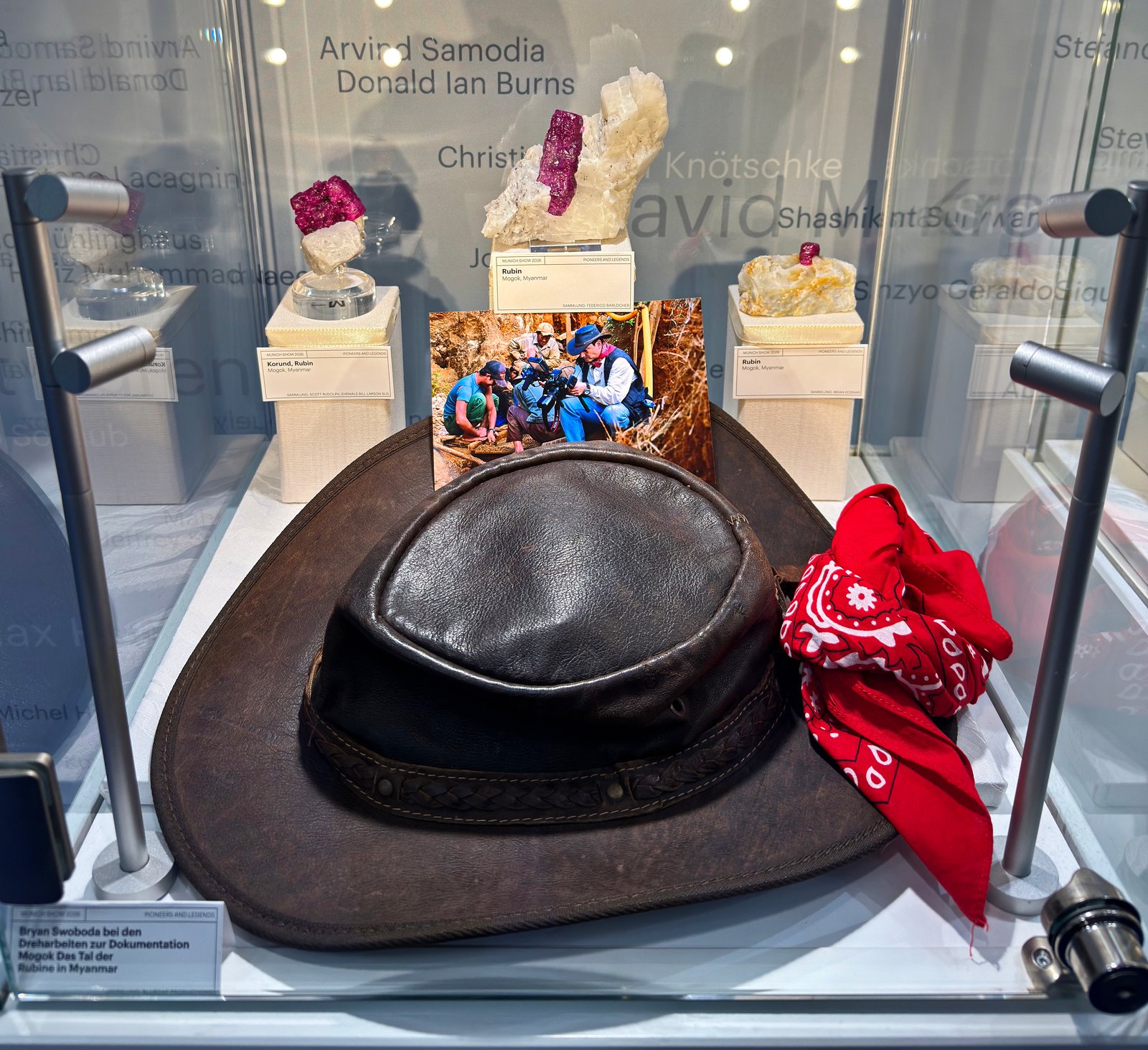
Photo: Franziska & Wolfgang Waeger
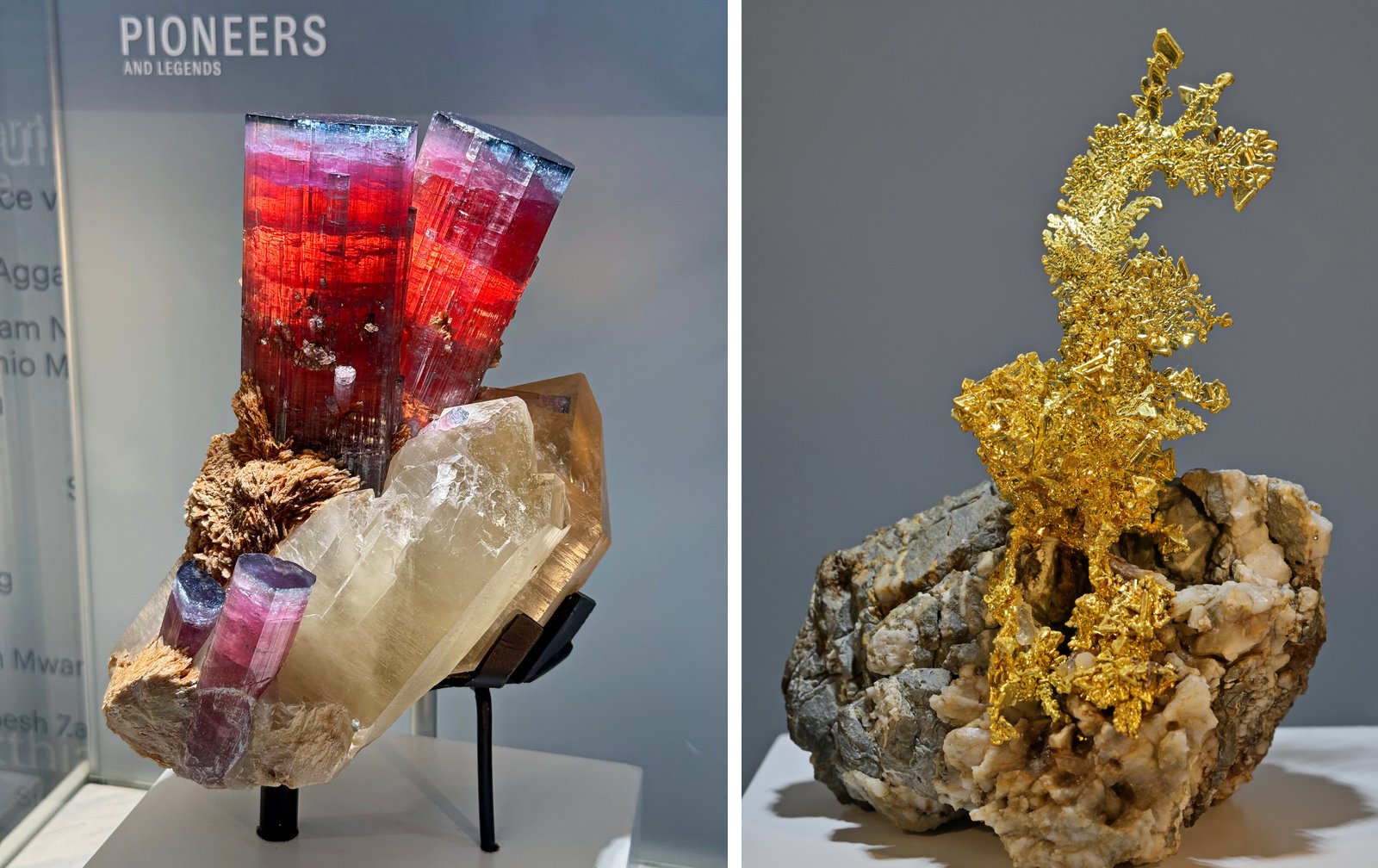
When it comes to preservation, museums remain the foremost institutions for the general public. This year, several museums lent pieces to the exhibition. The Natural History Museums of Vienna and London displayed specimens on their historic bases, accompanied by photocopies of the original labels, along with pieces from the Sir Arthur Russell Collection. The Houston Museum of Natural Science brought the famous Rabbit Ears tourmaline, for the second time, together with a magnificent gold specimen reminiscent of a dragon. The Harvard Museum loaned five exceptional fluorites and the original zircon that serves as the international reference material for isotopic age analysis, but that is only the appetizer.
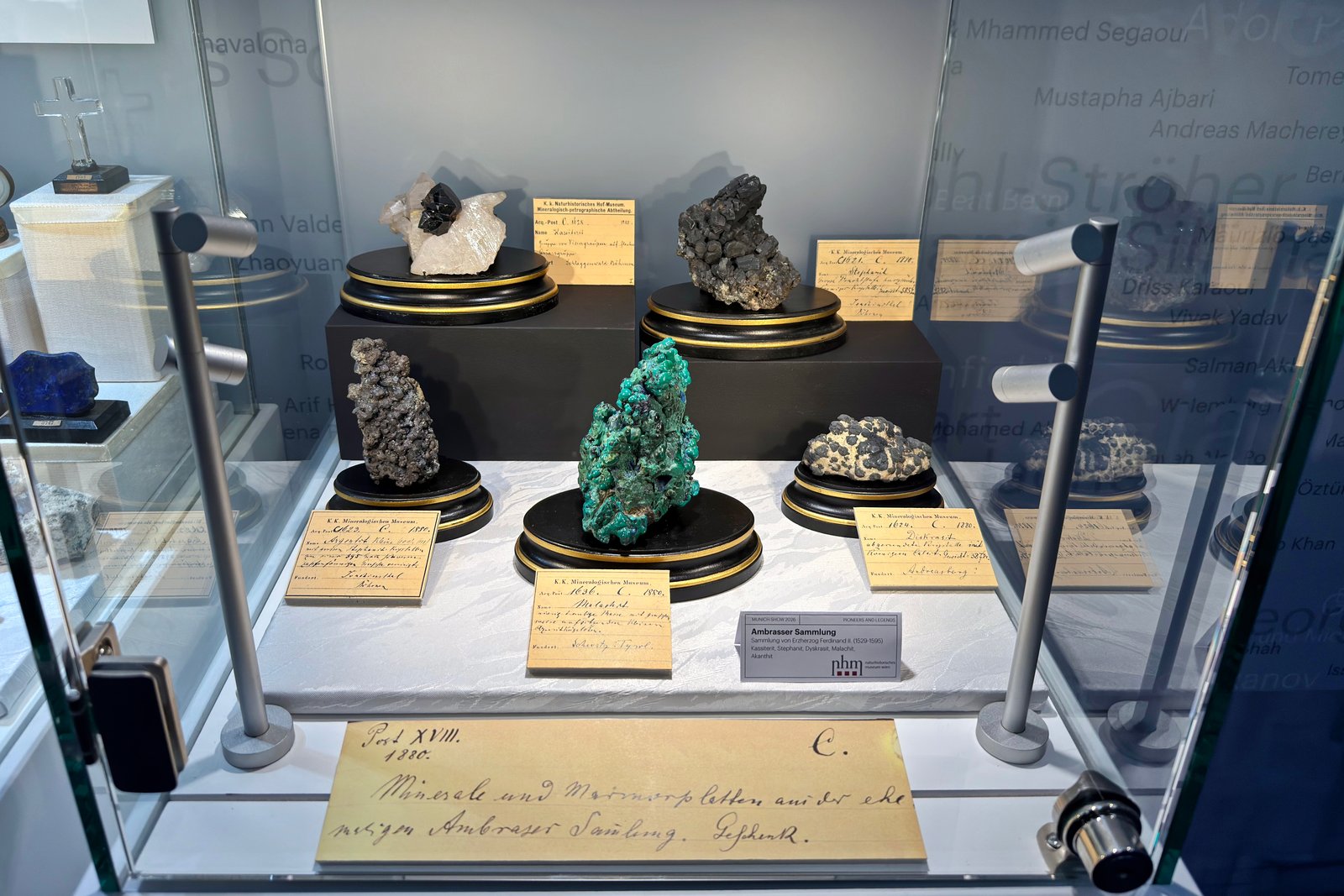
Photo: Franziska & Wolfgang Waeger
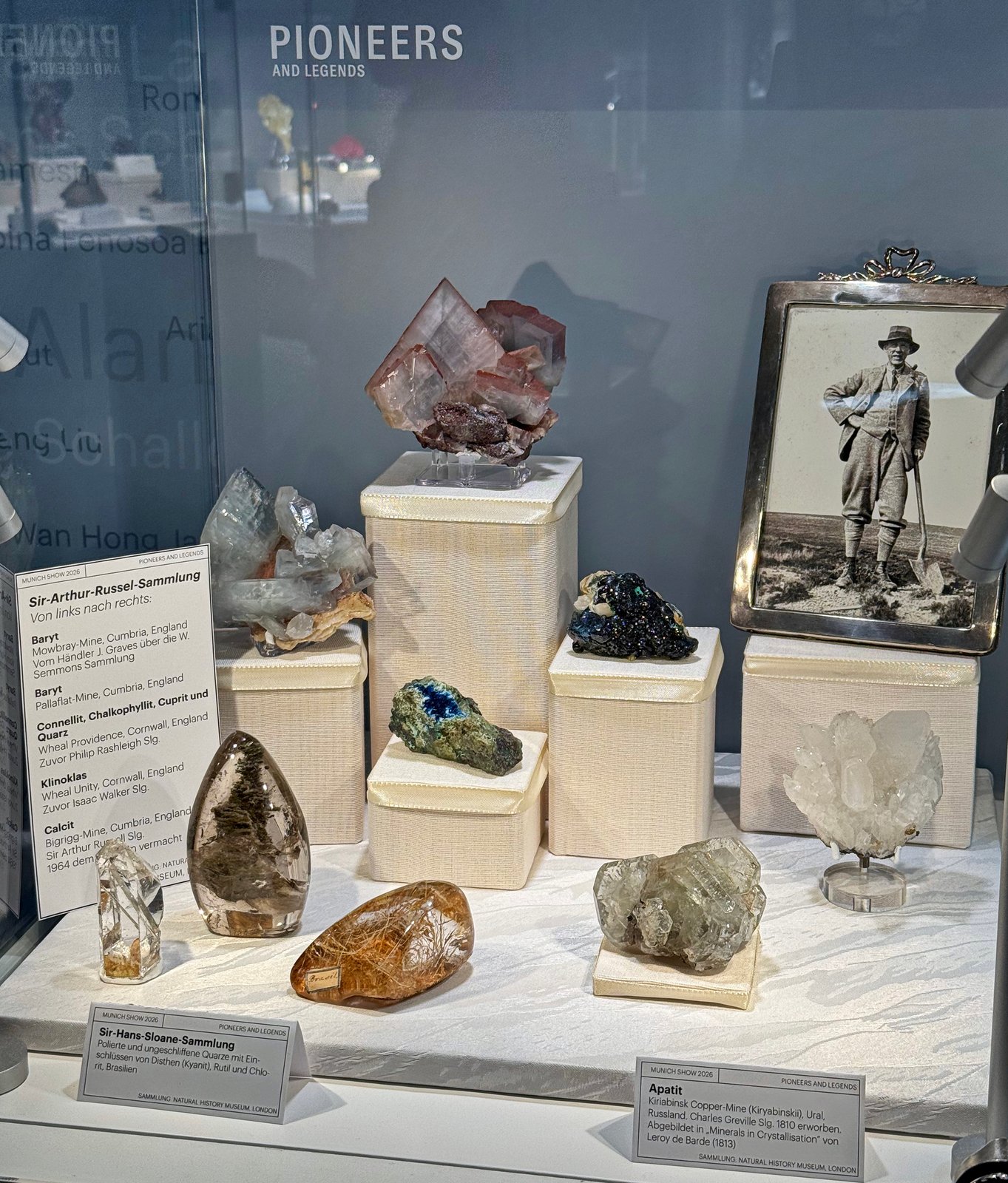
Photo: Franziska & Wolfgang Waeger
Photos: Franziska & Wolfgang Waeger
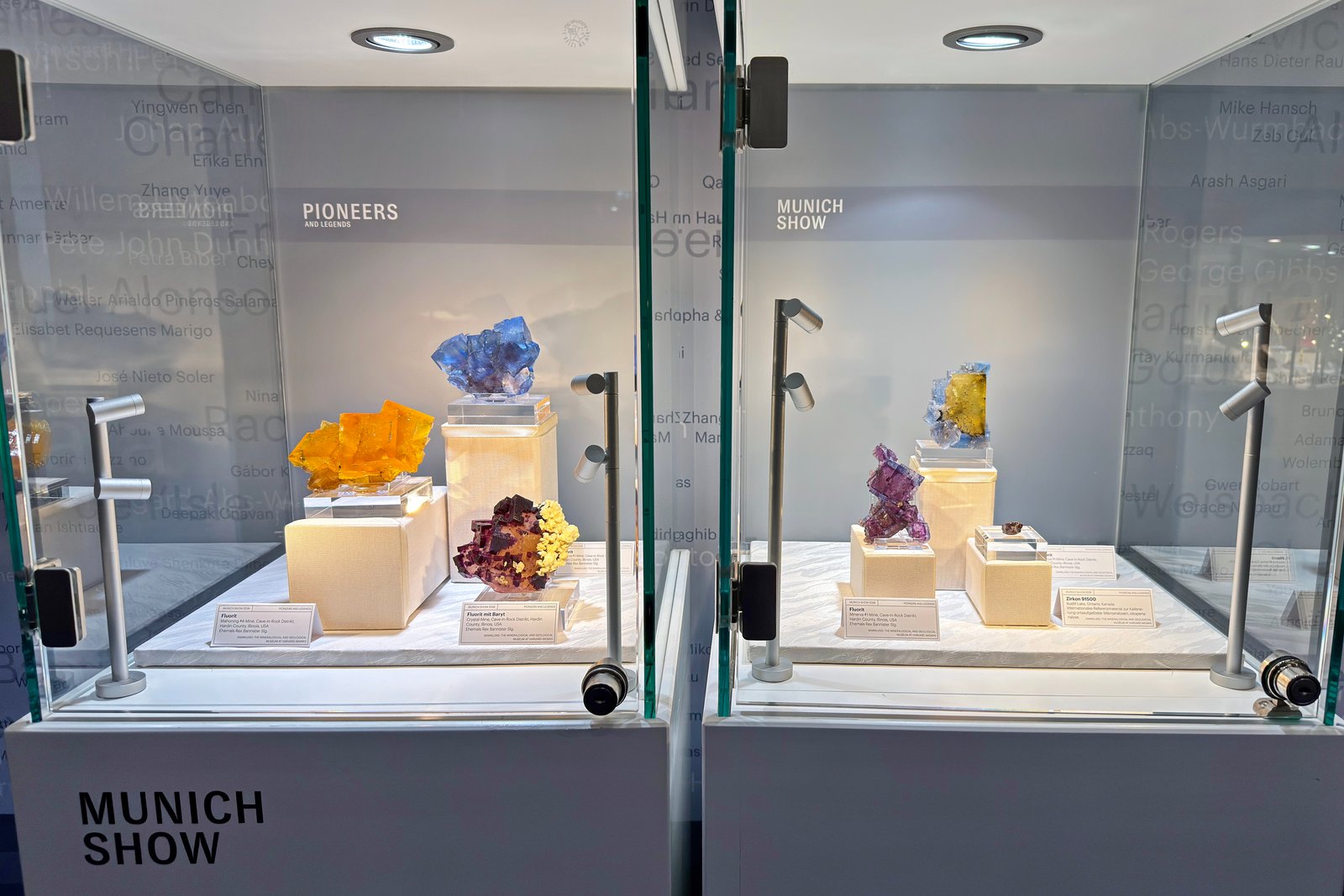
Photo: Franziska & Wolfgang Waeger
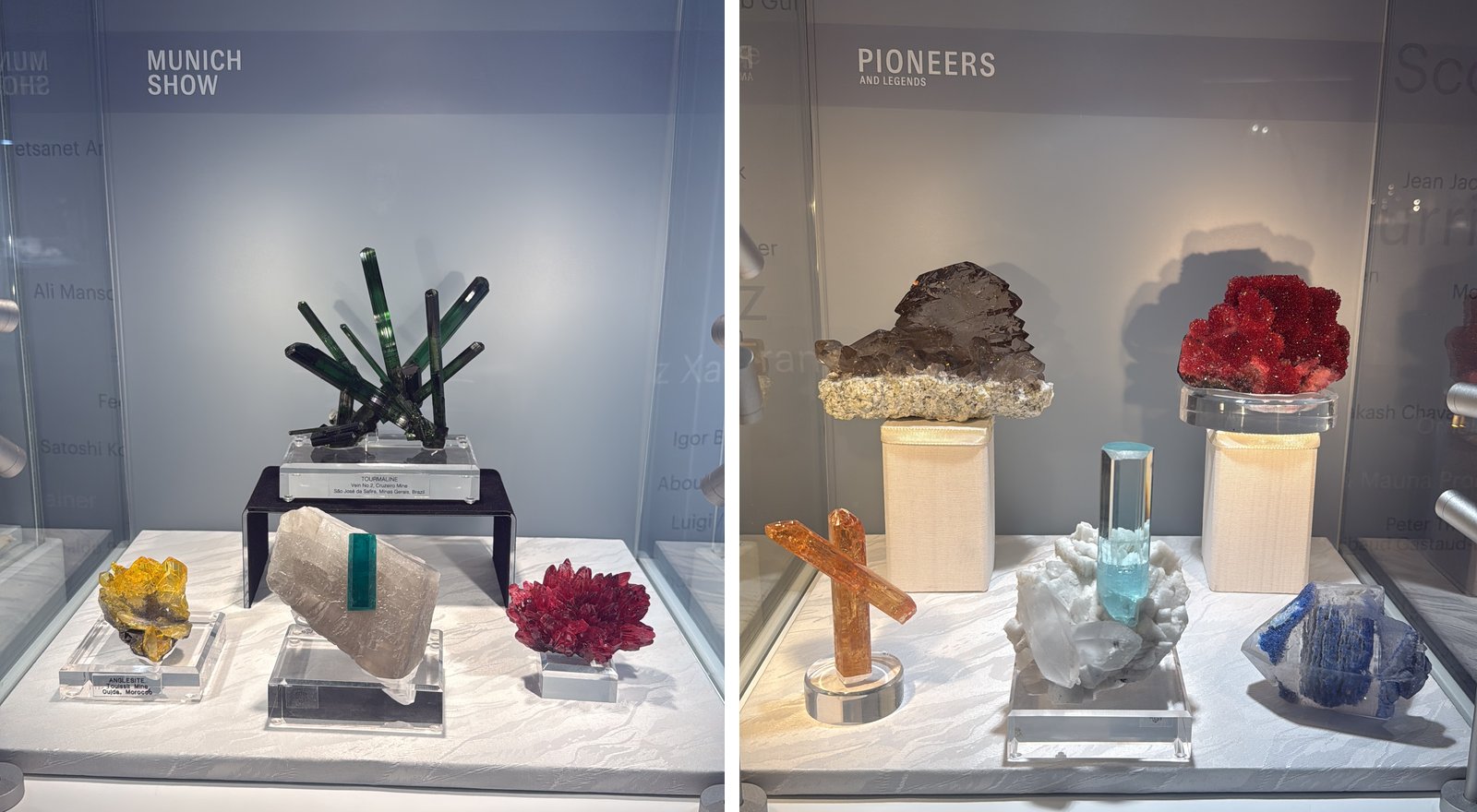
Continuing the legacy of their fathers as second-generation dealers, Ghulam Mustafa of Fine Art Minerals presented colorful specimens, including emeralds, rhodochrosite, and topaz of the highest caliber. The Gobin brothers told their story through specimens once owned by their father, Christian Gobin, including his business-card mineral and specimens from the Democratic Republic of the Congo for which the family is well known. Sami Makki of Matrix India Minerals brought classic Indian material that he and his father have been involved with for many decades.
Photos: Fine Art Minerals
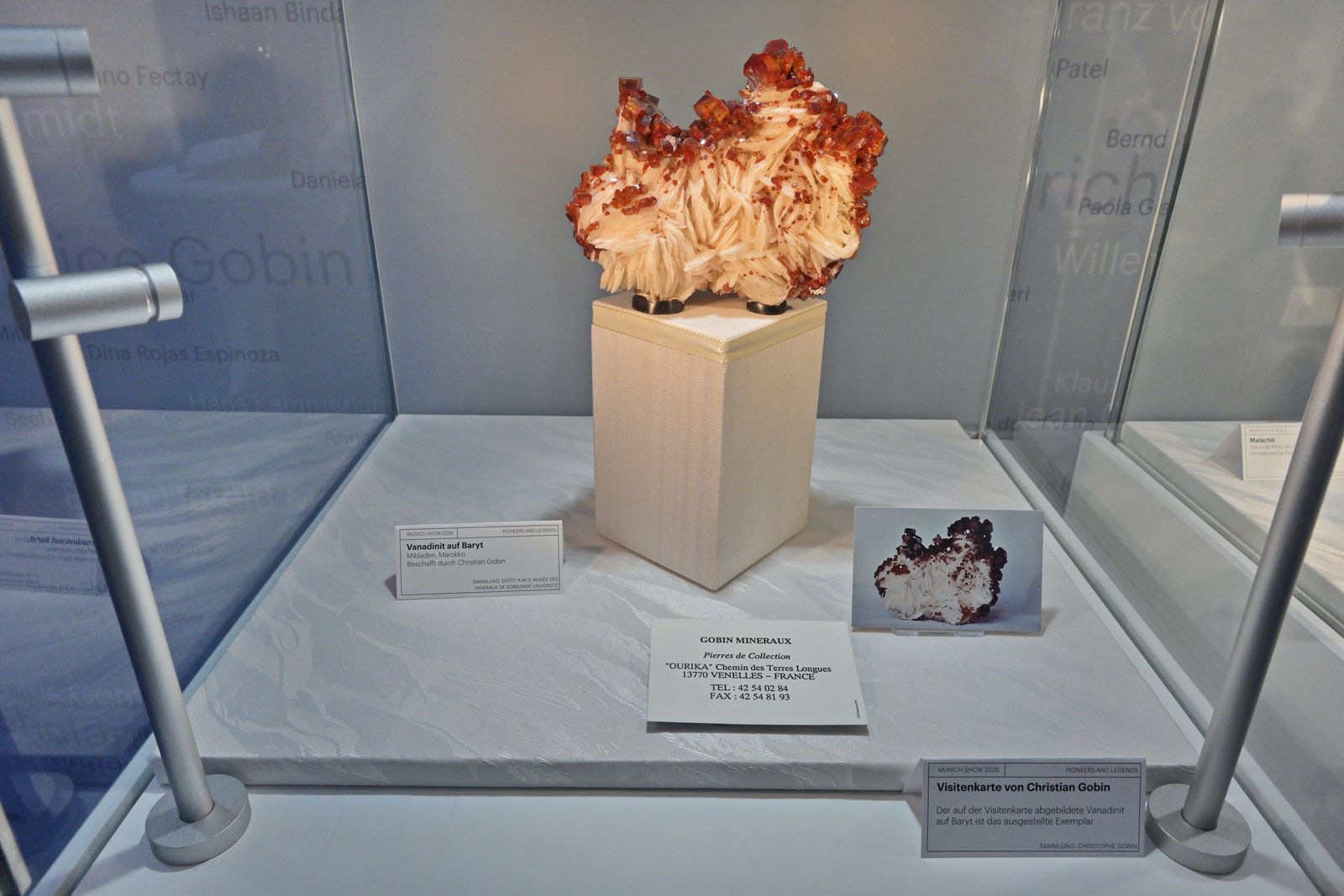
Photo: Franziska & Wolfgang Waeger
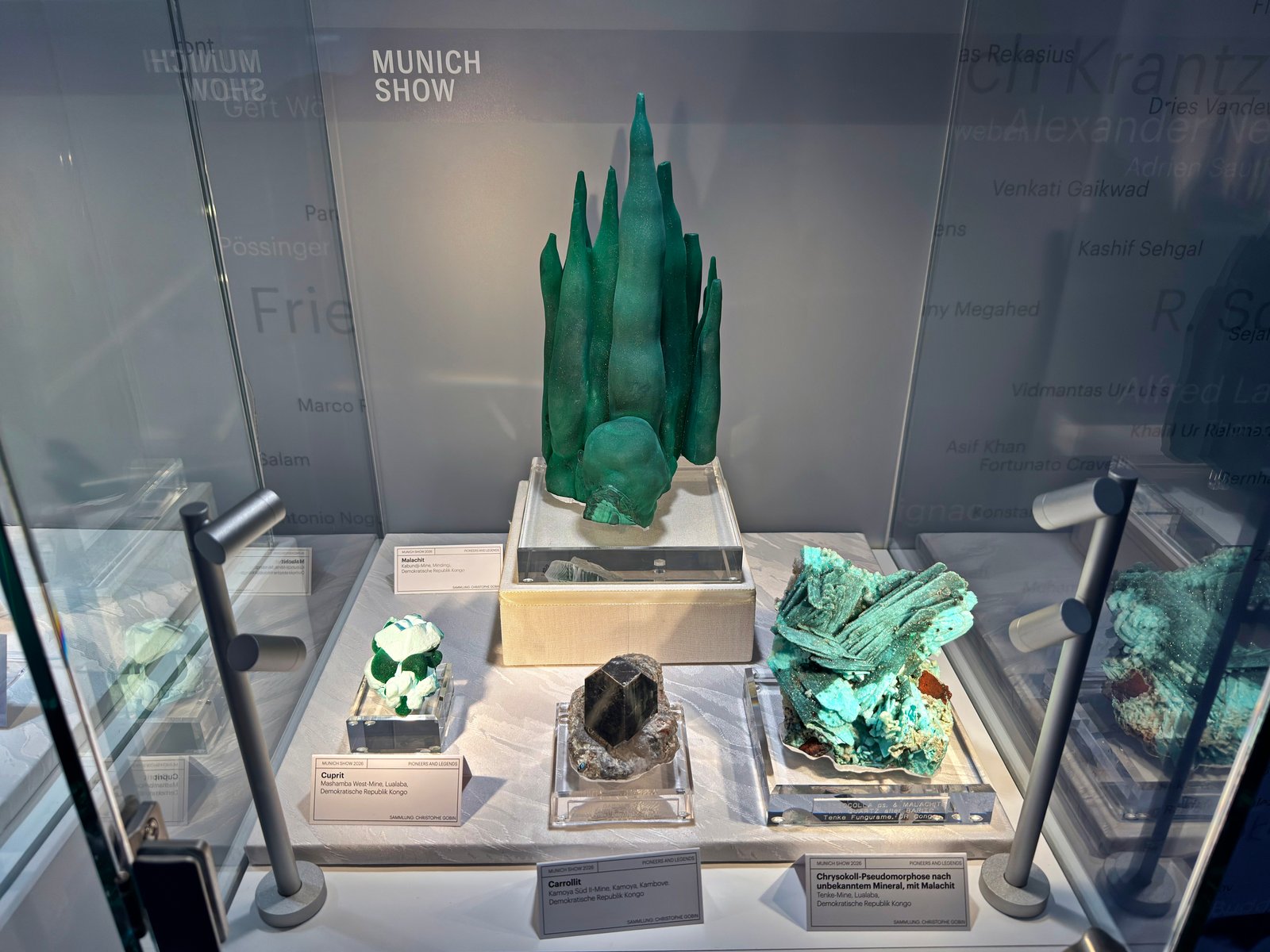
Photo: Franziska & Wolfgang Waeger
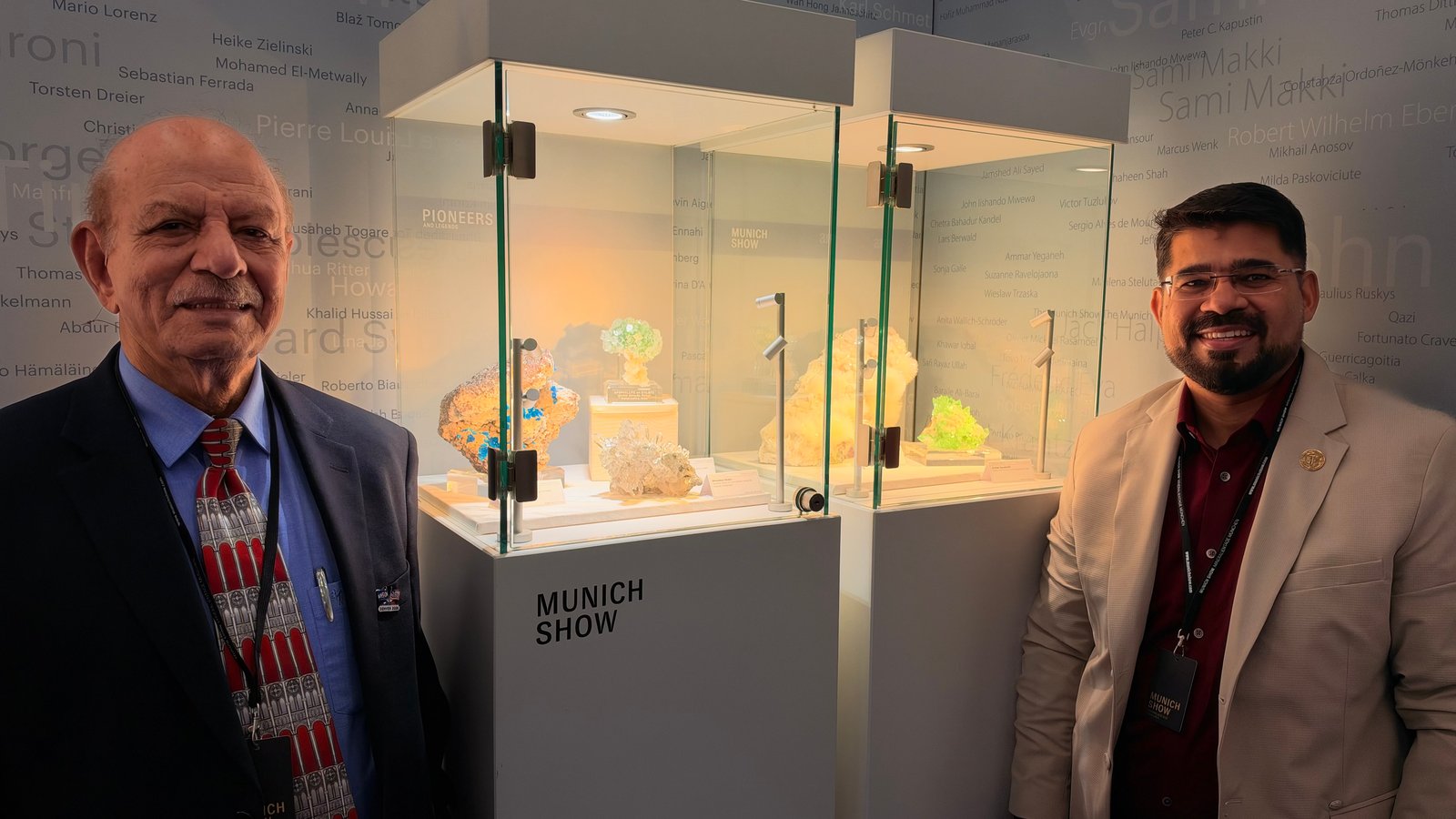
Photo: Franziska & Wolfgang Waeger
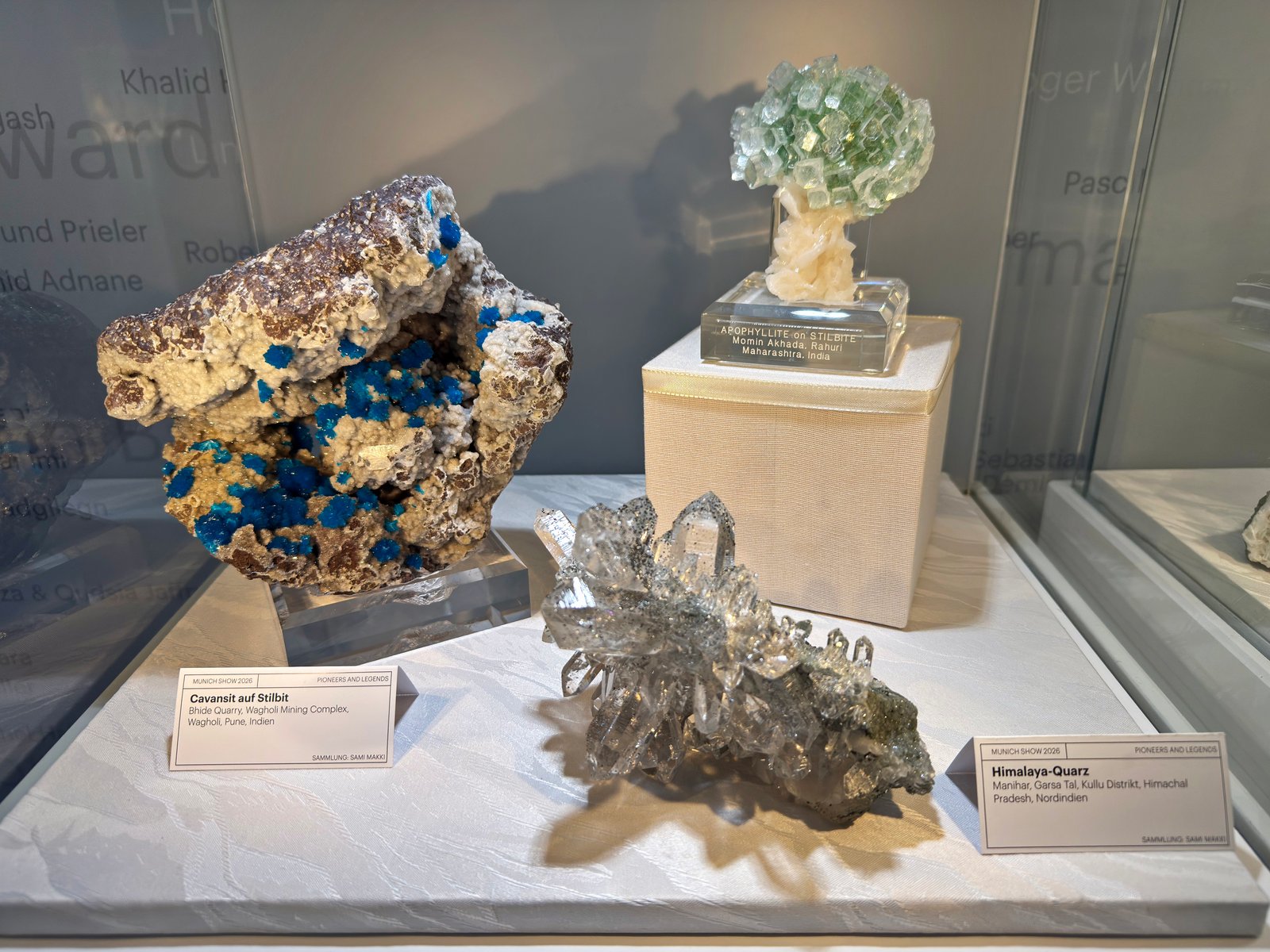
Photo: Franziska & Wolfgang Waeger
Mineral preparation laboratories, as we know them today, did not exist 30 years ago. MCP of Milan, Italy, was among the first to offer specimen preparation and professional cleaning services to the mineral world. This year, they presented remarkably large specimens from the recently acquired Adalberto Giazotto Collection, giving these pieces a new life for future collectors while preserving their stories. Among them was arguably the finest ajoite-in-quartz specimen from that famous find.
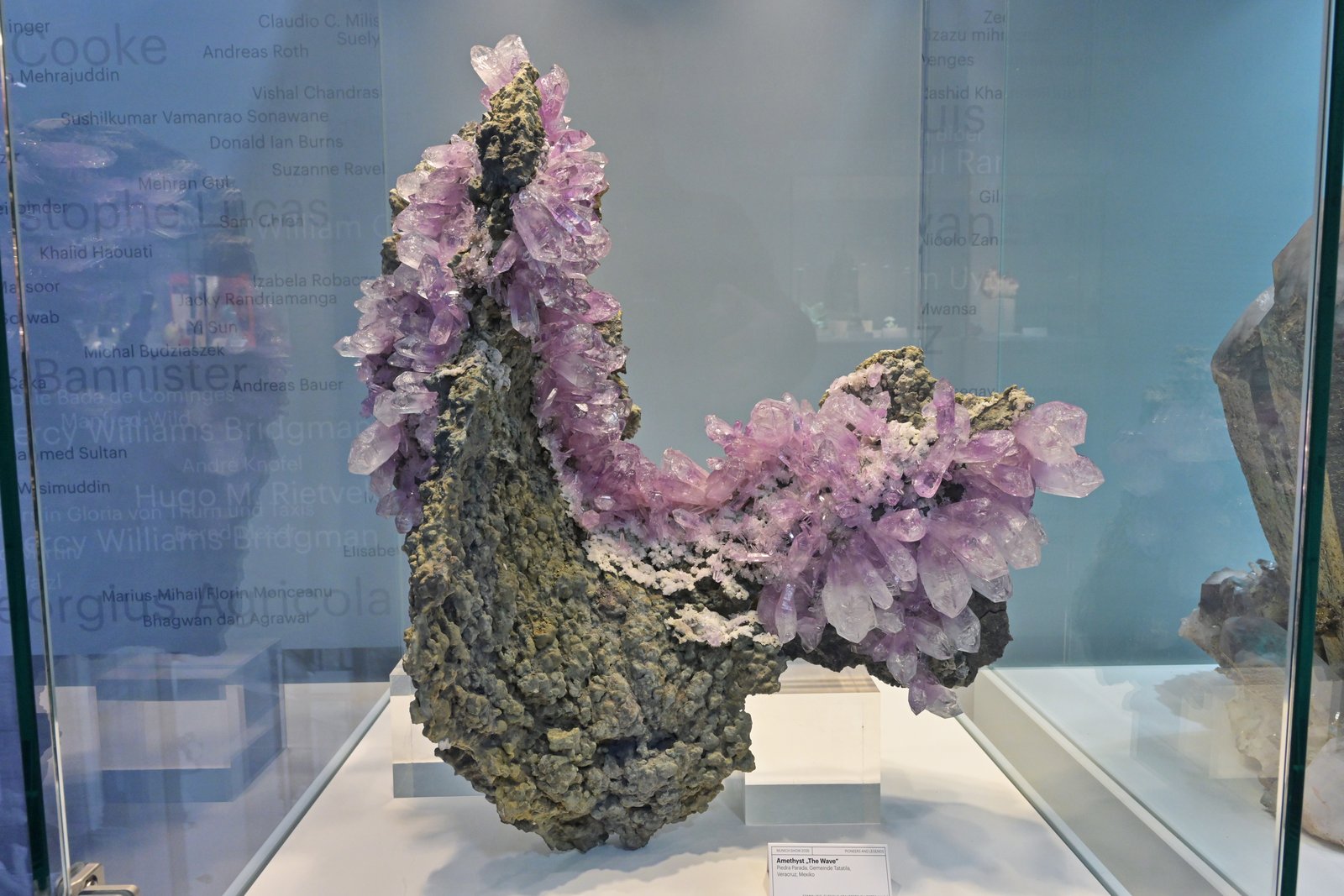
Photo: Franziska & Wolfgang Waeger
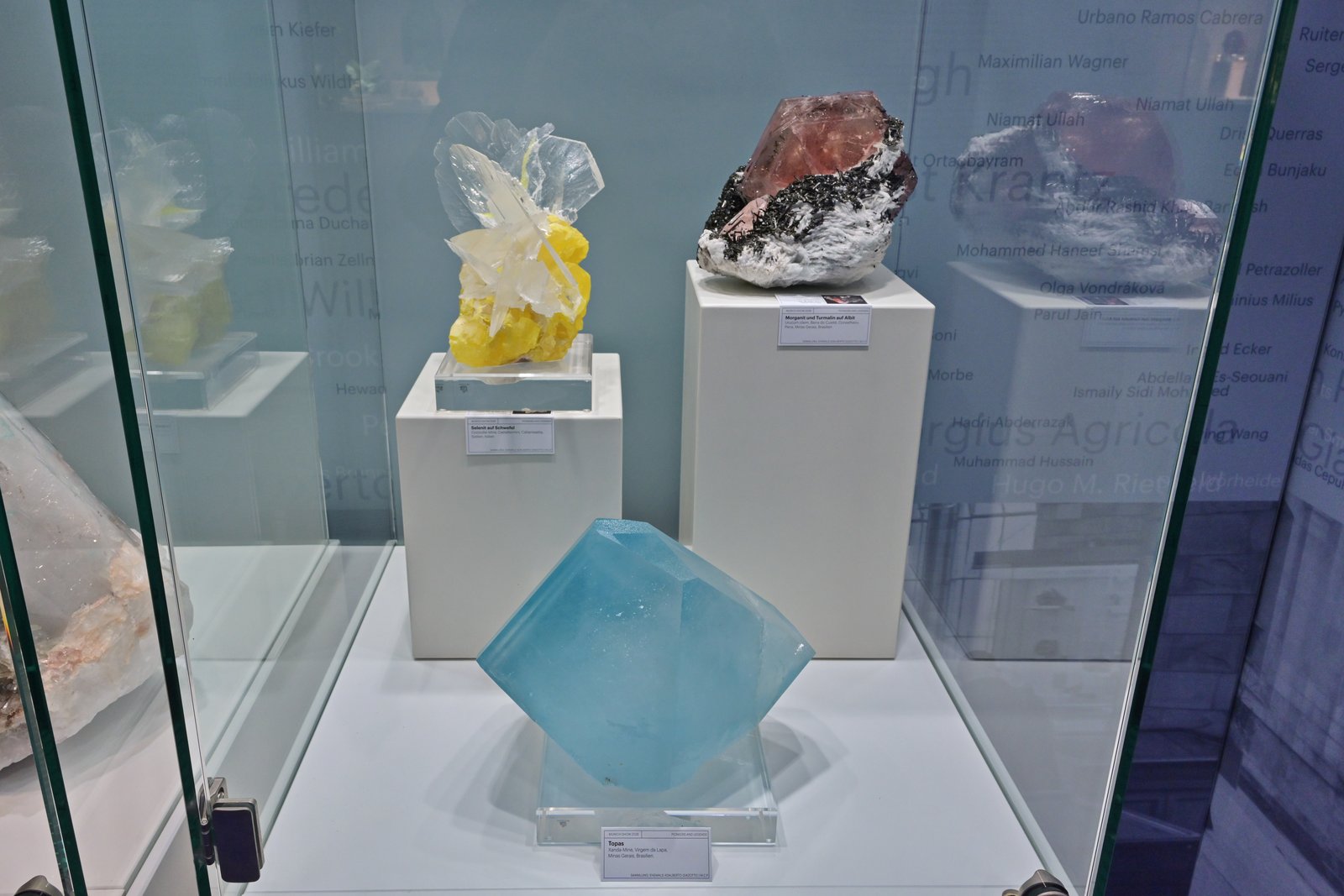
Photo: Franziska & Wolfgang Waeger
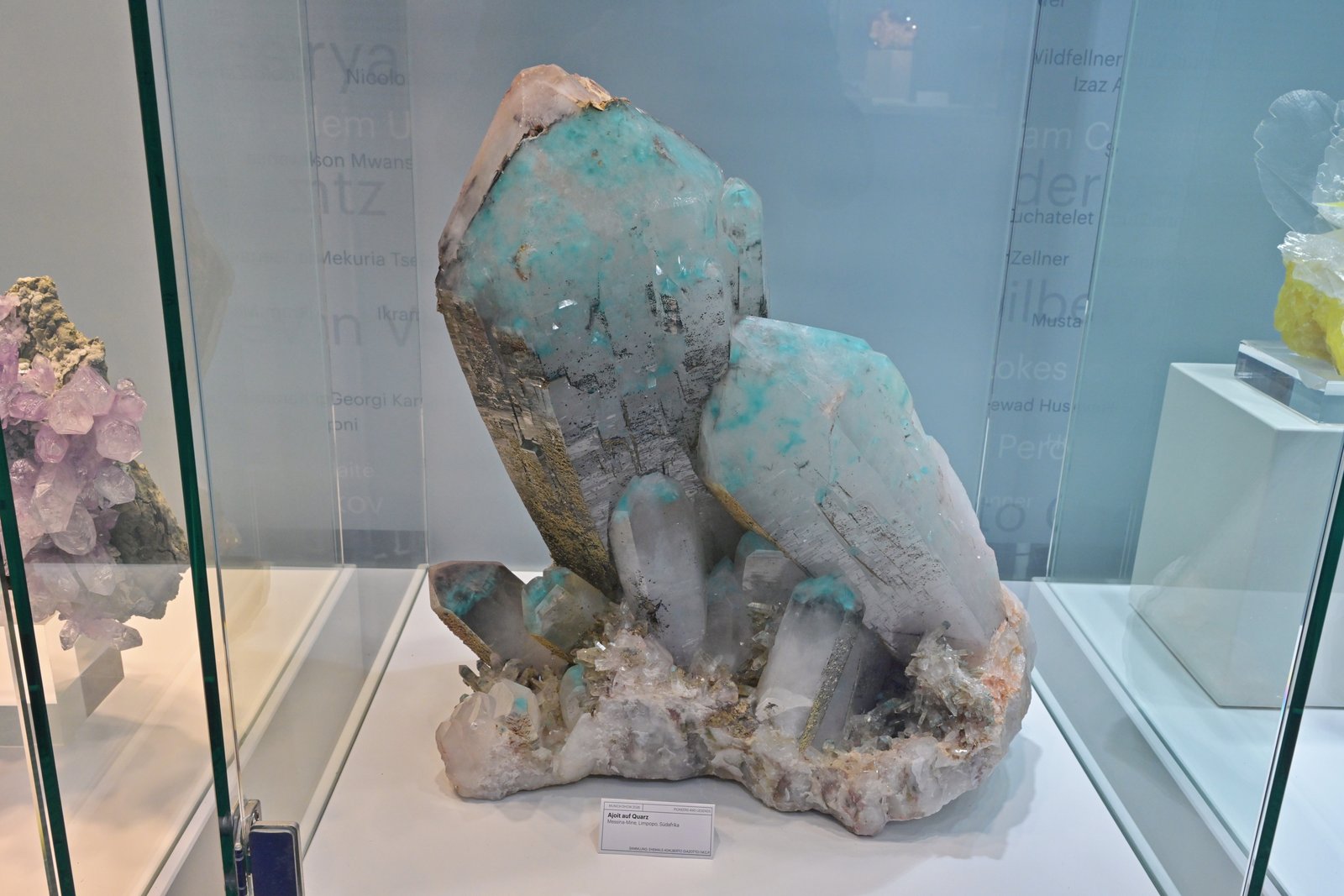
Photo: Franziska & Wolfgang Waeger
At the heart of the exhibition, Daniel Trinchillo of Fine Minerals International and the Houston Museum of Natural Science joined forces to bring the famous King of Kashmir all the way to Munich. Magnificent golds from Eagle's Nest, as well as the Alma Queen and Snowcone rhodochrosites, highlighted the importance of specimen mining operations and the possibilities of preservation.
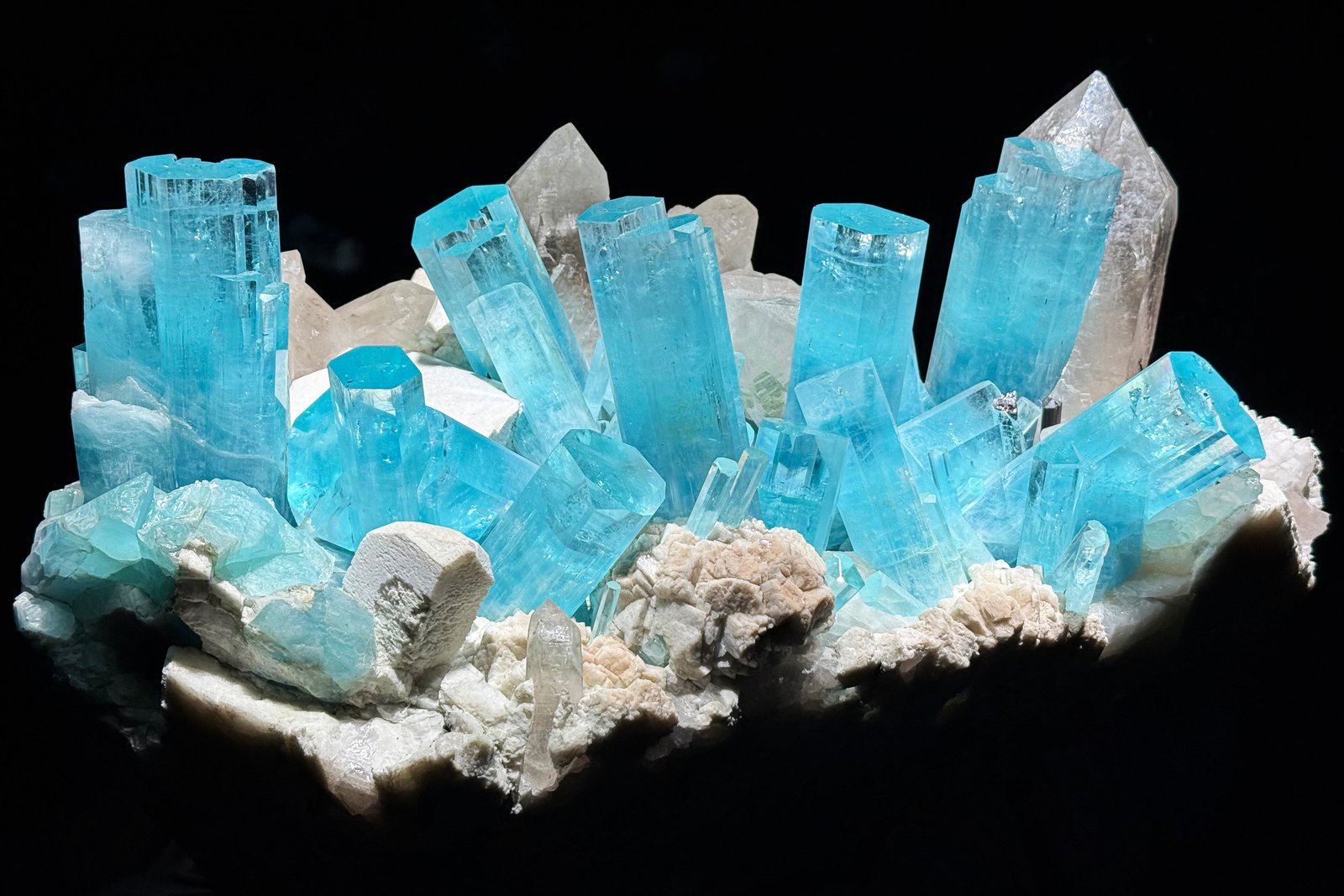
Photo: Franziska & Wolfgang Waeger
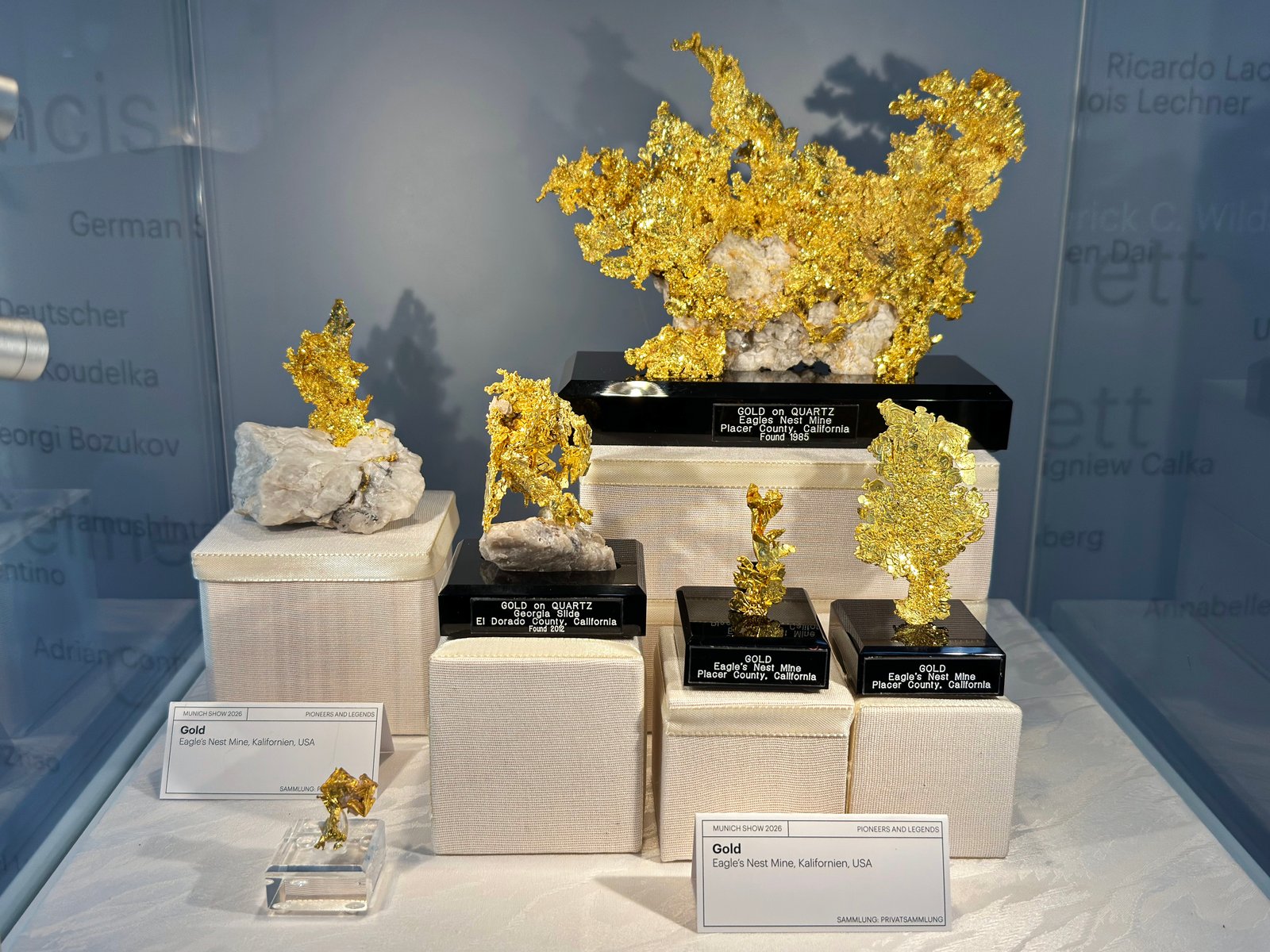
Photo: Franziska & Wolfgang Waeger
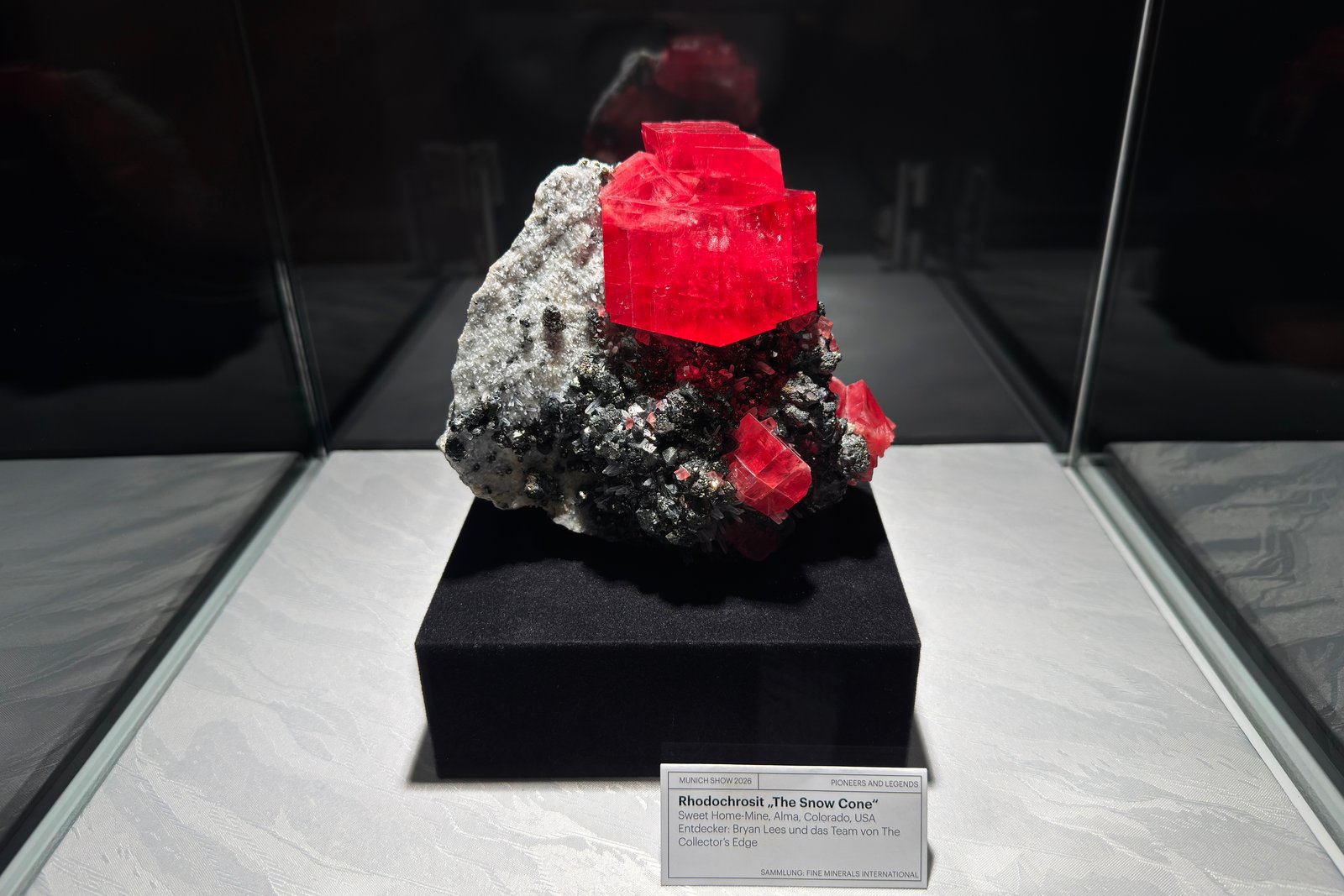
Photo: Franziska & Wolfgang Waeger
In the second hall, near the Alpine area, approximately 35 collector cases are displayed each year, each featuring a unique personal theme. Three cases highlighted here tie in particularly well with the show's theme. For the first time in Munich, the Young Mineral Collectors (YMC) filled one of the collector cases. This nonprofit organization, focused on mineral collectors under 40 years of age, represents the new pioneers of mineral collecting. Before YMC, there had never been an international mineral club dedicated to young collectors. Since 2018, the organization has connected, supported, educated, and empowered young enthusiasts worldwide. Ten European members filled a case with specimens that best represented their individual collecting styles and interests.
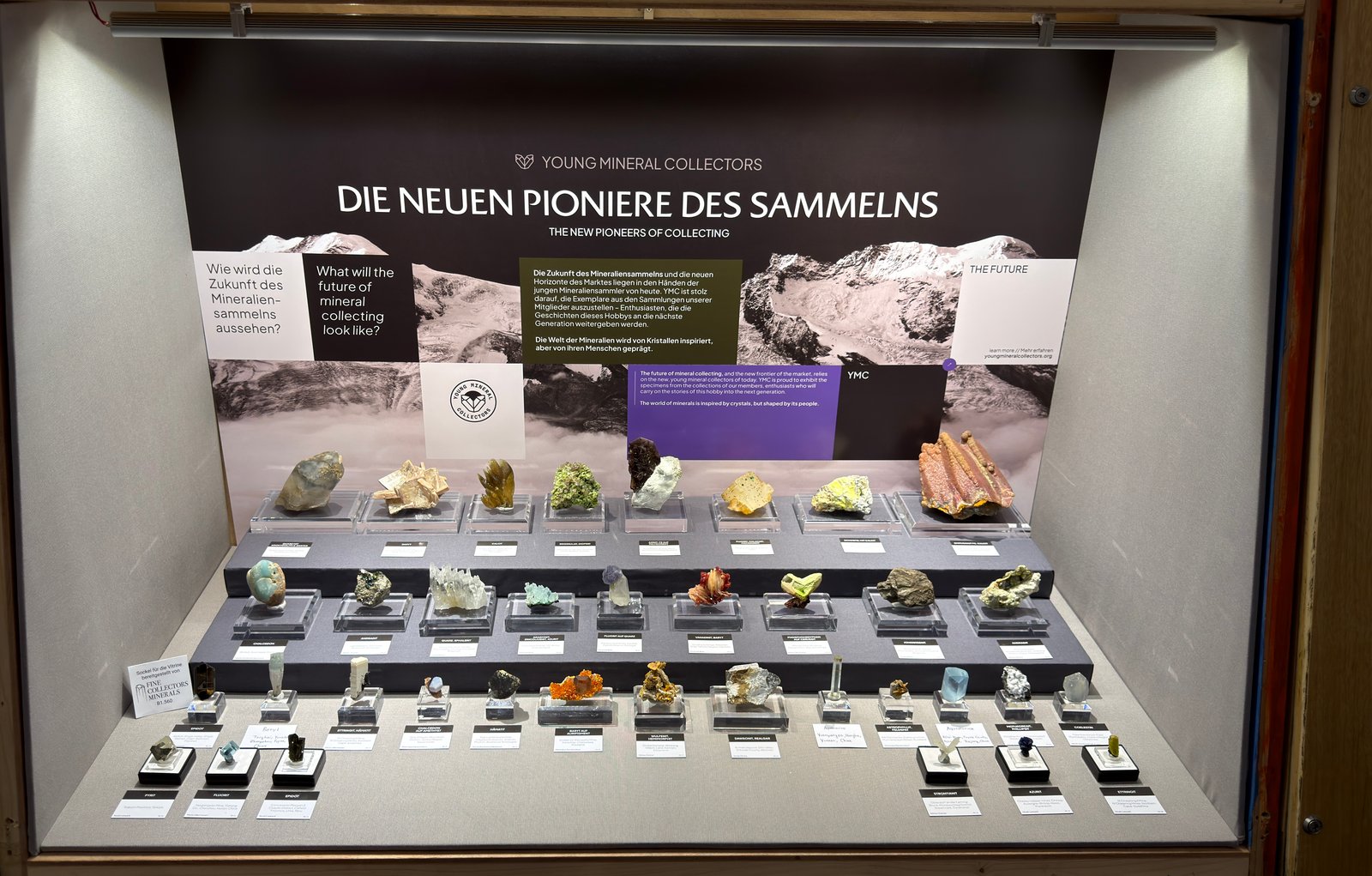
Photo: Matthew Parshchikov
Another first among the collector cases was a thumbnail-only display curated by young mineral collector Noah Lewark of Terra Collect. Featuring a broad range of localities and species, the case had a clean, Tucson-inspired look and demonstrated that outstanding crystallography, aesthetics, and quality can be achieved even on a small scale. The display also paid tribute to thumbnail pioneer Willard Perkin through two specimens from his former collection.
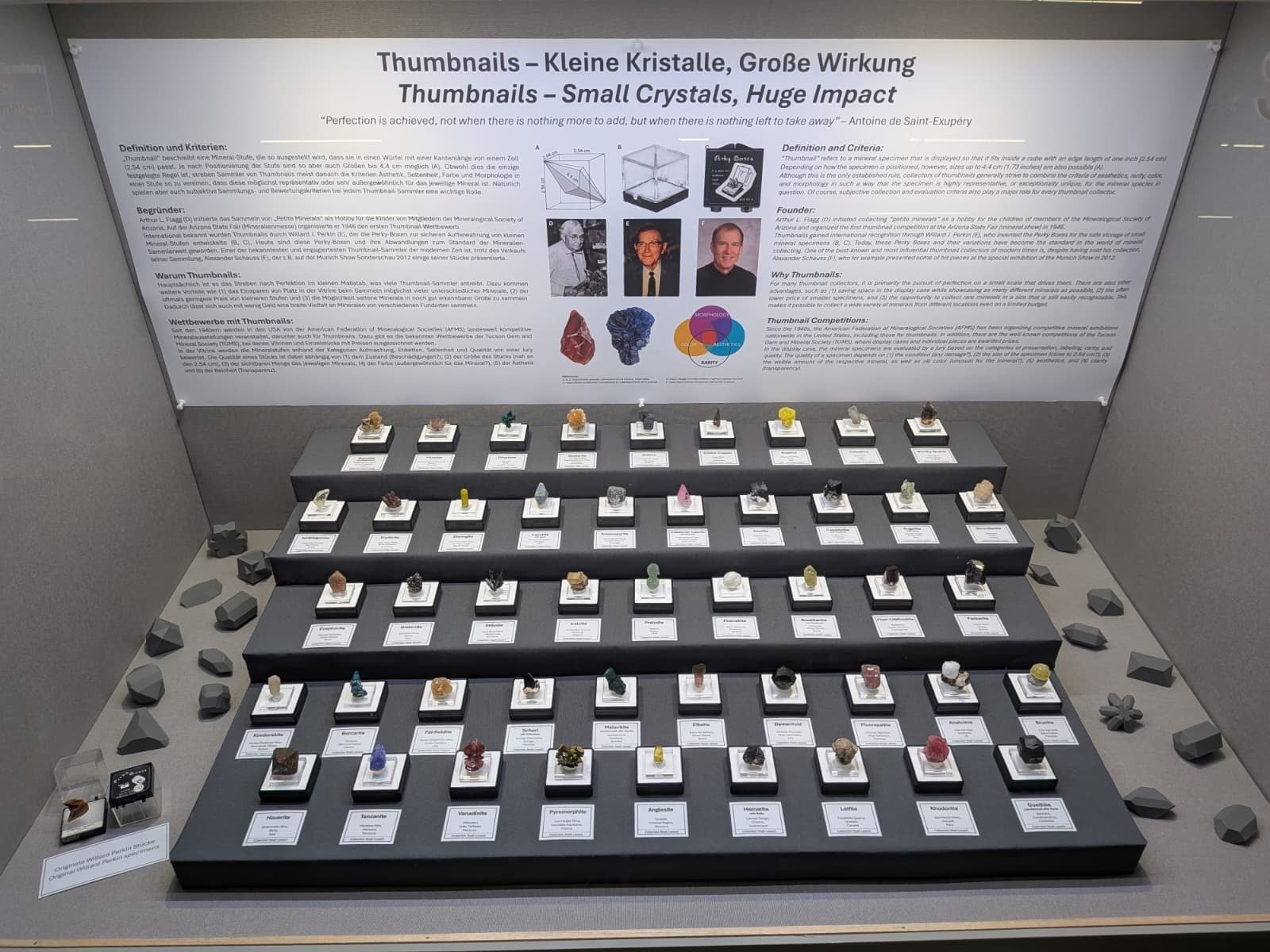
Photo: Noah Lewark
Dominik Seidel and Daniel Krawina, two young collectors, presented their discoveries from the Fichtel Mountains, a pegmatite region in eastern Bavaria. The main attractions were undoubtedly the fluorite specimens. One was a large blue cube with purple zoning, accompanied by smoky quartz, while the other was a smaller, sharper cube featuring a distinct purple generation shaped like a cross and overgrown by a transparent, colorless generation. Both specimens originated from the same pocket, from which the collectors also extracted two large plates of smoky quartz with albite and muscovite.
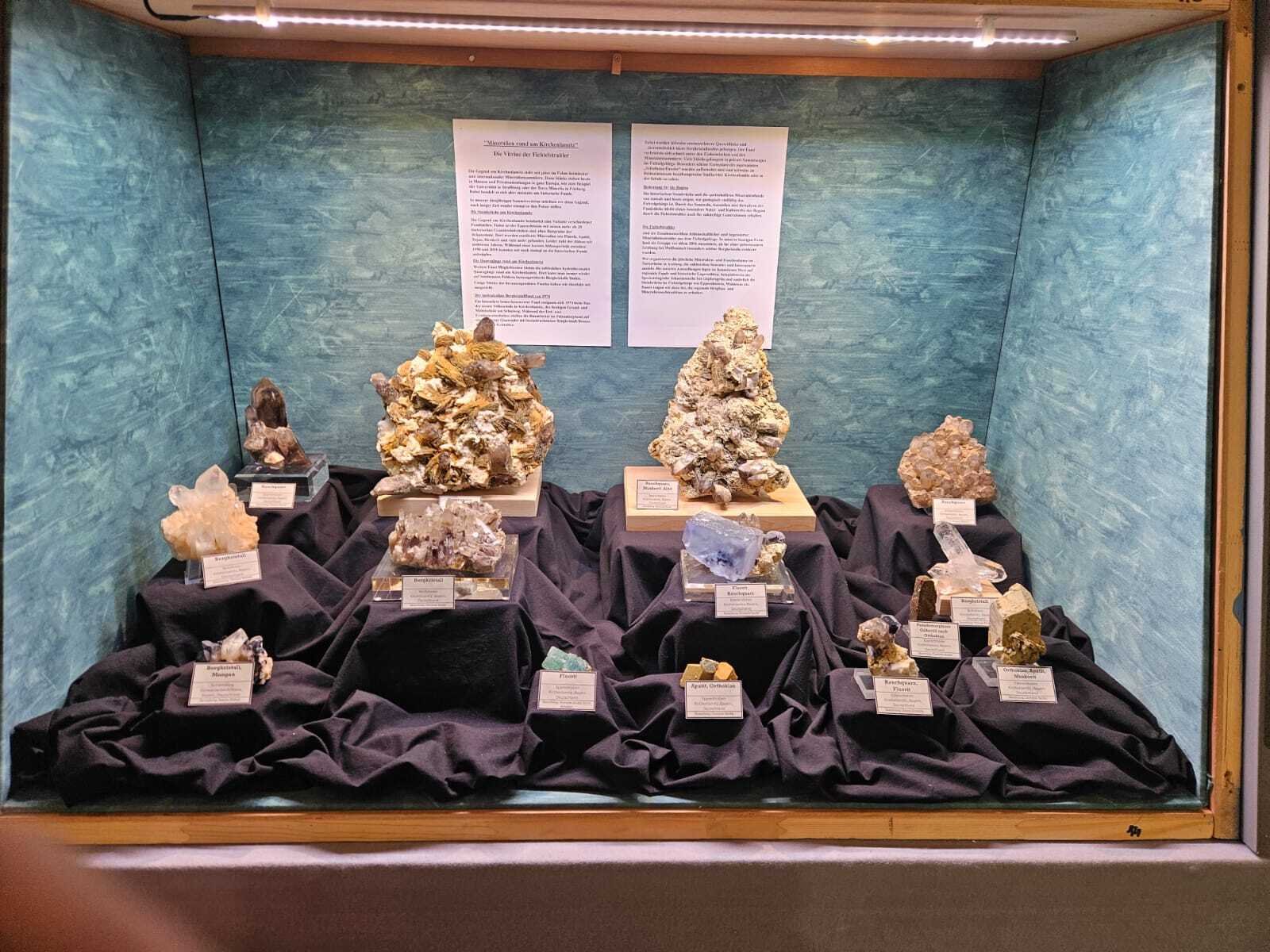
Photo: Dominik Seidel and Daniel Krawina
This year is all about (re)telling stories, honoring what was once thought impossible, and thanking the community. Because when you get closer to the greatest specimens, you automatically connect with the wonderful people who make up the collecting world. In this day and age, it has become significantly more important to stick together and support one another. People say the golden age of mineral collecting is over, but in fact, it is happening right now. Minerals have never been more accessible, collectors have never been more connected, and specimen quality continues to rise because our predecessors, the pioneers and legends of the mineral world, paved the way for future generations. Their discoveries, dedication, and vision created the path that today's collectors continue to follow.
Written by Matthew Parshchikov.
If you have specimens, locality information, research, or stories that could help others discover the world of minerals, we would be very happy to hear from you. Reach out to the team, info@earthwonders.com
Until next time, friends!