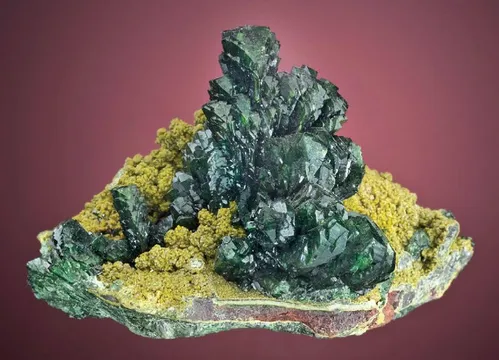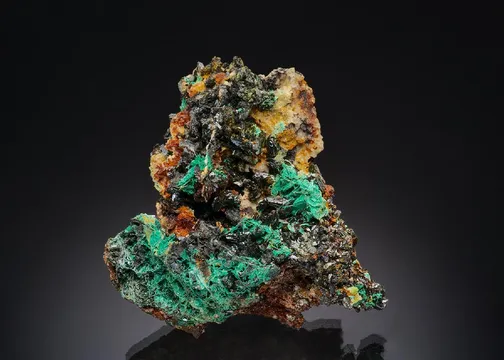
Olivenite, copper arsenate hydroxide; olive to yellow-green crystals with varied habits, prized by collectors from Cornwall to Tsumeb and Cap Garonne.
Key facts
Olivenite is a copper arsenate hydroxide, Cu2(AsO4)(OH), and one of the quintessential secondary copper minerals from the oxidized zones of arsenic-bearing ore deposits. Its name reflects its distinctive olive to yellow‑green color, although crystals can range from rich bottle‑green to brownish hues. It crystallizes in the orthorhombic system and occurs in a variety of attractive habits: sharp prismatic crystals, delicate acicular sprays, radiating hemispheres, botryoidal crusts, and velvety coatings. Luster is typically vitreous to silky on fibrous forms, and the best crystals can be strikingly bright for a copper secondary.
Collectors value olivenite for the combination of vivid color, varied habits, and its occurrence at world‑class classic localities. Historic Cornish mines produced archetypal crystallized specimens in the 18th–19th centuries; later, Tsumeb and Cap Garonne contributed superb modern classics. Associations are part of the charm: olivenite frequently accompanies conichalcite, duftite, adamite, clinoclase, chalcophyllite, liroconite, cornwallite, malachite, azurite, scorodite, and iron oxides. While individual crystals are usually small (millimeters), the species excels in aesthetics through fine sprays, radiating groups, and richly colored, contrasting matrix pieces.
Olivenite enjoys steady demand among both micromounters and cabinet collectors. Its historical pedigree from Cornwall appeals to classic locality enthusiasts, while photogenic modern pieces from Tsumeb and Cap Garonne draw aesthetics‑driven collectors. Prices vary widely: attractive micromounts and small sprays are accessible, but undamaged, well‑composed matrix specimens from benchmark localities—especially Cornwall with provenance, or robust Tsumeb crystals with contrast—can be expensive. Interest is also boosted by its relationship to the zinc‑rich analogue zincolivenite, which can form solid solutions at some deposits; pieces showing compositional or color transitions add scientific and collector intrigue.
While olivenite occurs broadly, a handful of localities set aesthetic and historical standards.
Among the most storied olivenites ever found, Wheal Gorland (St Day area, Cornwall) produced superb 18th–19th century classics. Expect sharp, slender prismatic crystals and radiating sprays in rich olive to deep green, commonly perched on gossanous or quartz‑rich matrix. Associations with Cornish arsenates—clinoclase, cornwallite, chalcophyllite—and occasional liroconite or malachite give coveted color contrast. Though usually small, the best groups are exceptionally well‑formed and extremely rare in pristine condition; provenance and period labels significantly enhance value. Intact, undamaged micro to small‑cabinet pieces from Gorland are considered reference material for the species.
Tsumeb delivered some of the most vibrant and three‑dimensional olivenites, typically from the oxidation and secondary enrichment zones. Crystals range from lustrous prismatic individuals to radiating sprays and dense carpets, often on contrasting white calcite/dolomite or dark iron‑oxide matrix. Color can be rich bottle‑green to yellow‑green, with superior luster compared to many localities. Associations with duftite, conichalcite, malachite, azurite, smithsonite, and quartz are common, and some pieces show compositions trending toward zincolivenite, of interest to specialists. Tsumeb matrix clusters with sharp, undamaged terminations are centerpiece‑quality and are among the most sought after modern olivenites.
Color and Luster:
Crystal Habit and Aesthetics:
Size and Composition:
Condition:
Provenance:
Repairs:
Cleaning and Alterations:
As always, disclosure from reputable dealers and a careful loupe inspection reduce surprises.
Olivenite contains arsenic; handle responsibly and avoid creating or inhaling dust.
Handling:
Light, Heat, and Environment:
Cleaning:
Storage and Display:
By prioritizing minimal handling, mild cleaning, and stable conditions, olivenite’s rich greens and delicate architectures will remain attractive for decades.