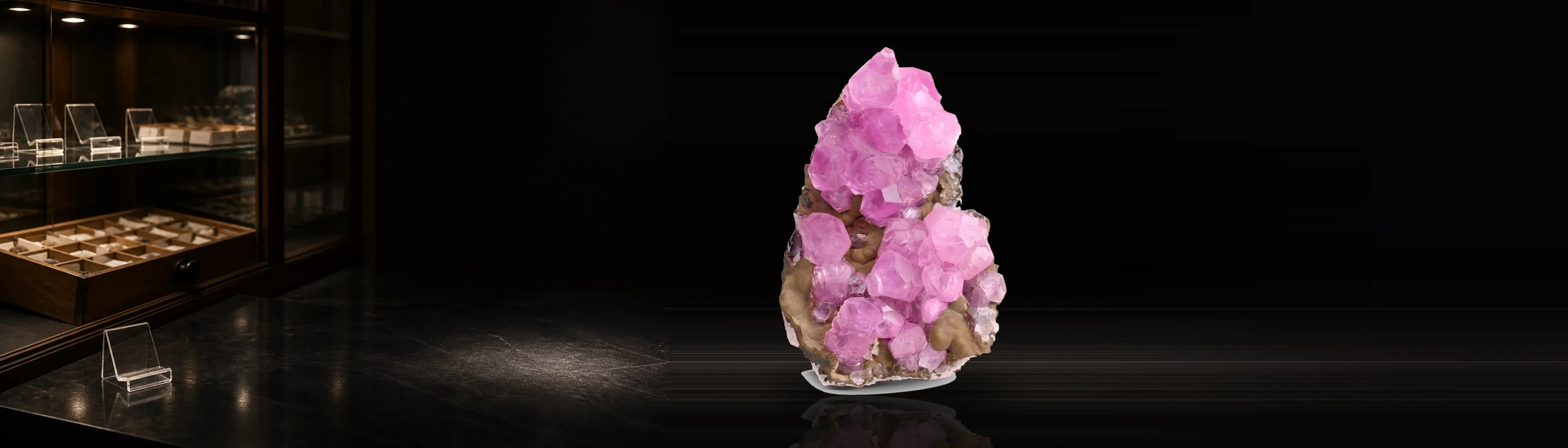
A mineral survived a hundred million years underground. Then it spends six months on a sunny windowsill and fades, or a winter in a humid basement and starts to crumble. Most collection damage isn't dramatic - it's slow, quiet, and entirely preventable, caused by the everyday conditions of an ordinary room.
Storing and displaying well comes down to two jobs: protect specimens from the things that degrade them, and present them in a way that does them justice. Here's how to do both - and how the newest kind of display case takes the pressure off the physical one.
Four forces do nearly all the damage. Knowing which of your pieces are vulnerable to which is most of the battle.
- Light. Some species genuinely fade or degrade in light, especially sunlight and UV. Realgar and orpiment break down and can crumble; the ruby silvers (proustite, pyrargyrite) darken; vivianite blackens; and prolonged strong sun can fade amethyst, rose quartz, celestine, and some fluorite. Light-sensitive species belong in dark drawers, not on a sunny shelf.
- Humidity. The collector's classic nightmare is "pyrite disease" - pyrite and marcasite reacting with humid air, producing sulfuric acid that crumbles the specimen, throws off a sulfurous smell, and can damage neighbors and labels. Soluble species (halite, some sulfates) absorb moisture and deteriorate in damp air. Most collections want stable, moderate humidity; vulnerable pieces want it dry, sometimes sealed with desiccant and isolated.
- Temperature swings and heat. Rapid changes stress crystals and can crack them; heat dries out and crazes hydrous species and opal. Avoid attics, garages, radiators, and direct sun.
- Physical contact and dust. Specimens abrade each other, dust settles into crevices (and shows mercilessly in photos), and bare hands leave oils on lustrous faces. Separate, enclose, and handle with care.
One safety note: radioactive species (uraninite, autunite, torbernite and friends) should be stored in a separate, ventilated spot, handled minimally, and clearly labeled.
Most of any serious collection isn't on display - it's stored, and stored well:
- Drawer cabinets are the collector standard: flat, dark, dust-free, and space-efficient. Dark drawers also happen to be perfect for light-sensitive species.
- Individual compartments or boxes stop specimens from touching and abrading one another. Specimen boxes, micromount and thumbnail boxes, and Riker mounts each suit a size class.
- Soft, safe padding - but mind the material. Avoid raw cotton against delicate crystals; its fibers snag on fine points and acicular sprays. Unbleached tissue or polyester fiber is gentler.
- A label in every drawer and box. This is non-negotiable, and it's where storage meets cataloging - more below.
- A dry, stable room. Not the basement, not the attic. A consistent interior space beats a beautiful but hostile one.
Display is where specimens earn their keep - and where they're most exposed. Do it without sacrificing them:
- Enclosed glass cases keep dust off and let you control the environment. Open shelves look great and collect grime.
- Cool, low-UV lighting. Modern LED is ideal: bright, low heat, and easy to find in low-UV options. Avoid hot halogens and, above all, direct sunlight. Keep light-sensitive pieces out of display entirely, or rotate them.
- Secure every piece against falls. A dab of museum putty or conservation gel under a specimen prevents the catastrophic shelf-tip - essential in earthquake country, wise everywhere.
- Consider sightlines and grouping. Display at eye level where possible, and group by theme, locality, or species so the case tells a story rather than just filling space.
- Mind security for valuable pieces - locked cases, discretion about what's visible from a window, and coverage that matches (see insuring a collection).
The fastest way to degrade a collection's value - without touching a crystal - is to separate specimens from their information. A piece whose locality and history have wandered off is worth a fraction of the same piece fully labeled.
So every specimen carries a label, and every label carries a catalog number that ties the physical piece to its digital record. Write the number on the label and the box, never just one. Get that link right and the collection stays coherent for life; break it and provenance leaks away every time you move a drawer. (This is the backbone of our cataloging system.)
Here's the shift worth noticing: the best-displayed collections increasingly live in two places. There's the physical case - limited by shelf space, lighting, and the species you dare expose - and there's the digital gallery, which has none of those constraints.
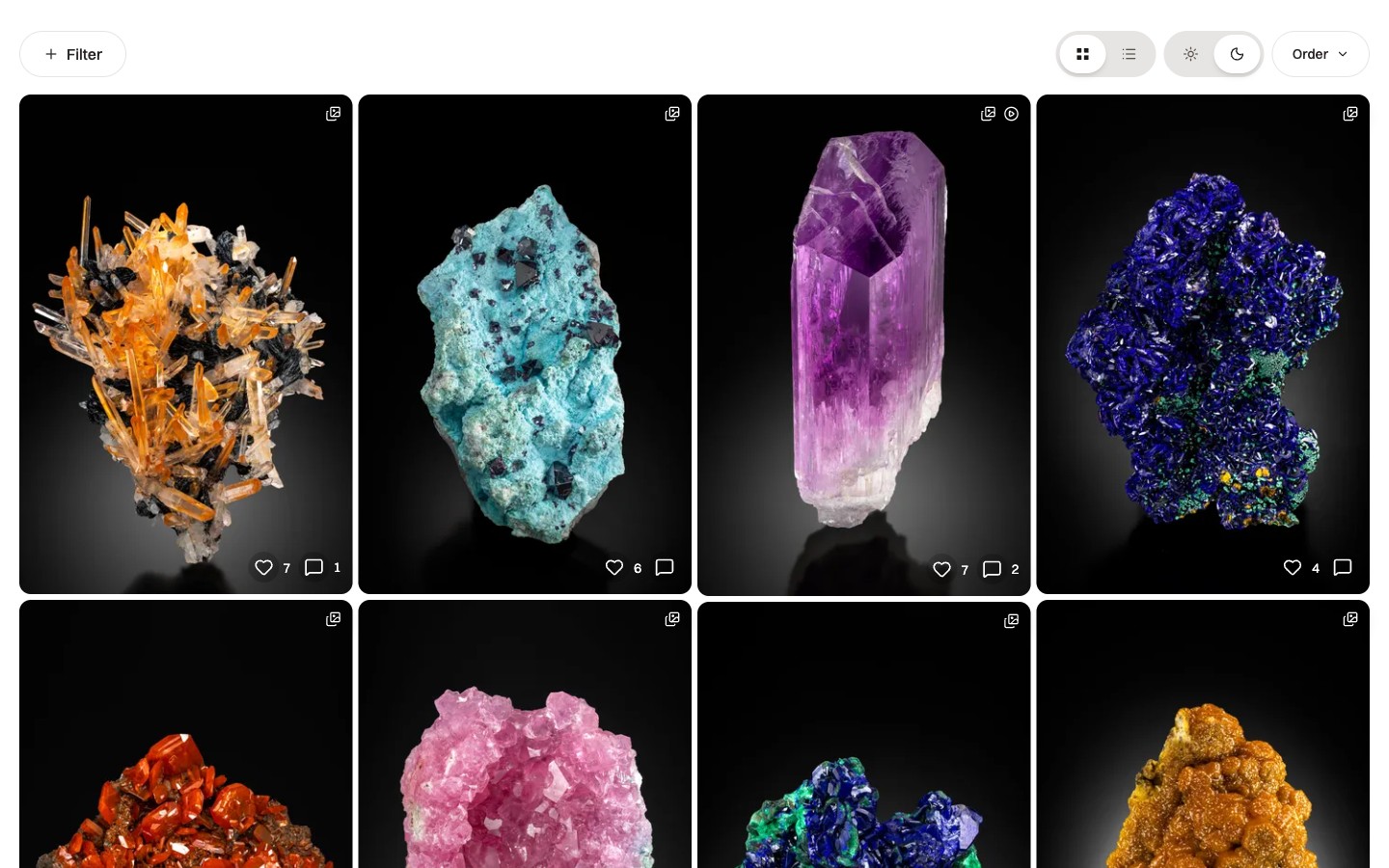
A digital display case: every piece visible at once, lit perfectly, dust-free, in a light or dark gallery - including the light-sensitive specimens you'd never leave on a shelf.
A digital gallery solves the display problems physical cases can't. Light-sensitive realgar that must live in a dark drawer can still be shown, beautifully, online. Your whole collection is visible at once instead of the fraction that fits the cabinet. And it's the only display case you can hand to someone a thousand miles away.
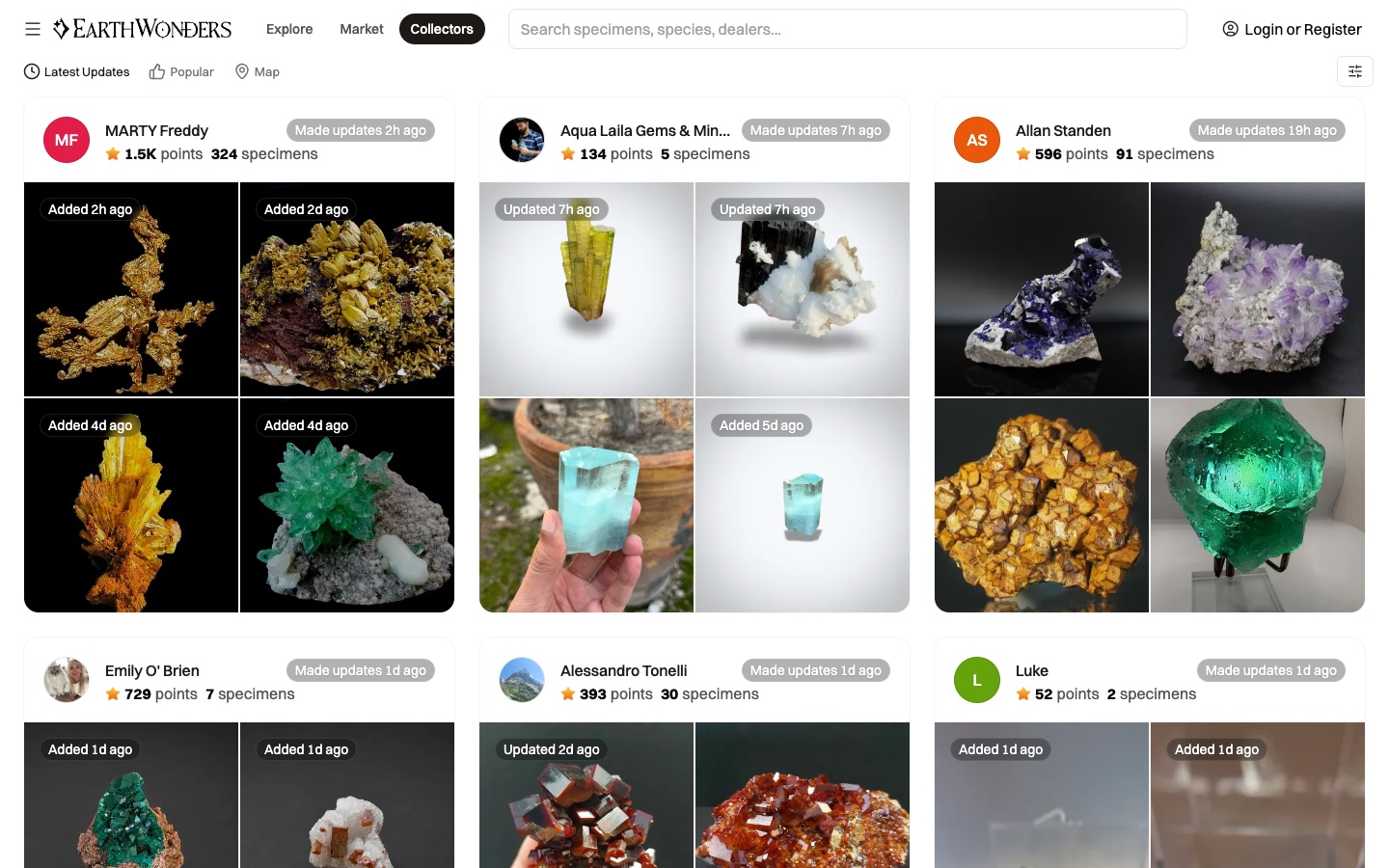
Share the whole collection with one link - earthwonders.com/yourname - without exposing a single physical specimen to light, dust, or risk. And it stays private until you decide to publish it.
On EarthWonders that gallery is free, arrangeable to suit the collection, available in clean light or dark views, and private by default - you publish it only when you want to. It's the display case that protects the real ones: you can keep the fragile and fade-prone pieces safely stored, and still show them off to anyone, anywhere.
Keep light-sensitive species in the dark, vulnerable pieces dry, everything away from heat and direct sun, and each specimen separated, secured, and labeled with its catalog number. Display in enclosed cases under cool light, and let a digital gallery carry the pieces that can't safely sit out. Do that, and your collection will both survive the decades and look the way it deserves the whole time.
Show your collection without risking it. Build a free gallery on EarthWonders - arrange it your way, view it light or dark, share it with one link, and keep it private until you choose otherwise.