
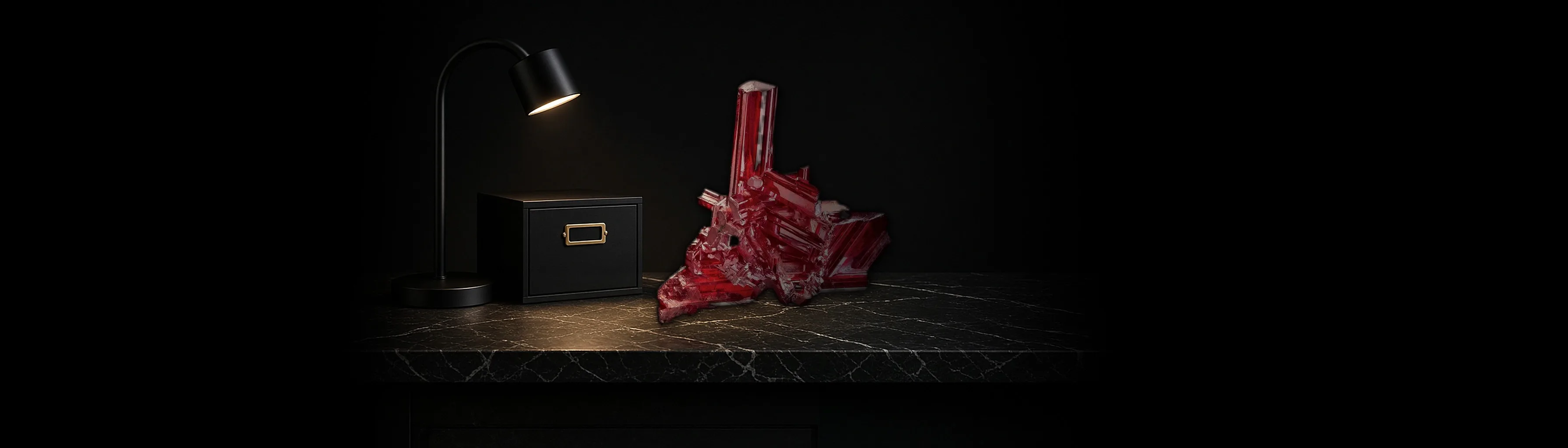
Realgar (red) and pararealgar (orange and yellow) with calcite, Getchell mine, Nevada. The yellow-orange areas are light-induced alteration products. Photo: James St. John, CC BY 2.0, via Wikimedia Commons.
Light damage is the sneakiest kind of mineral damage. Nothing breaks and nothing falls. A kunzite on a bright shelf just gets a little paler each month, and a realgar crystal grows a faint yellow skin that one day starts to flake. By the time you notice, the colour or the crystal is gone, and it doesn't come back.
The good news is that only a small group of minerals is seriously at risk. Most quartz, garnet, pyrite and other silicates can sit under display lights for decades. Here's which species to worry about, how sure we are about each, and what actually protects them.
- It adds up. Museums measure exposure in lux-hours, which is brightness multiplied by time. 50 lux for 24 hours is the same dose as 200 lux for 6 hours. A dim lamp that's always on can matter as much as a bright one used briefly.
- It's usually permanent. Light can rearrange a mineral's atoms (realgar), reset the "colour centres" behind colours like kunzite pink and celestine blue, or drive surface reactions (proustite, cinnabar). None of these normally reverses.
- UV is the strongest part, but not the whole story. Daylight is the biggest source of ultraviolet, and ordinary window glass doesn't block UVA. For some minerals, though, ordinary visible light is enough.
- Heat rides along. Spotlights warm specimens. In one realgar experiment, a halogen lamp 30 cm away heated samples to 60 °C, which also puts fluorite and native sulfur at risk of thermal shock.
Realgar is a vivid red arsenic sulfide, and collectors have long known it turns into yellow-orange powder in light. Older books call the powder orpiment. A 1992 study in American Mineralogist by Douglass, Shing and Wang (read it here) showed it's actually a different mineral, pararealgar, and pinned down what causes it:
- Every realgar they tested altered in sunlight, whether from Nevada, Romania or China. Only one Chilean locality resisted.
- Visible light does it, not UV. The reaction runs at wavelengths of about 500–670 nm and is fastest in the green-yellow (about 530–560 nm). When a filter let UV and infrared through but blocked visible light, nothing happened.
- Speed depends on intensity. Unfiltered sun caused visible change within hours. A specimen getting about an hour of direct sun a day, plus room light, changed significantly within a few months. A month under lab fluorescent lighting showed no detectable change.
- It crumbles because the pararealgar forms a skin that cracks and flakes off, exposing fresh realgar underneath to the same fate.
The practical upshot: UV filters and "UV-free" LEDs don't protect realgar. Warm-white LEDs give off plenty of light in the 500–600 nm range. The only protection is less light, for less time. Keep realgar in a lightproof box, display it briefly and dimly, and photograph it quickly.
⚠️ Realgar is an arsenic mineral, and its yellow powder comes off easily. Handle it with gloves, keep it in a lidded box, never blow its dust towards you, and never use acid on it (arsine gas risk).

Translucent red realgar crystals covered by a pararealgar coating (Estonian Museum of Natural History). Photo: Kaarel Tiidus, CC BY-SA 4.0, via Wikimedia Commons.
- Proustite and pyrargyrite. These "ruby silvers" are translucent red when fresh and darken with prolonged light. Museum guidance lists them alongside realgar as minerals that keep their colour only in the dark. Treat them like realgar: dark by default.
- Orpiment. Photosensitive and slowly decays. It's also an arsenic mineral, so the same handling rules apply.
- Stibnite. Long light exposure is reported to dull its lustre.
- Cinnabar. Only mildly photosensitive, but it can develop a dark surface. Studies of cinnabar pigment in paintings link the darkening to light combined with chlorides and moisture. Scientists still debate whether the dark layer is metallic mercury or metacinnabar. Keep cinnabar out of strong light, damp and salt.

Proustite ('ruby silver'). Bright red and translucent when fresh; it darkens on prolonged light exposure. Photo: Parent Géry, Public domain, via Wikimedia Commons.

Cinnabar on dolomite. Light (especially combined with chlorides or moisture) can produce a dark surface film. Photo: JJ Harrison (https://www.jjharrison.com.au/), CC BY-SA 3.0, via Wikimedia Commons.
- Kunzite and hiddenite. Among the best-known faders. GIA and specialist references both warn that pink kunzite and green hiddenite can lose colour in light. Store them in the dark and display them under low, cool light.
- Topaz. Imperial, blue and champagne or brown topaz (including some Utah material) often fade, and some darken.
- Beryl. It depends on the variety. Pink morganite may fade, and deep-blue maxixe beryl may turn colourless or pink.
- Others. Colour changes are also reported for spinel, sapphire, zircon, scapolite, phenakite and sodalite. Hackmanite is a special case: it's tenebrescent, changing colour and changing back in UV and visible light. That's a party trick, not damage.

Kunzite (pink spodumene) from the Paprok mine, Nuristan, Afghanistan. The pink colour can fade in strong light. Photo: Parent Géry, CC BY-SA 3.0, via Wikimedia Commons.
- Amethyst fades in strong light and heat, and conservation guidance consistently says to keep it out of direct sun. Big geodes in sunny rooms or shop windows are the classic casualties.
- Rose quartz, smoky quartz and citrine can fade too, though how much varies a lot between pieces.

Amethyst geode (detail) from Planalto, Brazil (MNHN Paris). Some amethyst bleaches with long sun exposure or heat. Photo: Marie-Lan Taÿ Pamart, CC BY 4.0, via Wikimedia Commons.

Crystallised rose quartz from Lavra da Ilha, Minas Gerais, Brazil. Rose quartz is reported to fade in light. Photo: Parent Géry, CC BY-SA 3.0, via Wikimedia Commons.
- Celestine. Its pale blue comes from colour centres that sunlight can bleach. Some collectors say the colour partly returns after time in the dark, but that isn't firmly established, so don't count on it.
- Fluorite. Some green, blue and purple fluorites fade or change colour in sunlight. Many don't.
- Barite. Some pieces are photosensitive. Colourless barite can pick up colour, blue can darken, and yellow-brown can turn greenish or blue. This is based on a single specialist source.

Blue celestine crystals from the Sakoany deposit, Madagascar. Colour centres in celestine can bleach in sunlight. Photo: Ivar Leidus, CC BY-SA 4.0, via Wikimedia Commons.
- Vanadinite. Specialist references and collector reports say red or yellow pieces may darken in strong sunlight. We found no controlled study, and the effect seems to vary by locality. Keep it out of direct sun, but it doesn't need realgar-level darkness. Crocoite is sometimes said to darken too, though some specialists are sceptical.
- Vivianite. It often darkens from pale green to deep blue-black and can split along its cleavage. Light has long been blamed, but a 2024 study in Geochimica et Cosmochimica Acta suggests the oxidation may not be driven by light at all. The science is unsettled, so store it dark, dry and still.
- Disputed claims. Pink tourmaline, lepidolite, chalcopyrite and marcasite are sometimes called light-sensitive, but specialist references describe these claims as lacking general agreement or as dubious.

Vanadinite from Mibladen, Morocco (MNHN Paris). Some red or yellow samples darken in strong sunlight. Photo: Marie-Lan Taÿ Pamart, CC BY 4.0, via Wikimedia Commons.

Deep green vivianite crystal from the Tomokoni mine, Bolivia. Vivianite darkens and can split apart over time; whether light or oxygen is the main driver is debated. Photo: Ivar Leidus, CC BY-SA 4.0, via Wikimedia Commons.
- Dark by default. Keep high-risk species (realgar, orpiment, proustite, pyrargyrite, kunzite, hiddenite, coloured topaz, vivianite) in lightproof boxes or closed drawers.
- No direct sun, ever. That means no windowsills, no bright shop windows and no sunny rooms, even behind glass.
- Rotate. Show sensitive pieces for short spells, then rest them in the dark. Conservators accept that display specimens are partly "sacrificial", and rotation spreads the cost.
- Keep it dim, and know the museum benchmark. A 2025 study proposes under 50 lux for light-sensitive minerals, and about 10,000 lux-hours a year for the most reactive. That's roughly 200 hours a year at 50 lux. It's a strict museum target rather than a home rule, but it shows how little light a realgar should get.
- Timers and motion sensors keep case lights on only while someone is looking.
- Choose LEDs with low UV, but remember that low UV still means visible light, which is what harms realgar.
- Keep lights outside the case or at a distance, so their heat stays off the specimens.
- Unpack and photograph quickly. A new realgar or proustite shouldn't spend an afternoon under photo lights or by a window.
- Track it. Photograph sensitive pieces under the same lighting once a year and compare. Slow fading is almost impossible to see by eye, but obvious side by side in your catalog.
⚠️ UV lamps for fluorescence. Short sessions are fine for most fluorescent minerals, but don't leave light-sensitive species under UV for long, and protect your eyes and skin from shortwave UV.
Here's where a digital display earns its place. A realgar that has to live in a drawer can still be seen, beautifully, in your EarthWonders gallery, while the real one stays in the dark. More on cases, cabinets and galleries in How to Store and Display a Mineral Collection.
| Sensitivity | Minerals | What to do |
|---|
| Very high | Realgar, proustite, pyrargyrite, orpiment | Dark storage; brief, dim display only |
| High | Kunzite, hiddenite, imperial/blue/brown topaz, vivianite (cause debated) | Dark storage; low light; rotate |
| Moderate | Amethyst, rose and smoky quartz, citrine, celestine, some fluorite, some barite, morganite | No sun; moderate display lighting |
| Variable or reported | Vanadinite, cinnabar, stibnite, crocoite | No direct sun; normal indoor display OK |
| Disputed | Pink tourmaline, lepidolite, chalcopyrite, marcasite | Normal care |
| Stable | Most quartz, garnet, pyrite and most other silicates | Normal display |
Light damage adds up and rarely reverses, so treat it as a budget, not a switch. Keep realgar, the ruby silvers, orpiment, kunzite and coloured topaz in the dark, and remember that UV filters don't protect realgar, because visible light is what changes it. Keep amethyst, celestine and their friends out of the sun. Light everything else with cool, low-UV LEDs on timers, rotate the sensitive pieces, and let a digital gallery do the showing off for the specimens that can't sit out. For the bigger picture, see our mineral specimen care guide.







_1_(18719248190).jpg)
.jpg)


.JPG)


