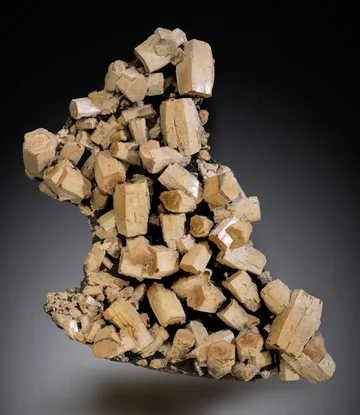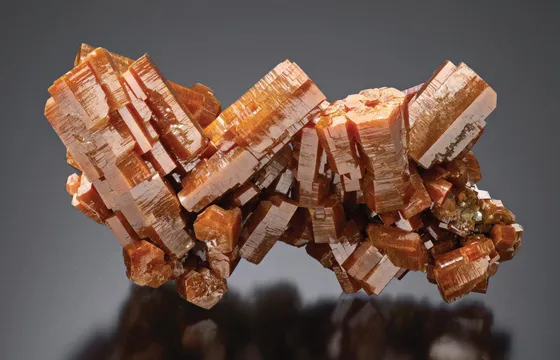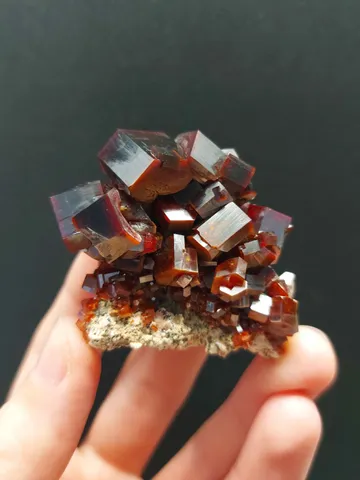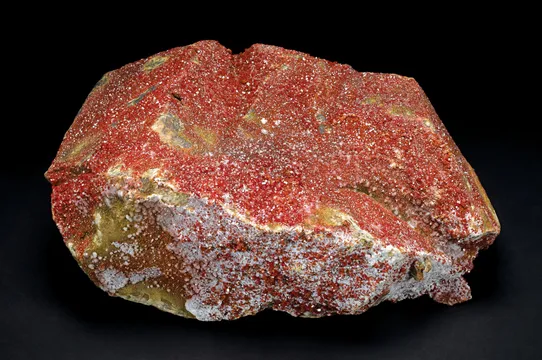
Vanadinite: vivid red-to-orange hexagonal barrels with bright luster; secondary lead mineral from oxidized zones, famed in Mibladen, Morocco, prized for color.
Key facts
Vanadinite is a lead vanadate chloride, Pb5(VO4)3Cl, and a member of the pyromorphite-mimetite group. It is best known for its arresting colors—vivid cherry reds, fire-orange, and deep brownish-crimson—combined with sharp hexagonal “barrel” crystals that show brilliant, often almost glassy luster. Many crystals display flat pinacoidal terminations; others can be hoppered or slightly tapered, and some form stacked barrel-like “bottle” shapes. Because the species is dense and moderately soft (Mohs 3–3.5), crystals are typically stout and brittle rather than elongated and flexible.
In nature, vanadinite forms as a secondary mineral in the oxidized zones of lead deposits. Its most iconic associations include white to honey-colored barite, creamy calcite, dark iron oxides/goethite, green mottramite/descloizite, and sometimes wulfenite. Morocco has produced the lion’s share of modern vanadinite—so much so that “Mibladen red” has become a phrase unto itself—but great classic pieces also came from Mexico, Namibia, and the United States. With abundant smaller, affordable specimens and occasional world-class showpieces, vanadinite is a staple in both beginner and advanced mineral collections.
Vanadinite is one of the most recognizable and popular display minerals. Its combination of intense, saturated color; bright, reflective luster; and textbook hexagonal form checks every box for aesthetics. Since the late 20th century, prolific production from Moroccan districts (especially Mibladen and Touissit) made it widely available and elevated the species to “must-have” status. The best Moroccan clusters—large, gemmy, perfectly terminated red crystals perched on snow-white barite or sculptural iron-oxide matrix—rival many classic show minerals for visual punch.
Collectors prize:
Fine vanadinite ranges from modestly priced thumbnails and miniatures to cabinet pieces commanding strong five figures. Because supply from top pockets can be sporadic—especially at the higher quality tiers—top pieces tend to hold demand over time.
While vanadinite occurs worldwide, a handful of districts set the standard for form, color, and aesthetics. Below are historically and currently important sources, each known for distinctive styles that collectors seek.
Mibladen (Midelt Province) is the modern epicenter of vanadinite. Over the past several decades it has produced astonishing quantities—yet the finest pieces still stand out: thick, lustrous, cherry-red hexagonal prisms with razor-sharp terminations. Many are on white to cream barite blades, creating dramatic red-on-white contrast; others sit on sculptural iron-oxide/goethite matrix or creamy calcite. Colors range from fiery orange-red to deep crimson, often in uniform, saturated tones. Crystal sizes span micro to multi-centimeter, with some pockets yielding glassy, gemmy faces that reflect like polished enamel.
Collectors value Mibladen specimens for sheer aesthetics, availability across sizes and budgets, and the chance to obtain near-perfect form. While production remains periodic, the best pieces—large individual crystals, undamaged clusters, and balanced matrix compositions—remain intensely competed for and are already considered classics of the species.
The Touissit-Bou Beker district is renowned for superb, highly lustrous vanadinite crystals, often a bit darker in tone—wine-red to brownish-red—frequently perched on black mottramite or iron oxides. These contrasts are striking: red, mirror-bright hexagons standing against nearly black, velvety backdrops. Classic crystals can be thick and blocky with exceptional surface gloss; some show subtle tapering or hoppered growth at the terminations.
Touissit pieces are generally rarer on the market today than Mibladen material, and pristine, balanced matrix specimens with multiple undamaged crystals command a premium. Their darker hue and dramatic contrast have made them cult favorites among vanadinite specialists.
Mexico’s San Carlos Mine is a classic locality famous for vivid, red-orange vanadinite crystals—often excellent hexagonal barrels—frequently arranged on white to tan barite. These specimens have a refined, “classic” look: balanced composition, bright luster, and superb contrast. Production has been intermittent over decades, and truly choice matrix pieces are now quite scarce, adding to their desirability.
Serious vanadinite collectors regard San Carlos as essential for a rounded collection. Attractive, undamaged crystals with strong color on clean barite matrix are the benchmark, and premium examples rival Moroccan pieces for elegance.
Arizona has produced vanadinite from several oxidized lead deposits; the Yuma Mine is among the better-known sources. Crystals are usually smaller but brightly colored—orange-red to cherry—and sit on limonitic/iron-oxide matrix. While less common than Moroccan material, Arizona vanadinite carries historical interest for U.S. collectors and provides attractive, affordable pieces that complement a locality-focused suite.
Look for undamaged, lustrous crystal fields with strong color on sculptural matrix. Because crystals tend to be smaller, overall composition and sparkle are key.
Buy from reputable sources, ask about repairs, and use a loupe and UV torch when evaluating higher-value pieces.
Vanadinite is a lead-bearing mineral with moderate softness and brittleness. Proper care preserves both appearance and safety.
With careful handling and sensible cleaning, vanadinite’s saturated colors and brilliant luster will remain captivating for decades.