






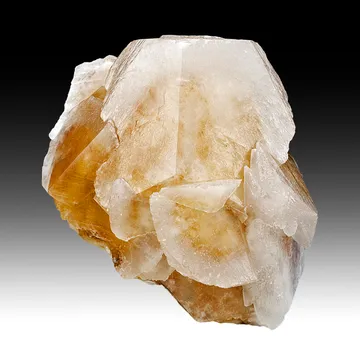
Sweetwater Mine, Missouri: a Viburnum Trend locality famed for sculptural calcite prisms, brassy chalcopyrite, and lead-gray galena, prized by collectors.
Key facts
Sweetwater Mine is one of the great specimen localities of the Viburnum Trend, the “New Lead Belt” of southeast Missouri. It is an active underground Mississippi Valley-type lead-zinc-copper mine near Ellington in Reynolds County, developed in Upper Cambrian carbonate rocks of the Bonneterre Formation where ore fluids moved through permeable dolomite, algal boundstone, oolitic grainstone, collapse breccias, and fault-prepared ground above and around Precambrian basement highs. To the economic geologist, Sweetwater is a textbook case of lead-rich MVT mineralization cut by structural complications along the Ellington fault zone; to the collector, it is the source of some of America’s most recognizable calcite-galena-chalcopyrite-dolomite combinations.
The mine’s signature specimens are sculptural rather than merely crystallized: yellow to amber calcite prisms and scalenohedra rising from breccia and dolostone matrix; flashing brassy to rainbow-tarnished chalcopyrite dusting the matrix like metallic glitter; heavy lead-gray galena cubes, cuboctahedra, and octahedra; and pale dolomite rhombs that soften the palette. The best Sweetwater pieces have a distinctly Missouri look—thick, architectural, high-contrast, and often displayable from several angles. They are not delicate alpine miniatures; they are products of a large industrial orebody, and the finest examples carry that sense of depth, weight, and underground scale.
Regional View
Country View
Sweetwater’s mineralogical personality is unusually broad for a lead-zinc mine. Galena and sphalerite are the principal ore minerals, with chalcopyrite giving the locality its copper accent; but the collector suite also includes calcite, dolomite, pyrite, marcasite, quartz, anhydrite-related casts, nickel-cobalt thiospinels, copper sulfides, and bituminous hydrocarbons. That range reflects the Viburnum Trend’s repeated pulses of mineralizing fluid rather than a single simple event. In cabinet specimens, the story is visible: one generation is covered by the next, calcite grows over sulfides, chalcopyrite tarnish rims and sparkles over older faces, and some galena crystals record a full spectrum from dominantly octahedral to dominantly cubic habits.

Photo: Wikimedia Commons
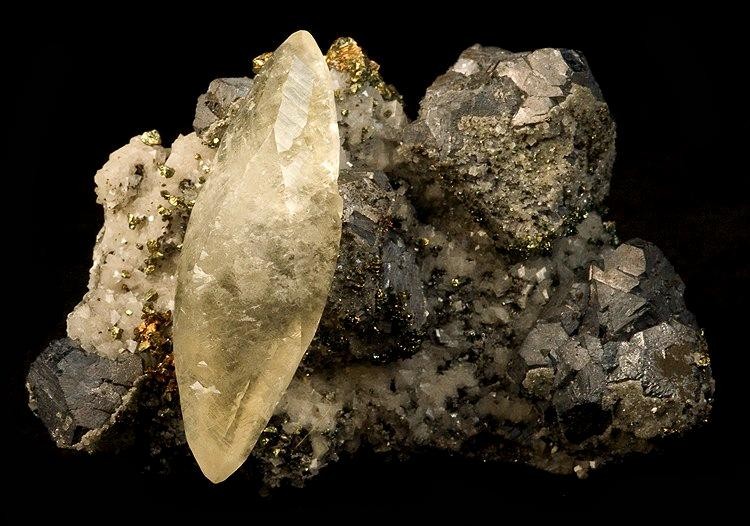
Photo: Wikimedia Commons
Search for specimens: View all specimens from Sweetwater Mine, USA
Sweetwater Mine is in southwestern Reynolds County, Missouri, roughly northwest of Ellington and south of the main cluster of Viburnum Trend mines. It has also appeared under several historical or local names: Ozark Lead Company Mine, Frank R. Milliken or Milliken Mine, Adair Creek Mine, Blair Creek, and Logan Creek. Those older names matter to collectors because early labels can be confusing; a specimen marked “Milliken,” “Ozark Lead,” or even broadly “St. Joseph Lead District, Missouri” may belong to the same Sweetwater lineage if the mineral association and provenance fit.
The deposit is a carbonate-hosted Mississippi Valley-type Pb-Zn-Cu system in the Bonneterre Formation, part of the Cambrian sequence above the Lamotte Sandstone and Precambrian crystalline basement. In the Viburnum Trend model, mineralizing brines moved through the Lamotte and into favorable Bonneterre carbonate facies, rising around basement knobs and reacting with permeable, brecciated, or chemically prepared zones. At Sweetwater, the ore deposit lies over local basement protrusions and is strongly influenced by the northwest-trending Ellington fault zone. The Sweetwater and Suses Branch faults divide the deposit into multiple orebodies, and studies of mine exposures have documented pre-ore and post-ore strike-slip movement. For collectors, that structural complexity helps explain why the mine has produced such varied pockets, from calcite-rich vugs to galena-heavy ore and unusual nickel-cobalt sulfide associations.
The orebodies are not narrow vein shoots in the classic hard-rock sense. They are stratabound and replacement-style zones in favorable Bonneterre beds, with ore shoots developed through dolomite and limestone units, breccia, algal boundstone, oolitic grainstone, and related porous or fractured horizons. Galena is the dominant lead mineral, sphalerite the zinc mineral, and chalcopyrite the conspicuous copper mineral; pyrite, marcasite, dolomite, calcite, and quartz belong to the broader gangue and accessory suite. The Viburnum Trend is notable among MVT districts for nickel and cobalt minerals as well as copper-iron sulfides, and Sweetwater is one of the localities where that more complex chemistry becomes visible in collector specimens.
The Sweetwater orebody was discovered during the great Viburnum Trend exploration boom of the 1950s and 1960s. Bear Creek Mining Company, the exploration arm of Kennecott Copper, drilled the discovery hole in 1962; contemporary accounts also describe Kennecott finding the southern orebody at depth in January 1964. Production began in 1968 under Ozark Lead Company. The mine was placed on standby in 1983 during depressed lead prices, sold to ASARCO in 1986, and restarted in December 1987. It was later acquired by The Doe Run Company in 1997 and remains part of Doe Run’s Southeast Missouri mining and milling operations.
Mining has used underground room-and-pillar methods, with drilling and blasting, load-haul-dump equipment or mine trucks, underground crushing, and hoisting through a deep multi-compartment shaft. Modern Doe Run operations in the Viburnum Trend produce lead, zinc, and copper concentrates, separated by milling and flotation. Sweetwater Mine/Mill remains a regulated industrial site, with state wastewater permitting and metallic-mineral waste permits covering the active mine and tailings facilities. It is not a fee-collecting locality and should not be approached as a field-collecting destination. Specimens reach collectors through miners, mine-approved channels, older collections, dealers, and secondary-market dispersals.
Collector labels most often mention Sweetwater generally, but some better-provenanced specimens record specific areas such as the south orebody, J-19, J-19 West Orebody, F-5, and Cemetery Ridge Development. The south orebody is especially important in the galena literature: hundreds of galena specimens from that area were collected and measured in a detailed study of crystal morphology. The J-19 area has produced notable calcite, galena, chalcopyrite, and dolomite combinations, including large double-terminated calcites and showy breccia-matrix plates. Cemetery Ridge Development material appears in recent dealer inventories, especially as calcite specimens on dolomite-rich matrix.
Sweetwater’s specimen production has been episodic, as one would expect from a working mine. Industrial ore production does not preserve crystals by default; pockets survive only when someone recognizes them, has the opportunity to extract them, and can remove them without the shock and abrasion that normally accompany mining. That is why the best Sweetwater pieces often combine the aesthetic immediacy of freshly opened pockets with the scars of their industrial setting: minor cleaves on calcite points, bruised galena corners, abraded chalcopyrite coatings, or matrix trimmed from a much larger ore block.
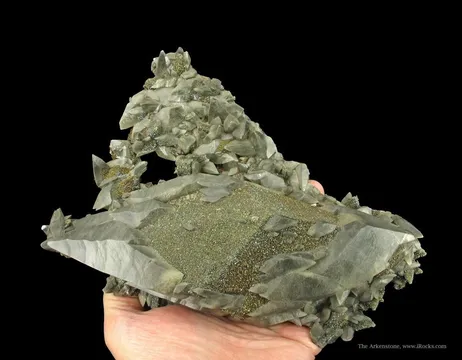
Calcite is the visual flagship of Sweetwater Mine, occurring as yellowish white to golden, amber, tan, gray, and locally very dark scalenohedra, hexagonal prisms, nailhead forms, steep rhombohedra, doubly terminated crystals, parallel-growth sprays, phantom crystals, and the overlapping “dragon scale” habit that made the locality famous far beyond specialist circles. Documented crystals reach several centimeters routinely, with exceptional display pieces far larger; one well-provenanced J-19 specimen carried a 23 cm double-terminated calcite, and dealer records describe black chalcopyrite-included calcite groups to 30 cm across and museum-sized plates. Associations are classic Sweetwater: galena, chalcopyrite, dolomite, sphalerite, pyrite, marcasite, and breccia or dolostone matrix. Good pieces have sharp terminations, translucency or internal phantoms, clean separation from matrix, lively chalcopyrite contrast, and minimal cleaving; ordinary pieces are common as yellow calcite clusters, but elite Sweetwater calcites stand apart by sculptural balance, deep color, strong provenance, or that unmistakable chalcopyrite-darkened “scale” texture.
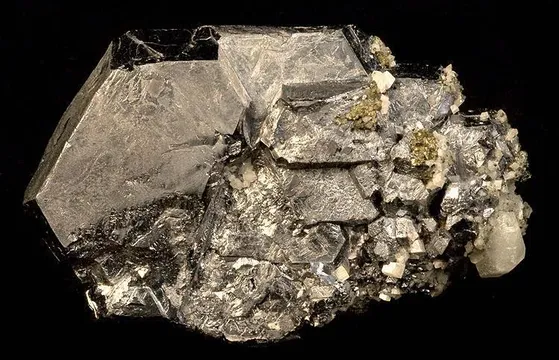
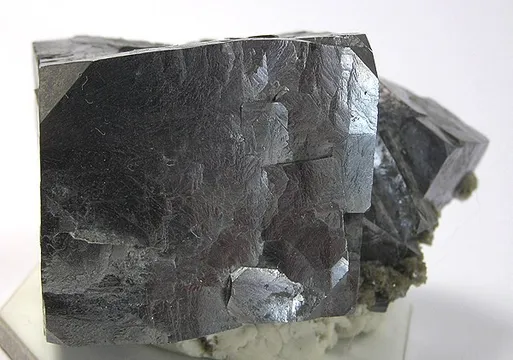
Galena from Sweetwater is one of the locality’s most studied and most collectible minerals, occurring as lustrous lead-gray cubes, cuboctahedra, octahedra, compound octahedral groups, modified cubes, arborescent or dendritic textures, and locally very large crystals on limestone, dolostone, breccia, dolomite, calcite, quartz, sphalerite, and chalcopyrite. Research on more than 400 well-crystallized specimens from the south orebody showed a continuous range of main-stage cuboctahedral forms from almost pure octahedral development toward dominantly cubic crystals, and collectors can often recognize that spectrum by eye. Sweetwater galena ranges from small bright crystals on calcite-rich plates to cabinet specimens with crystals several centimeters across; the best examples combine mirrorlike cubic faces or sharp octahedral form with undamaged corners, minimal dulling, and an aesthetic matrix of yellow calcite, white to pinkish dolomite, and sparkling brassy chalcopyrite. Octahedral Sweetwater galena is scarcer than the more familiar cubes and is especially desirable when isolated and pristine.
Chalcopyrite gives many Sweetwater specimens their sparkle and much of their market appeal, appearing as bright brassy microcrystals, subhedral crystals, platy to multi-twinned aggregates, coatings on galena or matrix, and naturally iridescent patches flashing gold, purple, blue, and green. It is a major accessory in the mine’s collector suite and a minor economic copper mineral in the broader ore assemblage, typically associated with calcite, dolomite, galena, sphalerite, pyrite, marcasite, siegenite, and copper sulfides. On fine cabinet pieces, chalcopyrite may form a glittering carpet beneath or around calcite, accent dolomite rhombs, coat galena crystals, or occur as inclusions that create dark phantoms and black “dragon scale” calcite. The best Sweetwater chalcopyrite specimens are not merely tarnished brassy patches; they show lively, natural-looking iridescence, crisp crystals, strong contrast with pale carbonate matrix, and no obvious artificial acid-coloring or oily surface enhancement.
Pyrite at Sweetwater is less often the headline mineral than calcite or galena, but it is a real and important part of the locality’s paragenesis, occurring with calcite, marcasite, galena, chalcopyrite, sphalerite, dolomite, quartz, and altered sulfate-related cavities. Collector references note pyrite both as crystals and as casts after anhydrite or gypsum, while calcite phantoms may be outlined by minute marcasite and pyrite inclusions. Sweetwater pyrite specimens are valued when they show sharp form, good luster, contrast against carbonate matrix, or interpretive interest as pseudomorphic or phantom-producing material; common small grains and dull sulfide crusts are far less appealing. Because pyrite and marcasite can be visually similar in small Sweetwater associations, well-labeled specimens or pieces with obvious cubic pyrite habit carry extra confidence.
Dolomite at Sweetwater is both a host rock and a specimen mineral, most often seen as white, cream, gray, or faintly pink rhombohedral microcrystals and small rhombs coating breccia or dolostone matrix beneath calcite, galena, and chalcopyrite. It is not usually collected here as large standalone crystals; its importance lies in composition, contrast, and texture. Fine Sweetwater combination pieces often use dolomite as the pale crystalline ground on which golden calcite, lead-gray galena, and iridescent chalcopyrite sit, and labels frequently describe dolomite microcrystals or rhombs only a few millimeters across. The best dolomite-bearing specimens have clean, sparkling, undamaged carbonate carpets with well-spaced sulfides and calcite rather than chalky, bruised, or iron-stained matrix; fluorescence can add interest, with dolomite-rich matrix reported as cream-colored under midwave ultraviolet in some specimens.
Marcasite from Sweetwater is documented as fine cockscomb crystals and as minute inclusions or drusy material associated with calcite, pyrite, galena, dolomite, and chalcopyrite. It is most familiar to collectors as a subordinate but character-giving mineral: small metallic blades or combs on matrix, gray drusy coatings near calcite, or internal phantom-forming particles that darken or outline calcite growth stages. Showy marcasite-only Sweetwater specimens are much scarcer than calcite-galena combinations, and good examples need crisp bladed form, bright metallic luster, and stable condition. Ordinary material is easily overlooked or confused with pyrite or tarnished chalcopyrite, so locality-specific association and morphology matter; any marcasite-rich Sweetwater specimen should also be watched for long-term stability, especially if it shows powdering, sulfurous odor, or white sulfate bloom.
Anhydrite is not a common showpiece mineral from Sweetwater, but sulfate influence is recorded in the mine’s specimen suite through pyrite casts after anhydrite or gypsum and the broader MVT setting in which evaporite-derived brines are central to mineralizing models. Collectors should think of Sweetwater anhydrite less as freestanding blue or white crystals and more as a paragenetic clue: former sulfate crystals or cavities that later served as molds, growth sites, or textures preserved by pyrite and carbonate minerals. The most desirable anhydrite-related Sweetwater pieces are therefore interpretive pseudomorphs or casts with recognizable original form, good pyrite coverage, and clear association with calcite, dolomite, galena, or chalcopyrite. Because anhydrite can hydrate to gypsum and because old labels may use “gypsum” and “anhydrite” loosely, cautious identification is warranted unless the specimen has strong provenance or analytical support.
Quartz is a minor but documented Sweetwater mineral, occurring as clear to smoky crystals or drusy quartz in association with galena, calcite, chalcopyrite, dolomite, sphalerite, and nickel-cobalt sulfides. It is not the species that made the mine famous, yet it can be important in paragenetic and aesthetic specimens: galena with quartz is documented from collector references, and a notable Sweetwater siegenite specimen was described on a bed of calcite and quartz with chalcopyrite. The best quartz-bearing pieces from the locality are those where the quartz is visibly crystallized, transparent to smoky, and integrated into a broader Sweetwater association rather than anonymous pale druse on dolostone. Small clear crystals on sulfide-rich matrix are more convincing than isolated quartz lacking the mine’s characteristic galena-calcite-chalcopyrite context.
Beyond the headline species, Sweetwater’s documented suite includes sphalerite, bornite, chalcocite, covellite, digenite, anilite, djurleite, carrollite, fletcherite, millerite, polydymite, siegenite, vaesite, erythrite, malachite, dickite, and bituminous petroleum or anthraxolite-like material. Djurleite is especially notable here because well-formed crystals have been reported to about 0.75 inch, while siegenite is recorded as octahedra to several millimeters and polydymite as acicular crystals to about 12 mm. Sweetwater itself is not the type locality for fletcherite—the type locality is the nearby Fletcher Mine in the same Reynolds County district—but fletcherite is documented from Sweetwater and belongs to the unusual nickel-cobalt-copper thiospinel story that separates the Viburnum Trend from many simpler MVT districts. These rarities are seldom obvious to the naked eye on ordinary specimens; they are most meaningful when confirmed, well-labeled, and preserved in their natural sulfide associations.
Sweetwater is a working mine, not a public collecting site. Modern access is controlled by the operator, and specimens should be acquired through established mineral dealers, mine-connected provenance, or older collections rather than by attempting to enter or collect on the property. Labels with specific areas—south orebody, J-19, J-19 West Orebody, F-5, Cemetery Ridge Development—are worth preserving, as they add geological and market value.
The most common locality problem is not deliberate fraud but vague or inherited labeling. Sweetwater material may be confused with other Viburnum Trend mines such as Brushy Creek, Fletcher, Buick, West Fork, and Magmont, especially when the specimen is simply calcite, chalcopyrite, dolomite, and galena on carbonate matrix. Older labels may say Milliken Mine, Ozark Lead Company Mine, Adair Creek Mine, or a broad “Missouri Lead Belt” attribution. Those can be legitimate, but they need context. A Sweetwater attribution is strongest when it comes with older dealer provenance, a recognized collection label, a specific mine area, or a combination habit closely matching known Sweetwater finds.
Condition is central. Calcite terminations are easily cleaved, bruised, or internally fractured during extraction; a specimen may still be attractive, but sharp unchipped points and intact double terminations command a premium. Galena is heavy and soft enough to show edge bruising, corner knocks, dulling, and cleavage damage. Chalcopyrite coatings can be rubbed, chemically altered, or artificially brightened. Dolomite microcrystals can lose sparkle through dust, abrasion, or cleaning residue. Sweetwater pieces are often dense; large specimens should be supported from the matrix, not by individual calcite crystals or galena groups.
Artificially induced chalcopyrite iridescence is a known issue across the mineral market. Sweetwater can produce naturally colorful chalcopyrite, but collectors should be cautious of surfaces that look uniformly neon, oily, acid-bright, or inconsistent with protected areas of the specimen. Natural iridescence is often patchier and tied to crystal surfaces, exposure, and microtexture. Strong provenance matters when high prices are being asked primarily for “rainbow” color.
The black or very dark “dragon scale” calcites are among the most sought-after Sweetwater specimens, but the same popularity invites loose marketing. The dark color is generally attributed to dense chalcopyrite inclusions or sulfide-rich phantoms within otherwise calcitic growth, not to a separate exotic species. True Sweetwater “dragon scale” pieces should show overlapping individual calcite crystals, multigenerational growth, and credible provenance. Similar-looking blackened calcite or treated calcite from elsewhere should not be accepted on appearance alone.
Fluorescence is a real additional collecting point at Sweetwater. Calcite has been reported as dull orange under shortwave and longwave ultraviolet, and magenta-pink under midwave; specific specimens have shown bright pink midwave fluorescence, weak red longwave and shortwave responses, and short-lived phosphorescence in some zones. Dolomite-rich matrix may show a cream response under midwave. Because responses vary by growth zone and trace activators, fluorescence should be described from the individual specimen rather than assumed for all Sweetwater calcite.
Marcasite-bearing pieces require conservative storage. Keep them dry, avoid rapid humidity changes, and inspect periodically for deterioration. Galena and other lead sulfides should be handled sensibly: wash hands after handling, avoid generating dust, and do not use them in settings where children may mouth or abrade specimens. Cleaning should be minimal; aggressive acids can damage carbonates and alter chalcopyrite appearance.
Market availability is better than for many classic underground localities because Sweetwater has produced abundant calcite and combination material over decades and remains represented in modern dealer stock. Common small to cabinet calcite-chalcopyrite-dolomite pieces are regularly available. The real scarcity begins with undamaged cabinet and large-cabinet specimens, strong galena crystals, specific orebody provenance, older 1970s-1980s collection pieces, south orebody octahedral galena, confirmed nickel-cobalt rarities, and large black “dragon scale” calcite groups in excellent condition.
One of the most memorable Sweetwater stories is not about a delicate pocket but about scale. In collector lore and locality summaries, a galena cube reportedly found in 1971 weighed about 1,000 kg and was reduced to ore. It is the kind of detail that makes a specimen collector wince: a crystal that, if saved intact, would have become an almost absurd monument to the Viburnum Trend’s lead-rich mineralization. The story also explains why surviving Sweetwater galena specimens can feel like fragments of something much larger. The mine was built to produce metal, not museum pieces, and some of its most spectacular crystals almost certainly disappeared into the mill.
The south orebody yielded a more scientific kind of treasure. More than 400 well-crystallized galena specimens were collected there for a detailed study of morphology. Instead of treating “Sweetwater galena” as a single look, the work measured the relative development of octahedral and cubic faces and showed a continuous range of cuboctahedral forms. Some were almost wholly octahedral; others leaned strongly toward the cube. In the field of view of a hand lens, that means a Sweetwater galena crystal can be read as a record of changing fluid conditions and growth environment, not just a gray metallic cube on limestone.
The J-19 area has become a quiet provenance marker among serious collectors. A 2014 J-19 pocket produced at least one remarkable specimen with a 23 cm double-terminated calcite and two phantom clusters beneath it, later trimmed from excess matrix to make a more balanced display piece. Other J-19 West Orebody pieces include large breccia-matrix combinations with golden calcite to several centimeters, iridescent chalcopyrite, dolomite, and major galena crystals. The labels matter because “Sweetwater Mine” alone covers a complex underground operation; “J-19” narrows the story to a real collecting horizon within the mine.
The black calcite find—marketed widely as “dragon scale” calcite—shows how quickly an industrial mine can produce a pop-cultural mineral icon. These specimens are built from overlapping calcite crystals, each scale an individual crystal overgrowing an earlier generation. The darkness comes from heavy chalcopyrite inclusions or internal sulfide phantoms, creating a reptilian armor effect that looks almost too theatrical to be natural. Yet the very best pieces are also technically fragile: large, lustrous, scalenohedral groups can be heavily damaged during extraction. One dealer description of a major black Sweetwater calcite pocket estimated that about 98 percent of specimens from the pocket were recovered damaged, which explains why intact large examples command so much attention.
Sweetwater fluorescence has its own quieter drama. A studied calcite specimen showed two visually and luminescently distinct zones: larger yellowish-brown truncated calcite crystals on dark-gray limestone, and a lower zone of minute white steep scalenohedral calcite associated with poorly formed galena and subhedral chalcopyrite. Under midwave ultraviolet, the upper calcite gave an unexpected magenta response rather than the more usual red-orange; the lower calcite produced cream-white responses and measurable phosphorescence, with midwave afterglow lasting longer than the other wavelengths. For a mine known mostly for bold daylight specimens, that study added another layer: Sweetwater calcite can be read by ultraviolet as well as by form.
Mouat, M. M., and Clendenin, C. W. Jr. (1975), “Ozark Lead Company Mine, Viburnum Trend, Southeast Missouri,” in Guidebook to the Geology and Ore Deposits of Selected Mines in the Viburnum Trend, Missouri, Missouri Geological Survey Report of Investigations 58, pp. 48–56. A key early guidebook treatment of the Ozark Lead/Sweetwater mine geology.
Mouat, M. M., and Clendenin, C. W. (1977), “Geology of the Ozark Lead Company Mine, Viburnum Trend, Southeast Missouri,” Economic Geology, 72(3), 398–407. The classic mine-scale geological paper for Sweetwater’s former Ozark Lead operation.
Clendenin, C. W. (1977), “Suggestions for Interpreting Viburnum Trend Mineralization Based on Field Studies at Ozark Lead Company, Southeast Missouri,” Economic Geology, 72(3), 465–473. An important interpretation of mineralization based directly on Sweetwater/Ozark Lead field observations.
Roedder, E. (1977), “Fluid Inclusion Studies of Ore Deposits in the Viburnum Trend, Southeast Missouri,” Economic Geology, 72(3), 474–479. A fluid-inclusion study central to understanding Viburnum Trend ore-forming brines.
Craig, J. R., and Carpenter, A. B. (1977), “Fletcherite, Cu(Ni,Co)2S4, a New Thiospinel from the Viburnum Trend (New Lead Belt), Missouri,” Economic Geology, 72(3), 480–486. The original fletcherite description; Sweetwater is a documented occurrence of this related Viburnum Trend thiospinel.
Sun, Y. (1996), “Classification and Spatial Distribution of Galena Crystals at the Sweetwater Mine, Viburnum Trend, Southeast Missouri, U.S.A.,” in Carbonate-Hosted Lead-Zinc Deposits: 75th Anniversary Volume, Society of Economic Geologists Special Publication 4. The major study of more than 400 Sweetwater south-orebody galena specimens and their crystal morphology.
Hagni, R. D. (2018), “Platy Galena from the Viburnum Trend, Southeast Missouri: Character, Mine Distribution, Paragenetic Position, Trace Element Content, Nature of Twinning, and Conditions of Formation,” Minerals, 8(3), 93. Places Sweetwater galena textures within the broader Viburnum Trend galena story.
Crocetti, C. A., Holland, H. D., and McKenna, L. W. (1988), “Isotopic Composition of Lead in Galenas from the Viburnum Trend, Missouri,” Economic Geology, 83(2), 355–376. A lead-isotope study including Viburnum Trend galenas.
Sherwood, M. D., and Williams, G. A. (1998), “Missouri Mineral Locality Index,” Rocks & Minerals, 73(2), 98–117. A useful Missouri locality index that documents Sweetwater mineral occurrences in the state collector literature.
Harris, Calvin (2024), “Luminosity of a Calcite Specimen from the Sweetwater Mine, Ellington, Reynolds County, Missouri,” Friends of Mineralogy Midwest Chapter Newsletter, 39(5), September–October 2024. A focused collector study of fluorescence, phosphorescence, and brief intense phosphorescence in a Sweetwater calcite specimen.
Mindat: Sweetwater Mine, Ellington, Reynolds County, Missouri, USA — Core locality page with mineral list, coordinates, historical names, and reference bibliography.
USGS Scientific Investigations Report 2008-5140: Hydrologic Investigations Concerning Lead Mining Issues in Southeastern Missouri — Includes a concise history of Sweetwater Mine and its mill/tailings setting.
USGS Scientific Investigations Map 3280: Bedrock Geologic Map of the Spring Valley, West Plains, and Parts of the Piedmont and Poplar Bluff Quadrangles, Missouri — Valuable regional geologic context for the Ellington fault zone, basement highs, and Sweetwater deposit geometry.
Doe Run: Mining & Milling — Current operator overview of Viburnum Trend mining, milling, flotation, and underground methods.
Missouri Department of Natural Resources: Issued Metallic Mineral Waste Management Permits — Regulatory context for Sweetwater Mine’s permitted tailings and waste-management site.
Missouri Department of Natural Resources: Site-Specific Wastewater Permits — Shows the operating wastewater permit status for the Doe Run Sweetwater Mine/Mill site.
Bureau of Land Management: Doe Run Company Plan of Operation Approval Project — Public NEPA project page for recent Viburnum Trend mine-plan approvals and lease-renewal context.
Wikimedia Commons: Chalcopyrite and Calcite, Sweetwater Mine — Freely licensed photograph showing the classic calcite-chalcopyrite look.
Wikimedia Commons: Calcite-Galena-Chalcopyrite-Dolomite, Sweetwater Mine — Freely licensed image of an older collection combination specimen.
Fluorescent Mineral Society FMDB: Calcite Crystals with Internal Phantoms, Sweetwater Mine — Useful ultraviolet-response record for Sweetwater phantom calcite.
Richard Gunter Catalogue: Galena — Collector-oriented discussion of Sweetwater/Milliken galena, old labels, and associated species.
Minerals, 2018: Platy Galena from the Viburnum Trend — Open-access paper on Viburnum Trend galena forms, including Sweetwater references.
.jpg)
