A collector's guide to Viburnum Trend Mining District, USA: its geology, mining history and notable minerals, illustrated with the 76 specimens documented from this locality on EarthWonders.
Key facts
The Viburnum Trend is the modern collector’s face of Missouri lead: a long, narrow, deeply mined belt of Mississippi Valley-type Pb-Zn-Cu-(Ag) ore bodies cutting through the forested Ozarks of southeastern Missouri. Its great specimens came not from shallow diggings or weathered dump seams, but from active underground lead mines driven through the Upper Cambrian Bonneterre Dolomite, where ore fluids exploited reef facies, solution-collapse breccias, porous grainstones, faults, and open cavities along the western flank of the St. Francois Mountains. For collectors, that geologic setting matters because it produced not only enormous tonnages of galena ore, but also unusually handsome vug-grown specimens: gunmetal-gray galena cubes and spinel-twinned plates, sharp calcite scalenohedrons, pinkish to cream dolomite rhombs, brassy to iridescent chalcopyrite, marcasite, pyrite, sphalerite, and cobalt-nickel sulfides.
Historically, the district marks the handoff from Missouri’s famous Old Lead Belt to the “New Lead Belt.” St. Joe drilled the discovery hole near Viburnum in 1955, and the first ore from the No. 27 mine was shipped in mid-1960. By the early 1970s the Viburnum Trend had become the dominant American lead district, and it remains an active industrial mining belt rather than a recreational collecting area. That active-mining origin explains the character of the specimens: many are mine-run classics saved from stopes, pockets, watercourses, clay-filled cavities, and ore faces by miners, geologists, and contracted collectors when safety, timing, and management permission allowed.
Regional View
Country View
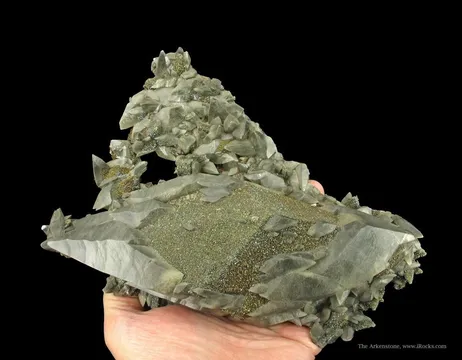
The best Viburnum Trend pieces have a look that is immediately recognizable: dense, metallic lead-gray crystals rising from pale dolomite or calcite; calcite “dogtooth” and nailhead crystals dusted or internally brightened by chalcopyrite; marcasite and pyrite adding a glittering late-stage skin; and, on the finest combinations, just enough contrast between silver-gray, cream, gold, amber, and iridescent colors to keep the specimen from reading as simply “ore.” The district is especially strong in cabinet-sized sulfide specimens, but it also produced miniatures with extraordinary composition, including delicate calcites, platy galena, siegenite on dolomite, and pocket specimens from named finds such as Brushy Creek’s Stope 72B30 and Fletcher’s Big Bear and Rainbow Pocket material.

Photo: Wikimedia Commons
Search for specimens: View all specimens from Viburnum Trend Mining District, USA
The Viburnum Trend is a carbonate-hosted Mississippi Valley-type lead-zinc-copper district in southeastern Missouri, developed principally in Iron, Reynolds, Washington, Crawford, Dent, and Shannon counties. The mineralized belt is commonly described as about 45 miles long in older Missouri Geological Survey literature, with later summaries placing the broader trend at roughly 70–75 km, aligned mostly north-south along the western side of the St. Francois Mountains. The main host is the Cambrian Bonneterre Dolomite above the Lamotte Sandstone and below less permeable Cambrian units, especially the Davis Formation, which helped confine mineralizing brines within favorable lower carbonate facies.
The geologic trap is not a simple vein. Ore was focused by a combination of stratigraphy, paleotopography, porosity, reef and grainstone facies, collapse breccias, and basement-controlled structures. The Bonneterre Formation laps onto buried Precambrian granite-rhyolite highs around the St. Francois Mountains; in places, Cambrian carbonates and clastics draped over these knobs, creating steep local dips, pinchouts, permeable zones, and breccias. In the mines, ore occurs as disseminations in dolomite, open-space fillings, breccia cement, replacements along bedding planes, and mineralized fracture systems. Missouri DNR summarizes the orebodies as generally north-south trending, tabular to sinuous, averaging about 1,200 feet deep, commonly 30–85 feet thick, and 200–2,000 feet wide. Individual mines have been reported in the tens of millions of tons, with ore containing up to about 8% galena and several percent sphalerite.
The principal ore minerals are galena and sphalerite, with chalcopyrite as the major copper sulfide. The collector assemblage is broader: calcite, dolomite, quartz, marcasite, pyrite, chalcopyrite, sphalerite, siegenite, bravoite, millerite, covellite, bornite, digenite, djurleite, polydymite, vaesite, gersdorffite, tennantite, enargite, and rare thiospinels occur in parts of the district. Economic-geology studies emphasize repeated pulses of mineralization rather than a single event; galena and sphalerite were deposited in multiple generations, and later vug-filling stages produced many of the clean crystals collectors prize.
Mining began with the No. 27 mine in mid-1960 after St. Joe’s 1955 discovery hole and the early-1950s search for replacements for declining Old Lead Belt reserves. The pace was extraordinary: by the mid-1960s major orebodies along the trend had been delineated, and by 1970 new mines, mills, smelters, and a railroad link had transformed a rural Ozark belt into one of the world’s great lead-producing regions. Major mines and units include Viburnum No. 27, No. 28, No. 29, No. 35/Casteel, Magmont and Magmont West, Buick, Brushy Creek, Fletcher, West Fork, and Sweetwater, formerly the Ozark Lead mine. Operators historically included St. Joe Minerals, AMAX, Homestake, Asarco, Cominco American, Dresser Industries, Kennecott, and Ozark Lead; consolidation eventually left Doe Run as the principal operator in the district.
The current collecting situation should be understood plainly: the Viburnum Trend is not a public rockhounding locality. The important specimen mines are active, closed, reclaimed, regulated, or privately controlled underground operations. Federal hardrock mineral leases in parts of the district are administered through the Bureau of Land Management, and Doe Run’s recent mine-plan approvals concern continued industrial mining, exploration, processing, and related surface facilities—not public mineral collecting. Legitimate collector pieces reach the market through old collections, dealer purchases, miner- or geologist-saved material, estate dispersals, and occasional authorized recoveries from working areas.
Specimen pockets have been highly localized. Brushy Creek’s Stope 72B30 is the classic galena example: a clay- and rubble-filled solution cavity intercepted in 1995 about 1,000 feet below the surface, yielding several tons of galena specimens, including a 2,155-pound cluster displayed at Doe Run’s central office in Viburnum. Earlier Brushy Creek watercourse pockets produced yellowish and gray calcite crystals, some coated with iridescent marcasite. Buick is famed for galena, calcite, pyrite “bars,” and siegenite on dolomite; West Fork and Fletcher produced distinctive galena, marcasite, calcite, chalcopyrite, and dolomite combinations; Sweetwater is especially familiar to collectors for calcite, chalcopyrite, galena, dolomite, marcasite, and uncommon covellite and siegenite specimens.
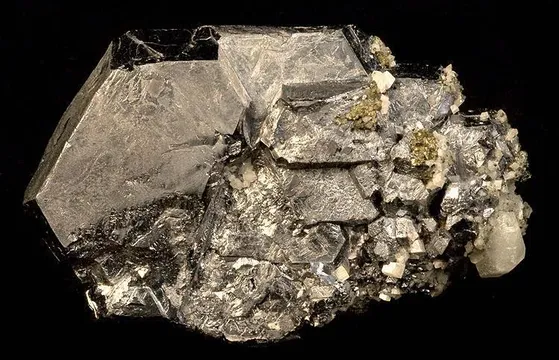
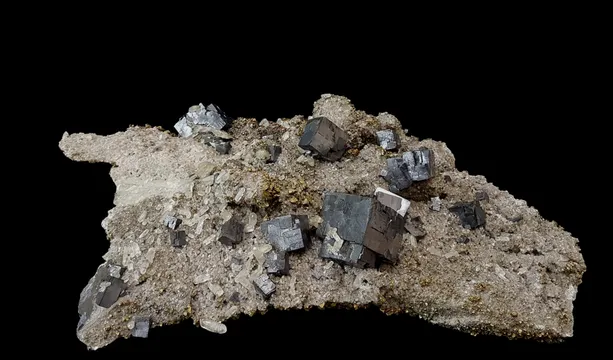
Viburnum Trend galena is the district’s defining mineral, occurring as bright metallic gray cubes, cuboctahedrons, octahedrons, modified crystals, spinel-twinned plates, skeletal to dendritic forms, and massive “steel galena” ore textures in special settings. Good collector crystals range from small sharp individuals of a few millimeters to cabinet pieces with 1–5 cm crystals, while exceptional pocket material includes much larger clusters, especially from Brushy Creek’s Stope 72B30. Associations are part of the value: galena on cream or pinkish dolomite, with calcite scalenohedrons, chalcopyrite, marcasite, pyrite, and sphalerite, is more desirable than broken ore-only masses. The most important pieces show sharp crystal form, high luster, minimal cleavage bruising, and a confident mine attribution—Buick for classic spinel-twinned and matrix pieces, Brushy Creek for Stope 72B30 and large pocket galena, West Fork and Fletcher for sharp cuboctahedral to unusual forms, Sweetwater for galena in calcite-chalcopyrite-dolomite associations, and Magmont for the platy galena specimens studied in detail by Richard Hagni.
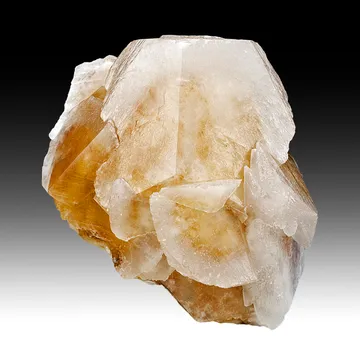
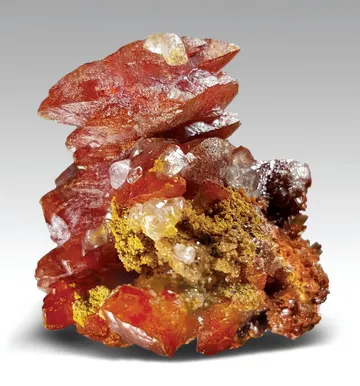
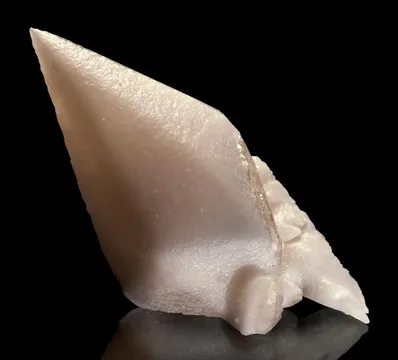
Calcite from the Viburnum Trend is a true co-star rather than merely gangue, with sharp scalenohedrons, doubly terminated crystals, nailhead-like forms, hexagonal crystals, pale amber to yellowish and gray crystals, and translucent crystals carrying inclusions or phantoms produced by chalcopyrite and marcasite. Sweetwater is especially well known for dogtooth and nailhead calcite on dolomite, galena, and iridescent chalcopyrite, while Brushy Creek produced memorable calcite from watercourse pockets and 1989-style calcite pieces coated by red, yellow, and brassy microcrystals of chalcopyrite and marcasite. West Fork and Fletcher add fine calcite perched on galena and dolomite, including pieces where a single scalenohedron dominates the composition. Top specimens have undamaged terminations, visible internal phantoms or metallic inclusions, strong contrast against sulfides, and an architectural placement that avoids the common problem of calcite being present only as cleaved accessory blades.
Viburnum Trend marcasite is usually a late, sparkling accent mineral, but in the best pieces it becomes visually decisive: brassy microcrystals coating calcite faces, glittering crusts on galena, and sharp late-stage aggregates associated with dolomite, pyrite, chalcopyrite, and calcite. The district’s paragenesis varies by mine; No. 28-type material is noted for late marcasite and pyrite, Sweetwater produced octahedral galena completely coated by later marcasite on some specimens, and Brushy Creek calcites may show marcasite mixed with iridescent chalcopyrite on earlier scalenohedrons. Good marcasite specimens from here are crisp, bright, and stable-looking, with a clean textural relationship to the underlying galena or calcite; ordinary examples are dull gray crusts, damaged coatings, or material already showing oxidation, powdering, or acidic deterioration.
Dolomite in Viburnum Trend specimens forms the pale visual stage on which many of the sulfides perform: cream, tan, white, pinkish-white, and sometimes saddle-shaped rhombs lining vugs, coating galena, and covering dolostone matrix. It is abundant as both host and gangue, but collectible dolomite is most attractive when the rhombs are lustrous, evenly distributed, and contrasting against galena, siegenite, chalcopyrite, or marcasite. Buick produced fine dolomite-associated galena and siegenite pieces, including 1980s siegenite crystals set in pinkish-white saddle dolomite; Fletcher specimens can show dolomite casts after dissolved galena, a particularly district-specific texture tied to ore remobilization; and Sweetwater and Brushy Creek combinations often depend on dolomite for color balance. Fine pieces avoid the chalky, bruised, or massive look and instead show individual rhombs with clean geometry and clear relationships to the sulfide generations.
Pyrite is less common as a showy collector species than galena, calcite, or chalcopyrite, but the Viburnum Trend produced several distinctive styles: late pyrite with marcasite, small bright golden balls on galena from West Fork-type material, pyrite associated with Stope 72B30 galena at Brushy Creek, and the famous Buick “bar” pyrites from a 1970s pocket, some reportedly showing central holes consistent with stalactitic growth. Brushy Creek pyrite clusters can be large but are not common as isolated high-quality specimens, and the best pieces have strong metallic luster, clear individual crystals or botryoidal-spherical aggregates, and a balanced association with galena, dolomite, or chalcopyrite. Ordinary pieces are massive sulfide patches or dull granular pyrite lost in ore matrix; exceptional ones are those that make pyrite a visible, sculptural feature rather than a background sulfide.
Chalcopyrite is the district’s color-maker, ranging from brassy yellow crystals and disseminations to naturally iridescent coatings that flash gold, red, blue, purple, and green on calcite, galena, and dolomite. It is economically important in parts of the trend and especially prominent in Brushy Creek, Casteel, Fletcher, Buick, and Sweetwater material, with Brushy Creek noted for relatively abundant chalcopyrite and Fletcher for chalcopyrite bands at the base of galena mineralization as well as open-space euhedral crystals. Sweetwater and Brushy Creek calcite-chalcopyrite combinations are among the most recognizable Viburnum specimens, and Fletcher’s 2021 “Rainbow Pocket” material is prized for vivid iridescent chalcopyrite accents. Fine pieces show natural iridescence, distinct crystals or sparkling coatings, and strong contrast with pale calcite or dolomite; weaker examples are merely tarnished brassy films or indistinct coppery patches on broken ore.
Quartz is a lesser but real Viburnum Trend gangue mineral, occurring in vugs and open-space linings with dolomite and sulfides rather than as the dominant collector species. Economic-geology descriptions place quartz among the gangue minerals accompanying galena, sphalerite, chalcopyrite, dolomite, calcite, pyrite, and marcasite, and dealer-documented Sweetwater and Brushy Creek combinations show quartz-rich sparkling matrix supporting chalcopyrite, calcite, marcasite, and dolomite. The best quartz-bearing pieces from the district are valued for composition rather than for world-class quartz crystals: a clean drusy surface, sharp color contrast with iridescent chalcopyrite, or a textural bridge between sulfide ore and carbonate crystals. Ordinary pieces are easy to overlook because the quartz is small, colorless to gray, or masked by calcite and dolomite.
Other documented Viburnum Trend minerals include sphalerite, bornite, covellite, digenite, djurleite, chalcocite, millerite, polydymite, vaesite, gersdorffite, tennantite, enargite, bravoite, nickeliferous pyrite, nickeliferous carrollite, castaingite, dickite, and siegenite, the last of which is one of the district’s great small-crystal prizes when bright metallic crystals sit cleanly on pale dolomite. The most important type-locality mineral is fletcherite, CuNi2S4, named for the Fletcher mine, where it occurs as minute steel-gray thiospinel grains in copper sulfide-rich mineralization replacing dolomite, associated with vaesite, pyrite, covellite, chalcopyrite, bornite, and digenite. Recent mineralogical work has also drawn attention to newly identified sulfate minerals from the Viburnum Trend, reinforcing the district’s status as more than a galena locality: it is a chemically complex MVT system with a serious micro- and ore-mineralogy record.
Viburnum Trend specimens are generally recognizable, but labels matter. Many pieces entered the market as “Viburnum Trend” without a mine name because miners, dealers, and old collections often grouped material by district; a precise label—Buick, Brushy Creek, Sweetwater, Fletcher, West Fork, Magmont, Casteel, or Stope 72B30—is worth preserving. Be cautious of overconfident relabeling based only on appearance. Sweetwater calcite-chalcopyrite, Brushy Creek calcite, West Fork galena, and Fletcher galena-dolomite pieces can resemble one another, and broad district labels are often more honest than invented mine attributions.
The most common condition issue is sulfide damage. Galena is heavy, soft, and perfectly cleavable, so bright fresh cleavage faces, bruised cube corners, and broken attachment points are routine. Stope 72B30 galena is famous for large floater and near-floater clusters dug from clay, mud, and rubble, but even those specimens may show shiny cleavage scars caused during extraction. Calcite is easily cleaved and is often damaged at terminations or along edges; the most desirable pieces retain intact scalenohedrons or nailhead terminations. Dolomite rhombs chip, and marcasite or pyrite crusts can shed if handled roughly.
Marcasite deserves special storage attention. Keep marcasite-rich Viburnum specimens dry, stable, and away from dramatic humidity swings; deteriorating marcasite can produce acidic sulfate products that attack labels, boxes, neighboring sulfides, and the specimen itself. Pyrite is usually more robust but should be treated with similar caution. Calcite may fluoresce in some Viburnum Trend pieces where activators such as manganese and lead are present, but fluorescence is not the central reason to buy the locality; crystal aesthetics and sulfide associations matter more.
Chalcopyrite color is a special authenticity point. Viburnum Trend chalcopyrite is often naturally iridescent, especially in celebrated calcite and dolomite combinations, but the broader mineral market contains acid-treated “peacock ore” from other sources. On Viburnum pieces, look for iridescence that follows natural growth surfaces, microcrystal coatings, and pocket textures rather than an artificial, uniformly neon film. Strong color alone does not prove treatment, but a trustworthy label, old collection provenance, and natural distribution of the colors are important.
Rarity is uneven. Galena and calcite from the district remain readily available, especially as older collection material and dealer stock. Good, undamaged, well-composed cabinet specimens with accurate mine labels are scarcer. Platy galena, strong Sweetwater or Brushy Creek calcite-chalcopyrite combinations, Buick siegenite on dolomite, West Fork pyrite-on-galena, Fletcher Big Bear galena, and Stope 72B30 galena with strong form command greater attention. True fletcherite specimens are essentially micro- or ore-mineralogical material, not display pieces, and should be bought only with analytical or institutional-quality provenance.
In 1979, Brushy Creek miners broke into one of those underground spaces that every collector imagines but few ever see. A watercourse opened about six feet above the drift floor—large enough for a miner to crawl into—and it led into a crystal-lined pocket about 15 feet high, four feet wide, and 30 feet long. That would have been memorable enough, but near the drift opening a smaller crystal-lined tunnel connected to a far larger watercourse: up to 15 feet wide, 15 feet high, and more than 200 feet long. For the next few years, as mining advanced nearby, miners and mechanics visited the passage and collected the yellowish and gray calcites that became classic Brushy Creek material, many with faces coated in iridescent marcasite. Then mining moved on, the justification for being in that part of the mine disappeared, and the watercourse was left alone for a decade or more.
The story resumed in 1994, when Mike New and Joe Kielbaso secured a contract with the mine’s new owners to collect the old Brushy Creek area. In spring 1995, Les Presmyk joined Mike, Joe, and Mark Kielbaso for his first visit. No professional collectors had been in those watercourses for 10 to 15 years. The appeal of that episode is not simply that specimens were recovered, but that the locality was a real underground room—old, mineral-lined, half-forgotten, and known to miners long before it was known to the collector market.
A different Brushy Creek moment came on 27 February 1995 in Stope 72B30. About 1,000 feet below the surface, mining intersected an oval solution cavity roughly 25 feet wide, 15 feet high, and 15 feet deep, lined and partly filled with galena crystals. The blast that exposed it had already removed part of the original cavity, revealing the largest diameter at the face. The ceiling and walls were coated with galena; below, a breakdown pile of dolomitic mud, clay, rubble, boulders, and fallen crystal groups filled the lower half. The geology suggested an old tubular solution feature that had collapsed before humans ever entered it.
Doe Run recognized the specimen potential and allowed a salvage effort, but time was short because the stope still had to be mined. A team of geologists and managers collected for about a month. Most specimens were not simply plucked from sparkling walls; they were dug from mud and rubble, and large galena crystals and boulders had to be moved from the breakdown pile to reach the best material. Many crystal groups had grown or settled into interlocking contact, so removing one meant damaging another. That is why so many Stope 72B30 pieces show bright fresh cleavage faces. The cavity nevertheless yielded several tons of specimens, including a single 2,155-pound galena cluster that went on display in the lobby of Doe Run’s central office in Viburnum.
The Magmont platy galena story is quieter but just as memorable to a crystallographer. Richard D. Hagni’s 2018 study began with a single large Magmont specimen carrying an astonishing number of flat galena crystals—forms that look wrong if one expects galena to behave only as cubes and octahedrons. Close study showed roughly centimeter-scale plates, some with marginal indentations, leading to the interpretation that they were spinel-twinned octahedral galena formed early in the paragenesis before later quartz and cubic galena overgrew parts of the assemblage. Hagni checked the occurrence against the memories of present and former Viburnum mine geologists, including Larry Nuelle, Bill Clendenin, Bob Dunn, Bruce Ahler, Rick Dingess, Andy Childers, and George Moellering. Their experience narrowed platy galena to about half the mines—Magmont, Buick, Fletcher, Brushy Creek, and Sweetwater—while Casteel, West Fork, No. 27, No. 28, and No. 29 were not known to them for that habit. The chemistry then removed an easy explanation: trace Ag, Bi, Sb, and As were too low to make exotic impurities the obvious cause, leaving rapid growth under oversaturated conditions as the favored explanation.
The mining story behind the specimens is equally striking. By 1970, only a decade after the No. 27 mine began production, the Viburnum Trend had new mine-mill complexes, smelters, and a railroad connection. The last St. Joe operation in the Old Lead Belt shut down in October 1972, ending 108 years of St. Joe mining there, while Brushy Creek came fully online in November 1973. In 1974, southeast Missouri lead production reached 562,097 tons of metal in ores and concentrates, reported as 85 percent of U.S. mine output. That industrial scale is the hidden context behind the specimens: many of the finest pieces survived because geologists and miners recognized beauty in the middle of one of the world’s great lead-producing systems.