Brushy Creek Mine, USA - Viburnum Trend locality famed for gray calcite dogtooth crystals, iridescent sulfides, and deep-zone mineralization prized by collecto…
Key facts
Brushy Creek is one of the great modern specimen names of the Viburnum Trend: an active, industrial-scale lead-zinc-copper mine in Reynolds County, Missouri, whose most memorable collector pieces came not from a weathered surface dig but from deep underground openings in the Cambrian Bonneterre Dolomite. The mine sits in the central part of the trend, south of Buick and north of West Fork, in the world-class Southeast Missouri lead district. Its ore belongs to the Mississippi Valley-type family: low-temperature, sediment-hosted sulfide mineralization controlled by carbonate facies, permeability, dissolution, and the buried Proterozoic basement relief beneath the Bonneterre.
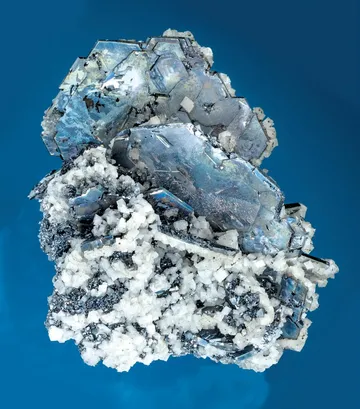
For collectors, Brushy Creek has a sharply defined personality. The classic specimen is gray to yellowish-gray scalenohedral calcite, often in spiky, translucent-to-opaque “dogtooth” groups, with internal phantoms and glittering sulfides. Iridescent marcasite and chalcopyrite may dust selected crystal faces, fill recessed areas, or appear as ghostly layers suspended within later calcite overgrowths. Good examples are architectural and three-dimensional: gray calcite blades and points rising from a metallic bronze-gold-green skin, with enough translucency to show the earlier crystal surface trapped inside.
Regional View
Country View
Brushy Creek also matters because it is not just another Viburnum calcite locality. Its orebody overlies buried Proterozoic knobs, and later work identified unusually deep, copper-, nickel-, cobalt-, and zinc-rich lower-zone mineralization near the Lamotte Sandstone-Bonneterre Dolomite contact. That lower ore zone added a scientific dimension to the locality beyond cabinet specimens: it showed that Brushy Creek preserved an atypical mineralizing episode below the district’s main lead-rich horizon.

Photo: Wikimedia Commons
The best Brushy Creek pieces occupy a special niche in American mineral collecting. They are neither the water-clear calcites of Elmwood nor the bright purple fluorites of Cave-in-Rock, but something more industrial and unmistakably Missouri: lead-district calcite with a metallic skin, born in a working mine more than a thousand feet underground, and recovered in major episodes that were unusually well remembered by the collectors who handled them.
Search for specimens: View all specimens from Brushy Creek Mine, USA
Brushy Creek Mine is at Greeley, Reynolds County, Missouri, in the Viburnum Trend mining district. The locality is commonly given in specimen labels as Brushy Creek Mine, Greeley, Viburnum Trend District, Reynolds County, Missouri, USA; older labels may use Oates, Viburnum, or simply “Brushy Creek mine, Reynolds Co.” The mine lies near the center of the Viburnum Trend, about 7 km south of Buick, and forms part of the long north-south belt of Southeast Missouri base-metal mineralization.
The deposit is a Mississippi Valley-type lead-zinc-copper system hosted chiefly by the Cambrian Bonneterre Formation, with the broader Viburnum Trend controlled by reef, grainstone, back-reef, and related carbonate facies developed around buried Precambrian highs. At Brushy Creek, the ore overlies three buried Proterozoic paleotopographic knobs. The larger central high trends northeast and rises close to the Davis Formation; smaller highs occur to the southwest and southeast. The distribution of ore is tied less to spectacular district-scale breccia bodies than to porosity and permeability in the Bonneterre, especially grainstone units.
The principal ore minerals are galena, sphalerite, and chalcopyrite, in a lead-dominant assemblage. Dolomite, calcite, pyrite, and marcasite are the main gangue minerals, with dickite and other minor phases in small voids. Lead mineralization is reported through the mine’s long north-south extent, and the orebody reaches its greatest width where the basement highs penetrate the Bonneterre. Unlike some neighboring mines, Brushy Creek does not show one simple mine-wide zonation pattern; sphalerite is closely associated with galena, while chalcopyrite can occur independently of either sphalerite or galena.
St. Joe Minerals brought the Brushy Creek mine and mill into full operation in November 1973, the same period in which production in the Old Lead Belt was ending and the Viburnum Trend was becoming the dominant American lead producer. Historical accounts list Brushy Creek as a 5,000-ton-per-day St. Joe operation in the mid-1970s. Later ownership passed into the Doe Run era, and modern references identify Brushy Creek Mine/Mill as a Doe Run operation. Doe Run’s own description of its Viburnum operations notes underground roadways linking Casteel, Buick, Brushy Creek, and Fletcher, underscoring that Brushy Creek is part of a large, integrated modern mining complex rather than an abandoned collector mine.
Access today should be treated accordingly. This is an active industrial mine and mill complex on controlled property, not a public collecting locality. Legal collecting depends on explicit company permission or formal arrangements; casual underground entry, dump collecting, or “just looking around” is neither appropriate nor safe. Most specimens reaching collectors came from mine-intersected cavities recovered by miners, employees, or contracted specimen-mining projects, especially the famous calcite-marcasite workings in the 106 drift area and the galena-producing Stope 72B30.
The most famous Brushy Creek specimen episode began when mine workings intersected watercourse cavities lined with calcite and marcasite. Material from these openings circulated for years, and a later professional collecting project in 1994-1995 recovered a large volume of specimens from the cavity system. Labels citing the 1100-foot level, 106 drift, N106 drift, or 106 North Stope are especially meaningful because they tie a specimen to this classic calcite-marcasite occurrence. A separate and highly important occurrence, Stope 72B30, produced exceptional galena, including very large clusters and spinel-law twinned crystals.
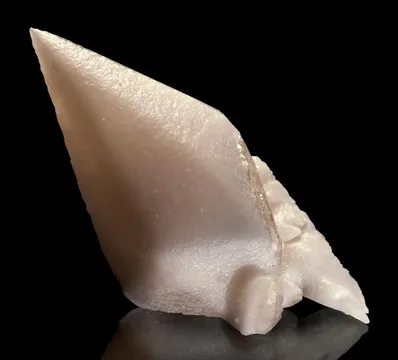
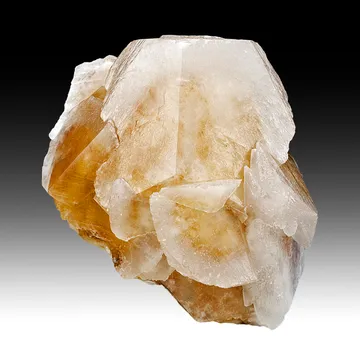
Brushy Creek calcite is the mine’s signature collectible mineral: gray, yellowish-gray, smoky, or mottled scalenohedral crystals, commonly translucent at the edges and opaque in thicker sections because of fine sulfide inclusions and phantom layers. The most desirable pieces show sharp, lustrous dogtooth crystals in open, three-dimensional groups, with marcasite and chalcopyrite selectively coating earlier growth surfaces before later calcite overgrew them; backlighting can reveal the earlier crystal outlines inside the later calcite. Classic specimens are often associated with marcasite, chalcopyrite, dolomite, galena, and pyrite, with labels from the 106 drift or 1100-foot level especially prized. Miniatures to cabinet pieces are common on the market, but large, undamaged, aesthetic plates with strong gray phantoms, bright iridescent sulfide color, and little edge bruising are much harder to replace.
Brushy Creek chalcopyrite is best known not as isolated brassy tetrahedra but as the sparkling partner in the mine’s calcite-marcasite combinations. It occurs as fine brassy to iridescent microcrystals and granular coatings on gray calcite, commonly mixed with marcasite in recessed areas, along earlier calcite faces, or as inclusions that help create the phantom effect. In ore specimens it is one of the principal sulfides, and in collector pieces it may appear with calcite, marcasite, dolomite, galena, sphalerite, and locally dickite or siegenite. Superior chalcopyrite pieces from Brushy Creek show natural metallic color and crisp distribution on the calcite rather than a muddy sulfide dusting; the best examples have bright bronze, gold, and multicolored sparkle positioned so that it emphasizes the calcite geometry instead of hiding it.
Marcasite is essential to Brushy Creek’s visual identity, forming glittering brassy, bronze, reddish, greenish, and iridescent coatings on calcite and sometimes occurring as more massive or crystalline sulfide surfaces with calcite accents. In the famous calcite pockets, marcasite coated an earlier generation of calcite before renewed calcite growth sealed it inside as gray phantoms or left it exposed as sparkling skins. It occurs with calcite, chalcopyrite, dolomite, galena, pyrite, and sphalerite, and Brushy Creek specimens are often judged by the marcasite’s freshness, iridescence, and selectivity: a crisp coating on certain faces is far more desirable than dull, oxidized, powdery coverage. Although many specimens are described casually as calcite with chalcopyrite, the iron sulfide component is often the dominant visible metallic mineral, so careful identification matters.
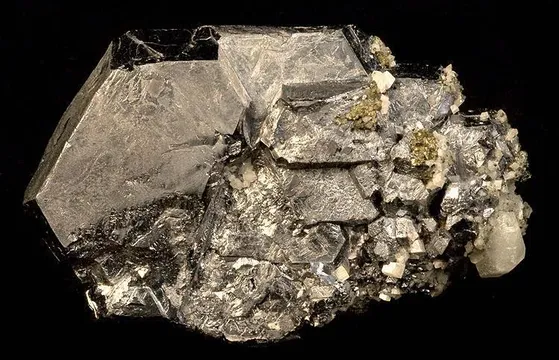
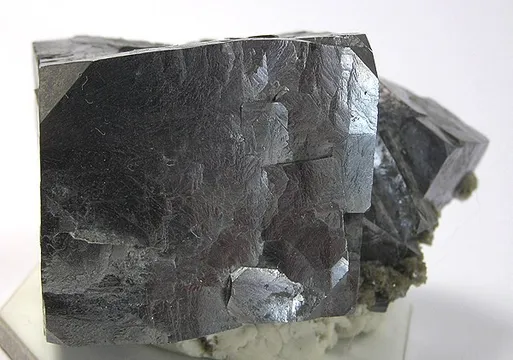
Brushy Creek galena ranges from ore-stage masses and crystals to highly collectible cubic, modified cubic, platy, and spinel-law twinned forms. The most important collector occurrence is Stope 72B30, famous for large galena crystals and clusters, some recovered from mud, clay, rubble, and breakdown material in a cavity rather than neatly pried from open walls. These specimens may be associated with dolomite, chalcopyrite, calcite, pyrite, and marcasite; some show bright cleavage scars from the difficulty of extracting interlocked crystals. The best Brushy Creek galenas are not merely heavy cubes: they show unusual modifications, sharp twinning, iridescence or luster, and enough matrix or associated sulfides to confirm the Viburnum character, while ordinary pieces can be massive, bruised, or visually indistinguishable from broader Missouri ore.
Other minerals documented from Brushy Creek include sphalerite, dolomite, pyrite, aragonite, quartz, dickite, kaolinite, gersdorffite, linnaeite, millerite, polydymite, siegenite, wurtzite, and nickel-bearing pyrite known as bravoite. The mine is not chiefly a type-locality locality in the collector sense; its rarities are more important as paragenetic and geochemical indicators. Siegenite is particularly attractive when present as lustrous silver octahedra or spinel twins with chalcopyrite, marcasite, galena, and dolomite, while dickite and the nickel-cobalt sulfides connect Brushy Creek to the lower-zone and hydrothermal alteration story that makes the mine scientifically richer than its familiar calcite specimens alone suggest.
Brushy Creek specimens are usually authentic when they carry coherent old labels, but locality precision varies. Labels may read Brushy Creek, Brushy Creek Mine, Reynolds County, Greeley, Oates, Viburnum Trend, 106 drift, N106 drift, 106 North Stope, 1100-foot level, or Stope 72B30. The more specific labels are valuable. The mine’s calcite-marcasite-chalcopyrite habit is distinctive, but similar-looking gray calcite and sulfide combinations from other Viburnum Trend mines, especially Sweetwater and Fletcher, can be confused with it. Provenance, old collection history, and a label tying the specimen to a known Brushy Creek find are worth preserving.
No major tradition of fabricated Brushy Creek specimens is documented, but misidentification is common. “Calcite with chalcopyrite” labels may understate or omit marcasite, and some pieces sold as pyrite-coated calcite are better understood as marcasite-rich specimens. Conversely, brassy sulfides in ore pieces may require magnification, experience, or analysis to distinguish chalcopyrite, pyrite, marcasite, and related phases. Bright iridescence on Brushy Creek marcasite and chalcopyrite can be natural, but suspiciously loud rainbow colors, especially on loose chalcopyrite-heavy pieces without good provenance, should be considered carefully because acid-enhanced “peacock ore” is a familiar treatment problem in the wider mineral trade.
Condition is the central quality issue. Calcite is soft, has perfect rhombohedral cleavage, and Brushy Creek crystals are often exposed points on a fragile crust, so bruised tips, broken edges, repaired major crystals, and cleaved terminations are common. Some Stope 72B30 galena pieces also show bright cleavage faces from extraction damage. This is not automatically disqualifying; the cavities were difficult to collect, and even major specimens may have minor scars. Still, the premium goes to complete, balanced groups with minimal tip damage, intact sulfide-coated faces, and no distracting repairs.
Marcasite should be kept dry and stable. Most Brushy Creek material in collections has aged well, but any iron sulfide specimen deserves sensible storage: low humidity, no damp cabinets, no acidic paper, and no aggressive washing. Avoid acid cleaning entirely on calcite, and do not soak complex calcite-sulfide pieces. Galena specimens should be handled as lead-bearing minerals: wash hands after handling, keep dust away from children and food areas, and never cut, grind, or abrade specimens indoors. Brushy Creek calcite is not rare in a general sense, but top-level pieces from named classic workings are genuinely finite, and the best large cabinet specimens with strong phantoms, lively iridescence, and old 1990s collecting provenance have become increasingly desirable.
In 1979, Brushy Creek miners broke into a watercourse rather than an ordinary ore pocket. The opening was about six feet above the drift floor and big enough for a miner to squeeze into. Beyond it was a crystal-lined chamber about 15 feet high, four feet wide, and thirty feet long. That alone would have made a mine story worth retelling, but a smaller tunnel near the drift led onward into a second watercourse that dwarfed the first: up to 15 feet wide, 15 feet high, and more than 200 feet long. Its walls carried the gray and yellowish calcite crystals that later made Brushy Creek famous, with iridescent marcasite coating selected faces.
For several years after the discovery, as mine work continued nearby, miners and mechanics visited the crystal-lined watercourses and collected specimens. That explains why early Brushy Creek calcites filtered into collections before the major specimen-mining project. They were not from a roadside pocket or a casual dump find; they were carried out of an operating lead mine by people who had legitimate reason to be underground. When mining moved away from the area, collecting became harder to justify, and the cavities effectively slept.
The second act came in the 1990s. Top Gem Minerals, then owned by Mike New and Joe Kielbaso, secured a contract with Doe Run to collect the Brushy Creek calcite-marcasite pocket system. Mine Rat Minerals records the effort in two campaigns: August to December 1994, and April to July 1995. The logistics sound almost absurd until one remembers how fragile these pieces are. More than 26,000 diapers and four miles of bubble wrap were used to protect specimens. The wrapped material filled more than 800 chicken boxes. In all, over 24 tons of specimen material were shipped back for later sale.
The excavation itself was not a quick grab. The hand-worked chambers ran 425 feet horizontally, and the ceiling height reached 30 feet in places. The named crew associated with the project included Joe Kielbaso, Mark “The Mine Rat” Kielbaso, Brian Stefanec, Brian Huntsman, Paul Jett, Ray Carillo, Travis “T-Bone” Hartin, and Eugene Quintana. Those names matter because Brushy Creek is one of the relatively rare modern American specimen stories where the people, dates, working area, and packing scale are still attached to the material.
Stope 72B30 added a different kind of Brushy Creek legend. The galena was not all neatly lining clean pocket walls; much of it had to be dug from dolomitic mud, clay, and rubble in the lower half of a collapsed cavity. Large galena crystals and boulders had to be removed from the top of the breakdown pile before the better specimens could be reached. Some crystal groups were interlocked so tightly that removing one meant damaging another, leaving the bright cleavage faces still seen on some pieces today. One recovered cluster alone weighed 2,155 pounds and was placed on display in the lobby of Doe Run’s central office in Viburnum.