Marcasite - orthorhombic dimorph of pyrite with cockscomb blade clusters, metallic luster and iridescent tarnish; prized for sculptural form yet requires caref…
Key facts
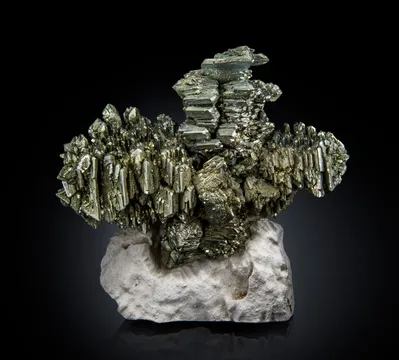
Marcasite (FeS2) is the orthorhombic dimorph of pyrite and one of the most visually distinctive sulfides in the cabinet. Its hallmark “cockscomb” or “spearhead” crystal aggregates—tight fans of razor-thin bladed crystals—give rise to dramatic, sculptural forms. Colors range from pale brassy to a cooler, tinny bronze, often developing a multicolor iridescent tarnish. Marcasite also forms radiating sprays, nodular concretions, stalactitic and “ball” structures from sedimentary environments, and sharp, simple tabular crystals in select hydrothermal deposits. Associations are classic Mississippi Valley–type partners—calcite, dolomite, fluorite, galena, and sphalerite—with occasional showy contrasts on white carbonates.
As a collector species, marcasite shines for form and texture rather than gemminess. Good pieces “read” across a room thanks to complex surface geometry and bright metallic luster. The catch: marcasite is less chemically stable than pyrite and can deteriorate in humidity, which makes careful curation essential. When chosen from good, proven localities and stored properly, however, marcasite can be long-lived—and few minerals match the crisp elegance of a fine cockscomb spray.
Marcasite’s popularity rests on aesthetics, availability from classic districts, and its unmistakable habits. Generations of collectors cut their teeth on Tri-State District “cockscombs” and Southern Illinois bladed fans perched on fluorite or calcite. European chalk cliffs (e.g., Cap Blanc-Nez) yielded attractive nodules and stalactites, while Romanian and Czech mines produced sharp, lustrous sprays that remain desirable today. At the high end, complete, undamaged clusters with mirror-bright luster and strong composition command robust prices despite the species’ reputation for instability. Many collectors deliberately seek localities noted for relatively stable specimens (e.g., Tsumeb, certain Tri-State and Romanian pieces), then house them in controlled microclimates. The result: a niche but passionate following spanning thumbnail specialists to cabinet-case display connoisseurs.
While marcasite occurs widely, a handful of districts have produced the most collectible habits and compositions. Below are significant and reliably identified localities with their characteristic styles.
The Tri-State District’s Joplin Field (Missouri–Kansas–Oklahoma) is the archetype for “cockscomb” marcasite. Classic specimens show tight, fan-like sprays of spearhead twins with brilliant metallic sheen on dolomite or with galena and sphalerite. The best are fine-grained but crisp, with radial blades stepping outward like feathers. Large, undamaged fans on contrasting carbonate matrix are especially prized. Historic material still circulates, and despite age, many remain stable if stored dry.
The chalk cliffs of Cap Blanc-Nez have produced classic sedimentary marcasite: nodules, stalactitic and botryoidal forms, and radiating growths sometimes with subtle iridescence. These pieces are collected as much for geologic curiosity and sculptural form as for metallic brilliance. Intact stalactites and complete nodules with attractive surfaces are favored. As with most chalk-hosted sulfides, they can be humidity-sensitive, so careful storage is essential.
Marcasite is notably sensitive to humidity and acidic environments and can decompose to iron sulfate species (“pyrite/marcasite disease”). Proactive care is essential.
By choosing crisp, undamaged fans from reputable localities and keeping them dry in inert microclimates, you can enjoy the intricate geometry and metallic sparkle that make marcasite one of the most sculptural sulfides in the hobby.