






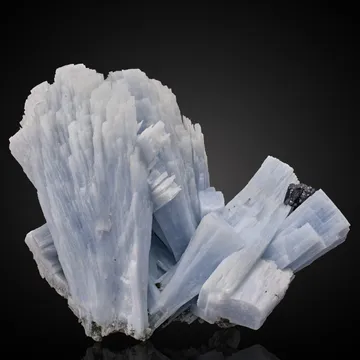
Anhydrite: water-free CaSO4 crystals with orthorhombic cleavage, blue to lilac hues; prized for sharp forms, angelite color, and rare, unaltered specimens.
Key facts
Anhydrite (CaSO4) is the water-free counterpart of gypsum and a classic evaporite mineral. It crystallizes in the orthorhombic system and is best known for its perfect cleavage in three directions at right angles, yielding crisp rectangular fragments and blocky crystals. Colors range from colorless and white to bluish-gray, lilac, and pale pink; translucent to opaque habits predominate, though rare crystals can be surprisingly glassy. In pockets, anhydrite may appear as thick blades, stout prismatic blocks, rosettes, or radiating aggregates; in evaporite beds it commonly forms nodules or “chicken-wire” textures.
Collectors value anhydrite for its sharp form, color (notably soft blues known commercially as “angelite” when massive), and dramatic associations—especially with fluorite, calcite, sphalerite, and galena in Mississippi Valley-type (MVT) mines, and with halite/sylvite in potash deposits. A key challenge is stability: anhydrite is metastable at Earth-surface conditions and can slowly hydrate to gypsum with moisture exposure, altering luster and form. Fresh, unaltered, well-crystallized pieces from classic pockets are therefore both uncommon and prized.
While not as ubiquitous in showcases as quartz or fluorite, anhydrite occupies a respected niche. Historic potash mines like Staßfurt (Germany) and Boulby (UK) supplied textbook material to museums. Mexico’s Naica Mine produced striking blocky crystals and important gypsum-after-anhydrite pseudomorphs that captured broad attention. Tennessee’s Elmwood district occasionally yielded attractive lavender-gray to blue-gray blades and blocks on sphalerite or calcite, making for aesthetic, contrasting specimens.
Massive blue anhydrite (“angelite”) from Peru popularized the species with lapidary enthusiasts in the late 20th century, indirectly increasing interest among mineral collectors. Today, choice anhydrite is still comparatively scarce in top specimen quality. The best pieces—sharp, lustrous crystals on contrasting matrix with minimal hydration—are genuinely hard to find and can command strong prices relative to the species’ general availability.
Below are several historically and currently important sources of collectible anhydrite, each known for distinct habits or associations.
Naica (Chihuahua) is famed for its world-class gypsum crystals, but it also produced excellent anhydrite. Specimens range from thick, blocky, translucent plates to coarse blades, often perched with calcite or set among sulfides. Many outstanding Naica specimens show alteration rims or partial pseudomorphs of gypsum after anhydrite, revealing sharp, geometric outlines with softer gypsum textures—a fascinating paragenetic story in one piece. Truly fresh anhydrite surfaces from Naica, with a satiny to vitreous luster, are scarce and coveted.
Anhydrite is inherently moisture-sensitive and may hydrate to gypsum over time. Proper environmental control is essential.
By prioritizing dryness, minimal handling, and gentle cleaning, collectors can preserve the crisp edges, fresh luster, and distinctive forms that make anhydrite a rewarding, if challenging, species to own.