A collector's guide to Shigar Valley, Pakistan: its geology, mining history and notable minerals, illustrated with the 379 specimens documented from this locality on EarthWonders.
Key facts
Shigar Valley is one of the defining names in modern pegmatite collecting: a high Karakoram mineral district where gem-bearing granitic pegmatites and Alpine-type fissures have yielded the crisp, high-contrast combinations that made northern Pakistan a staple of fine-specimen cabinets. The valley lies north of Skardu along the Shigar River system, with the Basha and Braldu rivers feeding in from the north; in collecting usage, specimens from tributary areas such as Dassu, Yuno, Mungo, Kashmal, Haiderabad, Alchuri, Hashupa, Nyet Bruk, Baha, Goyungo, and related workings are often traded under the wider Shigar Valley name. That breadth is part of the locality’s appeal and part of its labeling difficulty: “Shigar” can mean a precise valley locality, a village-centered group of pegmatites, or the larger mineral-producing district through which rough and specimens move toward Skardu and the international market.
Geologically, the locality sits in a spectacularly active mountain belt. Shigar Valley follows the Main Karakoram Thrust, where rocks of the Asian plate lie to the north and the Kohistan-Ladakh arc lies to the south. The mineral specimens collectors prize are mostly from complex, zoned pegmatites intruded into rocks of the Karakoram Metamorphic Complex, with gemstone pockets in coarse intermediate zones and near core-margin zones. The classic pocket assemblage is immediately recognizable: pale to medium blue aquamarine, colorless beryl, topaz, schorl, garnet of almandine-spessartine affinity, fluorapatite, fluorite, quartz, albite, microcline or orthoclase, and muscovite. In the nearby Alpine-type clefts, especially around Alchuri and Hashupa, the character shifts toward quartz, actinolite/byssolite, rutile, adularia, titanite, zoisite, clinozoisite, epidote, axinite, calcite, and related fissure minerals.
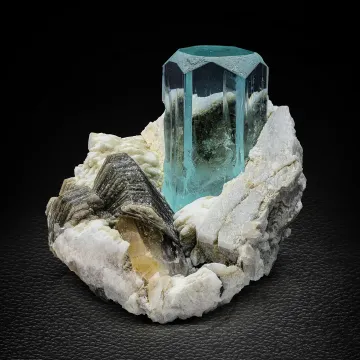
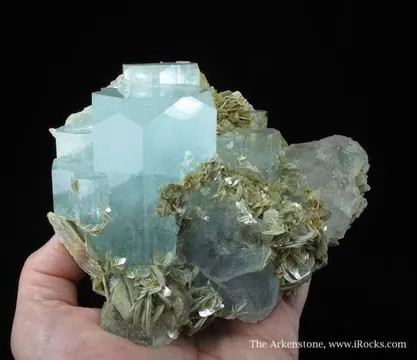
The finest Shigar specimens have a look that is almost architectural. Aquamarine rises as lustrous hexagonal prisms from snowy albite or blocky feldspar; black schorl adds graphic contrast; muscovite books catch the light as silvery rosettes; red garnets can punctuate a matrix like deliberate enamel inlay. The color of the aquamarine is usually not the dark, saturated blue of fantasy marketing but a distinctly Pakistani range of icy blue, aqua, pale greenish blue, and nearly colorless zones. The best pieces are prized not merely for gemminess but for intact pocket context: crystals standing naturally on matrix, with unforced composition, good termination quality, and minimal post-mining reconstruction.
Regional View
Country View
Shigar’s historical importance is not simply that it produced aquamarine. Brazil, Madagascar, Russia, Namibia, and the United States all had older aquamarine traditions. Shigar helped change collector expectations for aquamarine specimens by supplying fine crystals still seated on their original pegmatite matrix. Over the last several decades, the best material from the district has moved from rough-gem trade into the top tier of specimen collecting, aided by better pocket preservation, more careful extraction, improved preparation, and a collector market willing to reward “mother-rock” pieces rather than only loose gem crystals.

Photo: Daderot, Wikimedia Commons
Search for specimens: View all specimens from Shigar Valley, Pakistan
The Shigar Valley mineral district is best understood as a network of high-altitude pegmatite and cleft occurrences rather than a single mine. The main collector specimens come from granitic pegmatites, many of them complex and zoned, exposed in steep terrain between roughly 2,500 and 4,000 meters above sea level. Published field descriptions distinguish simple, unzoned pegmatites—often barren of gem material—from complex pegmatites with fine-grained border zones, coarse intermediate zones, and blocky central zones. The productive cavities are commonly rounded or ovoid, developed in the central parts of the intermediate zone or at the core-margin zone, and may be packed with gemstones in a light pink to white clayey material. These miarolitic pockets are the source of the aquamarine, beryl, topaz, fluorapatite, fluorite, garnet, schorl, albite, quartz, and mica combinations familiar to collectors.
The country rocks and structural setting vary across the district. The Shigar Valley lies along the Main Karakoram Thrust, and the pegmatites are described from metasedimentary and meta-igneous rocks of the Karakoram Metamorphic Complex, with related intrusive rocks such as the Sumayar pluton cited in regional studies of gemstone-bearing granitic systems. The north side of Shigar shares a pegmatite complex with the Braldu Valley; this matters in the real specimen trade because excellent aquamarine, topaz, and related pegmatite minerals from Braldu and Basha tributary localities are frequently labeled “Shigar Valley.” Serious collectors should therefore read old labels with geographic tolerance but also with skepticism: a specimen labeled only “Shigar” may be perfectly legitimate in trade usage while still needing a more exact locality if one is claimed later.
The principal mineralized bodies are pegmatitic dikes, veins, lenses, pods, and patches. Their economic and collector value is pocket-driven. A miner may follow a pegmatite for meters or tens of meters with little reward, then intersect a cavity containing loose crystals on the floor, crystals attached to ceiling or wall, clay, broken fragments, and matrix plates. Schorl is widely reported through the gem-producing localities, while other gem species are more pocket- and locality-specific. Published sample localities include Yuno, Kashmal or Kashmol, Dassu, Nyet or Nyit Bruk, Goyungo, Mungo, Baha, Alchuri, and Hashupa. Yuno is repeatedly cited for beryl, garnet, apatite, topaz, fluorite, and muscovite-rich specimens; Kashmal is noted for beryl, schorl, topaz, fluorite, and apatite; Alchuri and Hashupa are especially important for Alpine-type fissure minerals such as zoisite, clinozoisite, actinolite, rutile, quartz, and axinite.
Mining has generally been small-scale, seasonal, and locally controlled. Older accounts describe secretive mining by local people, guarded mine locations, crude tools, and numerous short adits or drifts driven into gem-bearing pegmatites. A Geological Survey of Pakistan publication records that Shigar Valley aquamarine mines were allotted on lease to Shahzad International, while also noting that many mines remained effectively under local control and that small quantities of aquamarine were being mined. The same publication emphasizes the realities of the region: many workings are one- or two-person operations, underground developments can extend tens of meters, and deeper work becomes increasingly difficult without better equipment.
Production statistics are fragmentary. Official historical production figures most often quoted for northern Pakistani aquamarine relate to the GEMCP period and the Shengus area rather than a clean, valley-specific Shigar total, so the specimen record is a better guide to Shigar’s importance than tonnage. The production history collectors actually see is episodic: particular pockets, particular mine seasons, and particular matrix recoveries. Finds from Yuno, Kashmal, Haiderabad, Mungo, Dassu, and Nyet Bruk have each contributed recognizable styles, from “bic-pen-like” aquamarines in the Haiderabad-Yuno area to large aquamarine-garnet matrix pieces from Dassu and the great matrix aquamarine recoveries of the Braldu-linked Shigar mineral world.
Access today is not casual collecting. These are active or semi-active mountain workings, often on claimed ground controlled by families, village groups, or local mining teams. Weather, snow, altitude, unstable adits, blasting, cliff exposure, and local rights all matter. The correct collector approach is to obtain permission from land and mineral-rights holders, work through reputable local contacts, and assume that named mines are not open public collecting sites. For buyers, the practical “access” question is documentation: the best specimens should come with a clear chain of locality information, at least to valley or mine-area level, and any known repairs, reattachments, or preparation history should be disclosed.
Aquamarine is the signature Shigar Valley mineral: long, lustrous hexagonal beryl prisms in pale blue, aqua, greenish blue, and locally stronger blue tones, most prized when naturally perched on white albite, cleavelandite, microcline, orthoclase, or muscovite with black schorl as contrast. Published gemological work on Shigar aquamarine records translucent to transparent material, weak bluish-white fluorescence under both long- and short-wave ultraviolet, abundant fluid inclusions, and iron-related blue color rather than Maxixe-type irradiation color; collector specimens range from thumbnail crystals through cabinet pieces, with classic crystals reaching the “dozen centimeters” scale and exceptional pockets producing far larger groups. Yuno high mines material is noted for clusters, flat terminations, good to very deep blue color in some crystals, and associations with cleavelandite, muscovite, and pink apatite; Haiderabad is associated with slender “bic-pen-like” aquamarines. Ordinary Shigar aquamarine is plentiful enough that simple loose crystals or pale damaged prisms are common, but a genuinely fine Shigar piece must combine sharp termination, transparency, pleasing color, damage-free exposure, and believable matrix integration.
Beryl from Shigar Valley is more than aquamarine: the district also yields colorless goshenite and uncommon pink to peach beryl marketed as morganite, all from the same evolved pegmatite environment. Published Shigar studies identified beryl from Yuno, Kashmal, and Nyet, and described colorless transparent crystals as goshenite and pale blue crystals with rectangular prism faces as aquamarine. On specimens, beryl commonly appears with muscovite, albite, quartz, schorl, microcline, garnet, topaz, fluorite, and fluorapatite, and the best examples are judged by a mixture of gem character and pocket architecture. Colorless beryl is often overlooked beside aquamarine, but fine Shigar goshenite can be very clean, sharply terminated, and visually strong when set against feldspar or mica; mediocre pieces are simply pale, etched, contacted, or locality-vague.
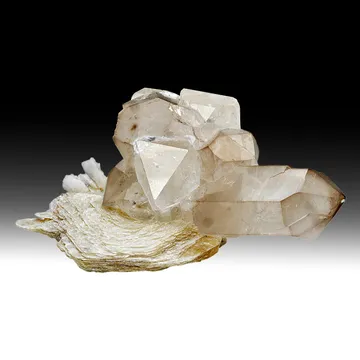
Quartz occurs in both Shigar’s pegmatite pockets and its Alpine-type clefts, giving the species two distinct collector personalities here. In pegmatites it is a matrix and pocket companion to aquamarine, topaz, albite, muscovite, schorl, fluorapatite, garnet, fluorite, and K-feldspar, sometimes as colorless crystals, smoky crystals, or intergrown supports that frame the principal gem mineral. In the Alchuri and Hashupa clefts, quartz is more often part of an Alpine assemblage with actinolite or byssolite, rutile including sagenitic habits, adularia, albite, calcite, titanite, zoisite, brookite, vesuvianite, siderite, chlorite, and epidote-related minerals. Fine Shigar quartz is valued when it is transparent, sharply terminated, included in a visually interesting way, or structurally important to a combination specimen; ordinary pieces are usually relegated to matrix unless the crystal is clean, doubly terminated, smoky, chlorite-included, or carrying good accessory minerals.
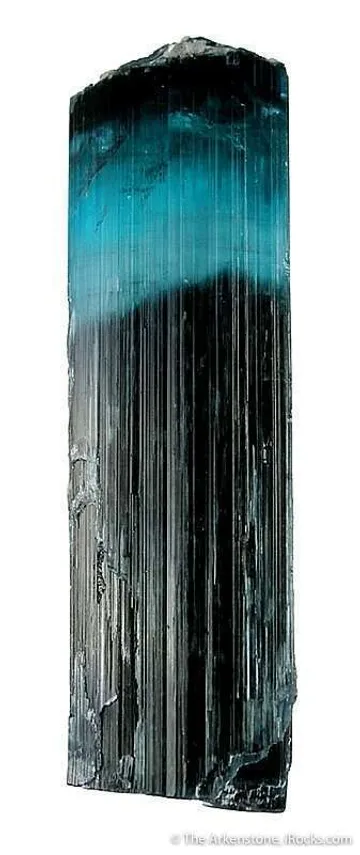
Tourmaline in Shigar Valley is overwhelmingly represented by black schorl and schorl-foitite compositions rather than the multicolored elbaite that collectors associate with some other Himalayan and Afghan pegmatites. Published work describes schorl as widespread through the gem-producing localities, with a Kashmal crystal showing clear striations along the prism faces, and reports schorl from Kashmal and Dassu in X-ray diffraction studies. On specimens it appears as black, vertically ribbed prismatic crystals, sprays, or embedded rods in albite, muscovite, quartz, feldspar, and aquamarine combinations; it is often the visual counterweight that makes the blue of an aquamarine or the white of albite look sharper. True colored tourmaline labels from Shigar deserve careful scrutiny because misattribution from Afghan material is a known problem in the broader trade; the strongest Shigar tourmaline pieces are those with convincing local matrix, old provenance, or analytical support.
Orthoclase and other K-feldspars form some of Shigar’s most important matrix architecture. In pegmatite specimens, blocky white to cream feldspar gives aquamarine, topaz, schorl, quartz, and muscovite a clean display base; in the great matrix aquamarine pockets, white orthoclase or microcline helped create the snow-and-ice aesthetic that collectors immediately recognize as northern Pakistan. Orthoclase is also recorded from Alchuri, where the assemblage belongs to the Alpine-type side of the valley’s mineralogy rather than the classic aquamarine pegmatites. The best orthoclase-bearing Shigar specimens are not purchased for feldspar alone but for how the feldspar supports the main crystals: crisp faces, minimal bruising, bright color contrast, and natural-looking seating separate a good matrix piece from a reconstructed or merely broken feldspar base.
Garnet from Shigar Valley belongs chiefly to the almandine-spessartine side of the garnet group, with published chemical work showing garnets that are not pure end-member almandine or spessartine and with Dassu material showing increasing manganese content toward the rim. Collectors know the best pieces as reddish brown to red crystals with aquamarine, albite, microcline, muscovite, quartz, feldspar, or schorl; Yuno is specifically documented for reddish brown garnet with yellowish white calcite from the same pegmatite, and the Dassu “Aqua-Garnet” pocket made the aquamarine-plus-red-garnet association famous at the elite specimen level. Excellent Shigar garnet specimens are judged by rich color, sharp crystal form, freedom from abrasion, and placement as a contrast accent rather than as scattered dark grains; world-class examples are matrix compositions where garnet actively completes the design.
Feldspar is the essential supporting mineral group of Shigar Valley pegmatite specimens, present as white albite and cleavelandite plates, blocky microcline, orthoclase, and broader K-feldspar or feldspar-group matrix. The district’s finest aquamarine, topaz, garnet, and schorl specimens depend on feldspar for contrast and structure: pale feldspar makes aquamarine look bluer, schorl look blacker, and red garnet more vivid. In the productive pegmatites, feldspar belongs to the coarse intermediate and blocky core zones as well as the pocket walls, and it may preserve the original geometry of a cavity better than any single gem crystal. Ordinary feldspar matrix is common and easily damaged; exceptional feldspar in Shigar specimens is clean, sharply crystallized, balanced, and visibly original to the pocket.
Mica in Shigar Valley is both a rock-forming component of the pegmatites and a key aesthetic associate on specimens, most often appearing to collectors as muscovite books, sheets, rosettes, or silvery stacks. The group is documented in the Shigar mineral list and is especially visible in combinations with aquamarine, albite, topaz, fluorapatite, fluorite, garnet, quartz, and schorl. In pocket material, mica can cushion crystals, create sparkling background texture, or form sculptural books that are attractive in their own right. Good Shigar mica is lustrous, undistorted, and compositionally useful; ordinary mica is often bruised, bent, exfoliating, or merely present as a ragged parting surface on the back of a specimen.
Muscovite is the mica species most closely associated with classic Shigar Valley matrix specimens, occurring as pearly books, thin sheets, rosettes, and stacked blades with aquamarine, beryl, albite, quartz, topaz, fluorite, microcline, schorl, and garnet. Yuno high mines muscovite is documented with topaz, cleavelandite, beryl, quartz, fluorite, microcline, and spessartine, while published photographs of Yuno material show large books or sheets of muscovite with light pink apatite, green fluorite, and reddish garnet. On aquamarine specimens, muscovite can act as a sparkling plinth or as a contrasting silvery accent against blue beryl; the best pieces have fresh, flat, reflective blades that are not crushed or curled from pocket pressure or extraction.
Albite, especially cleavelandite, is the classic white matrix for Shigar Valley aquamarine, topaz, fluorapatite, schorl, quartz, muscovite, garnet, microcline, fluorite, and rare accessory minerals. On the best specimens it forms bright platy crests, porcelain-white crystalline carpets, or architectural feldspar foundations from which gem crystals stand naturally. Yuno aquamarine material is specifically associated with cleavelandite and muscovite, and topaz-bearing Shigar specimens commonly sit on albite-quartz-muscovite matrix. Albite is common enough that it should not inflate a specimen’s importance by itself; its value lies in whiteness, crispness, lack of bruising, and the way it frames the main mineral without looking trimmed, glued, or visually chaotic.
Schorl is the dominant tourmaline of Shigar Valley and one of the district’s most important visual associates. It occurs as black, striated prismatic crystals, sprays, rods, and embedded masses in pegmatite matrices with albite, muscovite, quartz, aquamarine, topaz, feldspar, fluorapatite, apatite, and occasional tantalate minerals. Research on the Shigar gemstones identified schorl from Kashmal and Dassu, while field descriptions emphasize that tourmaline can occur in border and intermediate zones as well as in gem-grade pocket assemblages near core-margin zones. Fine schorl pieces from Shigar are crisp, lustrous, undamaged, and compositionally balanced; many ordinary specimens show broken black tourmaline acting only as a dark background for aquamarine or topaz.
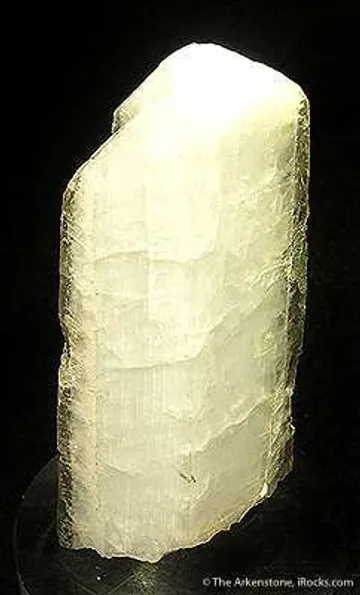
Topaz from Shigar Valley is documented as colorless to light yellow material from pegmatites at Yuno, Kashmal, Dassu, Nyet Bruk, and Goyungo, with studied colorless crystals around 1 x 3 cm collected from Kashmal, Yuno, and Goyungo and typically associated with albite, quartz, and muscovite matrix. The best collector pieces are glassy, sharply terminated, transparent crystals seated on white cleavelandite or feldspar with quartz, mica, fluorite, schorl, or aquamarine; topaz may also appear as modest accessory crystals on larger aquamarine-dominant pieces. Colorless Shigar topaz is easy to underrate because it lacks obvious color, so value rests on luster, clarity, termination, matrix balance, and condition; damaged cleavage surfaces, bruised tips, or vague “Skardu” labels reduce confidence and price.
Morganite is a scarce but desirable part of the Shigar beryl suite, occurring as pink to peach beryl in the same broad pegmatite province that produces aquamarine and goshenite. It is documented in the Shigar Valley mineral assemblage and in the broader Skardu/Shigar district record, commonly associated with aquamarine, albite, tourmaline, quartz, mica, and apatite-group minerals when it appears on matrix. Compared with aquamarine, Shigar morganite is much less abundant and usually less represented by large matrix showpieces, so the best specimens are those with definite locality provenance, natural color, clean terminations, and associations that look consistent with Shigar pegmatite pockets. Pale peachy beryl can be overnamed in the trade, so serious collectors should distinguish true morganite from slightly warm-toned goshenite or aquamarine unless the color is convincing.
Apatite from Shigar Valley is most familiar as fluorapatite in light pink to pink crystals from pegmatite pockets, especially Yuno and Kashmal, where published chemical work identified apatite and manganese-bearing apatite and noted higher MnO and FeO in Kashmal apatites compared with Yuno. Photographed Yuno material includes aggregates of light pink apatite and combinations of light pink apatite with green fluorite, reddish garnet, and large muscovite books. In collector specimens, apatite appears as pastel crystals or aggregates on albite, muscovite, quartz, feldspar, fluorite, garnet, and occasionally aquamarine; good pieces have clean color, distinct crystal form, and undamaged surfaces, while ordinary pieces are small, sugary, or visually lost in busy pegmatite matrix.
Other documented Shigar Valley minerals broaden the locality well beyond the headline species. Fluorite occurs as pale to dark green crystals at Yuno, Mungo, Kashmal, Baha, and Nyet Bruk, commonly with tourmaline, beryl, quartz, topaz, and muscovite; zoisite and clinozoisite are important from Alchuri and Hashupa; axinite is reported from Alchuri; rutile, including sagenitic habits, is notable in the Alpine-type assemblages; titanite, brookite, vesuvianite, siderite, calcite, actinolite, byssolite, prehnite, diopside, epidote, chlorite, zircon, cassiterite, columbite, tantalite-(Mn), stibiotantalite, fluornatromicrolite, genthelvite, bavenite, boromuscovite, natrolite, triplite, and hydroxylherderite or herderite-series minerals are all part of the wider documented Shigar mineral list. Several rarities are of specialist interest rather than common display material, but they help explain why Shigar is a serious mineral locality, not merely a source of attractive blue beryl.
The first authenticity issue with Shigar Valley is locality precision. Many legitimate specimens from the Braldu and Basha tributary systems are sold under the broad Shigar Valley umbrella, and older labels often use “Skardu,” “Shigar,” “Shigar River Valley,” or “Northern Areas” loosely. That is not automatically a problem, but a specimen claimed as Yuno, Kashmal, Haiderabad, Mungo, Alchuri, Hashupa, Dassu, Nyet Bruk, Baha, or Goyungo should have a reason for that precision. When paying a premium for a named pocket or mine area, ask whether the information comes from the miner, the first dealer, a published figure, an old collection label, or a later market guess.
Repairs and reconstructions are common enough to matter. Pegmatite pockets may contain crystals that were naturally detached before mining, crystals broken by blasting, and matrix fragments separated during extraction. Reattachment of aquamarines to natural sockets can be legitimate when disclosed, especially if the crystal and socket are from the same pocket, but it must affect price and description. Be alert for aquamarine crystals perched too neatly on unrelated albite, glue around schorl or feldspar contacts, mismatched luster between crystal and matrix, and “360-degree” matrix pieces whose underside tells a different story. High-end Shigar aquamarines should be examined under strong light and magnification for glue lines, filled fractures, polished breaks, repaired tips, and added support pins or base work.
Color treatment is less central for Shigar aquamarine than for some gem materials. Gemological study of Shigar aquamarine has shown low-alkali, iron-colored aquamarine rather than Maxixe-type irradiation color, and the classic natural palette is pale to medium blue, greenish blue, aqua, and near-colorless. Overly saturated “electric” blue loose crystals deserve closer scrutiny, especially if they are not on matrix or if the label is vague. Morganite should be naturally pink to peach, not merely a faint warm cast in otherwise colorless beryl. Topaz is expected to be colorless to light yellow in documented Shigar occurrences; bright blue topaz offered as natural Shigar material should be treated with caution unless it has strong documentation and testing.
Mislabeling of tourmaline is another recurring concern. Shigar is a schorl locality first. Colored elbaite is much less secure in Shigar attribution, and some gallery or market material labeled from Shigar has been suspected of being Afghan. A credible colored tourmaline specimen should have matrix, provenance, and ideally analytical support consistent with the locality. Black schorl with aquamarine, albite, quartz, feldspar, and muscovite is far more typical.
Condition standards are unforgiving because the district is famous for fresh pocket specimens. Aquamarine tips should be checked for bruises, frosted contacts, internal cracks, and included or milky termination zones. Beryl crystals can look transparent down the c-axis but cloudy from the side, a natural inclusion effect that may or may not be aesthetically acceptable. Topaz has perfect basal cleavage and is easily cleaved or edge-chipped. Albite and cleavelandite plates crush at exposed edges. Muscovite flakes bend and exfoliate. Garnets may be abraded where pocket clay and broken feldspar moved against them. Fluorapatite is softer than quartz and beryl and can be nicked or etched.
Fluorescence is usually a minor buying factor, but Shigar aquamarine has been recorded with weak bluish-white fluorescence under both long-wave and short-wave ultraviolet. Apatite may be more visually responsive under UV, depending on composition and impurities, but fluorescence should not be assumed for every specimen. Store Shigar matrix specimens away from vibration, avoid aggressive ultrasonic cleaning, and be cautious with water on clay-rich or repaired pieces. For dusty specimens, a blower, soft brush, and careful spot cleaning are safer than soaking unless the preparation history is known.
Market availability remains relatively good for ordinary aquamarine, albite, muscovite, quartz, and schorl combinations, but truly elite Shigar specimens are scarce. The locality produces enough material that small aquamarines and repaired pieces are constantly available, yet undamaged, naturally balanced, matrix aquamarines with strong color and documented provenance command serious competition. Morganite, topaz on attractive matrix, well-crystallized garnet combinations, fluorapatite with vivid color, and rare-species specimens are far less common than the broad “Shigar” label might suggest.
The modern Shigar story turns on a deceptively simple idea: save the mother-rock. For generations, miners in northern Pakistan were rewarded mainly for gem crystals, not for the fragile matrix that made a specimen scientifically and aesthetically whole. Blue beryl was pried loose, feldspar was smashed away, and a pocket that might have produced a world-class matrix piece often became a handful of saleable singles. In the 2010s, collectors, dealers, and preparation specialists began trying to change that habit. They showed local partners how diamond chainsaws had transformed preservation at places like Pederneira, Elba, and Sweet Home, and sent tools and training into the mountains. At first, the saws sat unused long enough for parts to dry and rust. The lesson took years, one family and mining group at a time.
A breakthrough came in 2018 at the Dassu mine with the pocket that collectors came to call the “Aqua-Garnet” Pocket. It yielded the rare combination every advanced collector hopes for from Shigar: aquamarine and red garnet together on real matrix. Some pieces were still damaged by older extraction habits, but others survived as major specimens. The great prize was a 55 cm-wide matrix plate later pictured in The Mineralogical Record: a flowerlike cluster of aquamarine set in quartz, albite, feldspar, and muscovite rosettes, all decorated by red garnets. It entered the Mim Museum in Beirut, and the pocket became proof that specimen-conscious extraction could turn a Pakistani pegmatite cavity into museum-scale art.
The next year produced the legend. In late April 2019, miners at the Biangsapi Gon mine in the Nyet Bruk region of the Braldu Valley encountered the rim of a pocket nearly 30 meters inside the mountain. An explosive charge cracked the rim but did not destroy the pocket. When they cut a small window and looked inside, they saw aquamarines lying loose in clay and mud on the floor. Above them, attached to the ceiling, hung a huge cluster of nearly 30 pristine aquamarine crystals with quartz, on white albite and microcline. Instead of hacking it out, the miners collected the loose floor crystals, photographed the cluster in place, descended to the village, and sought help.
On June 5, 2019, Marco Amabili received the first photographs and videos. By June 17 a technician had reached the base camp. The approach itself reads like a test of nerve: four hours by Jeep from Skardu along the Shigar and Braldu route, then a night ascent by headlamp, 300 meters up an exceptionally steep cliff face, and then into the mountain to see the aquamarine cluster still hanging from the pocket ceiling. The entrance was so tight that the technician had to remove his helmet to peer inside. The negotiations that followed nearly collapsed. On June 20 and 21, Amabili was reportedly on the phone with Ali for almost 24 hours straight. Only on the night of June 22 was a deal finally struck for the loose crystals and the giant still in place.
The extraction took nearly two weeks. The first tools were inadequate: 2 cm wedges, a poor electric drill from China, and a job that would have taken months if done that way. The crew descended into Shigar Valley looking for larger wedges, paused long enough to watch a polo match, and eventually acquired five better wedges with Haji-Ali’s help. Back at the mine, the miners cut an arched working space toward the pocket. One miner using the electric drill was struck in the jaw hard enough to burst his lip, nearly break his teeth, and swell his cheek. Still the work continued.
The final act was both primitive and exquisitely careful. Foam panels bought in Skardu were stacked almost a meter thick beneath the ceiling specimen. When the final saw cut did not release the mass, the crew inserted three small 2 cm wedges and tapped delicately until the nearly 200 kg block popped free. It dropped onto the foam bed intact, with no crystal damaged. The men turned it over so the crystals pointed upward, dragged it through the tunnel on a thick blanket, and later wrapped it in foam, blankets, and a dense rope web for the descent down the 300-meter cliff. The cable system and anchor had to hold; if they failed, the specimen and the men guiding it could have been destroyed. It reached the ground safely.
Once the King of Kashmir was at Haji-Ali’s house, one of the most extraordinary details emerged. The loose aquamarines gathered from the pocket floor nearly two months earlier were unwrapped and tested against open sockets on the giant matrix. Several of the finest crystals fit back exactly. Their sockets showed micro-recrystallized surfaces, evidence that the crystals had been naturally detached long before mining rather than simply snapped off in extraction. In a WhatsApp video, Ali placed them one by one into position, repeating the memorable line, “and this one [is] also perfectly fitting.”
The final preparation took place at MCP in Milan under Federico Pezzotta. The specimen arrived with boxes of loose aquamarine, quartz, feldspar, and minor schorl fragments, plus bags of dust, sand, and tiny pieces from the bottom of the pocket so that nothing would be lost. Only three people were authorized to work on it in a concealed area of the lab. The matrix showed diamond chainsaw cuts but was solid, fresh, and naturally relatively clean. The restoration reunited the natural pocket components, trimmed the underside for balance, and transformed a dangerous ceiling cluster from a high Karakoram mine into one of the landmark aquamarine specimens of the modern era.