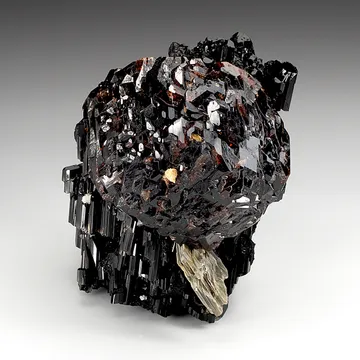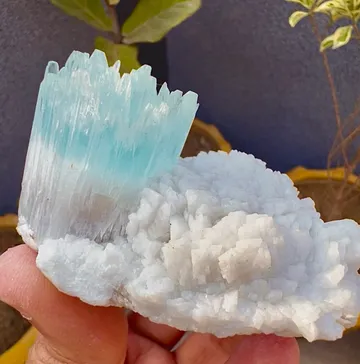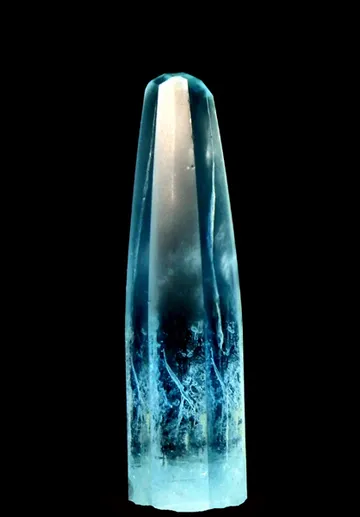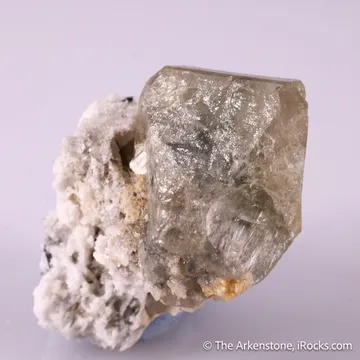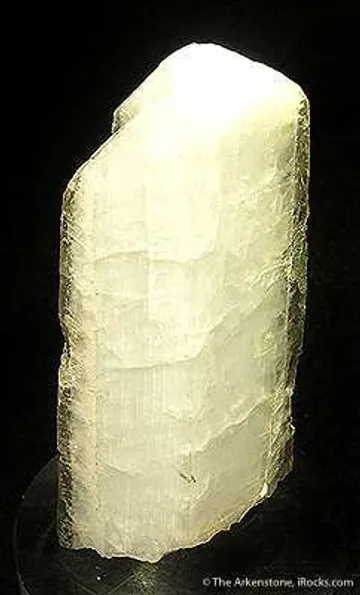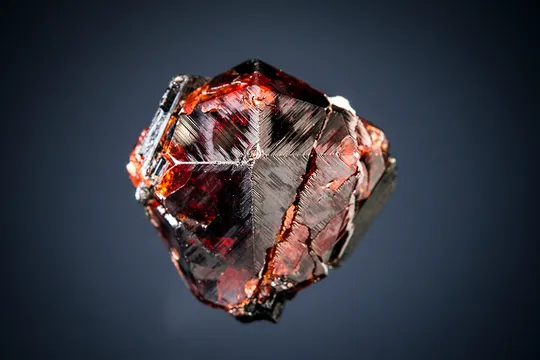
Shigar District, Pakistan — pegmatite locality yielding blue aquamarine, topaz, garnet and fluorite; prized for color, terminations, and pocket integrity.
Key facts
Shigar District is one of the great modern specimen provinces of the Karakoram, not because it is a single mine, but because an entire mountain drainage has been cut by gem-bearing pegmatites and alpine-type clefts. The district, carved administratively from the northern part of the old Skardu District in 2015, includes the Shigar Valley and its important tributary systems, the Braldu and Basha valleys. In older specimen labels and literature the same material may appear as “Skardu District,” “Northern Areas,” “Baltistan,” “Shigar Valley,” “Dassu,” “Dasso,” “Nyet,” “Nyet Bruk,” “Goyungo,” “Yuno,” “Kashmal,” or “Alchuri,” and serious collectors quickly learn that these names matter: Braldu pegmatites and Shigar alpine clefts produce related but visibly different mineral worlds.
The specimen fame of Shigar rests above all on granitic, commonly zoned and miarolitic pegmatites related to the Karakoram granitic bodies. These pegmatites intrude metasedimentary and meta-igneous rocks, with feldspar, quartz and muscovite forming the structural stage on which blue beryl, topaz, schorl, garnet, fluorite, apatite, morganite, goshenite and rarer phosphate or tantalate species appear. Their best aquamarines are architectural: long, glassy hexagonal prisms, often pale sea-blue to richly saturated sky-blue, standing upright from white albite, microcline, muscovite rosettes or pale quartz. A fine Shigar specimen has what collectors prize most in pegmatite minerals—color contrast, undisturbed pocket geometry, clean terminations, and enough matrix to prove the crystal belongs exactly where nature placed it.
Regional View
Country View
Shigar’s other face is Alchuri and the neighboring alpine-type clefts along the valley, where the mineral language changes from pegmatite pockets to fissure veins and metamorphic clefts. There the collector sees quartz, rutile including sagenitic networks, hematite, siderite, epidote, fluorapatite, titanite, vesuvianite, axinite-(Fe), prehnite, adularia, amphibole-group minerals and zoisite. This dual identity—world-class pegmatite aquamarine on one hand, crisp alpine-cleft assemblages on the other—is what makes Shigar more than a single-species locality.
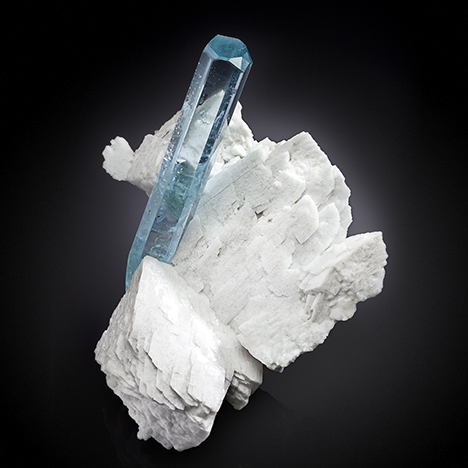
Photo: GIA Gems & Gemology
The modern high point came with large, specimen-conscious recoveries rather than simple gem extraction. The 2018 Aqua-Garnet Pocket at the Dassu mine and the 2019 King of Kashmir discovery near Nyet Bruk showed that Shigar could produce not only loose crystals but enormous intact mineral compositions: aquamarine with quartz, albite, microcline, muscovite and red garnet, recovered from cliff-side tunnels with drilling, wedges, cables and diamond saws. Those events helped shift the reputation of the district from a productive source of attractive Pakistani aquamarines to one of the defining localities of twenty-first-century fine mineral collecting.
Search for specimens: View all specimens from Shigar District, Pakistan
The collectible mineral deposits of Shigar District fall into two practical groups. The first, and commercially most important, is the suite of gem-bearing granitic pegmatites of the Shigar, Braldu and Basha drainage systems. These are feldspar-quartz-muscovite pegmatites, locally complex or zoned, with pockets and cavities in coarse-grained internal zones. The second is the alpine-type cleft mineralization best represented by Alchuri and nearby cleft localities, where metamorphic fissures produced quartz, epidote-group minerals, rutile, hematite, siderite, adularia, titanite, vesuvianite and related species. The district therefore bridges two collecting traditions: Himalayan-Karakoram pegmatite gems and alpine-cleft crystallization.
Geologically, the district lies in one of the most dramatic tectonic settings on Earth. The Shigar Valley runs along the Main Karakoram Thrust, where Asian Plate metamorphic rocks lie to the north and Kohistan-Ladakh arc rocks to the south. The pegmatites of the gem fields are associated with the Karakoram granitic system, commonly described in the literature as part of the Karakoram Axial Batholith or related to the Main Karakorum Batholith. They cut metasedimentary and meta-igneous country rocks and are locally exposed as dikes, veins and lenses in steep valley walls. In the Nyet Bruk area of Braldu Valley, published descriptions note sub-horizontal miarolitic pegmatites crosscutting a granitic meta-igneous body; individual pegmatites there may be roughly symmetrically zoned, with narrow border zones and coarser cores rich in cavities.
The ore body, in specimen terms, is the pocket. Productive zones are not mined as uniform industrial ore, but as discontinuous cavities and crystal-lined openings in pegmatite dikes. Border and intermediate zones may be barren or merely feldspathic, while the coarse cores and core-margin areas can hold gem crystals. Albite and K-feldspar provide the pale matrix, quartz forms clear to smoky crystals, muscovite books and rosettes line open spaces, black tourmaline marks boron-rich evolution, and blue beryl concentrates close to or within miarolitic cavities. Topaz, fluorite, apatite, garnet, beryllonite, hydroxylherderite, montebrasite, pollucite, triplite, väyrynenite, tantalite-(Mn), microlite-group minerals and other rare species reflect the chemical specialization of certain pegmatites, especially in the Braldu system.
Mining has been small-scale, seasonal, family- or village-based, and intensely local. Historical accounts describe local miners guarding productive workings, keeping locations secret, and following pockets through adits and drifts that could extend tens of metres underground. Government and development-sector summaries record Shigar as one of Baltistan’s major gemstone clusters, with working areas including Haiderabad, Baha, Dassu, Goyungo, Doko and Zail, Sesko and Bain, and Nyet Bruk. A Geological Survey of Pakistan volume noted that the aquamarine mines of Shigar Valley had been leased to Shahzad International, while also emphasizing that local people controlled and mined many of the workings using primitive methods. Another company profile for Global Mining Company, connected with Shahzad International’s mining interests, specifically listed an aquamarine resource-assessment project at Dasso in the Shigar Valley.
Production has never resembled an orderly industrial mine schedule. It has been episodic, controlled by weather, access, pocket luck, local ownership and market demand. Older official production figures cited for the broader northern Pakistan gemstone program include aquamarine production from the Shengus area during the early and late 1980s, but Shigar’s specimen history is better read through pockets than tonnage. Long before the most famous twenty-first-century discoveries, Shigar and Dassu were already recognized in collector literature for aquamarine, including 1980s and 1990s specimens entering Western collections under labels such as Dusso or Dassu, Skardu District, Northern Areas, Pakistan.
Access today should be understood as commercial and restricted, not recreational. These are not casual collecting sites. Many workings are active, locally controlled, leased, claimed by families or groups, and situated on hazardous cliffs or high, unstable mountain slopes. Travel involves remote valleys, changing road conditions, altitude, snow, seasonal flood risk and local permissions. Collectors should assume that legal access requires land and mineral-rights permission and that most serious specimens are obtained through Pakistani miners, Skardu and Peshawar dealers, international dealers, or established marketplace channels rather than by field collecting.
The named finds now embedded in Shigar collecting history include the 2018 Aqua-Garnet Pocket at Dassu and the 2019 King of Kashmir pocket at Biangsapi Gon near Nyet Bruk in the Braldu Valley. The Aqua-Garnet Pocket produced exceptional aquamarine and red garnet combinations on quartz, albite, feldspar, microcline and muscovite matrix, including a 55 cm specimen now associated with the Mim Museum collection in Beirut, an 18 cm aquamarine-and-garnet piece, a 12 cm specimen nicknamed “The Waterfall,” and other significant combinations. The King of Kashmir pocket produced a colossal aquamarine-quartz-feldspar group whose prepared form is widely cited at approximately 45 x 80 x 55 cm and 140 kg, with large gem-quality blue crystals rising from pale matrix. Together these pockets taught miners and collectors the same lesson: in Shigar, the matrix can be as important as the crystal.
Aquamarine from Shigar District is beryl, Be3Al2Si6O18, at its most sculptural: long hexagonal prisms, commonly transparent to translucent, with colors ranging from nearly colorless and pale greenish blue to fine sea-blue and saturated sky-blue, typically rising from albite, microcline, quartz, muscovite or schorl-rich matrix. GIA’s study of Shigar aquamarines documented pale greenish blue to pale blue samples and weak bluish-white fluorescence under both long-wave and short-wave UV, while field and collector literature shows that the finest district specimens can be far larger than gem-lab study pieces, with crystals in the dozen-centimetre range common enough to define the locality’s look and exceptional pocket plates far larger. Dassu, Nyet Bruk, Goyungo, Baha, Chhappu, Yuno and Kashmal are among the locality names that appear on Shigar aquamarine labels, though older labels may simply say Skardu or Shigar Valley. The best specimens show unbroken terminations, strong blue color without murky basal clouding, natural integration into pale feldspar or mica, balanced placement, and credible pocket geometry; ordinary pieces are paler, damaged, loose, overcleaned, heavily repaired, or mounted on matrix without convincing contact.
Quartz from Shigar District appears in two important settings: as clear to smoky pegmatite crystals accompanying aquamarine, topaz, feldspar and muscovite in Braldu and Shigar pegmatites, and as sharply crystallized alpine-cleft quartz at Alchuri and related fissure localities, where it may be associated with rutile, siderite, hematite, apatite, chlorite, epidote or adularia. In the great aquamarine pockets, quartz is not just background; smoky to light smoky quartz can frame blue beryl and white feldspar in the most important matrix compositions, including the King of Kashmir assemblage and later side-pocket material described with smoky quartz, orthoclase and aquamarine. At Alchuri, quartz specimens can carry sagenitic rutile nets, siderite and hematite, giving them a very different collector appeal from the pegmatite pieces. Good Shigar quartz is judged by transparency, sharpness, undamaged tips, clean association and geological plausibility: quartz that clearly grew with aquamarine, topaz or rutile is more desirable than a loose, anonymous crystal, while over-trimmed matrix or suspiciously perfect glued compositions should be treated with caution.
Beyond aquamarine and quartz, Shigar District has a broad documented mineral list that reflects both pegmatite evolution and alpine-cleft mineralization. The pegmatites are known for albite including cleavelandite, microcline, orthoclase, muscovite, schorl, topaz, almandine-spessartine series garnet, spessartine, fluorite, fluorapatite, morganite, goshenite, beryllonite, hydroxylherderite, montebrasite, pollucite, triplite, väyrynenite, tantalite-(Mn), stibiotantalite, oxynatromicrolite, polylithionite, rhodochrosite and zircon. Chhappu is especially notable because lithium-bearing pegmatite minerals are documented there in a way not typical of all Braldu-Shigar pegmatites. Alchuri adds an entirely different suite: epidote, clinozoisite, axinite-(Fe), titanite, vesuvianite, hematite, rutile including sagenite, siderite, prehnite, adularia, natrolite, tremolite and zoisite. The gem-quality zoisite reported from Alchuri is especially interesting because gem zoisite outside Tanzania is rare, and pink to brownish-green Alchuri material has attracted gemological attention.
Shigar District specimens deserve close inspection because the very style that makes them desirable—blue aquamarine perched dramatically on white albite or mica—is also easy to fake convincingly. Documented Pakistan-market problems include crystals glued onto unrelated matrix, reconstructed “Frankenstein” specimens made from natural fragments, resin or crushed-rock filler used to hide joins, undisclosed repairs, polishing or oiling, and matrix bases modified to accept loose crystals. Aquamarine on muscovite or albite can be perfectly natural from the district, but the contact should show geological continuity: the beryl should enter or grow from the matrix, with compatible feldspar, mica or quartz wrapping naturally around the base rather than sitting on glossy adhesive.
A UV lamp and magnification are useful screening tools. Some adhesives fluoresce differently from the minerals, and glue may collect in protected crevices around a crystal base. However, UV response is not a complete test, because GIA recorded weak bluish-white fluorescence in tested Shigar aquamarines themselves. The correct question is not simply “does it glow?” but “does the contact, filler, dust, mica, matrix texture and fluorescence make geological sense?” For high-value pieces, ask for daylight and side-light photographs of the base, repair disclosure, provenance, and whether detached crystals were reattached to original matching sockets or merely mounted.
Repairs are common enough that they should not automatically disqualify a fine Shigar specimen. Pocket minerals from cliff-side workings often detach naturally, break during extraction, or require stabilization. The King of Kashmir account itself describes legitimate professional preparation: careful cleaning, refitting of naturally detached crystals into matching sockets, local stabilization, trimming and removal of coatings from quartz, feldspar and aquamarine surfaces. For a serious collector, the ethical line is disclosure. A repaired original pocket piece can remain world-class; a fabricated association is a decorative object with a misleading label.
Condition issues are typical of pegmatite pocket minerals but amplified by Shigar’s mining conditions. Aquamarine crystals may have bruised terminations, chipped prism edges, basal cloudiness, healed fissures, etched zones, mica or iron-oxide coatings, and natural detachment scars. Quartz and feldspar matrix can be friable, especially where cleavelandite blades or mica rosettes undercut heavier crystals. Muscovite books bruise and split easily. Schorl may be incomplete or naturally broken. Large matrix plates are heavy and awkward; old repairs can weaken if the piece is handled by the crystal rather than the matrix.
Rarity is highly tiered. Small loose aquamarine crystals and modest matrix pieces from Shigar remain widely available, though many are pale or damaged. Attractive miniatures and cabinet specimens with one clean blue crystal on white albite or muscovite are actively traded. Fine undamaged matrix pieces with strong color, multiple crystals, quartz or garnet association, and exact locality provenance are much scarcer. Large natural pocket plates from Dassu, Nyet Bruk or Goyungo with documented provenance occupy the highest tier of the modern mineral market. Alchuri alpine-cleft specimens are less famous to the general public than aquamarine, but good rutile-quartz, epidote, vesuvianite, axinite, titanite and zoisite pieces are significant specialist minerals and should not be dismissed as secondary Shigar material.
The great modern Shigar story begins not with a single crystal, but with a change in attitude. For years, international dealers and Pakistani partners tried to persuade local miners that specimens should not simply be hacked apart for saleable crystals. Matrix was the “mother-rock,” the proof of origin and the difference between a gem crystal and a mineral composition. The idea sounded obvious to collectors, but underground and on a cliff face the incentives were different: a loose crystal was portable, fast cash; a matrix plate was heavy, breakable, slow and dangerous. Diamond chainsaws were introduced, but for years the tools sat unused while miners continued with the old methods.
Then came the 2018 Aqua-Garnet Pocket at Dassu. The pocket produced aquamarine with red garnets on pale feldspar, quartz, microcline and muscovite—an association already known, but never before recovered in such quality, scale and balance. The miners used drilling methods and breaking bars to remove large plates of matrix, some still carrying intact crystals. A few plates were so large that they tested the cable system used to lower specimens from the high cliffs. Not every piece survived the old habits; some were damaged before the new methods took hold. But enough came out well that the lesson became visible. One 55 cm piece, with a flowerlike aquamarine cluster surrounded by quartz, albite, feldspar, muscovite rosettes and red garnets, became a landmark specimen. It showed the miners that the matrix could be money, history and art at once.
The following spring, in 2019, the larger drama opened at the Biangsapi Gon mine near Nyet Bruk. A blast at the end of April cracked the rim of a pocket almost 30 meters inside the mountain, but did not destroy the pocket itself. That near miss mattered. The miners cut a window and looked in. On the floor lay a few dozen aquamarine crystals in clay and mud; above them, suspended from the pocket ceiling, was a giant cluster—nearly 30 pristine aquamarine crystals intertwined with quartz on white albite and microcline. For almost a month, the miners debated what to do. The extraordinary decision was not to attack it immediately.
On June 5, 2019, Marco Amabili received the first photographs and videos of the loose crystals and the giant still in place. The situation was urgent and unstable. The specimen was intact but not safe. It was still hanging from a pocket ceiling inside a mountain, above a cliff system where ordinary movement could be fatal. A senior extraction technician was sent to guide the work. By the night of June 17 he reached base camp, after a four-hour jeep journey from Skardu through the Shigar and Braldu valleys. From there, by headlamp, the miners and technician climbed roughly 300 meters up an incredibly steep cliff, then went deep into the mountain to see the blue giant. The opening was so tight that the technician had to remove his helmet just to look inside. He took a short video and climbed back down.
Negotiations took nearly another week. On June 20 and 21, Amabili was reportedly on the phone with Ali almost continuously while the team tried to buy not just the loose crystals already removed, but the huge in-situ specimen still high in the mountain. A deal was finally struck on the night of June 22. The real work began two days later.
On Monday, June 24, the extraction team widened the working area with a diamond saw. The first inspection showed the problem clearly: the pocket orientation was terrible for extraction, and it would take a week or two simply to create enough room to work. The miners began with feathers and wedges, drilling holes and splitting rock, but the wedges were only 2 cm in diameter and the drill was poor. At that pace the job could take months. The next day they descended to the Shigar Valley to search for larger tools. In town they paused to watch rounds of polo—an absurdly human interlude in the middle of one of the great mineral recoveries—and then tried to buy wedges from a quarry. The quarrymen refused even a generous price. With Haji-Ali’s help, they were allowed to buy just five larger wedges. Five wedges were enough.
By June 26 the new wedges were working. The crew climbed back to the Nyet Bruk wall by 4 p.m. and began carving an arched access space. The pocket was still awkward, cramped and dangerous. On June 28 one of the men took a blow from a jammed drill that burst his lip, nearly broke his teeth and swelled his cheek. Later another drill lurch struck a miner in the jaw so hard he almost passed out; it cracked a front tooth, and after cursing for five minutes he regained his composure and kept working. These are not romantic details. They are the reality behind a clean mineral photograph.
Another pocket appeared on the left wall while the main working space was being widened. It held detached black tourmalines, then a view into nearly two meters of pocket space with large smoky quartz crystals and white feldspar. At first, no aquamarine could be seen. Later, when there was space to lie down and look properly, the miners saw a single beautiful aquamarine embracing a smoky quartz just behind the rock that had blocked the view. They wanted to take it at once, but the side pocket was sealed again until the main specimen was safe.
The daily logistics were as remarkable as the crystals. The men slept and ate in a tunnel they called “headquarters,” moving between cliff ledges and the pocket adit by traverses where a wrong step could be fatal. A cable-trolley system was the lifeline: water, fruit, a charged phone, first-aid materials, tools and saw parts could be sent straight up the cliff in a basket. When the diamond saw broke, Ali had his son go to Peshawar for a spare; another repair part was later made on a lathe in Skardu and sent back up the cable.
The final cuts were a feat of geometry and nerve. The specimen was too big and unbalanced to remove exactly as found, so smaller associated pieces were separated first. For the main mass, the crew had to make lateral and upper cuts that would meet behind the specimen without leaving it hanging by a stem or sending it crashing down in pieces. At one point the saw tip had to pass between two aquamarine crystals less than 2 cm apart. The saw could not be held straight; the miners worked sideways, sometimes lying upside down while water and mud poured into their faces. Foam panels of different densities and thicknesses were piled nearly a meter thick beneath the hanging mass.
When the final cut was complete, nothing happened. The giant did not drop. The calculations looked correct, the rock sounded almost free, and the team inserted three small 2 cm wedges into the upper cut. With delicate alternating taps, the mass finally popped loose and fell onto the foam bed—nearly 200 kg of aquamarine, quartz and feldspar landing intact. The miners turned it over so the crystals pointed upward and shouted with joy. Not a single crystal was damaged. They wrapped it in a thick blanket, grabbed the corners, and dragged it up the tunnel and out to the ledge.
Even then, the mountain was not finished with them. The specimens still had to be packed and lowered 300 meters down the sheer cliff on a steel cable. If the cable or anchor failed, the specimen would be destroyed and the people around it would be in danger. It survived. Once in Haji-Ali’s house, the loose crystals collected from the pocket floor were unwrapped and tested against the sockets on the giant matrix. The best crystals fit back into their original positions. In one video, Ali’s narration fixed the moment in mineral history: “and this one [is] also perfectly fitting.”
The prepared King of Kashmir became one of the defining specimens of the modern era, but the deeper legacy may be practical. Shigar miners had already produced world-class aquamarines; the difference was that this time a pocket was treated as a whole geological sculpture. Detached crystals, matrix fragments, side pockets, saw cuts, wedges, foam, towels, ropes, secrecy, photographs, repairs and cleaning all became part of a single recovery story. The lesson carried back into the district’s tunnels: the next great pocket might not need to be broken before anyone realizes what it is.