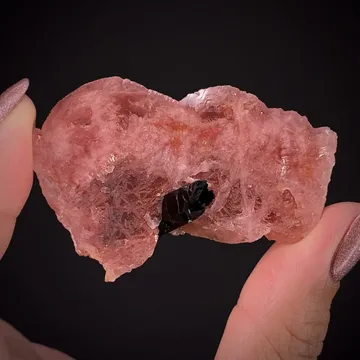
Gilgit, Pakistan — famed pegmatite locality yielding aquamarine, tourmaline and beryl; prized for high-mountain clarity, diverse minerals, and collector histor…
Key facts
“Gilgit, Pakistan” is one of those locality names that every serious pegmatite collector learns to read with both excitement and caution. On labels it may mean the town of Gilgit itself, the Gilgit District, the old “Northern Areas” trade route, or a broader Karakoram-Haramosh source area feeding the Gilgit and Skardu mineral markets. Strictly, Gilgit town is more important as a collecting and trading hub than as a mine site: many specimens sold historically as “Gilgit” came from high pegmatite districts scattered through the surrounding region, especially the Haramosh Mountains, Stak Nala, Shingus, Bulechi, Khaltaro, Shigar, Braldu, Hunza and Nagar. For collectors, that ambiguity is part of the locality’s history—and a reason why old labels, pocket notes and specimen morphology matter.
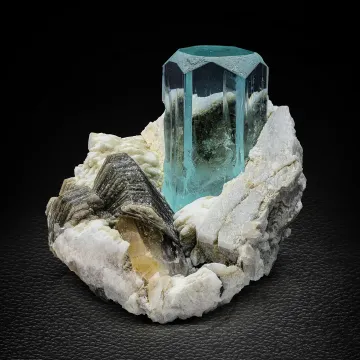
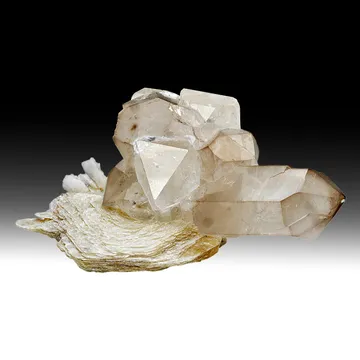
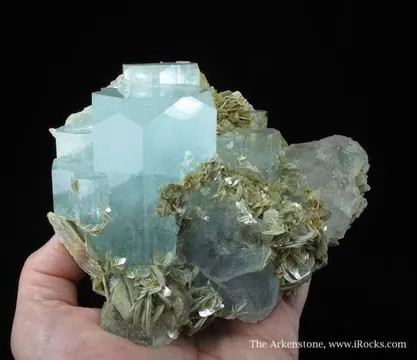
The specimens that made Gilgit famous are products of complex granitic pegmatites emplaced in one of the most dramatic tectonic settings on Earth: the collision zone between the Indian plate, the Kohistan-Ladakh arc and the Asian plate. In the Haramosh-Nanga Parbat region and the Shigar-Braldu systems, pegmatite dikes and sills cut gneiss, amphibolite, schist and granitic rocks, with gem crystals concentrated in miarolitic cavities, coarse-grained core zones and intermediate zones. The classic assemblage is instantly recognizable: aquamarine rising from snowy albite or pearly muscovite; dark schorl or green-black tourmaline standing in contrast to pale blue beryl; smoky or colorless quartz; microcline; fluorapatite; topaz; spessartine-almandine garnet; fluorite; and rare Be-Li-Nb-Ta accessory minerals.
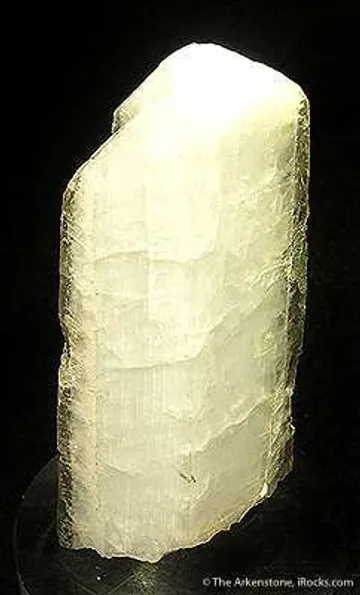
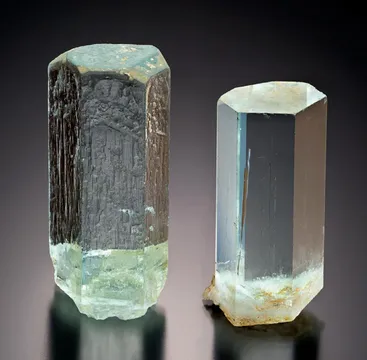
The best “Gilgit” specimens have a high-mountain clarity of design. Aquamarine is at its finest as upright, glassy, pale to rich blue hexagonal prisms on bladed albite or muscovite; tourmaline is prized when it shows sharp termination, strong luster and clean color zoning from black, green or brown stems to pink, colorless or blue caps. Ordinary pieces are abundant: single bruised aquamarines, loose schorl prisms, repaired crystals and matrix chunks with little balance. Exceptional pieces are another matter. A complete, unrepaired aquamarine group with true natural attachment, a fine Stak Nala tourmaline standing free of its cleavelandite matrix, or a well-documented old “Gilgit” aquamarine from the late 1980s and early 1990s still commands serious attention.
Regional View
Country View
The locality also matters because it helped introduce Pakistan’s northern pegmatites to the international specimen market. The 1985 Mineralogical Record article on the Shingus-Dusso gem pegmatites fixed the area in collector literature, and subsequent finds from Stak Nala, Shigar and Nagar broadened the picture. By the time Pakistani aquamarines and bicolored tourmalines were appearing regularly at international shows, “Gilgit” had become a shorthand label for a whole frontier of Karakoram pegmatite collecting.

Photo: Wikimedia Commons

Photo: Wikimedia Commons
Search for specimens: View all specimens from Gilgit, Pakistan
The deposit type represented by most collectible “Gilgit” material is gem-bearing granitic pegmatite, commonly complex and locally zoned. In the broader Gilgit-Baltistan pegmatite province, the important bodies occur as dikes, sills, lenses and irregular pegmatitic masses cutting high-grade metamorphic rocks and granitic bodies. The collectible crystals grew in open cavities rather than in massive ore. These pockets developed in coarse-grained internal zones where residual, volatile-rich fluids concentrated beryllium, boron, lithium, fluorine, phosphorus, niobium, tantalum and other elements needed for beryl, tourmaline, topaz, apatite, fluorite and accessory oxides.
The Haramosh and Shingus-Bulechi-Stak Nala pegmatites occupy a particularly significant structural position in the Nanga Parbat-Haramosh syntaxis. Pegmatite swarms there are hosted in the gneissic complex and related late-stage granitic intrusions; individual pegmatites may be only centimeters thick or several meters thick, and some have been traced for tens to more than a hundred meters. The bodies cut across foliation in places, follow joint systems in others, and have been deformed, faulted or altered after emplacement. Typical mineral proportions in the Haramosh pegmatites are feldspar-dominant, with quartz, muscovite, biotite and schorl as major accessories; the collector-grade material comes from vugs lined by albite, microcline, quartz, mica, aquamarine and tourmaline.
Stak Nala deserves special attention because it is one of the most famous tourmaline pegmatite localities associated with the Gilgit trade name. The tourmaline-bearing pegmatites lie north of the Indus River in the Stak Valley, reached historically from the Gilgit-Skardu road by a rough road toward Toghla and then on foot. Reports describe the main productive body as a roughly 1-meter-thick pegmatite sill, with another thicker pegmatite body to the south. The internal structure is zoned from border to wall to core, and pockets tend to occur in the upper part of the core zone. The specimens for which Stak Nala is remembered are euhedral elbaite and tourmaline-group crystals in cavities with quartz, feldspar, mica and cleavelandite; many are bicolored or tricolored, with dark bases and lighter, gemmier terminations.
The Shigar and Braldu systems, though not in Gilgit town, are closely tied to the way “Gilgit” specimens entered commerce. Shigar Valley lies along the Main Karakoram Thrust, with the valley system separating Asian-plate metasediments to the north from Kohistan-Ladakh arc rocks to the south. Its pegmatites occur near the Shigar and Braldu rivers at high elevation and range from simple to complex, from unzoned to well-zoned. In the Dassu, Niyit Bruk, Gone and Tisgtung areas, dikes and veins host pale blue aquamarine, schorl, topaz, feldspar, quartz, muscovite, fluorite, apatite, garnet and rarer accessory species. At Dassu, aquamarine occurs in vugs with quartz, feldspar and mica; at Niyit Bruk, the locality became noted for fine brown topaz; at Gone, aquamarine occurs with plagioclase, orthoclase, quartz, muscovite and schorl.
Mining history is mostly the history of small, seasonal and difficult pegmatite work rather than large-scale industrial mining. The Gemstone Corporation of Pakistan began systematic attention to northern Pakistan’s gem wealth around 1979, and local villagers, independent miners and small claimholders played a decisive role in actually finding and extracting the pockets. Stak Nala tourmaline was first found by local villagers in the early 1980s, after which the Gemstone Corporation of Pakistan investigated the area and documented important tourmaline-bearing pegmatites. The Khaltaro emerald occurrence in Gilgit District was discovered by the Corporation in 1985 during reconnaissance of Haramosh pegmatites. In Nagar Valley, a major aquamarine discovery by hunters in 1987 opened another stream of “Gilgit-Baltistan” aquamarine to the market.
Collecting access today should be considered highly restricted and local-permission dependent. These are not casual collecting sites. Many workings are on steep, unstable, high-altitude ground; some are reached by footpaths above river gorges, and historical reports describe mine portals cut into dangerous vertical rock faces. The great majority of material reaches collectors through miners, village dealers, Skardu and Gilgit intermediaries, Peshawar’s Namak Mandi trade, and international dealers. For the collector, the practical “access” issue is therefore provenance: whether a specimen is genuinely from the stated pegmatite, whether the matrix attachment is natural, whether repairs are disclosed, and whether a vague “Gilgit” label can be refined to Stak Nala, Shingus, Haramosh, Khaltaro, Shigar, Braldu, Nagar or another real source.
Tourmaline from the Gilgit collecting sphere is best understood through the Haramosh and Stak Nala pegmatites: crystals occur in miarolitic cavities with quartz, feldspar, mica and albite, and the finest pieces show sharp, lustrous, striated prisms standing free on cleavelandite or quartz rather than half-buried in massive pegmatite. Stak Nala is the classic source for bicolored and tricolored tourmaline, with opaque black, brown or dark green lower sections grading upward into translucent to transparent green, colorless, pink or blue terminations; specimens of a few centimeters are commoner than large, dramatic groups, and fully exposed, unrepaired crystals over 4 cm on matrix are legitimately choice. Good Gilgit-region tourmaline is separated from ordinary material by intact terminations, natural balance on matrix, visible zoning, clean luster and the absence of suspicious glue at the crystal base.
Aquamarine is the signature beryl of the Gilgit trade label, appearing as pale blue, greenish blue to richer blue hexagonal prisms from zoned pegmatites in the Haramosh, Shigar-Braldu, Hunza and Nagar systems. Northern Pakistan aquamarines commonly form long prisms up to the decimeter scale, while many commercial and study crystals fall in the 1–12 cm range; the better specimens are not merely loose gemmy sticks but crystals naturally set on albite, muscovite, feldspar, quartz or schorl. The most desirable Gilgit-labeled aquamarines have transparency, saturated blue color for the region, complete terminations, minimal bruising along prism edges, and a matrix that contributes architecture—pearlescent muscovite books, white cleavelandite blades, or contrasting black tourmaline—rather than acting as a crude support.
Indicolite from the Gilgit sphere is the blue to blue-green tourmaline component of evolved pegmatite material, most prized when it appears as a distinct gemmy zone or termination on elbaite rather than as a vague dark-blue cast in otherwise black tourmaline. In Stak Nala-style specimens, blue may occur toward the crystal end in combination with green, pink, colorless or darker basal zones, and the best pieces show the color transition clearly through a transparent or translucent termination. Because blue tourmaline is far less abundant than black schorl in the broader pegmatite assemblage, fine Gilgit-labeled indicolite is judged harshly: true blue color, undamaged termination, lustrous prism faces, natural matrix association with albite, quartz or muscovite, and credible source documentation make the difference between a collectible indicolite and a merely blue-leaning tourmaline label.
Other documented minerals in the Gilgit collecting region include albite and cleavelandite, microcline, muscovite, quartz, schorl, topaz, fluorapatite, fluorite, almandine-spessartine garnet, goshenite, morganite, phenakite, titanite, diopside, grossular, zoisite, tantalite-group minerals, columbite-group minerals, cassiterite, lepidolite and hydroxylherderite. The standout rarity is billwiseite, Sb3+5(Nb,Ta)3WO18, a rare Sb-Nb-Ta-W oxide described from the Stak Nala pegmatite and preserved as type material at the Royal Ontario Museum. Khaltaro, in Gilgit District, adds an unusual emerald story to the region: pegmatite-associated emerald and aquamarine occur in the Haramosh massif there, although the emeralds are generally pale, fractured and far rarer in the market than the aquamarines and tourmalines.
The first authenticity issue is locality precision. “Gilgit” on an old label may be historically meaningful but geographically imprecise. It may refer to Gilgit town as the point of purchase, to Gilgit District, to Gilgit-Baltistan, or to material that moved through Gilgit or Skardu from several mountain districts. When possible, refine the source to a real producing area: Stak Nala for classic bicolored tourmaline, Khaltaro for pegmatite-associated emerald, Shingus or Haramosh for aquamarine and schorl combinations, Shigar or Braldu for aquamarine-topaz-feldspar assemblages, or Nagar/Chumar Bakhoor for aquamarine on mica and feldspar.
The second issue is reconstruction. Recent gemological reporting from Pakistan has specifically documented artificially assembled mineral specimens circulating near mining areas and in local gem markets, including aquamarine crystals mounted onto matrix with resin-like adhesives. That warning is directly relevant to Gilgit-labeled aquamarine and tourmaline specimens because the highest prices are paid for exactly the forms that are easiest to fake by assembly: a clean aquamarine upright on muscovite, a tourmaline perched on cleavelandite, or a multi-crystal composition with dramatic balance. Examine the base of each crystal under magnification and long-wave UV; look for glossy glue seams, powdered matrix mixed with resin, unnatural sockets, crushed mica packed around a contact, colorless adhesive films, or a matrix that does not crystallographically or texturally relate to the crystal.
Repairs are common and not automatically disqualifying, but they must be disclosed. High-altitude pegmatite mining, hand extraction, blasting, transport by foot and mule, and later trimming all take a toll. Aquamarine bruises along prism edges and terminations; schorl and elbaite snap across the c-axis; cleavelandite blades shear away; muscovite books flake and shed. A repaired crystal can still be desirable if the repair is stable, limited and honestly described. A reconstructed specimen presented as natural is a different matter.
Treatments are more serious in gem rough and cut stones but can overlap with specimen buying. Aquamarine may be heated in the gem trade to improve blue color, though matrix specimens are more often suspect for assembly than for heat treatment. Beryl specimens from Pakistan have also been reported dyed, polished or oiled in deceptive contexts. Emerald from Khaltaro and elsewhere may be oiled to hide fractures. Fluorite and apatite can be oiled or coated to improve luster. Tourmaline may be irradiated in the broader gem trade, so faceting rough sold as untreated indicolite or elbaite should be tested when value warrants.
Fluorescence is not the main attraction for most Gilgit material, but it can assist inspection. Pakistani aquamarine studied from Shigar showed weak bluish white fluorescence under both long-wave and short-wave UV, while billwiseite is reported inert to ultraviolet radiation. In practical collecting, UV is most useful for detecting glue, coatings and filled cracks rather than for confirming locality.
Market availability is uneven. Small aquamarines, schorl associations and mica-matrix pieces from Gilgit-Baltistan are readily available, including fresh material. Fine old Stak Nala bicolored tourmaline on matrix is much scarcer, especially intact freestanding crystals from the early production period. Strongly colored, complete aquamarine groups on natural matrix are increasingly contested, and old-label Gilgit aquamarines with distinctive color-zoned, frosted, water-clear prisms have a following of their own. Khaltaro emerald specimens and verified billwiseite-bearing material are genuinely rare.
In the early 1980s, the Karakoram pegmatites were still a frontier for outside mineral dealers. Giuseppe Agozzino, then beginning his Pakistan field work, later recalled that he started in the Karakoram in 1981 with help from Balti people and completed more than 20 gem-mineral explorations between 1981 and 1984. His targets were the Haramosh Mountains and the country around Shigar, Basha and Braldu—names now familiar to collectors but then still emerging into the international specimen trade. At that time, the known aquamarine localities under active attention were few: the Dassu area along the Braldu River, the Shengus area, and Mount Haramosh.
The image of Dassu from those accounts is memorable: a village facing a huge granite wall beyond the Braldu River, the rock cut by hundreds of veins carrying blue aquamarine and sherry-colored topaz. This is the kind of terrain that explains why so many specimens reached the market through local networks rather than through formal, continuously operated mines. Pockets were not evenly distributed ore shoots; they were openings in hard rock, sometimes reached only by miners willing to climb, dig and break into a vein where a prospector’s eye had read something promising from feldspar, quartz, mica and tourmaline.
Shengus gives another vivid picture of the Gilgit-Skardu mineral road. A mine camp was set up beside the road linking Gilgit and Skardu, near the village of Shengus, only about 50 meters above the Indus River. Around the camp, aquamarine-bearing pegmatites were scattered through the mountains. The crystals from Shengus were described as elongated, brilliant and gemmy, though generally pale—exactly the kind of material that can be visually impressive on matrix but must be judged for natural attachment and condition.
The Stak Nala tourmaline story began locally. Villagers found tourmaline there in the early 1980s, and subsequent exploration by the Gemstone Corporation of Pakistan identified two main tourmaline-bearing pegmatite bodies about half a kilometer apart. Most production came from a single pegmatite sill only about 1 meter thick. That thin seam, hidden in high and difficult country, produced the bicolored and tricolored tourmalines now considered classic Pakistani material: dark bases, gemmy colored terminations, and cleavelandite jackets that make the crystals look as if they survived a storm of white blades.
The mining conditions around these pegmatites could be severe. A Baltistan gemstone-sector study described many deposits at elevations between 5,000 and 14,000 feet, with some workings in dangerous vertical rock faces. In the Shingus area, mines across the river were reached by a single wire and tray, pulled by hand. The report’s photograph captions are unforgettable: “What a bridge!” and “What a mine!” Mine owners told the field party that two fatal accidents had occurred in the Shingus area from falls near vertical mine portals. It is hard to look at a delicate aquamarine on albite in the same way after reading that; the specimen is not only a product of pegmatite chemistry, but of human nerve, poverty, mountain skill and risk.
Nagar added a later chapter. In 1987, hunters from villages in Nagar Valley discovered a major aquamarine deposit east of Karimabad in the Hunza region. The pegmatites were high—around 5,000 meters—and could be worked only for a short season each year. Enormous quantities of aquamarine reportedly came out, but much of it was specimen-grade rather than gem cutting material. For collectors, that distinction is crucial: a pocket can be commercially important because it yields many crystals, yet only a small fraction may have the composition, integrity and aesthetics needed for a top cabinet specimen.
Peters, Joseph J., Kazmi, Ali H., and Obodda, Herbert P. (1985), “Gem Pegmatites of the Shingus-Dusso Area, Gilgit, Pakistan,” The Mineralogical Record, 16(5), 393–411 — The foundational collector-mineralogical article for the Shingus-Dusso pegmatite district and the classic Gilgit-region aquamarine-tourmaline-topaz assemblage.
GIA, “Gem Pegmatites of the Shingus-Dusso area, Gilgit, Pakistan” abstract, Gems & Gemology, Spring 1986 — Contemporary gemological abstract summarizing the 1985 Mineralogical Record paper and placing the pegmatites in the suture zone between the Indo-Pakistan and Asian crustal plates.
Blauwet, Dudley, Smith, Bill, and Smith, Carol (1997), “A Guide to the Mineral Localities of the Northern Areas, Pakistan,” Mineralogical Record, 28(3), 183–200 — Important locality guide cited by Mindat for the caution that Gilgit town is chiefly a mineral trade center and that “Gilgit” labels are often regional.
Agheem, M. Hassan, Shah, M. Tahir, Khan, Tehseenullah, Arif, M., and Laghari, Amanullah (2010), “Mineralogical studies of the gemstones-bearing pegmatites of the Shigar Valley, Skardu, Gilgit-Baltistan, Pakistan,” Journal of Himalayan Earth Sciences, 43, 1 — Field and mineralogical study confirming topaz, aquamarine, tourmaline, goshenite, garnet, epidote-group minerals, quartz and fluorite in Shigar Valley pegmatites.
Agheem, M.H., Shah, M.T., Khan, T., Murata, M., Arif, M., and Dars, H. (2014), “Shigar Valley gemstones, their chemical composition and origin, Skardu, Gilgit-Baltistan, Pakistan,” Arabian Journal of Geosciences, 7, 3801–3814 — Chemical and genetic study of Shigar gemstones, useful for understanding magmatic-hydrothermal pegmatite formation in the region.
Hu, Yang, and Lu, Ren, “Aquamarine from Pakistan,” Gems & Gemology, Spring 2018 — Gemological study of Pakistani aquamarine, with data on habit, inclusions, fluorescence, chemistry and common matrix associations.
Hawthorne, F.C., Cooper, M.A., Ball, N.A., Abdu, Y.A., Černý, P., Cámara, F., and Laurs, B.M. (2012), “Billwiseite, ideally Sb3+5(Nb,Ta)3WO18, a new oxide mineral species from the Stak Nala pegmatite, Nanga Parbat-Haramosh Massif, Pakistan,” The Canadian Mineralogist, 50, 805–814 — Original full description of billwiseite from Stak Nala.
Handbook of Mineralogy: Billwiseite — Concise reference for billwiseite formula, occurrence, association with lepidolite and B-rich muscovite, type material and locality.
Mindat: Billwiseite mineral page — Database entry for the Stak Nala type-locality mineral and its crystallographic data.
Mindat: Khaltaro, Gilgit District, Gilgit-Baltistan, Pakistan — Locality page documenting the Khaltaro emerald-bearing pegmatite field, discovery history and mineral list.
GIA, “Reconstructed Specimens and the Rise of Deceptive Practices in Pakistan,” Gems & Gemology, Winter 2025 — Essential modern warning on glued, reconstructed, dyed, oiled and otherwise altered Pakistani specimens, including aquamarine on matrix.
“EXPLORING THE GEMSTONE MINES HUB OF GILGIT-BALTISTAN || GEMSTONE MINES OF PAKISTAN” — Discover Pakistan With Saif — Field-style video from the Rondu/Bulachi area showing the landscape and gemstone-mining context of Gilgit-Baltistan.
“DOCUMENTARY ON AQUAMARINE GEMSTONE CRYSTALS MINES OF PAKISTAN | SUMAYAR NAGAR GILGIT BALTISTAN” — YouTube documentary — Video focused on the Sumayar/Nagar aquamarine mining area and its associated gem minerals.
“Nagar Valley Aquamarine Mine Part-01” — Dailymotion — Older video on Sumayar/Nagar aquamarine mining and the regional gemstone trade.
“Aquamarine with Schorl & Quartz” — Vimeo — Rotational specimen media for a Shengus, Roundu District aquamarine with schorl and quartz, useful for studying aesthetics of Gilgit-Baltistan matrix pieces.
“Triple Aquamarine Crystals from Shigar Valley, Pakistan” — Vimeo — Specimen video illustrating luster and form in Shigar Valley aquamarine.
Mindat: Gilgit, Gilgit District, Gilgit-Baltistan, Pakistan — Best starting point for the strict locality record and the important note that Gilgit is chiefly a trade center for regional minerals.
Mindat: Gilgit-Baltistan, Pakistan — Regional mineral index for the wider territory from which many “Gilgit” trade-label specimens originate.
Mindat: Shigar Valley, Shigar District, Gilgit-Baltistan, Pakistan — Key regional page for Shigar-Braldu pegmatites, geology and mineral lists.
Mindat: Khaltaro, Gilgit District, Gilgit-Baltistan, Pakistan — Specific page for the high-altitude Haramosh emerald-bearing pegmatite field in Gilgit District.
GIA: Aquamarine from Pakistan — Concise gemological account of Pakistani aquamarine habit, associations, inclusions, fluorescence and chemistry.
GIA: Reconstructed Specimens and the Rise of Deceptive Practices in Pakistan — Important buying caution for aquamarine, beryl and other Pakistani matrix specimens.
Journal of Himalayan Earth Sciences: Mineralogical studies of the gemstones-bearing pegmatites of the Shigar Valley — Useful academic summary of Shigar pegmatite mineralogy and gemstone occurrence.
Gem-A: Memories of Pakistan — Giuseppe Agozzino’s recollections of Karakoram gem exploration in the 1980s.
Handbook of Mineralogy: Billwiseite — Compact reference for the Stak Nala type-locality mineral.
Wikimedia Commons: Beryl-150444.jpg — Publicly licensed photograph of an aquamarine specimen labeled Gilgit, Pakistan.
Wikimedia Commons: Tourmaline-Albite-51259.jpg — Publicly licensed photograph of classic Stak Nala bicolored tourmaline with cleavelandite.