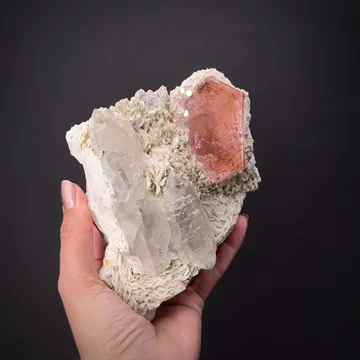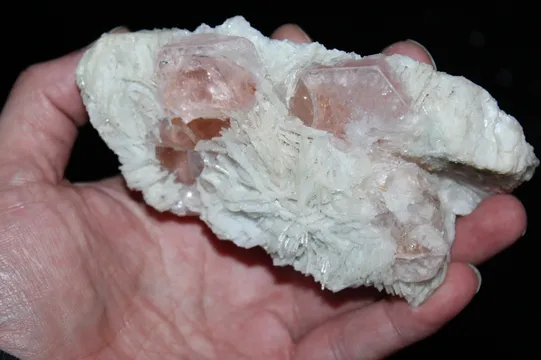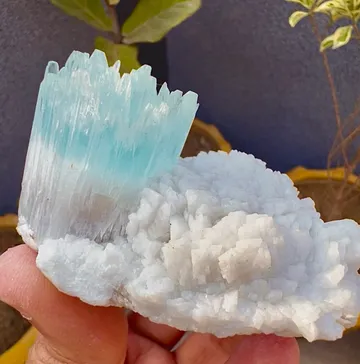
Morganite - pink to peach beryl with glassy hexagonal prisms; valued for pastel color, sizable crystals on matrix, and classic pegmatite localities.
Key facts
Morganite is the pink to peach variety of beryl (Be3Al2Si6O18), colored primarily by manganese. It ranges from delicate blush to rich salmon, sometimes with subtle lilac or orange overtones. Crystals are typically hexagonal prisms with bright, glassy luster and flat or complex terminations; in many pegmatites they are partially or deeply etched, yielding sculptural, “melted” faces prized for their natural artistry. The best specimens are transparent, pastel to saturated in color, and often contrast beautifully against white cleavelandite, smoky quartz, lepidolite, or schorl tourmaline.
Collectors value morganite for its soothing palette, gemminess, and association with classic pegmatite districts. It can occur as impressive crystals—often 5–15 cm, and sometimes giants exceeding 20–30 cm—yet fine, undamaged matrix pieces remain scarce. Prices vary widely: modest singles or etched fragments are accessible, while exceptional matrix specimens with vivid color, high clarity, and good size command top-tier prices.
Named in 1910 by George F. Kunz in honor of financier and mineral patron J. P. Morgan, morganite quickly became a darling of both the gem and specimen worlds. Early classic material from Madagascar and Southern California’s Pala District established its prestige, while later waves from Brazil, Afghanistan, Pakistan, and Mozambique brought renewed interest and fine crystals to market.
Its enduring popularity stems from the blend of elegance and rarity: pastel hues that glow under light, crystals large enough to impress in cabinet displays, and dramatic matrix combinations with cleavelandite and smoky quartz. Because much morganite suitable for cutting ends up faceted, truly fine, intact crystals—especially on matrix—are significantly rarer than the volume of cut gems might suggest. As a result, collectors continue to compete for top examples when they appear.
While morganite is found in many granitic pegmatites worldwide, a handful of districts have set the standard for quality, size, and aesthetics.
Southern California’s Pala District is historically significant for early morganite discoveries—romantic “rose beryl” crystals associated with lilac kunzite, cleavelandite, and smoky quartz. Classic Pala pieces show soft, even pink with excellent transparency and clean, textbook terminations. Although many crystals were cut, surviving matrix specimens—especially aesthetically perched prisms on white cleavelandite—are celebrated for their balance and contrast. Even small, undamaged singles remain desirable due to the district’s storied history and the scarcity of pristine material from early workings.
Paprok is famed for its refined pegmatite mineralogy, and morganite here often forms gem-clear, pastel pink prisms on delicate cleavelandite, sometimes with tourmaline and smoky quartz. The best are remarkably transparent, with crisp faces and balanced clusters that display exquisitely. True, undamaged matrix pieces are uncommon due to mining conditions, so intact, aesthetic specimens have become modern classics.
Pakistan’s high-altitude pegmatites have produced elegant morganites—often pale pink to peach, highly transparent, and associated with cleavelandite, smoky quartz, and schorl. Typical pieces are clean and modern in aesthetic: sharp, glassy prisms or lightly etched crystals with excellent luster. While sizes vary, the best display a harmonious interplay of pink beryl against snowy albite and dark quartz, making them showy and photogenic.
Color: The most coveted morganites display a vivid, even pink or warm peach-pink that reads clearly without backlighting. Saturation matters: medium to strong tones with minimal brown or gray overshadowing are more desirable. Some pieces show subtle color zoning; attractive zoning can add character, but uneven or washed-out areas detract. Lighting is key—LED or daylight brings out the glow; avoid judging color under overly warm bulbs.
Clarity and Luster: Transparency ranges from translucent to gem-clear. High clarity, especially in the termination and display face, greatly enhances value. Luster should be bright and glassy on prism faces and terminations. Etched crystals—common in Madagascar and Brazil—can be extremely aesthetic when surfaces are glossy rather than dull.
Crystal Form and Termination: Look for well-formed hexagonal prisms with clean edges and crisp terminations. Flat pinacoids and multi-faceted terminations are both prized if sharp. Etched forms can be spectacular in their own right, but symmetry still counts—balanced, sculptural etching is preferred over heavily corroded, shapeless masses.
Matrix and Associations: Morganite on white cleavelandite, with smoky quartz or lepidolite, is classic and visually striking. Balanced composition—crystal well-positioned and not crowded—always elevates appeal. Because pocket conditions often break crystals free, undisturbed matrix pieces are rarer and command strong premiums.
Condition: Morganite is hard (7.5–8) but can show parting parallel to the basal pinacoid and internal stress cracks. Chips on terminations or prism edges are common and significantly reduce value, especially on otherwise fine pieces. Seek specimens with minimal or no damage in primary display areas.
Scale and Presence: All else equal, larger crystals with strong color and clarity stand out, but a smaller pristine crystal on elegant matrix can outshine a bigger, damaged one. Evaluate the “glow” and the way the crystal interacts with light—great morganite tends to look radiant even without strong backlighting.
Repairs:
Polishing:
Color Treatments:
As always, buy from reputable sources and request disclosure on repairs or treatments. A well-documented, naturally colored, unrepaired matrix specimen is the gold standard.
Handling:
Light and Temperature:
Cleaning:
Storage:
By focusing on color purity, clarity, crisp form, and aesthetic matrix, collectors can build a morganite suite that is both historically meaningful and visually serene—gem crystals that softly command attention on any shelf.