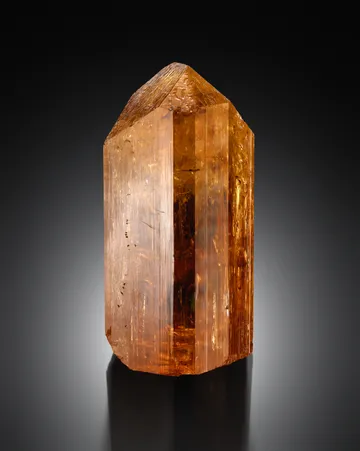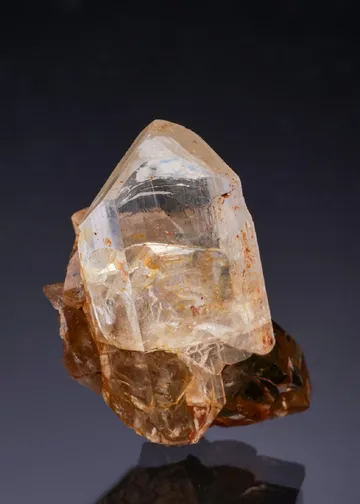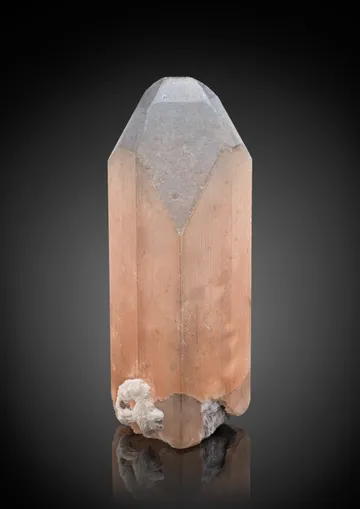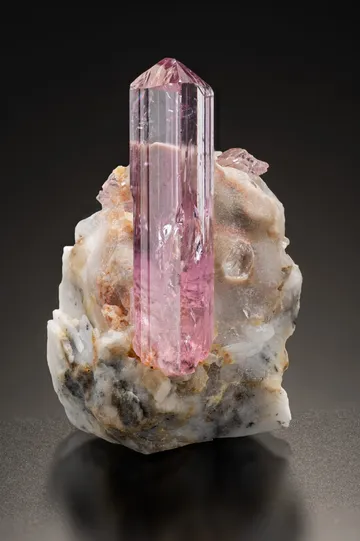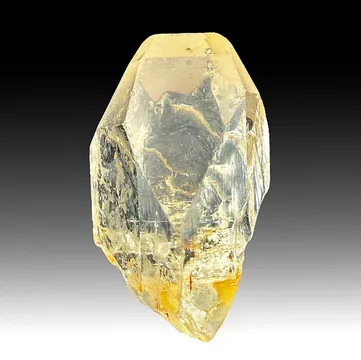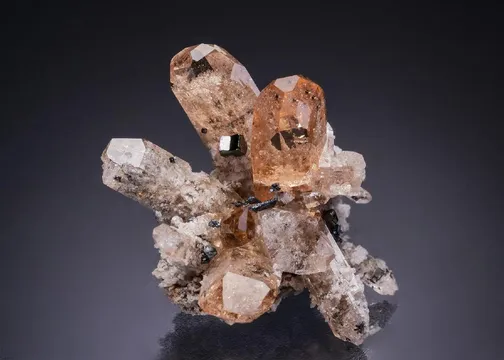
Topaz — hard, glassy orthorhombic crystals from pegmatites and rhyolites; colors range from colorless to pink; sharp terminations aid identification, localitie…
Key facts
Topaz, Al2SiO4(F,OH)2, is a premier collector species combining high hardness (Mohs 8), glassy luster, and sharply defined orthorhombic crystal forms. The classic habit is a prismatic crystal with vertical striations and simple, bright terminations, though complex or etched faces are common from certain localities. Its color range is broad: colorless, honey, sherry to cognac, golden “imperial,” peach, and rare pinks; pale blues occur naturally but are uncommon (most vivid blues seen in gems are irradiated and not typical for specimens).
Aesthetically, topaz excels as both single prisms and on matrix with quartz, feldspar, or mica from granitic pegmatites; dramatic rhyolite-hosted crystals from Utah offer a completely different look. The species’ perfect basal cleavage gives topaz its famed gem brilliance yet demands careful handling—crisp terminations and undamaged edges are highly prized. With iconic sources from Brazil’s imperial district to Pakistan’s rare pinks, Namibia’s sculptural pegmatite crystals, and Utah’s collectible sherry topaz, topaz sits squarely among the most coveted non-beryl silicates in fine mineral collections.
Topaz enjoys enduring popularity as both gem and mineral specimen. “Imperial” topaz from Ouro Preto, Brazil—saturated golden to orange-pink—has long been a trophy for collectors, with fine single crystals commanding major prices. The rediscovery and steady trickle of pink topaz from Katlang, Pakistan, created intense demand due to its rarity and captivating hue. Meanwhile, Utah’s Topaz Mountain made the species accessible to field collectors; fresh sherry crystals from the rhyolite vugs became a rite of passage for many enthusiasts.
In the pegmatite world, Namibia’s Erongo Mountains and Russia’s Murzinka provide elegant combinations on feldspar and smoky quartz, while etched “Volodarsk” topaz from Ukraine stands out for surreal dissolution patterns and limpid interiors. Top-tier specimens are fiercely competed for—especially large imperial crystals with fine color, pristine Utah sherries retaining natural hue, or truly pink, damage-free Katlang examples—yet the species remains approachable thanks to widespread modest-quality material. The result: broad appeal from beginners to connoisseurs, with a topaz “ladder” at every price tier.
While topaz occurs worldwide, a handful of classic districts define the species in collections. Below are renowned sources, each with a distinct aesthetic or color signature.
Ouro Preto (Minas Gerais) is synonymous with “imperial” topaz—saturated golden, orange, peach, and occasionally pink to reddish hues that glow under light. Crystals range from stout, limpid prisms to elongated, striated crystals with brilliant luster. True matrix specimens are rare; most crystals occur as singles from pockets or gravels. Collectors prioritize intense, even color, strong transparency, and undamaged terminations; larger crystals with rich color are exceptionally rare and valuable. Historically important pockets in this district set the benchmark for imperial color and purity, and the best examples stand shoulder-to-shoulder with elite pegmatite species in world-class cabinets.
Katlang (Mardan District) is famed for natural pink topaz—among the rarest and most coveted topaz colors. Fine crystals show delicate to saturated pinks, often with peach or champagne tones and brilliant, glassy faces. Most specimens are single crystals; matrix pieces are exceedingly uncommon. Because pink is both rare and light-sensitive in some cases, pristine, richly colored crystals with sharp terminations are fiercely sought. Katlang pinks occupy a unique niche, appealing to both gem and specimen collectors thanks to their color rarity and brightness.
Topaz Mountain (Thomas Range) yields vivid sherry to cognac-colored crystals from cavities in topaz-bearing rhyolite. Crystals range from sharp, gemmy prisms to frosted, naturally etched forms, commonly associated with bixbyite and red hematite coatings. Many are found as loose crystals liberated from their vugs. The classic sherry color can be light-sensitive and may fade with prolonged sun exposure; collectors therefore treasure examples that retain their hue and exhibit faultless terminations. Attractive, affordable, and historic, Utah topaz is a staple for North American collections.
Erongo pegmatites produce elegant topaz crystals—colorless to champagne and occasionally pale blue—showing classic prismatic form and strong luster. Many occur on aesthetic matrix with feldspar, schorl, and quartz, and some exhibit natural etching or growth patterns that give depth to the faces. Erongo pieces are prized for balanced compositions, contrasting white feldspar or smoky quartz, and the availability of larger, well-terminated crystals. Unrepaired, unreworked matrix specimens with strong display presence are the most desirable.
The Murzinka pegmatites of the Urals are a classic source of topaz on feldspar and smoky quartz. Crystals are typically colorless to champagne, occasionally sherry, with vitreous, sharply defined faces. Older finds produced beautifully composed matrix pieces embodying “textbook” pegmatite sculpture: topaz perched on orthoclase with smoky quartz accents. The best Murzinka pieces are admired for historic significance and refined crystallography, with crisp terminations and minimal damage.
Formerly known as Volodarsk-Volynskii, this Ukrainian district is renowned for etched and skeletal topaz crystals from granitic pegmatites. Many are limpid and colorless to pale honey, with dramatic dissolution features that create “landscapes” on the crystal faces. Some occur with amazonite and smoky quartz, making eye-catching combos. Collectors value these for their unique surface textures, clarity, and the mesmerizing way light plays across etched geometries.
Nigeria’s Jos Plateau is an alluvial source known for bright, water-clear topaz crystals, often as gemmy single prisms with smooth, high-gloss faces. Colors range from colorless to champagne; matrix pieces are unusual. A significant portion of the material historically fed the gem market, making large, pristine crystals desirable as specimen survivors. Clarity, size, and fresh, unabraded terminations are the key quality markers.
Color
Clarity and Luster
Crystal Form and Termination
Size and Proportion
Condition
Aesthetics
Repairs and Reattachments
Polishing and Restoration
Color Treatments
Handling
Light Exposure
Temperature and Environment
Cleaning
Storage
With attention to color, clarity, form, and careful stewardship, topaz can anchor a collection—from iconic imperial trophies to historic Ural matrix pieces, rare pinks, and the beloved sherry crystals of Utah.