A collector's guide to Aliabad, Pakistan: its geology, mining history and notable minerals, illustrated with the 41 specimens documented from this locality on EarthWonders.
Key facts
Aliabad is a deceptively compact name on mineral labels. In the specimen trade it has been used for fine “Nagar” and “near Aliabad, Hunza Valley” aquamarine–fluorite combinations from the high pegmatite country of Nagar, while the strict Aliabad marble locality refers to metamorphosed ruby-bearing marbles above the village. Serious collectors should understand both meanings, because older labels, dealer stock, and museum captions often preserve the broader Hunza/Nagar usage rather than the more precise modern locality names.
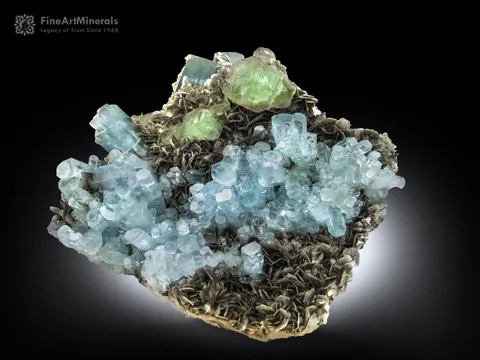
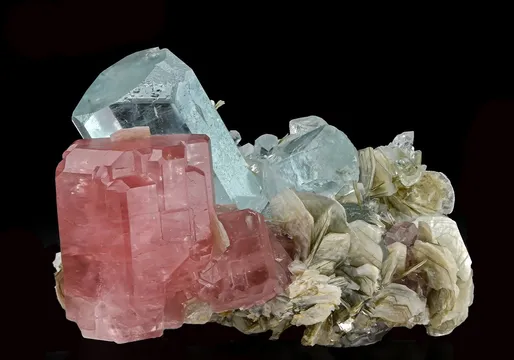
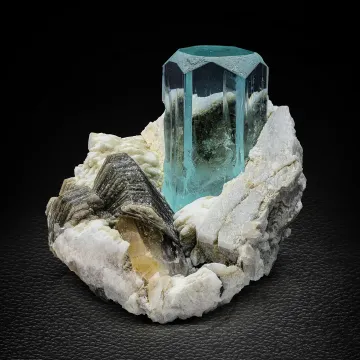
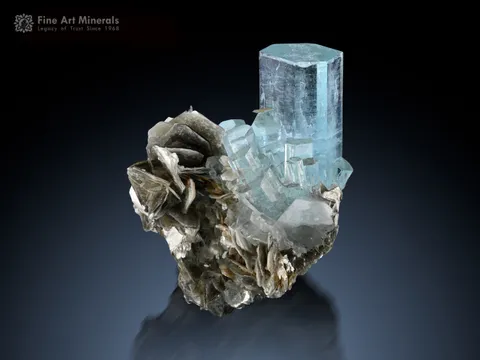
The classic collector image is the pegmatite suite: pale to saturated blue aquamarine crystals rising from honey, bronze, or silvery muscovite, sometimes with pink, green, or bicolored fluorite. The best examples are not simply loose gem rough; they are composed matrix specimens in which the beryl, mica, and fluorite look grown together in a pocket, with sharp terminations, glassy prism faces, and enough transparency to glow in strong light. These pieces belong mineralogically to granitic miarolitic pegmatites of the Nagar–Sumayar–Hunza region, not to the marble-hosted ruby bodies immediately above Aliabad village.
Regional View
Country View
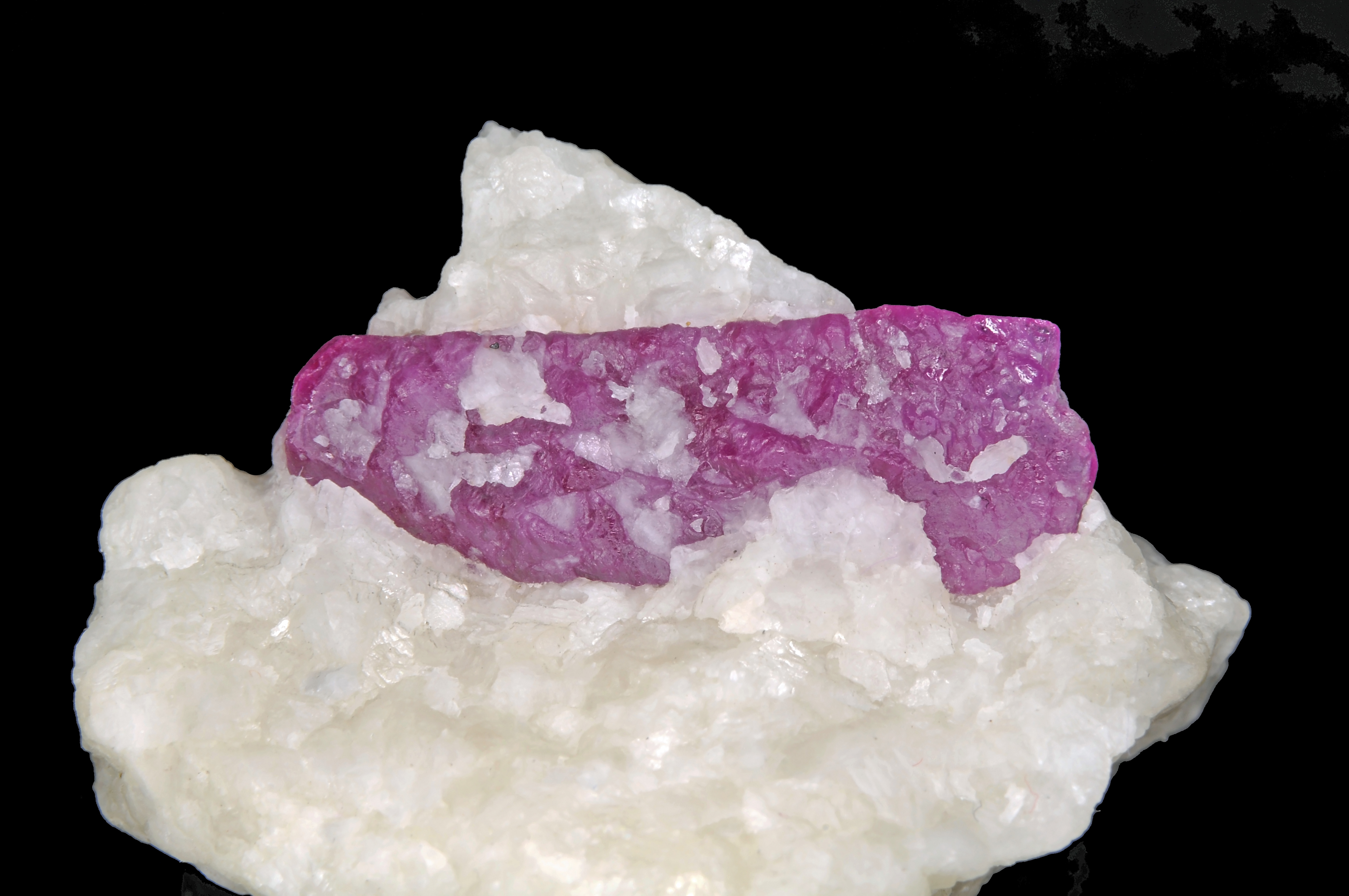
The other Aliabad story is the marble story: ruby, sapphire, spinel, and green pargasite in white calcite marble. These specimens are geologically unrelated to the aquamarine pegmatites but historically intertwined on labels because both occur in the same dramatic Hunza–Nagar collector landscape, where steep metamorphic slopes, road-building, artisanal workings, and high-altitude pegmatites supplied the mineral trade from the late twentieth century onward.

Photo: Rob Lavinsky, iRocks.com / Wikimedia Commons

Photo: Rob Lavinsky, iRocks.com / Wikimedia Commons
Search for specimens: View all specimens from Aliabad, Pakistan
Aliabad stands in the Hunza–Nagar mineral belt of Gilgit-Baltistan, where two very different deposit types have been conflated on historical labels. The strict Aliabad marble locality is a mine zone above Aliabad village in Nagar District, developed in steep marble levels reported as high as about 800 m above the village. The village itself lies on an alluvial terrace near the Hunza River and is not the actual bedrock source of the specimens. Labels reading simply “Aliabad” therefore need interpretation: ruby, spinel, sapphire, and pargasite point to the marble levels; aquamarine and fluorite on muscovite point instead to the nearby Nagar/Sumayar pegmatite tradition, especially material long traded as “Nagar,” “near Aliabad,” or “Aliabad, Hunza Valley.”
The marble deposit is a metamorphic corundum-spinel occurrence. Published petrologic work describes a calcite marble containing gem-quality ruby in the northwestern Karakoram, occurring as concordant intercalations within sillimanite- and garnet-bearing biotite-plagioclase gneisses and mica schists, with the metamorphic sequence cut by aplite and pegmatite dikes. The recognized marble assemblages include calcite with corundum, phlogopite, margarite, sheridanite, Al-rich pargasite, and anorthite, and a second assemblage of calcite with spinel, corundum, phlogopite, and sheridanite. Later genetic interpretations emphasized the role of evaporitic components and saline fluids in marble-hosted ruby formation during regional metamorphism.
The aquamarine–fluorite association that makes Aliabad labels attractive to collectors belongs to granitic pegmatites of the Nagar region, especially the high Chumar Bakhoor/Sumayar mining area. Modern descriptions of those pegmatites place aquamarine, fluorite, fluorapatite, muscovite, feldspar, quartz, topaz, and schorl in miarolitic cavities, where open space allowed crystals to grow freely rather than as compact massive gem rough. The muscovite matrix is part of the identity of the specimens: blades and books of mica form the bright, reflective stage on which aquamarine and fluorite crystals stand.
Mining history likewise divides into two strands. The Hunza ruby marbles were investigated and worked by government-related operators in the 1970s and after. Government summaries record Pakistan Mineral Development Corporation operating Hunza ruby mines from 1972 to 1979 and Gemstone Corporation of Pakistan operating from 1979 to 1994, with reported rough ruby production on the order of 0.1 million carats during the latter period. Field accounts also note old workings and occasional later activity in the Hunza Valley marble deposits, including signs of blasting and the beginning of corporate interest at some nearby ruby-bearing marbles.
The pegmatite story is more artisanal. Chumar Bakhoor is repeatedly described as a locally organized, high-altitude gemstone area, with miners from Sumayar working a compact group of pegmatites during a short season controlled by snow and elevation. The mines have been associated with a village miners’ association rather than a single large industrial operator, and the best specimens reached the international trade through local miners, brokers, and specialist dealers. The practical collecting season in the high pegmatites has been described as late July into October, while lower deposits in the region may be workable over a longer window.
Collecting access today should be treated as mining-rights dependent, not recreational. The marble and pegmatite sources are in steep, locally controlled mountain terrain; permission, local guides, current safety information, and respect for miners’ rights are essential. For collectors buying specimens rather than visiting, the most important locality issue is label precision. “Aliabad, Hunza Valley” on an aquamarine-muscovite specimen is best read as an older or broad trade label, while “Aliabad marbles” should be reserved for the corundum-spinel-pargasite marble assemblage.
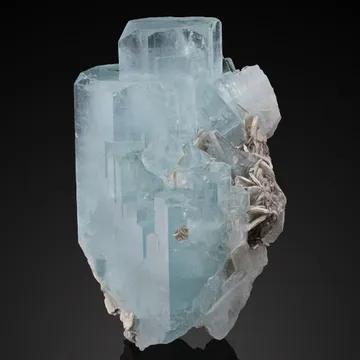
Aquamarine sold under Aliabad or “Nagar near Aliabad” labels is the pale-to-medium blue beryl of the Hunza–Nagar pegmatites, prized when sharp hexagonal prisms are naturally perched in bladed muscovite rather than detached as loose crystals. Cabinet examples documented from old dealer stock show crystals around 4–6.6 cm on matrix, commonly glassy, transparent to translucent, and associated with muscovite plus subordinate fluorite; fine pieces are separated from ordinary ones by undisturbed matrix contacts, bright unabraded terminations, pleasing crystal placement, and that unmistakable contrast between cool blue beryl and warm mica blades. The best specimens have enough clarity to read light through the crystal, enough color to avoid looking merely colorless, and enough matrix integrity that the aquamarine appears grown in place rather than seated into a mica “nest” after mining.
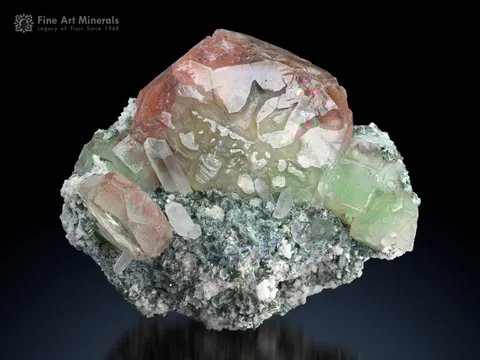
Fluorite from the Aliabad/Nagar label tradition ranges from delicate pink to green, pale yellowish, colorless, and bicolored crystals, most admired when it occurs with aquamarine on muscovite or as complete transparent pink crystals in their own right. Documented examples include cuboctahedral and octahedral forms, pink-green combinations to about 3 cm on aquamarine-muscovite plates, and a celebrated transparent pink spinel-twinned crystal measuring 8.5 x 5.4 x 2.2 cm with flat colorless epitaxial fluorite growths on a face. Quality hinges on completeness and transparency: a small, pristine, sharply modified fluorite with clean color zoning and no bruised edges is far more desirable than a larger but frosted or chipped crystal, especially because complete fluorite crystals on these mica-rich Pakistani matrices are much less common than aquamarine alone.
Other documented minerals tied to Aliabad in the strict marble sense include calcite, corundum as ruby and sapphire, spinel, pargasite, phlogopite, margarite, clinochlore var. sheridanite, anorthite, pyrite, and norbergite. The ruby-spinel-pargasite-calcite assemblage is the important rarity suite here, with green pargasite crystals providing one of the most recognizable visual signatures of the Hunza marbles. In the broader Nagar pegmatite context behind many aquamarine and fluorite labels, the common associates are muscovite, albite, microcline, quartz, fluorapatite, topaz, and schorl.
For Aliabad-labeled aquamarine and fluorite, the major authenticity problem is not synthetic material; it is construction, repair, and locality imprecision. Pakistani aquamarine on muscovite is a beautiful but vulnerable specimen style, and broken crystals can be reattached, loose aquamarines can be seated into unrelated mica, and accessory fluorite or apatite can be added to make a more valuable “combination” specimen. A disclosed repair to an original contact may be acceptable on an otherwise important piece. An undisclosed assembled specimen is not.
Examine the crystal-to-matrix contact before admiring the termination. On a natural aquamarine-muscovite specimen, mica blades should wrap or terminate plausibly around the beryl, with no carved socket, crushed mica paste, glossy resin, odd white filler, or suspiciously perfect gap around the base. Under magnification, look for glue films, dust trapped in adhesive, sudden changes in luster at the base, and a crystal whose broken underside does not match the matrix cavity. Ultraviolet light can help reveal some adhesives, but it is not definitive; many modern repairs are subtle.
Condition issues are common and locality-specific. Muscovite blades bruise, bend, and shed easily. Fluorite edges nick readily, especially on exposed octahedral or cuboctahedral corners. Aquamarine terminations are harder but still commonly chipped at the top or around basal repairs. Because the matrix is often more fragile than the main crystal, aggressive cleaning is a mistake; use minimal water, a soft brush, and no ultrasonic cleaning for composite aquamarine–fluorite–muscovite pieces. Handle by the matrix only if it is structurally sound, and never by an aquamarine crystal projecting from mica.
For Aliabad marble specimens, watch for oiling, resin, or assembly of ruby in calcite or pargasite-bearing marble. Bright red corundum in white marble is visually compelling and easy to enhance or misrepresent, so provenance matters. Many ruby crystals are included, fractured, or partly embedded; clean, sharp, saturated red crystals on undamaged marble are scarcer than casual market listings suggest. Pargasite and spinel specimens should be checked for abrasion against the white marble matrix and for repaired protruding crystals.
Market availability is uneven. Representative aquamarine on muscovite from the broader Nagar/Sumayar source area is regularly available, but fine, unrepaired, well-balanced matrix pieces with aquamarine and fluorite together are much less common. Pink or bicolored fluorite specimens with strong transparency and clean edges are sought after. Strict Aliabad marble specimens—ruby, spinel, sapphire, and pargasite—appear more sporadically, and good locality documentation significantly improves their desirability.
The most repeated origin story begins with a local hunter, Muhammad Shah, in 1984. The account belongs to the Chumar Bakhoor side of the Aliabad/Nagar label problem: a high pegmatite area in Sumayar that later became one of the great Pakistani aquamarine sources. Before the name Chumar Bakhoor became standard on labels, much of the material circulated more broadly as Nagar, Hunza, or near Aliabad. That is why an old collection label can be both historically honest and geographically imprecise.
The geography explains the romance and the confusion. From the valley settlements, the pegmatites are not casual roadside prospects but high mountain workings reached by hours of climbing. Field accounts describe miners’ camps overlooking the Hunza Valley and a season compressed by altitude, snow, and weather. In one widely cited account, the Sumayar miners’ association allowed 55 groups of six men each to work the Chumar Bakhoor pegmatites, with the income benefiting the village. That communal mining structure is part of the reason these specimens carry such a local identity: they are not products of a giant mechanized mine but of small teams working pockets in unforgiving terrain.
Jim Clanin’s 2007 field reconnaissance gives the locality its most practical voice. Before visiting workings, his party met miner groups or associations, explained its purpose, and was usually assigned a guide. Some mines were turned down because they were too inaccessible or dangerous. At high elevations, pockets could remain frozen, engines could fail, air pressure could defeat pneumatic equipment, and every useful item had to be carried upward by donkey, horse, or by the miners themselves. In this setting, a complete aquamarine-on-muscovite plate is not just a pretty object; it is something that survived blasting, extraction, descent, packing, and a long chain of trade.
The same reconnaissance makes the Hunza ruby marbles feel entirely different from the aquamarine pegmatites. Clanin visited six ruby localities in five days in the Hunza area, with workings along the east side of the Hunza River. The ruby-bearing marbles were described as part of the Karakoram metamorphic belt north of the Main Karakoram Thrust, and the sequence could be traced regionally. At Aliabad, Ganesh, Dhorkan, and neighboring localities, the marbles carried the familiar suite of micas, spinel, pyrite, rutile, graphite, and corundum. Some workings had been opened years earlier by government operators; later evidence included fresh blasting smells and signs of renewed activity.
One of the most memorable single-specimen stories is a fluorite. A transparent pink spinel-twinned crystal from Aliabad, 8.5 x 5.4 x 2.2 cm, was photographed and described by Rob Lavinsky with the comment that a mineral buyer who visited remote places bought every one of these he saw, “and that’s not many.” The crystal was complete enough to show the re-entrant angle of the spinel twin from the side, and it carried two flat colorless fluorite crystals epitaxially grown on a face. That little detail—the pink fluorite with colorless plates on it—is the kind of thing that turns a locality example into a connoisseur specimen.
A newer episode comes from gemological microscopy rather than fieldwork. A Chumar Bakhoor aquamarine weighing 1418 ct and measuring about 77 x 55 x 45 mm was documented with twelve white octahedral fluorite inclusions visible inside the beryl, each about 5–10 mm across. External fluorite with aquamarine on muscovite is the familiar combination. Fluorite sealed visibly inside aquamarine is another level of rarity, and the specimen was described as surprising after four decades of mining.