A collector's guide to Broken Hill, Australia: its geology, mining history and notable minerals, illustrated with the 727 specimens documented from this locality on EarthWonders.
Key facts
Broken Hill is one of the essential names in mineral collecting: a supergiant silver-lead-zinc deposit in far western New South Wales whose specimens join economic geology, metamorphic petrology, mining history, and classic cabinet aesthetics in one locality. The lode lies within the Paleoproterozoic Willyama Supergroup of the southern Curnamona Province, where originally stratabound sulfide-rich horizons were folded, overturned, recrystallized, and partly remobilized during high-grade metamorphism. That long geological overprint is exactly what gives Broken Hill its collector character. The ore is not merely galena and sphalerite; it is galena and sphalerite intergrown with manganese silicates, garnets, pyroxenoids, carbonates, phosphates, silver halides, arsenates, tungstates, and a remarkable suite of rare secondary species.
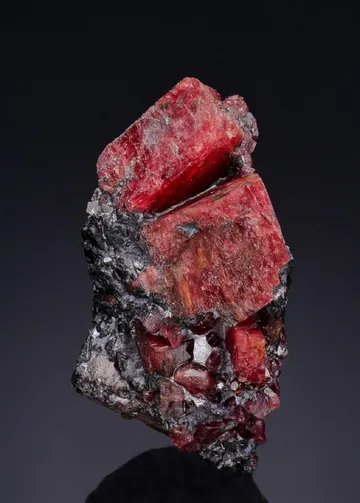
Collectors prize Broken Hill for two visual worlds. The first is the deep primary lode: lustrous, lead-gray galena hosting red rhodonite, spessartine, bustamite, manganoan hedenbergite, calcite, apatite, and related silicate assemblages. The second is the oxidized zone: silver halides, cerussite, smithsonite, pyromorphite, anglesite, coronadite, goethite, copper minerals, and a parade of micro-species from the open cuts and dumps. At its best the locality has a look that is instantly recognizable—rhodonite crystals flashing raspberry to clove-red out of metallic galena, reticulated cerussite like frozen lace, bubbly pale smithsonite on dark manganese oxide, and minute but brilliantly important rare species from Kintore and Block 14.
Broken Hill also matters because it is the type locality for the broad family of “Broken Hill-type” deposits and because the mine founded one of Australia’s great industrial companies. Charles Rasp’s 1883 discovery of heavy black material on the ragged outcrop called the “broken hill” led within two years to the Broken Hill Proprietary Company. The orebody became the Line of Lode: a long, arcing, deeply mined mineralized system that supported a major outback city, transformed Australian mining and metallurgy, and supplied museums and private collections worldwide with specimens for more than a century.
Regional View
Country View
The richness of Broken Hill specimens is inseparable from the deposit’s deformation. The sulfide lenses were folded into a complex boomerang-like geometry, and the same structural complexity that challenged generations of mine geologists also created the pockets, shears, fault cavities, oxidized shoots, and remobilized pods that collectors know by mine names and block numbers. North Mine rhodonites, Zinc Corporation and New Broken Hill Consolidated fault-zone carbonates, Kintore and Block 14 oxidized-zone micros, and old BHP Mine cerussites are not interchangeable labels; each represents a different episode in the orebody’s mineral history.


Search for specimens: View all specimens from Broken Hill, Australia
Broken Hill is in Yancowinna County, western New South Wales, near the South Australian border. The mineralized belt runs through and beneath the city as the famous Line of Lode, the eroded surface expression of a much larger, steeply plunging and structurally complex ore system. In collector terms, “Broken Hill” can refer broadly to the city and its historic line of mines, but good labels should ideally specify the mine, lease block, open cut, shaft, lens, or dump where that information has survived.
The deposit is a metamorphosed silver-lead-zinc system hosted by high-grade metasedimentary and meta-igneous rocks of the Willyama Supergroup. Modern descriptions commonly treat the ore as a Broken Hill-type deposit, broadly related to stratiform sediment-hosted or exhalative base-metal mineralization but profoundly modified by later metamorphism and deformation. The primary ore is not a simple vein. It consists of separate stratabound sulfide lenses, folded, repeated, overturned, and locally remobilized, so that lead-rich and zinc-rich horizons could be mined as distinct lodes. Galena and sphalerite are the principal ore minerals, but the defining Broken Hill gangue includes rhodonite, spessartine-rich garnet, manganoan hedenbergite, quartz, calcite, bustamite, fluorapatite, gahnite, wollastonite, and other silicate and carbonate minerals.
The classic lode terminology is important for serious labels. The main system includes lead lodes such as 2 Lens and 3 Lens and zinc lodes such as 1 Lens, A Lode, B Lode, and C Lode. The lodes differ in gangue mineralogy: some are quartz-garnet-rich, others calcite-rhodonite-rich, others more dominated by manganese pyroxenes and pyroxenoids. The North Mine became especially noted for superb rhodonite from 3 Lens. Bustamite was particularly associated with calcite-rich parts of 2 Lens and high-grade shear zones, including Zinc Corporation stopes between the 18 and 20 levels. At New Broken Hill Consolidated, fayalite and ilvaite were reported from margins of large rhodonite masses against banded calcite ore, especially between the 19 and 21 levels.
The oxidized zone produced many of the locality’s most collectible secondary specimens. The original outcrop was a ragged manganiferous ironstone ridge, not a broad cap of uniform gossan. Near-surface oxidation was concentrated where the mineralization came closest to the surface in the central part of the field, particularly around the upper Broken Hill Proprietary ground. Early mine geologists distinguished manganiferous iron ore at the surface, silver-rich dry high-grade kaolin ore, carbonate lead ore rich in cerussite, lower-grade oxidized mixtures, and underlying sulfide ore. Some oxidized cavities were on a spectacular scale: large vughs in the ironstone body of ML 11 were described as ranging from roughly room-sized to several metres long, with black coronadite stalactites coated or floored by smithsonite. The zone between oxidized and sulfide ore also carried supergene silver sulfides and blocks of native copper.
Mining began after Charles Rasp, a boundary rider on Mount Gipps Station, pegged the first claim on 5 September 1883, assisted in the early stages by David James and James Poole. The Syndicate of Seven organized the early venture, and Broken Hill Proprietary Company Limited was floated in 1885. The first years worked the rich oxidized silver-lead ores; as mining went deeper, the enormous sulfide body presented metallurgical problems, especially in recovering zinc from complex sulfide ore. Broken Hill became a proving ground for flotation, including the Potter-Delprat process, an innovation with worldwide importance in base-metal metallurgy.
Mining along the Line of Lode evolved through a succession of companies and workings, including the Broken Hill Proprietary Mine, Broken Hill South, North Broken Hill, Zinc Corporation, New Broken Hill Consolidated, Southern Cross, British, Block 14, Kintore, Blackwood, and later Rasp operations. Underground workings dominated the great era of the field, while later open cuts exposed and redistributed oxidized and remnant ore. Kintore and Block 14 were especially important to collectors because late twentieth-century open-cut mining made oxidized material accessible and produced large numbers of rare and attractive species, including minerals later described as new. Material from these open cuts, including ore dumped elsewhere such as at the Pinnacles area, became a major source of Broken Hill micros and small cabinet specimens in the modern collecting era.
Current mining has continued in the district into the twenty-first century. The modern Rasp Mine works silver-lead-zinc mineralization in the city area, including Western Mineralisation and parts of the original Main Lode, using underground methods and flotation processing. Broken Hill Mines reports a JORC 2012 mineral resource for Rasp and describes the operation as centrally located within Broken Hill. For collectors, that means the classic locality is not simply abandoned heritage ground; it includes active mining leases, operating infrastructure, fenced open cuts, tailings facilities, and areas where access is controlled for safety, environmental, and legal reasons.
Collecting access today is therefore limited and should be treated as permission-based. Historic specimen availability came from mine employees, organized access, old dumps, open-cut operations, and material dispersed into collections and dealer stock. Some dump material has been fossicked in the past, particularly oxidized ore associated with Kintore and Block 14, but an old collecting story is not a present access right. Much of the Line of Lode is within active or heritage-managed mining ground, and mine dumps may be on leases, council-managed land, private land, or contaminated ground. Visitors should expect to buy specimens from established dealers or local mineral shops, visit museum collections, and obtain explicit permission before entering or collecting on any mine or dump site.
At Broken Hill, galena is less often the showy “lead cube” of textbook displays than the heavy, blue-grey to steel-grey sulphide matrix that makes the locality’s red silicates and secondary lead minerals so unmistakable: lustrous cleavage masses and crude to well-formed cubic/octahedral patches host cherry rhodonite, orange-red spessartine, and later cerussite, anglesite, pyromorphite, stolzite, minium, native silver, and occasional chalcocite or sulphur. The classic cabinet aesthetic is the sharp colour break between metallic galena and ruby rhodonite or glassy spessartine, especially material from the North Mine and Broken Hill Proprietary workings; more oxidised pieces from the old open-cut and gossan zones may carry cerussite or anglesite directly on altered galena. Ordinary Broken Hill galena is abundant, massive, and dull from handling or oxidation; the better collector pieces show bright metallic faces, well-exposed cleavage geometry, undamaged associated red silicates, and enough galena mass to make the specimen read unmistakably as Broken Hill rather than as a generic sulphide ore chunk.
Broken Hill rhodonite is one of the defining classics of Australian mineral collecting: blood-red to cherry-red, commonly transparent to translucent in the best crystals, and typically set in coarse metallic galena with spessartine, calcite, bannisterite, arsenopyrite, bustamite, sphalerite, quartz, chalcopyrite, fluorapatite, and pyrosmalite-group minerals. The famous habits are prismatic, bladed, or tabular crystals, sometimes in parallel groups, ranging from small gemmy individuals under a centimetre to crystals of several centimetres; the Australian Museum’s celebrated 1700 ft level Zinc Corporation Mine specimen is a compact 5 x 3 x 0.7 cm group of sharp parallel blades, while published gemological work records rhodonite crystals in ore from the North Mine 25/26 level ranging from a few millimetres to 70 mm, with inclusions of galena, sphalerite, quartz, and fluorite. The most desirable pieces are not merely pink manganese silicate: they have saturated red colour, glassy luster, sharp terminations, translucency when backlit, and undamaged crystals standing proud of the galena; mediocre pieces tend to be massive, fractured, brownish, or show only broken rhodonite embedded flush in ore.
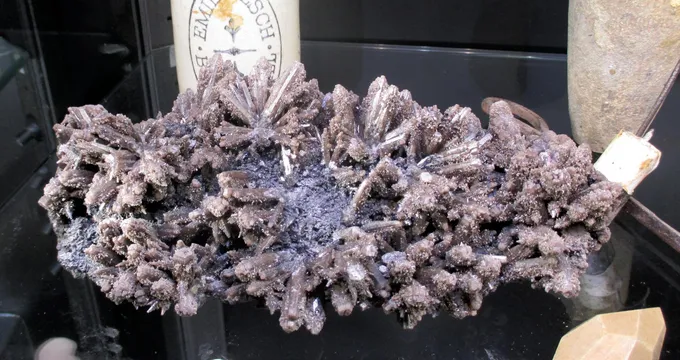
Cerussite from Broken Hill is world-class and unmistakably tied to the oxidised lead zone: colourless to white, bright, heavy crystals occur as bladed individuals, reticulated “snowflake” lattices, arrowhead twins, and open, fragile frameworks on gossan or galena-rich matrix with anglesite, chlorargyrite, malachite, smithsonite, coronadite, azurite, goethite, minium, spessartine, cuprite, native copper, pyromorphite, and calcite. The great benchmark is the BHP Block 14 Mine material; one Australian Museum specimen from that mine, collected before 1930 and registered in 1933, measures 33 x 27 x 12 cm and carries reticulated blades reaching 28.7 cm, an extraordinary scale for such fragile lead carbonate. Fine Broken Hill cerussite is judged by openness of form, sparkle, intact terminations, freedom from bruising, and the presence of a natural matrix; commoner examples are small broken blades, cloudy masses, or detached fragments whose locality appeal is historical rather than sculptural.
Broken Hill smithsonite belongs to the great oxidised-zone suite rather than to the primary sulphide ore: it occurs with cerussite, anglesite, coronadite, chlorargyrite, goethite, azurite, kaolinite, malachite, rosasite, aurichalcite, pyromorphite, galena, sphalerite, spessartine, calcite, and native silver from localities including the Proprietary Mine, Block 14, Kintore opencut, the MMM/Blackwood area, Junction, and Potosi. Colours range through white, cream, yellow, blue, and the prized copper-influenced apple green; habits include sharp dog-tooth crystals as well as rounded, bubbly, tear-drop, and silky botryoidal coatings, with the Australian Museum recording a 6.5 x 8.5 x 3.5 cm Proprietary Mine smithsonite-on-cerussite specimen from the Albert Chapman Collection. Better Broken Hill pieces have fresh lustre, distinct form, attractive colour zoning or green “bubble” coverage, and a readable association with cerussite, coronadite, or gossan; chalky crusts and dull white patches are far more ordinary unless they sit on a strong historic matrix.
Spessartine is the garnet that gives many Broken Hill sulphide specimens their second flash of red-orange fire: sharp dodecahedral to modified dodecahedral crystals occur in and on galena, commonly with rhodonite, chalcopyrite, sphalerite, bustamite, fluorapatite, hedenbergite, and quartz, with the North Mine especially noted for classic examples. Most collector specimens are thumbnails to small cabinets, but the visual drama comes from individual garnets in the several-millimetre to centimetre range; documented specimens show glassy cherry-red to reddish-orange crystals to about 7 mm on North Mine galena-rhodonite matrix, and representative trade pieces include modified dodecahedra reaching around 1 cm, with larger crystal claims usually needing careful damage inspection. The best Broken Hill spessartines glow when backlit, stand in relief rather than being swallowed by galena, and show sharp faces without abrasion; lesser examples are dark, granular, or simply garnet-rich ore where the crystals are too embedded to display their form.
Pyromorphite was one of the richer secondary lead minerals of the Broken Hill oxidised zone, and the locality produced a notably broad range of habits and colours: green, yellow, brown, pale grey, and arsenian varieties occur as needles, slender prisms, intergrown sprays, and stout barrel-shaped hexagonal crystals on gossan, galena, smithsonite, cerussite, anglesite, stolzite, chlorargyrite, malachite, goethite, and coronadite. A classic Australian Museum specimen from the 150 ft depth at BHP Block 14 Mine, registered in 1907, is a 9.5 x 14 x 7 cm plate bristling with clove-brown barrel crystals, while Blackwood opencut material from the MMM Mine is known for lustrous lime-green prisms to about 5 mm on a 9.5 x 5.9 x 3.6 cm example; analytical work on 28 Broken Hill specimens showed compositions ranging from near end-member pyromorphite to arsenian pyromorphite, with local zoning tied to changing oxidised-zone solutions. Choice pieces here combine saturated colour, clean hexagonal form, and a natural gossan or sulphide matrix; granular green crusts are collectible but do not carry the same weight as discrete, lustrous crystals with depth or mine provenance.
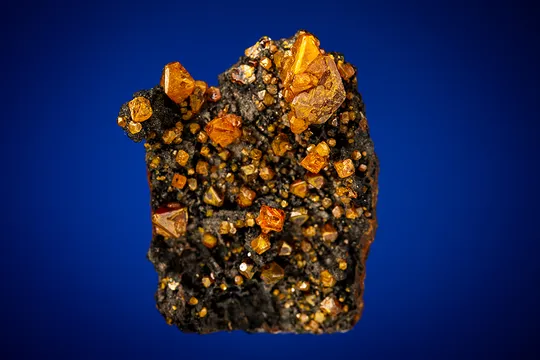
Broken Hill stolzite is a small but serious collector’s mineral: honey, straw-yellow, orange-brown to smoky crystals form sharp tetragonal dipyramids on iron-rich gossan and altered lead ore, most characteristically with raspite, pyromorphite, wulfenite, galena, limonite, quartz, chlorargyrite, kaolinite, marshite, coronadite, and cerussite. The Proprietary Mine yielded particularly important material, including the Australian Museum’s George Smith Collection specimen registered in 1907, a 9 x 8 x 6 cm gossan piece with crystals to 2 cm; Broken Hill records also include Block 10, Block 14, Kintore, Junction, and Zinc Corporation Mine occurrences. The finest specimens are valued for isolated, lustrous, complete dipyramids standing proud of dark matrix, ideally with warm honey colour and undamaged edges; ordinary examples are minute crusts, resinous brown specks, or confused mixtures with raspite where the stolzite identity and form are not visually compelling.
Calcite at Broken Hill is best understood as a versatile gangue and secondary species across the Pb-Zn-Ag system rather than as a single famous pocket style: colourless, white, cream, pale brown, and manganese-tinted pink calcite occurs with pyrite, bustamite, galena, rhodochrosite, sphalerite, fluorite, rhodonite, inesite, quartz, chalcopyrite, fluorapatite, kutnohorite, spessartine, bannisterite, baryte, smithsonite, siderite, alabandite, and pyromorphite. In specimens it appears as cleavages, rhombohedral or scalenohedral crystals, drusy cavity linings, and spiky pale aggregates on sulphide or gossan matrix; old descriptions also note creamy calcite associated with pyrite on galena-rich Broken Hill material, while manganese-rich pink calcite adds colour to ore pieces otherwise dominated by dark sulphides. Good Broken Hill calcite specimens earn their place by association—sharp calcite with rhodonite, bustamite, inesite, rhodochrosite, or galena is far more interesting than plain carbonate cleavage—and by freshness, translucency, undamaged points, and the ability to frame the more diagnostic Broken Hill minerals rather than obscure them.
Anglesite is one of the great oxidised lead minerals of Broken Hill, forming colourless, pale yellow, honey, smoky-grey, brownish, and locally dark crystals in cavities and altered galena, commonly with cerussite, galena, smithsonite, coronadite, goethite, linarite, chalcocite, chlorargyrite, spessartine, pyromorphite, kaolinite, native sulphur, brochantite, native copper, marshite, aurichalcite, and chalcopyrite. Classic habits include thick prismatic to blocky orthorhombic crystals and flattened prisms; published locality notes record Broken Hill crystals up to 5 cm in galena cavities, smoky grey to black from included unoxidised galena, while illustrated “best of species” discussions cite sharp yellow prismatic crystals to 8 cm rising from matrix. Top pieces have glassy lustre, transparency or a rich smoky internal glow, strong orthorhombic form, and association with cerussite or galena that explains their oxidised-zone origin; broken, etched, or merely massive pale lead sulphate is much more routine.
Chlorargyrite, the silver chloride of the Broken Hill oxidised silver suite, is a specialist’s prize rather than a flamboyant cabinet mineral: waxy yellow-green, greenish-grey, brownish-green, butterscotch, or darkening resinous AgCl occurs as crusts, cubic crystals, rounded masses, and bromine-bearing varieties on gossan or oxide matrix with cerussite, iodargyrite, coronadite, spessartine, smithsonite, quartz, malachite, goethite, rosasite, native silver, kaolinite, chalcophanite, acanthite, atacamite, stolzite, azurite, raspite, pyromorphite, minium, anglesite, pseudomalachite, brochantite, and occasional molybdenite. The old Block 14, BHP, Kintore, and Junction-style silver-halide specimens are important because Broken Hill produced unusually rich and well-preserved halide assemblages, including bromian chlorargyrite with iodargyrite; colour matters, because fresh green to yellow-green material is more appealing than darkened, featureless horn silver. Strong examples show recognizable waxy crystals or coherent sheets on contrasting coronadite, malachite, cerussite, or gossan and carry old provenance; ordinary pieces are small, dirty, easily misread crusts that need confidence in label and association.
Native copper from Broken Hill belongs to the oxidised-zone story: it occurs as arborescent, branching, cylindrical, hackly, or wiry masses with malachite, cuprite, cerussite, ktenasite, paratacamite, atacamite, brochantite, pyromorphite, anglesite, nantokite, garnet-group minerals, and chlorargyrite. The Proprietary Mine produced particularly attractive old specimens, including an Australian Museum example registered in 1936 that measures 9.5 x 8 x 1 cm and shows branching cylindrical copper crystals; that piece came from the Philip Charley collection, linking it to one of the original Broken Hill syndicate figures and possibly to very early collecting. The best Broken Hill copper is three-dimensional, naturally patinated, and still recognizably crystallised rather than a flattened smelter-like scrap, with green malachite or red cuprite adding context; commoner examples are dull hackly copper in oxidised ore without the branching form that makes the locality’s crystallised coppers memorable.
“Garnet” at Broken Hill mostly means the manganese-rich garnet association that underpins the famous lode: spessartine and garnet-group material occur through the metamorphosed Pb-Zn-Ag system, from massive garnetiferous gangue and calc-silicate assemblages to collector specimens where red-brown garnets accompany galena, rhodonite, fluorapatite, chalcopyrite, sphalerite, bustamite, quartz, and locally copper or oxide minerals. The broader district also records almandine and other garnet occurrences, but the collector look most associated with Broken Hill is the dark red to reddish-orange dodecahedral garnet sparkling in metallic galena or paired with rhodonite; Museum Victoria specimens specifically record spessartine garnet from Broken Hill with galena and rhodonite matrices. The best “garnet” pieces are those where the garnets are sharp enough to read as individual crystals and the matrix tells the Broken Hill story—galena-rhodonite-garnet is far more desirable than a generic granular garnet rock—while indistinct brown masses, even if mineralogically correct, sit well below sharp crystal specimens in collector value.
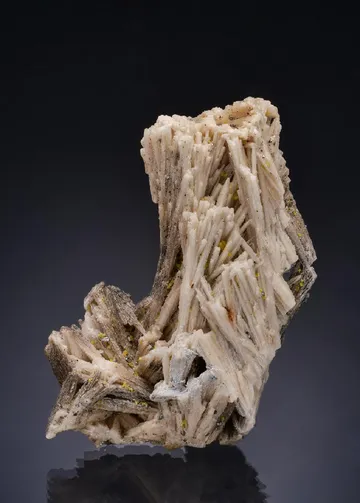
Broken Hill bustamite is one of the locality’s signature manganese silicates: not merely pink massive material, but true collector-grade crystals from the Line of Lode, especially North Mine and the New Broken Hill Consolidated workings, where it occurs with galena, sphalerite, calcite, reddish-brown spessartine, hedenbergite, fluorapatite, fluorapophyllite, rhodonite, and quartz in the calc-silicate portions of the orebody. The best-documented high-iron bustamite from New Broken Hill Consolidated was collected from a disseminated sphalerite- and galena-bearing calcite-spessartine-bustamite-diopside skarn and formed pale pink, slightly yellowish, subhedral crystals as much as about 2 cm wide and 10 cm long; classic cabinet specimens, however, are usually judged less by analytical pedigree than by their Broken Hill look—rounded, greasy to vitreous, salmon-pink, cherry-red, barley-sugar orange, or pinkish-brown blades and prisms emerging from contrasting galena, calcite, quartz, or dark green manganoan hedenbergite. North Mine material is especially varied, including delicate “hairy” acicular bustamite—slender, tapering, mostly colorless to pale pink crystals—as well as bladed red-to-pink crystals on sphalerite and hedenbergite; these delicate sprays are far rarer in good condition than blockier pieces. Ordinary specimens are granular or fibrous pink masses with little relief, often confused at a glance with rhodonite; better Broken Hill pieces show obvious individual crystals, contrasting matrix, clean terminations or rounded crystal ends, and minimal bruising on the exposed edges. For top quality, look for the unmistakable combination of saturated warm color, three-dimensional crystal placement, and the classic Mn-silicate assemblage—bustamite with galena, spessartine, sphalerite, hedenbergite, or calcite—rather than a flat pink seam on dark ore.
Broken Hill is one of the great classic localities for iodargyrite, and its specimens are very much creatures of the oxidized silver-rich zones: soft, waxy AgI occurring as pale lemon-yellow to greenish-yellow coatings, flattened masses, veinlets, globules, and small crystals in gossan, kaolin, coronadite, and associated silver-halide assemblages. The main productive labels include Broken Hill Proprietary, Block 14, the Kintore opencut, and related Line of Lode material, where iodargyrite appears with chlorargyrite, bromine-bearing chlorargyrite, coronadite, azurite, malachite, jalpaite, goethite, cerussite, and limonite; the Australian Museum silver-halide work showed just how compositionally complex these halide specimens are, with yellow-green halides, purple-brown coatings, worm-like masses, kaolinite-hosted veinlets, and AgI-rich later generations all represented. In collector terms, the species is difficult: the mineral is soft, easily rubbed, and often massive or visually subtle, and old specimens may have darkened where silver halides have been altered by light. A fine Broken Hill iodargyrite is therefore not just “some yellow wax” on gossan; it should show clear, identifiable yellow to yellow-green iodargyrite in protected areas, preferably as lustrous crystals or coherent crusts with strong contrast against black coronadite, ocherous gossan, white kaolin, or blue azurite. The best examples also carry the locality’s silver-halide story on one piece—iodargyrite with chlorargyrite or bromian chlorargyrite, perhaps with azurite or coronadite—while ordinary ones are small smeary patches, abraded coatings, or material that cannot be confidently distinguished without analysis.
Azurite is far less common in elite Broken Hill quality than the district’s fame might suggest, but when the copper-bearing oxidized zones cooperated they produced superb, sharply colored specimens from Broken Hill Proprietary, Potosi, and related workings, often in association with cerussite, malachite, iodargyrite, coronadite, and ocherous gossan. The classic Broken Hill azurite style is deep navy to royal-blue crystals—stacked, lustrous, and prismatic to blocky—perched on warm brown or iron-stained matrix; documented specimens show individual crystals around the centimeter scale, and strong small-cabinet pieces may carry a display face of saturated azurite with yellow-green iodargyrite or pale cerussite providing a distinctly Broken Hill contrast. Other material appears as smaller crystals on malachite, blue crusts, or azurite with secondary copper minerals, and these are much more common than true display-grade crystal groups. What separates a good Broken Hill azurite from ordinary material is intensity and preservation: sharp glossy faces, dark blue color that does not grey out, undamaged crystal tips, and a composition that looks complete rather than a rubbed coating on gossan. Specimens with azurite and iodargyrite are especially desirable because they tie two Broken Hill specialties together; pieces with azurite on cerussite or with malachite replacement are also attractive, but the collector should distinguish crisp azurite crystals from later dull blue-green alteration if paying for top locality quality.
Native silver from Broken Hill ranges from oxidized-zone occurrences with silver halides to the famous silver-antimony assemblages of Browne’s Shaft in the old Junction Mine, later part of the North Mine complex, where the mid-1960s discovery of a galena-siderite “Consols type” vein in the 179K section of the main 12th level drive produced the district’s most admired collector specimens. Much of this silver is antimonial, and the Browne’s Shaft vein yielded both wires and crystalline masses with dyscrasite, acanthite, pyrargyrite, proustite, polybasite, allargentum, siderite, barite, calcite, and galena; large masses weighing several kilograms were encountered, and the best-known preserved example is a huge specimen in the Albert Kersten Geocentre collection at Broken Hill. Because many pieces were enclosed in siderite, classic specimens were commonly prepared by careful acid removal of carbonate to expose silver crystals, wires, or dyscrasite-silver combinations; that preparation history is part of the locality’s collecting culture, but crude acid work can leave an unattractive etched look. Fine Broken Hill silver is sculptural and obviously native: bright to steel-grey curls, wires, arborescent groups, or coarse crystallized plates, ideally with siderite, galena, dyscrasite, acanthite, or calcite still present enough to prove the paragenesis. Ordinary pieces are small tarnished smears, polished-looking fragments, or silver-colored galena mistaken for silver; better specimens show ductile form, coherent wires or crystal faces, and a real Broken Hill label such as Browne’s Shaft, Junction Mine, Kintore opencut, or Broken Hill South.
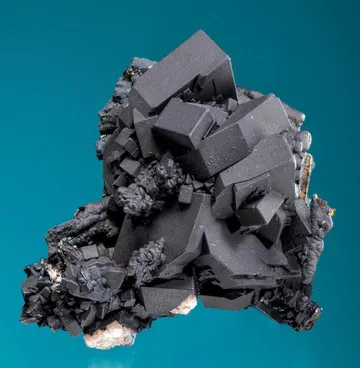
At Broken Hill, coronadite is far more than “black manganese oxide”: it is one of the great architectural matrix minerals of the oxidized lode, especially at Broken Hill Proprietary, Kintore, MMM, and related open-cut and Line of Lode material, where black to dark grey lead-manganese oxide forms stalactitic, botryoidal, cavernous, and concretionary masses under smithsonite, cerussite, chlorargyrite, bromine-bearing chlorargyrite, iodargyrite, pyromorphite, kaolinite, goethite, and other secondary minerals. The most recognizable Broken Hill coronadite specimens are black stalactites or cellular masses dusted with icy colorless-to-white smithsonite “seeds” or teardrops, sometimes only a few millimeters across but covering much of the display face; others are classic cerussite pseudomorphs after anglesite, their sharp orthorhombic forms coated with semi-lustrous black coronadite over a pale or glassy cerussite interior. In some pieces, broken edges reveal the paragenetic transition from rusty-orange goethite cores to darker coronadite, a detail that gives otherwise dark specimens real mineralogical interest. Good coronadite from Broken Hill has relief, texture, and associations: intact stalactites to several centimeters, a velvety or semi-lustrous black surface, and a bright secondary species riding on it. Ordinary pieces are heavy black lumps with little form; the best are unmistakably Broken Hill because the black oxide matrix is sculptural and is tied to smithsonite, cerussite-after-anglesite, or silver halides in an undamaged, displayable composition.
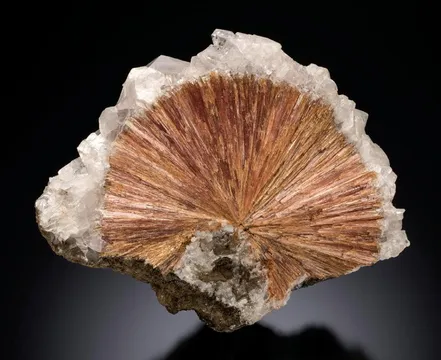
Broken Hill inesite is a classic but comparatively understated manganese-silicate prize, first important to collectors and mineralogists because of the American Mineralogist study of inesite from the Broken Hill lode and now sought as old-time pink sprays and aggregates from the Mn-rich portions of the orebody. It occurs as rose, salmon-pink, orange-pink, to reddish-brown radiating crystals, bladed tufts, and compact sprays, most attractively on pale calcite or quartz and commonly in the company of rhodonite, bustamite, manganite, and other manganese silicates or oxides. A documented cabinet example from the New Broken Hill Consolidated mine measured 11.5 cm and showed inesite with calcite, a good indication of the scale possible even though most collector pieces are thumbnails to small cabinets. The appeal is in texture and color: Broken Hill inesite usually lacks the flamboyant, robust firework sprays of the best Kalahari pieces, but it compensates with historic locality pedigree and a recognizable Mn-silicate setting. Better examples show distinct radial structure, clean salmon to rose color, glossy crystal faces where preserved, and strong contrast against white calcite or dark oxide; ordinary specimens are matted pink crusts, frayed sprays, or massive material without clear crystal form. Because the sprays are delicate, condition is decisive—fan edges, tips, and exposed tufts should be examined closely, and unrepaired matrix pieces with intact display faces are far preferable to loose or compressed clusters.
The Broken Hill collector species is chiefly pyrosmalite-(Mn), a rare manganese-rich chlorine-bearing silicate whose best Broken Hill crystals are large by the standards of the species and belong to the same manganese-silicate world as rhodonite, bustamite, manganoan hedenbergite, and galena. Historic material has been studied from the Broken Hill South Mine, including a vugh on the 1370-foot level, and from the North Broken Hill Mine around the 1700-foot level; fine museum specimens are also known from the Zinc Corporation Mine, including material from the 1900-foot level, and from South Mine. Habits include stout hexagonal to platy crystals and intergrown clusters in pink, reddish-pink, terracotta-red, liver-brown, to red-brown tones, with calcite, galena, quartz, axinite-(Mn), rhodonite, spessartine, fluorite, and especially hedenbergite among the notable associations. A South Mine specimen in the Albert Chapman collection has crystals to about 2.5 cm, and a Zinc Corporation specimen is praised for pyrosmalite with calcite and galena, underscoring why Broken Hill is so important for the species: crystals here can be visually collectible, not merely analytical grains. The best pieces show sharp, lustrous, recognizable crystals with warm reddish color and a three-dimensional cluster, ideally on matrix; ordinary examples are dark platy fragments, dull brown cleavages, or material confused with other Mn silicates. Provenance matters strongly, and labels naming South Mine, North Mine, Zinc Corporation, or a specific level add value when the crystal quality is there.
Rhodochrosite from Broken Hill occupies a tricky but rewarding niche because the district also produced abundant pink manganoan calcite and kutnohorite-like carbonates that can mimic it in hand specimen; the best Broken Hill rhodochrosite is therefore both aesthetic and credible, ideally supported by old provenance or analysis. It occurs in the Line of Lode and associated Broken Hill South, Kintore, Central Mine, Southern Operations, and Zinc Corporation material as pink to honey-brown or pinkish-brown carbonates with quartz, calcite, pyrite, galena, alabandite, kutnohorite, and dark Fe-Mn oxides. Particularly distinctive are globular to hemispherical rhodochrosite-smithsonite-series carbonates encrusting cavernous goethite-coronadite from the oxidized zone, with individual globules and intergrown hemispheres reported up to about 2 cm across; other collector pieces show rhodochrosite balls or coatings with amethystine quartz and pyrite on lead-zinc-calcite matrix from the Zinc Corporation mine. Fine specimens have clear pink to rose or attractive honey-pink color, discrete globular or crystalline form, and contrast against quartz, calcite, pyrite, goethite, or coronadite. Ordinary pieces are pale carbonate masses that may be manganoan calcite rather than rhodochrosite, so collectors should be cautious with strongly fluorescent pink carbonate unless the identification is secure. The most desirable Broken Hill examples combine visual appeal with the district’s oxidized-zone complexity: pink carbonate globules on black goethite-coronadite, or rhodochrosite with quartz and pyrite in a balanced, undamaged small-cabinet composition.
Goethite is one of the essential gossan minerals of Broken Hill, but its best collector expression is not simple brown ironstone—it is the dark chocolate-brown to rusty-orange oxide that records the oxidized history of the lode and supports many of the district’s most celebrated secondary species. At Kintore, goethite is famous as a coating on cerussite pseudomorphs after anglesite, a classic style discovered in 1989 in which sharp orthorhombic forms are preserved beneath dark goethite skins; broken edges may reveal pale cerussite beneath, adding contrast and confirming the pseudomorph story. In the Proprietary and broader oxidized zones, goethite also appears as porous, cavernous, and concretionary cores with coronadite, smithsonite, calcite, and rhodochrosite-smithsonite-series carbonates; some coronadite stalactites visibly begin as orange-brown goethite before transitioning outward to dark grey coronadite. The species is reported from multiple Broken Hill localities, including Kintore, Block 14, Potosi, and the main lode, usually as matrix, coatings, botryoidal crusts, or gossan rather than isolated crystals. Fine Broken Hill goethite specimens show sculptural form and association—cerussite-after-anglesite pseudomorphs neatly coated in dark goethite, globular carbonates on cavernous goethite-coronadite, or clean oxide matrices carrying smithsonite or silver halides. Ordinary goethite is earthy, friable, and anonymous; good pieces are crisp, stable, and unmistakably tied to the oxidized Broken Hill assemblage.
Broken Hill hedenbergite is typically manganese-bearing and belongs to the district’s calc-silicate and Mn-silicate assemblages rather than to the flashy secondary suite; it is best known from North Mine and Southern Operations material, where it occurs with bustamite, fluorapophyllite, spessartine, fluorite, pyrite, galena, and related pyroxenoid minerals. Collector specimens range from dark olive-green tabular crystals on lighter green hedenbergite matrix to yellowish-green and medium-green doubly terminated crystals, with documented single crystals around 1.9 cm and larger North Mine associations showing hedenbergite crystals to about 5 cm with spessartine garnets and galena. In the North Mine 2900 level assemblage, minute blocky green hedenbergite appears with flesh-pink to buff acicular bustamite and pale pink fluorapophyllite, a combination that gives even small specimens strong locality character. The best pieces are those where hedenbergite is visibly crystallized rather than merely massive: lustrous olive to greenish-black crystals with recognizable terminations, tabular form, or attractive placement beside bustamite, spessartine, or galena. Ordinary specimens are dark granular pyroxene-rich matrix that may be of interest only as association material. Because Broken Hill produced many visually similar Mn-bearing silicates, a good hedenbergite specimen benefits from a precise mine label and, where possible, analytical or long-standing collection provenance; as display material, contrast with pink bustamite or orange spessartine greatly improves its appeal.
Quartz is not the glamour species at Broken Hill, but it is an important collector mineral because it frames several distinctive assemblages: clear to milky prisms, saccharoidal fracture fillings, amethystine clusters, and rarer blue quartz occur with galena, rhodochrosite, pyrite, calcite, gahnite, spessartine, rhodonite, fluorite, and chalcopyrite across the Broken Hill workings. Southern Operations and the Zinc Corporation Mine have produced quartz with rhodochrosite and gahnite, while small local specimens include amethystine quartz on globular rhodochrosite with pyrite on a lead-zinc-calcite matrix, lightly colored amethyst clusters on galena and fluorite, and simple Broken Hill quartz crystal groups in the miniature range. Blue quartz is a locality curiosity, recorded with spessartine and rhodonite, and quartz also appears as the pale cryptocrystalline matrix from which rounded pink-orange bustamite crystals may project. Good Broken Hill quartz is therefore usually valued for association rather than as a stand-alone quartz specimen: a clean prismatic white or translucent crystal partly coated with pyrite, amethystine quartz rising from pink rhodochrosite, or quartz carrying galena, bustamite, fluorite, or Mn-silicates is more desirable than a generic milky cluster. Ordinary pieces are plain vein quartz; better ones preserve the crystal form, color accent, and mineralogical context that make the label unmistakably Broken Hill.
Pyrite occurs sporadically throughout the main Broken Hill orebody but becomes more conspicuous in cavities, fractures, and fault zones, especially in deeper parts of the Zinc Corporation and New Broken Hill Consolidated mines, where small brassy cubes and drusy coatings decorate calcite, manganoan calcite, quartz, rhodochrosite, fluorite, sphalerite, galena, and other sulfide-rich matrix. The typical Broken Hill pyrite crystal is small—often about millimetric—and cube-shaped, appearing as sparkling speckles over white calcite or pink manganoan calcite, or as thin brassy films of tiny crystals on fracture surfaces; older dealer descriptions also note South Mine specimens with sharp brassy crystals to roughly a quarter inch thickly covering pyrite-quartz matrix. As a collecting species here, pyrite is strongest when it participates in a Broken Hill association: pyrite on pink calcite, pyrite with amethystine quartz and rhodochrosite from the Zinc Corporation Mine, or pyrite accenting fluorite, galena, and Mn-carbonate material. Ordinary specimens are dull brassy grains in sulfide ore, and large isolated pyrite crystals are not what the locality is known for. Better pieces have fresh metallic luster, sharp undamaged cubes or a continuous glittering druse, and a matrix that adds color contrast; avoid oxidized, crumbling, or rusty pyrite coatings unless the piece has exceptional locality association.
Cuprite is one of the old Broken Hill oxidized-zone species with real specimen pedigree rather than merely a checklist occurrence: it was recorded as both massive red oxide and well-developed crystals lining vughs and cracks or scattered across gossanous material, especially in the upper levels of the lode and in classic material from the Broken Hill Proprietary Mine and Broken Hill South Mine. The locality’s best cuprites are not the giant octahedra of Onganja or Rubtsovsky, but smaller, sharp, historically important crystals—ruby-red to deep red-purple, sometimes appearing dark in thicker crystals, and commonly modified cubes or octahedral/rhombic-dodecahedral combinations. A famous early description notes a transparent ruby-red cube 12 mm across from the same boulder as nantokite at Broken Hill South, while trade and collection records describe deep red-purple modified cubic crystals to about 7 mm from the Proprietary Mine and malachite-coated greenish cubic cuprites to about 4 mm richly scattered on creamy cerussite/cuprite matrix with occasional reticulated cerussite. Associations are a large part of the Broken Hill character: native copper, cerussite, malachite, azurite, iodargyrite, chlorargyrite/embolite, hematite, tenorite, and rare silver-copper iodides such as marshite and miersite place a specimen firmly in the complex oxidized silver-lead-zinc-copper suite. Fine pieces are judged by intact crystal form, translucency or rich red color on fresh faces, undamaged positioning on gossan or cerussite-bearing matrix, and, above all, credible old Broken Hill provenance; ordinary examples are massive red cuprite, dull sooty coatings, or broken grains that lack the distinctive association with the old oxidized lode.
Broken Hill malachite belongs to the same supergene theater that made the locality famous for azurite, cerussite, cuprite, native copper, iodargyrite, embolite, smithsonite, and related oxidized species, and its most desirable habit is not generic botryoidal green crust but a clear pseudomorph story: complete or partial replacement of azurite crystals, often preserving the original azurite form while leaving patches or caps of deep blue against velvety to satiny green. The strongest historical material came from the span between the Proprietary and Block 14 mines, with later collecting in the Block 14 and Kintore opencuts; published descriptions of the Kintore workings record blocky azurite crystals to 2 cm with malachite and massive cerussite in A lode at the 280 m north level, lustrous azurite to 8 mm with blue rosasite and green malachite in 3 Lens, and malachite pseudomorphs after 1 cm azurite crystals on arrowhead cerussite. Older Proprietary and Block 14 specimens also include chalky green malachite slabs coated with small azurite prisms, while a more rubble-zone style from Block 14 is granular cerussite strongly cemented by malachite, with cerussite fragments from sub-millimetre size to roughly 8 mm. Good Broken Hill malachite therefore rewards form and context: sharply readable pseudomorphs after azurite, partial blue-green replacement, association with cerussite or cuprite, and a clean gossanous or manganiferous matrix rank well above shapeless green masses, painty coatings, or decontextualized copper stains.
Dyscrasite, Ag3Sb, is one of the great silver-antimony signatures of Broken Hill and is especially tied to the Consols-style mineralization rather than to the showier oxidized lead-carbonate suite. George Smith was already documenting dyscrasite from the Australian Broken Hill Consols Mine in the 1890s, where much of what miners called “native silver” proved to be dyscrasite, including enormous ore slugs measured in hundredweights; later, the mid-1960s discovery of a Consols-type galena-siderite vein in the 179K section of the main 12th-level drive of Browne’s Shaft, Junction Mine, gave collectors far better crystallized material. That Browne’s Shaft occurrence produced acanthite, dyscrasite, polybasite, proustite, pyrargyrite, and native silver, with the best dyscrasite-antimonial silver combinations commonly revealed only after acid removal of enclosing siderite. The typical specimen is tin-white to silver-gray metallic dyscrasite as compact crystalline masses, blades, or irregular intergrowths in or after siderite, commonly with native silver and sometimes in a broader suite including galena, baryte, calcite, acanthite, and ruby-silver species. Good pieces are those in which the metallic dyscrasite is visibly exposed yet not over-etched, with sculptural relief, preserved crystal texture, and convincing association with siderite and native silver; undiagnostic gray metal blebs, polished ore lumps, or pieces labelled “silver” without the antimony-mineral context are much less satisfying for Broken Hill specialists.
Mimetite is one of the better collector species from the Kintore–Block 14 oxidized system, and Broken Hill examples are valued for their paragenesis as much as for crystal size. In the Kintore opencut it is recorded as widespread in the oxidized zone, commonly on coronadite-goethite matrix and sometimes essentially alone, but the richest associations put it in the arsenate/phosphate mosaic of the open cuts: bayldonite, olivenite, conichalcite, carminite, cryptomelane, duftite, mawbyite, wulfenite, and the fornacite-vauquelinite pair all help define desirable material. Crystals to about 1.5 cm have been reported with a thin coating of bayldonite, and Central Mine material includes the curved barrel-like habit historically called campylite; Block 14 specimens, meanwhile, are documented with cerussite, kaolinite, linarite, quartz, and ktenasite. Color ranges through pale yellow, cream, honey, greenish yellow, and brownish tones depending on habit and coatings, with some specimens reading more as drusy crusts and others as individual barrels or globules on dark manganese-iron oxides. The best Broken Hill mimetite shows discrete, well-formed crystals or botryoidal/barrel aggregates on contrasting dark coronadite-goethite, ideally with documented Kintore, Block 14, No. 3 Lens, Central Mine, or Blackwood opencut provenance and meaningful associated rarities; ordinary pieces are dull yellow crusts without crystal definition or analysis-sensitive mixtures in which the arsenate suite is visually confused.
“Apophyllite” from Broken Hill is best understood in the older collector sense as apophyllite-group material, with analyzed occurrences commonly treated as fluorapophyllite-(K), and it belongs to the locality’s primary and fault-zone gangue assemblages rather than to the oxidized gossan suite. Maurice Mawby recognized apophyllite among the unusual rare silicate and gangue minerals of the sulphide zone, and locality records place apophyllite-group specimens at the North Mine and in the Zinc Corporation/New Broken Hill Consolidated part of the Southern operations. The classic collecting appeal is the combination with inesite: golden-brown acicular inesite in fan-shaped sprays lying against matrix, paired with colorless to milky-white, highly lustrous, glassy apophyllite crystals. A documented New Broken Hill Consolidated specimen shows an approximately 8 x 5 cm area of translucent to rarely transparent apophyllite crystals of varied habit up to about 1 cm across, with two prominent inesite fans each about 4.5 cm across on an 87 x 95 x 49 mm cabinet specimen. Good Broken Hill apophyllite is therefore judged by glassy luster, sharpness, transparency, and the presence of classic manganese-silicate companions—especially inesite, but also the broader rhodonite-rhodochrosite-bustamite gangue context—whereas plain milky apophyllite without provenance is easy to overlook and should not be confused with the abundant basalt-zeolite apophyllites from other Australian localities.
Broken Hill wulfenite is scarce and usually small-crystalled, but that is precisely why fine examples are prized: they represent a distinctive lead-molybdate expression within the Kintore oxidized assemblage rather than the large, flamboyant plates familiar from Mexico or Arizona. The best-documented occurrence is the Kintore opencut of the Broken Hill South Mine, where wulfenite is recorded with cerussite and quartz; Museum Victoria also holds Broken Hill material noted as wulfenite with pale yellow phosphatian mimetite, and the classic literature singles out the Kintore opencut for the mimetite-wulfenite association. Individual crystals are generally millimetric, tabular to blocky, and yellow to orange or honey-toned, with specimen aesthetics depending on contrast against white cerussite, quartz, or darker manganese-iron oxide matrix. A good Broken Hill wulfenite is not evaluated by size alone: sharp crystal outline, clean luster, freedom from bruising on the thin edges, recognizable association with mimetite or cerussite, and an old Kintore or Junction-line provenance matter more than a broad plate of indeterminate origin. Ordinary pieces are sparse yellow flecks on ironstone; superior pieces show several distinct, undamaged crystals placed compositionally on matrix, ideally with enough associated mimetite or cerussite to locate them unmistakably in the Broken Hill oxidized zone.
Sphalerite is fundamental to Broken Hill geologically—the great lode is, at heart, a Pb-Zn-Ag deposit—but attractive collector specimens are more selective than the tonnage would imply. The main metallic suite contains abundant sphalerite and galena with lesser pyrrhotite, chalcopyrite, arsenopyrite, löllingite, tetrahedrite and sulfosalts, and the deposit’s separate C, B and A lodes and 1, 2 and 3 lenses each carry distinctive gangue and metal ratios along the roughly 8 km ore system. In collections, Broken Hill sphalerite ranges from dark brown to nearly black, iron-rich material often labelled marmatite, to banded schalenblende and lustrous crystals or crystalline masses on galena-rich ore; documented photo associations include galena, bustamite, calcite, chalcopyrite, inesite, quartz, pyromorphite, cerussite, pyrite, spessartine, fluorite, smithsonite, azurite, malachite, rhodonite, and apophyllite-group minerals. It occurs across many parts of the district, including the Proprietary Mine, South Mine/Central and Kintore workings, British and MMM mines, Rasp, Consols, North Mine/Junction, Potosi, and the Zinc Corporation/Southern operations. The best collector pieces avoid the common “ore chunk” look by showing lustrous, discrete sphalerite crystals, banded schalenblende textures, or sharp contrast with galena, calcite, fluorite, rhodonite, inesite, or spessartine; ordinary examples are simply dense black zinc ore with little form, even if scientifically representative of the deposit.
Kutnohorite at Broken Hill is a cautionary but rewarding specialist species: confirmed material is rare, and the most attractive pink carbonate specimens historically sold under the name are not always true kutnohorite. Documented Broken Hill kutnohorite occurs sparsely in primary ores as granular material with jacobsite, while pink fibrous to prismatic secondary-vein aggregates often labelled kutnohorite have been shown by X-ray diffraction to be mixtures of manganoan calcite and calcian rhodochrosite, probably inverted from kutnohorite. The species is reported from Broken Hill generally and from the Zinc Corporation Mine in the Southern operations, with associated minerals in specimen records including quartz, calcite, pyrite, rhodochrosite, hisingerite, goethite, and smithsonite. Visually, this means the collector should be wary of any attractive rose carbonate simply called “kutnohorite” on the strength of color alone: Broken Hill has too many manganese carbonates and carbonate mixtures for that to be safe. Good pieces are those with analytical support, old museum or well-documented mine provenance, and a paragenetic setting consistent with the primary jacobsite-bearing material or carefully described secondary carbonate assemblages; ordinary pieces may be pretty pink fibrous carbonate, but without confirmation they belong in the “kutnohorite-labelled” category rather than as confident species specimens.
Amethyst from Broken Hill is a minor quartz variety, not one of the locality’s headline ore species, and it should be treated differently from the better-known Corona/MacDougall’s Well amethyst field about 90 km north of Broken Hill. Within the Broken Hill lode system, amethyst is documented as a quartz variety from the Southern operations and appears in old and modern specimen records from the North Mine, where the appeal is usually compact, deeply purple quartz rather than large geode-style clusters. The most credible Broken Hill examples are small cabinet or miniature specimens with natural purple color, clear crystal faces or vein-quartz texture, and specific mine provenance—North Mine or Southern operations labels are far more meaningful than a broad “Broken Hill region” tag, because the surrounding Barrier Ranges contain separate quartz and amethyst occurrences. Associations may be sparse compared with the lead-zinc-silver suite, so the specimen’s value rests on locality integrity, color saturation, and preservation of crystal form. Good pieces are sharply crystallized, visibly purple without artificial enhancement, and clearly tied to the Broken Hill mines; ordinary pieces are pale quartz fragments or regional amethyst whose label could just as easily refer to nearby fields rather than the orebody itself.
Beyond these species, Broken Hill is one of the world’s great mineralogical ecosystems, with more than 300 reliably documented minerals from the orebody and district and a remarkable roster of type-locality species. The type list includes Broken Hill proper species such as bernalite, birchite, miersite, and siidraite; Block 14 species including aldridgeite, cardite, edwardsite, hodgesmithite, liversidgeite, nyholmite, plimerite, and vanderheydenite; classic Proprietary Mine species such as marshite and raspite; Kintore-associated kintoreite, kolitschite, mawbyite, segnitite, and yancowinnaite; Consols Mine species such as costibite, paradocrasite, and willyamite; and the Potosi Mine acetate minerals hoganite and paceite. For collectors, the locality’s broader fame rests just as strongly on ruby-red rhodonite and orange spessartine in galena-rich ore, world-class reticulated cerussite, smithsonite, pyromorphite, anglesite, stolzite, raspite, native copper, iodargyrite, chlorargyrite/embolite, linarite, marshite, miersite, fluorite, bustamite, inesite, bannisterite, and rare arsenate-phosphate assemblages from Kintore and Block 14; the result is a locality where an unassuming miniature can be more important than a showy cabinet specimen if it carries the right mine, horizon, association, and analytical history.
Broken Hill is a locality where old labels matter. A specimen labelled simply “Broken Hill” may be fully legitimate, especially if it is an old-time piece, but better examples often carry mine or block information: North Mine, BHP Mine, Kintore opencut, Block 14, Zinc Corporation Mine, New Broken Hill Consolidated, Broken Hill South, British Mine, Blackwood opencut, or a lens and level designation. The more specific the label, the more useful the specimen is scientifically and commercially.
The most common locality confusion is with Kabwe, Zambia, historically also called Broken Hill. Kabwe produced famous lead-zinc specimens, especially zinc phosphates and carbonates, and older labels reading “Broken Hill” without country can be ambiguous. A Kabwe smithsonite or hopeite is not a Broken Hill, New South Wales specimen. Another recurring label error is “Broken Hill, South Australia”; the Australian Broken Hill is in New South Wales, although it sits close to the South Australian border and is culturally and logistically tied to Adelaide and Port Pirie.
The principal authenticity issue is misidentification or over-specific locality attribution rather than a large documented trade in fabricated Broken Hill specimens. Broken Hill assemblages are complex, and many rare species require analytical confirmation. Oxidized-zone micros from Kintore and Block 14 can be visually deceptive: green, yellow, blue, brown, or white crusts may be phosphates, arsenates, sulfates, carbonates, halides, or mixtures. Labels that name rare species without analytical history should be treated cautiously, especially for species-level claims in groups such as libethenite-zincolibethenite, tsumcorite-group minerals, jarosite-alunite-group minerals, and silver halides.
Condition is a major value driver. Broken Hill cerussite is often fragile, reticulated, or highly exposed; even small bruises on a lacework specimen can be visually obvious. Rhodonite in galena matrix commonly shows contact marks, cleavage, and edge chipping, while galena itself may be scratched, oxidized, or dulled. Pyromorphite and smithsonite from the oxidized zone may occur as small, bright crystals on friable iron-manganese oxide or clay-rich matrix. Many specimens from old dumps have been weathered, bumped, trimmed hard, or stabilized by careful past owners; evaluate them under strong light and magnification.
Handling considerations are real. Broken Hill suites include lead minerals such as galena, cerussite, anglesite, pyromorphite, mimetite, and wulfenite; arsenates and copper arsenates; and silver halides such as chlorargyrite, bromargyrite, and iodargyrite. Wash hands after handling, do not grind or saw specimens casually, keep dust down, and do not store friable lead-rich pieces where children can touch them. Silver halides can be light-sensitive and may darken with exposure, so the best chlorargyrite and iodargyrite specimens deserve low-light storage. Acid cleaning is risky: carbonates, sulfates, phosphates, and lead minerals can be damaged, and etched or “improved” surfaces are often less desirable than honest old patina.
Market availability is broad but uneven. Small Broken Hill galena, rhodonite, pyromorphite, smithsonite, cerussite, calcite, and mixed oxidized-zone pieces appear regularly from old collections and Australian dealers. Fine rhodonite in galena, undamaged reticulated cerussite, strong native silver and chlorargyrite combinations, classic smithsonite on coronadite, attractive stolzite or raspite, and well-documented rare species are much less available. The rarest Broken Hill minerals are often micromount or analytical specimens, valuable more for locality significance than display size. Cabinet-quality specimens with old labels from famous mines remain among the most desirable Australian classics.
The Broken Hill story begins with a misreading that changed Australian mining. Charles Rasp was not a trained geologist; he was a boundary rider on Mount Gipps Station, moving through the Barrier Ranges when the black, heavy outcrop of the “broken hill” caught his attention. He thought the dark material might be tin oxide. On 5 September 1883 he pegged the first block on the outcrop, and the early specimens proved to contain silver and lead. The first recorded mineral specimen from Broken Hill was that heavy black material—probably coronadite—collected at the very ridge that would be consumed by mining.
The discovery almost slipped through the hands of its discoverers. Early work was discouraging enough that some of the original interests changed hands before the great value of the lode was understood. Then, in January 1885, Philip Charley found the first rich silver ore on the property. Within months the Broken Hill Proprietary Company was floated, with 16,000 shares of £20 each. A remote line of black rock in sheep country had become the seed of BHP.
The deposit gave the town not just wealth but scale. By 1891 Broken Hill had become one of the world’s great sources of lead, zinc, and silver, with a population above 20,000. It kept growing into the early twentieth century, standing far inland from the coastal capitals yet ranking among the major towns of New South Wales. The lode made Broken Hill an industrial city in the outback, with smelters, mills, unions, rail links, mine managers’ residences, slag heaps, and the long physical scar of the Line of Lode running through civic life.
For collectors, one of the most vivid underground images comes from the oxidized orebody itself. In ML 11, large cavities opened in the heart of the ironstone body. Some were metres across; one reported range extended to about 2.7 x 4.5 x 12 metres. These were not delicate little pockets in a pegmatite but cavernous spaces in weathered silver-lead ore, where black coronadite formed stalactites and smithsonite coated the walls and floor. Imagine a manganese-black chamber in the oxidized lode, its surfaces crusted with pale zinc carbonate, sitting above the massive sulfides that would later define the mine’s economic life.
The lode was also a place of mineralogical surprises in faults. Carbonate-rich brittle fault zones cut through the orebody and, despite being enclosed by a huge lead-zinc system, locally carried no lead or zinc minerals. Instead they produced spectacular manganoan calcite, kutnohorite, rhodochrosite, sturtite, chlorite, inesite, fluorapatite, alabandite, pyrite, marcasite, and amethystine quartz. Some cavities were metres long and lined with terminated crystals. To a collector, these fault zones explain why Broken Hill can yield both heavy metallic ore specimens and airy, late-stage crystal groups that look like they came from a different geological province.
The open-cut era gave the locality a second collecting life. When Kintore and Block 14 were worked and their oxidized material was broken, moved, and dumped, collectors gained access to pieces that the early miners had often treated simply as ore or waste. Modern mineralogists and collectors recognized that this material contained an extraordinary micro-mineral suite. Several species new to science were later described from Broken Hill material, and old dump finds continued to produce surprises after the major books had already been written. At Broken Hill, even a small, dull fragment of oxidized ore can be important if it carries the right association and has the right analytical attention.
William D. Birch, ed. Minerals of Broken Hill. Broken Hill City Council in conjunction with Museum Victoria, 1999. The indispensable modern book-length treatment of the locality’s mineralogy, history, and specimen significance. URL: https://iugs-geoheritage.org/geoheritage_sites/the-broken-hill-pb-zn-ag-deposit/
William D. Birch and A. van der Heyden. “Minerals of the Kintore and Block 14 open cuts at Broken Hill, New South Wales.” Australian Journal of Mineralogy 3, no. 1, 1997, pp. 23–71. A key paper for the oxidized-zone and open-cut specimen suite. URL: https://www.mindat.org/reference.php?id=15943631
A. Webster. “Mine Geology and Mineral Localities at Broken Hill, New South Wales.” In Australia’s Greatest Mineral Deposits: Extended Abstracts of the 23rd Annual Conference of the States’ Mineralogical Societies, Journal and Proceedings of the Royal Society of New South Wales 133, 2000, pp. 42–44. A concise but highly useful collector-oriented account of lodes, oxidized zones, and pocket environments. URL: https://www.royalsoc.org.au/wp-content/uploads/2016/08/133_p12.pdf
Andrew Gallacher and Ian Plimer. “The Origin of Fault Zone Minerals at Broken Hill, New South Wales.” In Australia’s Greatest Mineral Deposits: Extended Abstracts of the 23rd Annual Conference of the States’ Mineralogical Societies, Journal and Proceedings of the Royal Society of New South Wales 133, 2000, pp. 14–16. Essential for understanding the late fault-zone assemblages that produced inesite, manganoan calcite, rhodochrosite, kutnohorite, and related species. URL: https://www.royalsoc.org.au/wp-content/uploads/2016/08/133_p12.pdf
Erik B. Melchiorre, Peter A. Williams, and Richard E. Bevins. “An Oxygen Isotope Thermometer for Cerussite: Applications at the Block 14 Mine, Broken Hill, New South Wales.” In Australia’s Greatest Mineral Deposits: Extended Abstracts of the 23rd Annual Conference of the States’ Mineralogical Societies, Journal and Proceedings of the Royal Society of New South Wales 133, 2000, pp. 22–25. A scientific look at cerussite formation temperatures in the oxidized zone. URL: https://www.royalsoc.org.au/wp-content/uploads/2016/08/133_p12.pdf
Peter Elliott. “Cardite, Zn5.5(AsO4)2(AsO3OH)(OH)3·3H2O, a new zinc arsenate mineral from Broken Hill, New South Wales, Australia.” Mineralogy and Petrology 115, 2021, pp. 467–475. Description of a Broken Hill type-locality zinc arsenate. URL: https://doi.org/10.1007/s00710-021-00750-2
N. V. Shchipalkina et al. “Ferrorhodonite, CaMn3Fe[Si5O15], a new mineral species from Broken Hill, New South Wales, Australia.” Physics and Chemistry of Minerals 44, 2017, pp. 323–334. Description of a rhodonite-group species tied directly to Broken Hill material. URL: https://doi.org/10.1007/s00269-016-0860-3
A. Pring, W. D. Birch, D. Sewell, E. Graeser, and W. Edenharter. “Kintoreite, PbFe3(PO4)2(OH,H2O)6, a new mineral of the jarosite-alunite family, and lusungite discredited.” Mineralogical Magazine 59, 1995, pp. 143–148. Description of the Kintore opencut type mineral. URL: https://www.mindat.org/min-2214.html
Peter Elliott and Allen Pring. “Aldridgeite, a new mineral from the Block 14 Opencut, Broken Hill, New South Wales.” Australian Journal of Mineralogy 17, 2015, pp. 67–71. Type-mineral paper for an oxidized-zone Block 14 species. URL: https://www.mindat.org/reference.php?id=15943631
Peter Elliott and Allen Pring. “Yancowinnaite, a new mineral from the Kintore Opencut, Broken Hill, New South Wales.” Australian Journal of Mineralogy 17, 2015, pp. 73–76. Type-mineral paper for a Kintore opencut species named for Yancowinna County. URL: https://www.mindat.org/reference.php?id=15943631
B. R. Frost, S. M. Swapp, and R. W. Gregory. “Prolonged existence of sulfide melt in the Broken Hill orebody, New South Wales, Australia.” The Canadian Mineralogist 43, 2005, pp. 479–493. Important for understanding high-temperature recrystallization and sulfide behavior in the lode. URL: https://doi.org/10.2113/gscanmin.43.1.479
B. P. J. Stevens, R. W. Page, and A. Crooks. “Geochronology of Willyama Supergroup metavolcanics, metasediments and contemporaneous intrusions, Broken Hill, Australia.” Australian Journal of Earth Sciences 55, no. 3, 2008, pp. 301–330. A key geochronological framework for the rocks hosting the deposit. URL: https://doi.org/10.1080/08120090701769456
Albert Kersten Geocentre — Jason King. A short Vimeo film introducing the formation and significance of the Line of Lode and the Albert Kersten Mining & Minerals Museum. URL: https://vimeo.com/110697380
GeoCentre Outback Museums Stories — Broken Hill City Council. A series of short museum films on the Line of Lode, mineral wealth, and the Albert Kersten Mining & Minerals Museum collection. URL: https://www.brokenhill.nsw.gov.au/Facilities/Albert-Kersten-Mining-and-Minerals-Museum/GeoCentre-Outback-Museums-Stories
Silver City (1936), clip 1 — Frank Hurley / Australia’s audio and visual heritage online. Historic sponsored-film footage of Broken Hill mining during the shift toward mechanized and electrically powered mine work. URL: https://aso.gov.au/titles/sponsored-films/silver-city/clip1/
Broken Hill: a mining history 1883–1983 — Terence McMahon. Archival film held by ACMI, described as a documentary history of the Broken Hill mining industry with early footage, stills, and commentary by Geoffrey Blainey. URL: https://www.acmi.net.au/works/77339--broken-hill-a-mining-history-1883-1983/
Mindat: Broken Hill, Broken Hill district, Yancowinna County, New South Wales, Australia — The central locality page for mineral lists, sublocalities, and specimen photographs.
Mindat: Broken Hill Proprietary Mine — Detailed species and reference information for the historic BHP Mine.
Mindat: Kintore opencut — Essential for the oxidized-zone minerals of Kintore, including type-mineral and rare-species references.
Mindat: Broken Hill South Mine — Sublocality data for one of the major historic mine areas on the Line of Lode.
Mindat: North Mine — Useful for North Mine assemblages, including rhodonite-bearing material.
IUGS Geological Heritage Site: The Broken Hill Pb-Zn-Ag deposit — Authoritative geoheritage summary by William Birch, including geology, mineral diversity, and key references.
Broken Hill Mines: Rasp Mine — Current operator information on the active Rasp silver-lead-zinc mine and its resources, mining methods, and processing.
BHP: Our History — Corporate historical timeline beginning with Charles Rasp’s 1883 Broken Hill discovery and BHP’s 1885 flotation.
National Museum of Australia: Minerals of Broken Hill — Accessible museum overview of the discovery, mineral wealth, and Broken Hill specimens in the national collection.
Broken Hill City Council: History — Civic historical timeline for Broken Hill, including Indigenous history, discovery, mining, and the long-lived Line of Lode.
Visit Broken Hill: Mining & Geology — Visitor-oriented account of the Line of Lode, mining history, and geological identity of the city.
Visit Broken Hill: MMM Dumps — Useful historical note on the MMM dump remnants and open-cut mining history between 1976 and 1991.
Wikimedia Commons: Minerals of Broken Hill — Open image category with many Broken Hill specimen photographs.
Royal Society of New South Wales: Australia’s Greatest Mineral Deposits, Broken Hill Symposium, 2000 — Includes important extended abstracts on Broken Hill fault-zone minerals, cerussite isotope work, currently producing lodes, and mine geology.
Geoscience Australia: Broken Hill Exploration Initiative Project — Background on major modern geoscientific work in the Curnamona Province around Broken Hill.
Geoscience Australia: Lead — General Australian lead resource page with a concise Broken Hill discovery and production-history note.
National Museum of Australia: Founding of BHP — Historical context for Philip Charley’s 1885 silver discovery and the founding of Broken Hill Proprietary.
Australian Dictionary of Biography: Charles Rasp — Biographical source for the boundary rider whose 1883 pegging began the Broken Hill mining field.
Wikimedia Commons: Rhodonite Australie.jpg — High-quality open photograph of a Broken Hill rhodonite specimen.
Wikimedia Commons: Rhodonite-Apatite-Galena-52618.jpg — Classic rhodonite, apatite, and galena combination specimen image.
Wikimedia Commons: Smithsonite-Calcite-190326.jpg — Broken Hill smithsonite and calcite specimen photograph.
Kabwe, Zambia Tourism — Useful for distinguishing Kabwe, formerly called Broken Hill, from Broken Hill, New South Wales.