






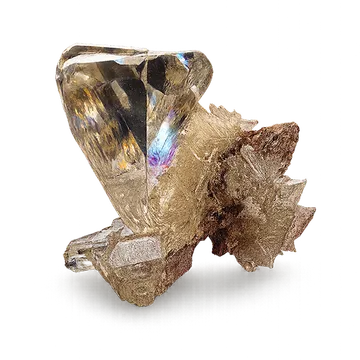
Broken Hill cerussite: iconic white-ivory crystals from Australia’s classic Pb-Zn-Ag deposit; prized for old-time form, locality pedigree, and intact survival.
Key facts
Broken Hill cerussite is one of the classic visual signatures of the Australian silver-lead-zinc fields: dense, surprisingly heavy clusters of white to ivory lead carbonate with an adamantine flash, often arranged in reticulated lattices, “snowflake” networks, V-twins, arrowhead twins, and long bladed crystals that look almost too delicate to have survived a mining camp. Its appeal is not merely that Broken Hill produced cerussite; many lead deposits do that. The distinction is the combination of old-time form, scale, locality pedigree, and the stark oxidized-zone associations of the Broken Hill lode.

Photo: Wikimedia Commons / GeoDIL
Broken Hill’s cerussite belongs to the weathered upper story of one of the world’s great Pb-Zn-Ag ore systems. The primary orebody is the archetype of the “Broken Hill type” deposit: a metamorphosed, structurally complex silver-lead-zinc body in the Proterozoic Willyama Supergroup. Cerussite formed later in the oxidized zone where galena and other lead minerals were attacked by carbonated waters, producing lead carbonate in open spaces, fractures, and gossan cavities. In the collector’s cabinet, the result can be instantly recognizable: white or cream cerussite against dark manganese-iron oxides, sugary anglesite coatings, smithsonite, malachite, azurite, chlorargyrite, pyromorphite, or remnants of galena.
The great Broken Hill cerussites are historical objects as much as mineral specimens. Many of the finest pieces were collected during the early decades of mining, when the oxidized lodes were being opened and the camp was still rough, hurried, and ill-equipped for preserving fragile crystals. Early writers repeatedly emphasized how difficult it was to remove the best groups intact. Collectors therefore prize not only size and sparkle, but survival: original old labels, early mine attribution, undamaged terminations, and reticulated networks that have not been rebuilt are all part of the value.

Photo: Wikimedia Commons
Broken Hill’s most famous examples sit in Australian public collections, including the Australian Museum’s celebrated Block 14 specimen, a 33 x 27 x 12 cm group collected before 1930 and registered in 1933. Its longest crystals reach 28.7 cm, a scale that explains why Broken Hill has remained in the conversation whenever collectors debate the finest cerussite localities in the world. Tsumeb may dominate modern perceptions of glassy, gemmy cerussite, but Broken Hill holds its place through architecture: swords, lattices, boxworks, and old oxidized-zone combinations that could only have come from this extraordinary lode.
Search for specimens: View all cerussite specimens from Broken Hill, Australia
Broken Hill lies in far western New South Wales and is one of the foundational names in Australian mining. The orebody was discovered in 1883 when boundary rider Charles Rasp recognized mineralization on the outcrop, initially thinking in terms of tin before the silver-lead richness of the lode became clear. The Broken Hill Proprietary Company was formed in 1885, and the district became the birthplace of BHP, later one of the world’s major resource companies.
Geologically, cerussite is a secondary mineral here, concentrated in the oxidized zone above and within the weathered portions of the lead-zinc-silver lode. The original Broken Hill orebody consisted chiefly of galena, sphalerite, and silver-bearing minerals, later modified by metamorphism, deformation, and long exposure to surface waters. Where lead-bearing sulfides were oxidized, cerussite developed in cracks, vugs, and gossan cavities, especially in association with anglesite, pyromorphite, coronadite, goethite, quartz, and other secondary species. The dark gossan at Broken Hill was not a simple iron cap; published work describes much of it as a dense black rock rich in plumbic coronadite, with cerussite and pyromorphite becoming more evident downward in cracks and scattered masses.
Historically important cerussite specimens came from multiple parts of the Line of Lode, including the Broken Hill Proprietary Mine, Block 14, the British Mine, the Central Mine, South Mine workings, and later the Kintore and Block 14 open cuts. Early descriptions single out the British Mine for long prismatic “sword” crystals and the Central Mine for enormous masses of reticulated white cerussite. The BHP Block 14 Mine is especially important to collectors because of the great museum specimens collected before its closure and the major suite donated to the Australian Museum in 1933.
Collecting access today should be treated as essentially closed unless formal permission has been obtained. Broken Hill is not an open public collecting ground; the old workings, dumps, leases, and operating or rehabilitated mine areas involve private tenure, mine safety obligations, and environmental controls. The best way to study the locality in person is through museum displays and heritage interpretation, especially the Albert Kersten Mining and Minerals Museum in Broken Hill and the Australian Museum collections in Sydney. Modern field collecting around active or historic mines without permission is not appropriate, and serious Broken Hill cerussite on the market overwhelmingly comes from old collections rather than contemporary casual collecting.
Production of collector-quality cerussite was strongest during the early mining of the oxidized zone in the late nineteenth and early twentieth centuries. Later open-cut work in oxidized ground, especially around Kintore and Block 14, yielded additional secondary material, including cerussite and pseudomorphs involving anglesite, but the iconic large reticulated and bladed specimens are chiefly old-time pieces. That age is part of their identity: a Broken Hill cerussite with an early Australian collection history is not just a specimen of PbCO3, but a survivor from the formative decades of Australian mineral collecting.
The most prized Broken Hill cerussites fall into a few recognizable habits. The first is reticulated cerussite: intergrown twinned crystals forming lattices, meshworks, boxworks, and “snowflake” groups. These may be flat, open, and architectural, or dense and three-dimensional, with white to cream crystal ribs crossing in repeated twin orientations. Many are partial floaters or skeletal groups detached from the cavity walls that once supported them.
A second classic habit is the long prismatic or bladed “sword” crystal. Early descriptions of Broken Hill emphasized elongated crystals projecting from a base like miniature swords, commonly accompanied by smaller intermediate crystals that filled out the group. The finest bladed examples can be dramatically sculptural, but they are also among the most vulnerable to breakage.
Arrowhead twins and V-twins are another Broken Hill hallmark. Historic accounts describe arrowhead twins reaching cabinet scale, and museum or dealer examples show stout ivory to colorless crystals with cyclic twinning and repeated angular terminations. Some individual crystals and twins are glassy and colorless in part, though much Broken Hill material is more ivory, white, cream, gray, smoky, yellowish, or pale brown than the ultra-transparent cerussite associated with Tsumeb or some Moroccan localities.
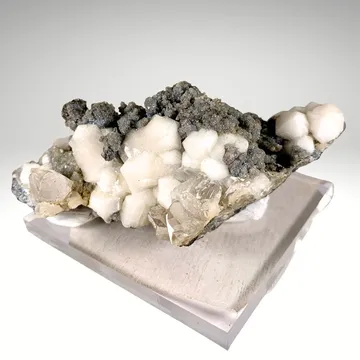
Anglesite is one of the key associated minerals and often occurs as a sparkling coating over cerussite. In some specimens, the coating is thin and sugary, adding brilliance without hiding the form. In others, anglesite partly replaces or masks the cerussite, creating pearly white to tan boxworks. The association is so common that Broken Hill cerussite should always be inspected under magnification: what reads at first glance as dull white cerussite may be cerussite coated with anglesite microcrystals, or a more complex cerussite-anglesite intergrowth.
Other recurring associations include smithsonite, malachite, azurite, chlorargyrite, coronadite, goethite, minium, galena, pyromorphite, calcite, cuprite, native copper, linarite, mimetite, and occasional silver halides. Dark coronadite- and goethite-rich matrix can provide excellent contrast, particularly for white cerussite twins. Malachite, azurite, and pseudomalachite combinations are scarcer but visually attractive when well balanced.
Typical collectible pieces range from thumbnails and miniatures with small twinned crystals to small-cabinet and cabinet clusters. Large intact reticulated groups are rare, and historically important examples may reach 15 to 30 cm or more. Exceptional museum specimens exceed normal collector scale: the Australian Museum’s Block 14 specimen is 33 x 27 x 12 cm, with crystals to 28.7 cm. For ordinary market material, however, a sharp, undamaged 5 to 8 cm Broken Hill cerussite with good reticulation, luster, and provenance can already be a serious specimen.
Quality is judged by architecture first. A fine Broken Hill cerussite should have recognizable twin form, whether as open reticulation, a clean V-twin, a bladed group, or an old-time boxwork. Luster matters greatly: adamantine faces, even on white crystals, separate desirable pieces from chalky or heavily corroded ones. Damage is expected to some degree in this locality, but the placement and honesty of that damage are crucial. Peripheral bruising may be acceptable on an old specimen; broken focal blades, glued networks, or missing terminations across the display face are much more significant. Provenance is a major quality factor, especially labels tying a piece to Block 14, BHP, South Mine, British Mine, Central Mine, Kintore, or an old Australian collection.
Broken Hill cerussite is an authenticity-driven locality. The species itself is not hard to identify when tested sensibly: cerussite is very dense, relatively soft, adamantine to vitreous, and usually white to colorless in Broken Hill material. The challenge is not usually whether the mineral is cerussite, but whether the specimen is correctly localized, honestly described, and structurally original.
Documented specimen-scale fraud specific to Broken Hill cerussite is not a major published theme, but repairs are a real concern. The very forms collectors prize—open reticulated lattices, long bladed crystals, and arrowhead twins—are mechanically vulnerable. Old-time specimens may have been broken during mining, transport, cleaning, photography, or later handling. Use magnification to inspect crystal junctions, the bases of blades, and points where reticulated networks meet matrix. Look for glossy glue in recesses, mismatched luster across a break, repeated oddly perfect junctions, or faces that do not line up crystallographically. Longwave UV can sometimes reveal modern adhesives, though absence of fluorescence does not prove absence of repair.
Condition standards should be realistic. Many genuine Broken Hill cerussites have small chips, bruised edges, missing terminations, iron-oxide staining, or natural coatings of anglesite that mute the luster. Old labels may use broad locality names such as “Broken Hill,” “B.H.P. Mine,” “South Mine,” or “Block 14,” and these are often more credible than modern overly precise attributions without provenance. A vague but old Australian label can be preferable to a recent label assigning an exact sublocality with no supporting history.
Treatments to watch for include stabilization of fragile reticulated groups, reattachment of broken blades, trimming of matrix to improve display, and overly aggressive cleaning. Acid cleaning can brighten cerussite but may also alter gossan matrix or remove desirable patina. Shellacked or darkened matrix is less often discussed for this locality than for some others, but any unnatural gloss on iron-oxide matrix deserves scrutiny. Cerussite is a lead mineral, so normal mineral-specimen hygiene applies: do not lick, soak, abrade, or prepare specimens in a way that creates dust; wash hands after handling; and keep fragile lead-carbonate specimens away from children.
Rarity is strongly tied to form and condition. Small Broken Hill cerussites and cerussite-bearing combination specimens remain available, especially from dispersed old collections. Large undamaged reticulated groups, good sword-crystal specimens, and pieces with early collection history are scarce. The finest examples have migrated into museums or long-held private collections, and when a significant old specimen appears, its value is driven as much by locality status and survival as by mineral aesthetics.
The most evocative Broken Hill cerussite story begins not underground but in a hotel. Edward W. “Teddy” Aldridge, publican of the Duke of Cornwall Hotel in Broken Hill, built one of the great early Broken Hill mineral collections during the late nineteenth century. Local legend has him trading beer for specimens with miners who came through the pub. Whether every exchange happened quite so neatly is less important than what the story reveals: in the oxidized-zone years, specimens moved straight from working miners into local cabinets, hotel rooms, and private display cases. The Powerhouse records that Aldridge accumulated nearly 5000 specimens, and a group of cerussites from the Aldridge-Dixson collection still preserves that social history: miners, beer, publican, university, museum.
The Aldridge material did not simply vanish into private hands. A large part of the collection was purchased by Hugh Dixson on behalf of Sir Edgeworth David of the University of Sydney, reportedly in place of a sale to an American buyer because David wanted the collection kept in Australia. In 1912, 92 Aldridge minerals were presented to the Powerhouse Museum through the University of Sydney. Another later note on a 17 x 15.5 x 8 cm reticulated cerussite tells a different, almost comic chapter in the life of the same collection: Dr. Hans J. Pohl acquired it from the University of Sydney Geology Department around 1952–1953, at a time when the department was “throwing out (literally)” duplicate Aldridge specimens. A mineral that would now be treated as a serious locality treasure could once be rescued from a university discard.
The Australian Museum’s Block 14 cerussite is a more formal, museum-grade survival story. The specimen was collected before 1930, registered in 1933, and came from the collection assembled by the management of the BHP Block 14 Mine after closure. It was donated to the Australian Museum through the mine manager, F. Voss-Smith. The collection had to travel from Broken Hill to Sydney by rail in wooden boxes, a dangerous journey for brittle lead-carbonate lattices and long bladed crystals. The remarkable detail is that none of the specimens were damaged in transit. For a 33 x 27 x 12 cm cerussite group with crystals to 28.7 cm, that is almost as impressive as the specimen itself.
That same Block 14 cerussite later became a public icon. Albert Chapman nominated it for Peter Bancroft’s 1973 book, The World’s Finest Minerals and Crystals, where it was considered one of the best crystal groups of any species. Its selection criteria were unforgiving—crystal perfection, matrix, aesthetics, association, color, luster, and size—and the Broken Hill cerussite scored highly across them. In 1983, Australia Post chose it for a prestamped envelope marking the centenary of Broken Hill, turning a fragile oxidized-zone mineral into a national commemorative image.
There is also a cautionary Broken Hill story every collector should remember. Peter Andersen recorded the path of another famous Block 14 cerussite that many collectors regarded as the world’s best Broken Hill example. It passed from the Kevin Davy collection to Noel Franks, then to Albert Chapman in 1984 with a price tag of $6500. During a photographic session at Chapman’s home in Glebe Point, Sydney, the specimen was dropped and shattered. It was repaired as well as possible, but the accident permanently changed the object. Later it passed into the Warren Somerville orbit and ultimately into the Australian Museum’s Bathurst extension. The lesson is stark: even the greatest cerussite is only one careless moment away from becoming a restoration problem.
.jpg)
