MMM Mine, Australia — Broken Hill locality yielding oxidised Pb-Zn-Ag minerals; lime-to-olive pyromorphite and smithsonite botryoids, prized by collectors.
Key facts
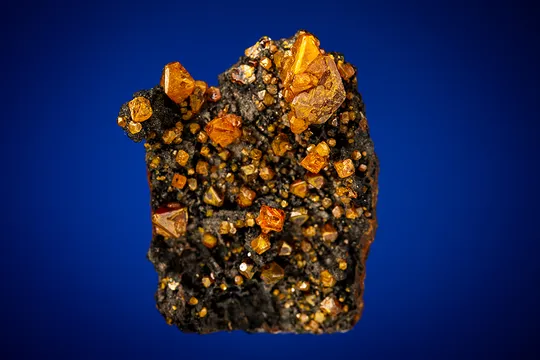
The MMM Mine is the collector’s name for the Minerals, Mining and Metallurgy Ltd era of the old Broken Hill South leases, especially the Blackwood opencut on the historic line of lode at Broken Hill, New South Wales. Its importance is quite different from the deep, classic sulphide specimen suite that made Broken Hill famous in the nineteenth and early twentieth centuries: MMM specimens are overwhelmingly products of the oxidised and supergene parts of a giant silver-lead-zinc system, reopened and quarried after Broken Hill South closed. The best material has a very distinctive look—acid-bright lime, yellow-green, butterscotch, and olive pyromorphite scattered or carpeted across dark grey to black coronadite; translucent grey-white smithsonite botryoids on the same manganese-rich matrix; sharp lead-carbonate and lead-sulphate forms; and, more rarely, copper-carbonate colour from malachite and azurite.
Geologically, this is Broken Hill-type mineralisation in its type district: a highly deformed and metamorphosed Proterozoic Pb-Zn-Ag orebody, later deeply oxidised where the lode came near surface. For specimen collectors, the MMM period matters because open-cut work exposed weathered lode material that earlier underground mining had either missed, discarded, or treated as mining ground rather than display material. The Blackwood opencut in particular became a source of late-twentieth-century Broken Hill secondary minerals—less common on the market than older South Mine, North Mine, or BHP specimens, but instantly recognisable when the labels are right.
Regional View
Country View
The MMM Mine sits within the central Broken Hill mining belt, close enough to the city that its dumps, pits, and rehabilitated workings form part of the urban mining landscape rather than a remote bush locality. That proximity is one reason labels need care: “Broken Hill,” “Broken Hill South,” “Blackwood opencut,” “British Mine,” “Kintore,” “MMM,” and later “Rasp” labels can all overlap historically, depending on the date of recovery and the exact pit or lease block.

Photo: Wikimedia Commons
Search for specimens: View all specimens from MMM Mine, Australia
The MMM Mine was not a newly discovered isolated orebody, but a late operating phase on the Broken Hill South ground. Minerals, Mining and Metallurgy Ltd acquired the Broken Hill South leases in 1972 and reopened the ground by open-cut mining, with the Blackwood opencut as the locality most strongly associated with modern MMM collector specimens. Underground operations ceased in 1976, while MMM’s overall operations continued until 1991, after which the assets passed through Normandy and then to later Broken Hill operators. The present Rasp Mine occupies parts of the broader CML7 area and works silver-lead-zinc mineralisation related to the original line of lode, but collecting access to old open cuts and mine land is not a casual field-collecting proposition.
The deposit belongs to the Broken Hill silver-lead-zinc system, a metamorphosed, structurally complex orebody hosted in Proterozoic metasedimentary rocks. Modern summaries commonly describe the Rasp–Broken Hill mineralisation as metamorphosed volcanic-hosted massive sulphide or Broken Hill-type Pb-Zn-Ag mineralisation; collector literature often emphasises the long, contorted line of lode, with lead-rich and zinc-rich lenses deformed, sheared, folded, oxidised, and locally remobilised. In the central CML7 area, exposures are limited by waste rock, tailings, old workings, and later urban development, so the open cuts—Blackwood, Kintore, Block 14, and older pits—became unusually important windows into the mineralised sequence.
The specimen suite reflects oxidation of primary galena, sphalerite, and associated sulphides. Galena supplied the lead for cerussite, anglesite, pyromorphite, and coronadite-bearing assemblages; zinc minerals weathered to smithsonite and hemimorphite; manganese-rich wall rocks and lode material contributed to the black coronadite-dominant matrices so typical of MMM specimens. Copper is a subordinate but conspicuous component where malachite, azurite, brochantite, linarite, and native copper occur.
Historically, the ground has a layered identity. The British Mine area, the Blackwood opencut, and the old Broken Hill South lease blocks are all part of the locality story, and the exact wording on a label can be meaningful. Specimens recovered before 1972 generally belong to the Broken Hill South or older mine-name era; material recovered during MMM open-cut operations is properly labelled to the MMM Mine, and, where known, to Blackwood opencut or another specific pit. The Blackwood opencut is especially important for pyromorphite on coronadite and for associated cerussite, anglesite, smithsonite, chlorargyrite, mimetite, native copper, rhodochrosite, rhodonite, quartz, jarosite, hemimorphite, marcasite, and other oxidised-zone species.
The most desirable specimen finds appear to have come from oxidised pockets and seams opened during late-1970s and 1980s open-cut work. The best pyromorphites are not giant crystals in the Chinese or French sense, but dense, sparkling Broken Hill plates: crystals from a few millimetres to roughly centimetre scale, unusually vivid against black manganese oxide. Smithsonite from MMM is prized for pale grey to white botryoids and wheatsheaf-like aggregates perched on coronadite. Cerussite and anglesite specimens range from small, sharp, bright examples to complex pseudomorphs and replacements that record multiple stages of lead-mineral alteration.
Collecting today should be regarded as restricted. The old MMM ground lies within an active or managed mining landscape with rehabilitation obligations, industrial hazards, lead-bearing dust, and historic workings. Serious collectors should obtain specimens through old collections, established Broken Hill dealers, reputable mineral dealers, or documented estate material rather than attempting unsanctioned entry.
Pyromorphite is the signature collector species of the MMM Mine, especially from the Blackwood opencut, where it forms lustrous lime-green, yellow-green, oil-green, butterscotch, and occasionally darker olive to brownish hexagonal prisms on coronadite-rich matrix. Typical crystals are small—commonly a few millimetres—but good plates show dense, sparkling coverage, crisp terminations, and strong contrast between bright Pb5(PO4)3Cl and dark lead-manganese oxide; the best cabinet pieces show multiple generations, with finer acicular or micro-prismatic pyromorphite and larger, more isolated hexagonal prisms, sometimes with simple hopper-like terminations. Associations with coronadite are classic, and cerussite, native copper, mimetite, and other oxidised-zone species may accompany it. At MMM, quality is judged less by sheer crystal size than by freshness, uninterrupted coverage, colour saturation, undamaged terminations, and a label that pins the specimen to Blackwood rather than vaguely to Broken Hill.
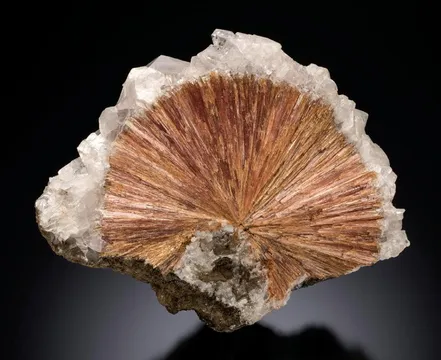
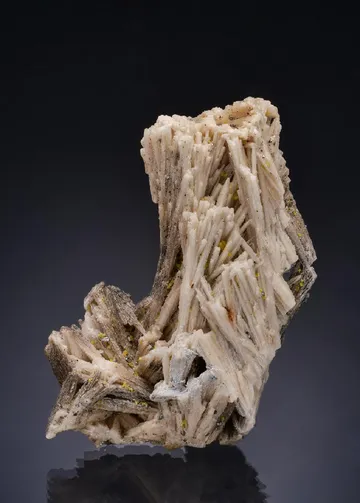
Cerussite from the MMM Mine occurs as white, grey-white, colourless, and milky lead-carbonate crystals and aggregates in oxidised lead ore, often with coronadite, pyromorphite, smithsonite, anglesite, or goethite. The locality produced attractive acicular and bladed-looking cerussite sprays as well as twinned lead-carbonate specimens, including pieces in the small-cabinet range; some MMM specimens are part of more complex alteration sequences where earlier lead sulphate forms have been replaced by cerussite and then coated or accented by iron oxides. The best examples show bright lustre, transparent to translucent edges, sharp form, and visual separation from the dark manganese-oxide matrix, while ordinary examples can look chalky, bruised, or massive. Because Broken Hill labels are historically complicated, cerussite with a precise Blackwood opencut or MMM provenance is preferable to pieces carrying only a broad “Broken Hill” label.
Smithsonite from MMM is most admired in the pale Broken Hill style: translucent grey, white, colourless to faintly creamy botryoidal druses, small globular clusters, and locally wheatsheaf-like aggregates scattered over grey to black coronadite. Individual rounded aggregates commonly measure only a few millimetres, but the effect on a good plate is superb—silky lustre, tight sparkling coverage, and strong tonal contrast against vuggy manganese-oxide matrix. The most attractive MMM smithsonites preserve open texture, with the smithsonite perched on stalactitic or botryoidal coronadite rather than forming a dull crust; cabinet-quality examples are valued for coverage, lustre, lack of abrasion, and the sculptural quality of the coronadite beneath. Labels connected to old collections such as Milton Lavers or other documented Broken Hill holdings add significant confidence and desirability.
Anglesite from the MMM Mine and associated Blackwood material represents the lead-sulphate stage of Broken Hill oxidation, forming colourless to white, transparent to translucent, lustrous crystals and crystal groups, commonly associated with cerussite and sometimes preserved only as a precursor form in later cerussite pseudomorphs. Small, blocky to tabular orthorhombic crystals are the most straightforward examples, while more prized specimens show sharp former anglesite morphology, bright surfaces, and complex association with cerussite, coronadite, and goethite. In collector terms, MMM anglesite is not abundant compared with Broken Hill’s broader lead-carbonate and pyromorphite output, and good pieces are judged by sharpness, lustre, completeness, and whether the specimen records the local replacement sequence without looking etched, chalky, or repaired.
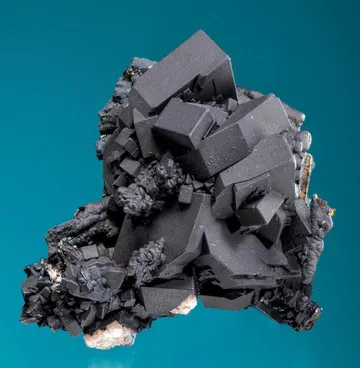
Coronadite is the dark stage on which many MMM specimens perform. At Blackwood it occurs as dull to silky grey, lead-grey, black, stalactitic, botryoidal, vuggy, and crustiform lead-manganese oxide masses, commonly carrying pyromorphite, smithsonite, cerussite, or minor associated species. It is seldom collected at MMM as a “pretty black mineral” alone, but it is mineralogically and aesthetically crucial: the best coronadite matrices have sculptural relief, clean dark colour, and enough open vug texture to make the overlying green pyromorphite or pale smithsonite stand proud. Good coronadite-only examples are usually of interest to locality and oxide specialists, especially where the matrix shows stalactitic growth, banding, or sharply crystallised surfaces rather than nondescript massive manganese oxide.
Malachite from the MMM Mine is a subordinate but visually welcome copper-zone mineral, occurring as green fibrous, drusy, botryoidal, and crustiform aggregates on oxidised Broken Hill matrix, with possible associations including azurite, cerussite, brochantite, linarite, native copper, and iron or manganese oxides depending on the exact pocket. Good MMM malachite is valued for saturated emerald to deep green colour, silky fibrous texture, and clean separation from darker matrix; large showy pieces are much less common than pyromorphite or smithsonite from the locality. The best examples look lively rather than powdery, with intact fibres or druse and minimal bruising on exposed edges.
Goethite at MMM appears principally as glossy black to brown-black iron-oxide coatings and crusts in oxidised lead ore, most memorably on specimens involving cerussite after anglesite, where dark goethite can mantle sharply formed pseudomorphs and accentuate the original crystal geometry. It may also be present with coronadite-rich matrix, which makes visual identification by eye alone unreliable unless the specimen has been labelled or analysed; coronadite tends toward lead-manganese oxide, while goethite supplies the iron-oxide sheen. Good MMM goethite specimens are those where the coating is lustrous, continuous, and does not obscure the pseudomorphic form, while lesser pieces are simply blackened oxidised matrix with little form or contrast.
Azurite is a minor but appealing copper mineral in the MMM suite, typically occurring as blue crusts, small crystals, or patches with malachite and other oxidised copper minerals rather than as the major tabular display crystals known from other Broken Hill workings. On MMM specimens it provides local colour contrast against dark manganese oxides, grey lead carbonates, and green malachite; the most desirable pieces show saturated royal-blue azurite in visible, undamaged areas rather than thin, dull, or altered blue smears. Because azurite is not the locality’s primary claim to fame, precise provenance and association with other MMM secondary minerals are especially important to its collector value.
Galena is the primary lead sulphide behind much of the MMM secondary mineral suite, but collectible MMM galena is far less celebrated than the oxidised minerals derived from it. Where preserved, it occurs as metallic lead-grey masses or crystals in Broken Hill lode material, locally altered to cerussite, anglesite, pyromorphite, coronadite-bearing assemblages, and other lead minerals. Good MMM galena specimens are mainly of locality interest unless they show sharp cubic cleavage faces, bright metallic lustre, or obvious alteration relationships; dull massive galena from Broken Hill is common enough that a specimen needs a strong label, an attractive oxidation association, or an old collection history to stand apart.
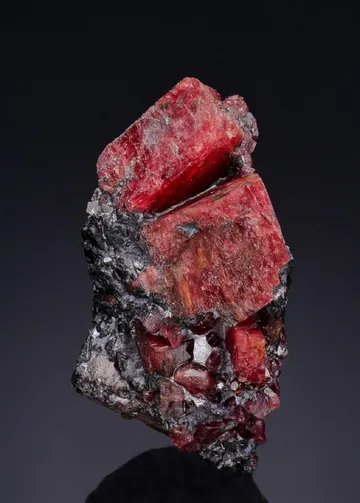
Other minerals documented from the MMM Mine and its named sublocalities include arsenopyrite, brochantite, chalcopyrite, chlorargyrite and bromian chlorargyrite, gudmundite, hematite, hemimorphite, jarosite, linarite, löllingite, marcasite, miersite, mimetite, native copper, pyrargyrite, pyrrhotite, quartz, rhodochrosite, rhodonite, spessartine, sphalerite, and wurtzite. The verified MMM list does not make the mine a type locality in the way nearby Block 14 and the wider Broken Hill field are known for rare species, but it is a fine locality for unusual oxidised lead-manganese associations—particularly coronadite-bearing pyromorphite and smithsonite—and for labelled late-period Broken Hill open-cut material.
The main authenticity issue with MMM specimens is not outright fakery so much as imprecise or historically confused labelling. “Broken Hill” is a broad label; “Broken Hill South” may be correct for older material; “MMM Mine” is appropriate for post-1972 material from the Minerals, Mining and Metallurgy operation; and “Blackwood opencut” is the strongest label for the classic lime-green pyromorphite on coronadite. Some specimens from the broader South Mine lease system are also labelled Kintore or Block 14, and those names should not be casually merged unless the provenance supports it. A collector should treat “MMM Mine, Broken Hill” as useful but incomplete, and “Blackwood opencut, MMM Mine, Broken Hill South Mine” as much stronger.
Condition is a serious factor. Pyromorphite crystals are small, bright, and easily dulled by abrasion; cabinet pieces with pristine sparkling coverage command a premium. Cerussite is brittle and dense, so exposed sprays, twinned edges, and pseudomorphs are prone to bruising. Smithsonite botryoids can look deceptively sturdy but often show rubbed high points, especially where they sit on rough coronadite. Goethite- or coronadite-coated pseudomorphs should be examined for flaked coatings, broken tips, and old glue along matrix breaks.
Treatments are not widely documented for MMM material, but ordinary collector caution applies. Cleaned pyromorphite should retain natural surface lustre without an oily shine; pale smithsonite should not appear artificially whitened or resin-stabilised; and black coronadite/goethite matrices may hide repairs. Because several key MMM minerals contain lead—pyromorphite, cerussite, anglesite, galena, coronadite, mimetite, and linarite among them—specimens should be handled with normal lead-mineral hygiene: wash hands after handling, keep dust out of the air, avoid trimming or sawing without proper controls, and do not display friable pieces where children can touch them.
Market availability is intermittent. Small pyromorphite plates and modest oxidised Broken Hill specimens appear occasionally, but strong MMM pieces with old labels, rich colour, and excellent condition are much less common. Smithsonite on coronadite and pyromorphite on coronadite are the most recognisable marketplace forms. Exceptional pseudomorphs involving anglesite, cerussite, and goethite can bring substantially higher prices than their muted colour might suggest, because they combine aesthetic form with Broken Hill mineralogical history.
In November 1981, the Blackwood opencut was still open enough to give collectors a view into the exposed oxidised zone, and one photograph from the Australian Museum archives captures a moment that has become part of the locality’s collecting memory: Albert Chapman and Ross Pogson collecting pyromorphite at Blackwood’s Opencut, MMM Mine. Chapman’s name carries special weight in Australian mineral collecting; the Albert Chapman Collection, later purchased by the New South Wales Government in 1988 and transferred to the Australian Museum in 1995, became famous for specimen quality, diversity, and especially its Australian content. The image is valuable not because it shows a staged cabinet specimen, but because it places named collectors directly on the oxidised Broken Hill ground during the MMM era, when the bright pyromorphite-on-coronadite material was still being recovered from the source rather than recycled through decades of dealers’ labels.
The modern visitor sees the MMM landscape differently. The Broken Hill Heritage Drive points out the MMM Dumps along Holten Drive, where waste from low-grade remnant ore mining marks the open-cut phase after Broken Hill South. The same guide notes the Kintore pit across Blocks 9, 10, and 11, the Blackwood pit on the old British Mine, and a smaller pit in Block 14—three names that still appear in mineral labels and still cause confusion when specimens are separated from their original tickets. For a collector, those dump ridges are more than industrial remnants: they are the visible footprint of the short but specimen-rich interval between the older Broken Hill South underground era and the later Rasp Mine redevelopment.