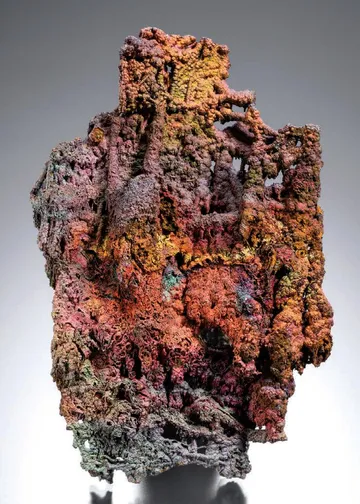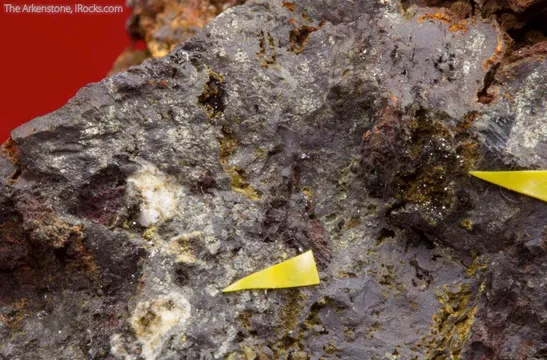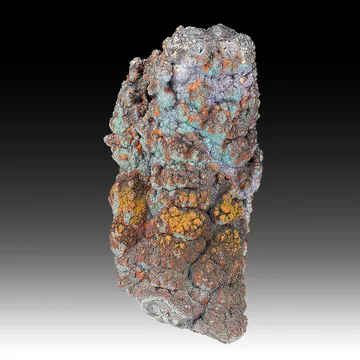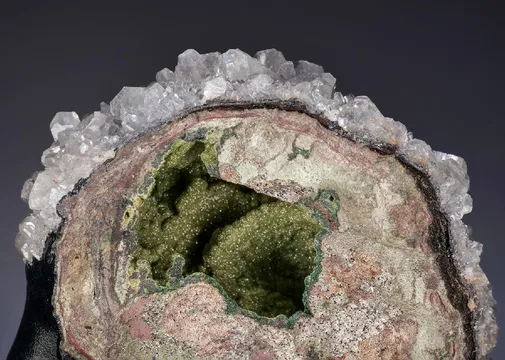
Goethite - iridescent botryoidal crusts, stalactitic forms, and rare euhedral crystals; a striking, affordable display mineral with strong color.
Key facts
Goethite (FeO(OH)) is the most widespread iron oxyhydroxide and a principal constituent of many “limonite” labels on older specimens. While common as a brown, earthy iron ore, it can also form striking display pieces: lustrous botryoidal crusts, stalactitic and stalagmitic “fingers,” acicular sprays, and sharp pseudomorphs after pyrite, marcasite, and siderite. Some of the most coveted examples show vivid iridescence—rainbow sheens of violet, blue, green, gold—caused by thin-film interference from ultra-thin surface layers and hematite intergrowths (historically called “turgite”).
Specimens range from velvety matte brown to submetallic or even mirror-bright; textures can be grape-like botryoids or sculptural cave-form stalactites. Microcrystals occur but true euhedral crystals are rare; most collector pieces are aggregates or replacements. Fine goethite pairs beautifully with contrasting species—vanadinite from Morocco, adamite from Mexico—and with clean, aesthetic forms it can be as eye-catching as many colorful minerals. Prices are typically accessible, though premium iridescent stalactites or classic pseudomorphs from famous localities are strongly sought and can be expensive.
Goethite’s appeal lies in both abundance and surprise. Many collectors first meet it as “limonite” on oxidized ore specimens, only later discovering that top-quality goethite can be dazzling. The Spanish “rainbow” discoveries (Murcia and Huelva) cemented goethite as a legitimate showpiece mineral, while historic pseudomorphs from German iron districts remain perennial classics. Mexican stalactites from Ojuela and matrix pieces with bright Moroccan vanadinite keep demand strong. Because supply ebbs and flows by pocket rather than by steady mining, the finest aesthetics—intense iridescence, sharp replacements, balanced stalactites—are never common, and select pieces command competitive pricing among advanced collectors.
Located in the La Unión–Cartagena district (Murcia), Filón Sur is world-famous for spectacular iridescent goethite. These pieces show saturated, multi-hued sheens—violet, cobalt, emerald, gold—over botryoidal or stalactitic surfaces. The “rainbow” effect results from ultra-thin surface layers and hematite/goethite intergrowths producing thin-film interference. Aesthetic forms range from grape-like clusters to elongated stalactitic “fingers,” often with satiny to submetallic luster. Fine, undamaged examples with even, high-saturation iridescence are considered among the best goethites ever found.
The historic Tharsis mines in Huelva Province produced classic iridescent goethite historically referred to as “turgite” (goethite–hematite). Specimens exhibit banded botryoids and stalactites with luminous peacock colors, sometimes darker and more metallic than Murcia examples. Antique collections often feature Tharsis pieces, making locality provenance an added draw. Top specimens show smooth, evenly coated surfaces with minimal bruising and rich color play across the display face.
Ojuela is a legendary oxidized-zone mine known for diverse species—and excellent goethite. Collectors prize its stalactitic and stalagmitic forms, velvety botryoidal crusts, and dramatic pseudomorphs (commonly after calcite or aragonite). Associations with adamite, mimetite, wulfenite, and hemimorphite add color. Luster ranges from matte velvet to glossy submetallic; some pieces show subtle iridescence. Large, undamaged stalactites or sculptural clusters, especially with contrasting species, are Ojuela highlights.
Though renowned for many species, Tsumeb yielded distinctive goethite in stalactitic forms, reticulated replacements, and pseudomorphs after earlier minerals. Surfaces can be silky to metallic, sometimes with faint iridescence. With Tsumeb, context is key: matrix associations and historically documented provenance elevate value. Sculptural stalactites with minimal damage are particularly prized as they display the mine’s characteristic elegance even in a common species.