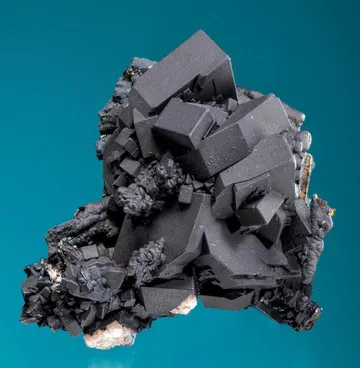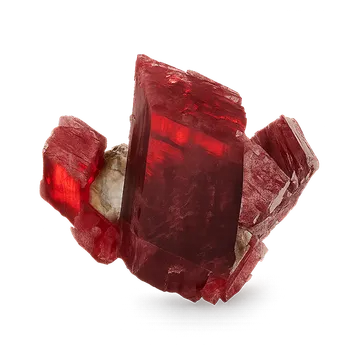
Broken Hill rhodonite, Australia — vivid red crystals in a famed silver-lead-zinc ore system, often with galena and spessartine; a premier locality for collect…
Key facts
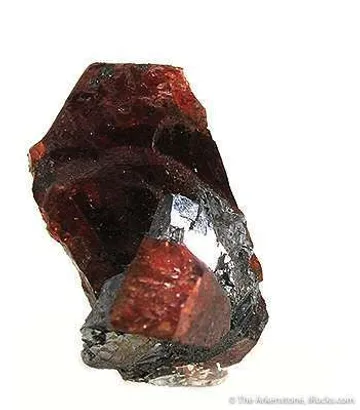
Broken Hill rhodonite is one of the great paradoxes of mineral collecting: a manganese silicate that grew not in a quiet manganese vein but inside one of the world’s most famous silver-lead-zinc ore systems, where red crystals sit in hard contrast against metallic galena, dark sphalerite, orange-red spessartine and pale calcite. The finest specimens are not the familiar massive pink lapidary rhodonite. They are deep red to brownish red, transparent to translucent, commonly tabular or prismatic crystals, sometimes gemmy enough to cut as rare collector stones. At their best they have a glowing, almost spinel-like red color when backlit, with sharp to rounded faces that betray both growth and later reaction with the sulfide ore.

Photo: Wikimedia Commons
The locality’s appeal is inseparable from the Broken Hill lode itself. The deposit is a highly deformed, high-grade metamorphosed silver-lead-zinc system in the Willyama Supergroup, famous for coarse galena and sphalerite, manganese silicates, garnets, pyroxenoids and a long suite of rare secondary species. In modern geoheritage language Broken Hill has been called a “mineralogical rainforest,” a phrase that suits it: hundreds of mineral species are recorded from the field, and dozens have Broken Hill as their type locality. For rhodonite collectors, that complexity matters. It is why Broken Hill pieces may show red rhodonite crystals embedded in galena, red-brown spessartine on galena, calcite with rhodonite, or mixed manganese-silicate assemblages involving bustamite, hedenbergite, pyroxroite/pyroxmangite-related material and, in some cases, the rhodonite-group species ferrorhodonite.

Photo: Wikimedia Commons
Historically, Broken Hill rhodonite belongs to the classic age of mining specimens. The orebody was pegged in 1883 after Charles Rasp recognized mineral promise in the gossanous “Broken Hill,” and the Broken Hill Proprietary Company was floated in 1885. From that beginning came one of Australia’s defining mining stories and a specimen culture as deep as the workings themselves. Fine rhodonite crystals were already important enough to be studied in the early twentieth century, and by the later twentieth century the best transparent crystals from the North Mine were treasured by miners, local collectors, museums and overseas specialists.
The ultimate Broken Hill rhodonites combine rich red color, translucency, crystal definition and matrix contrast. A freestanding crystal on bright galena can be electrifying, but the locality also produced crystal groups in calcite, embedded tabular crystals exposed in sulfide ore, and old-time vugs lined with rose-red crystals in massive rhodonite. The finest museum example is the Australian Museum’s blood-red crystal group from the 1700 ft level of the Zinc Corporation Mine, Albert Chapman Collection no. D.49966, a small but extraordinary specimen that has been described by the museum as the finest crystal group of its kind and compared visually to the sails of the Sydney Opera House.
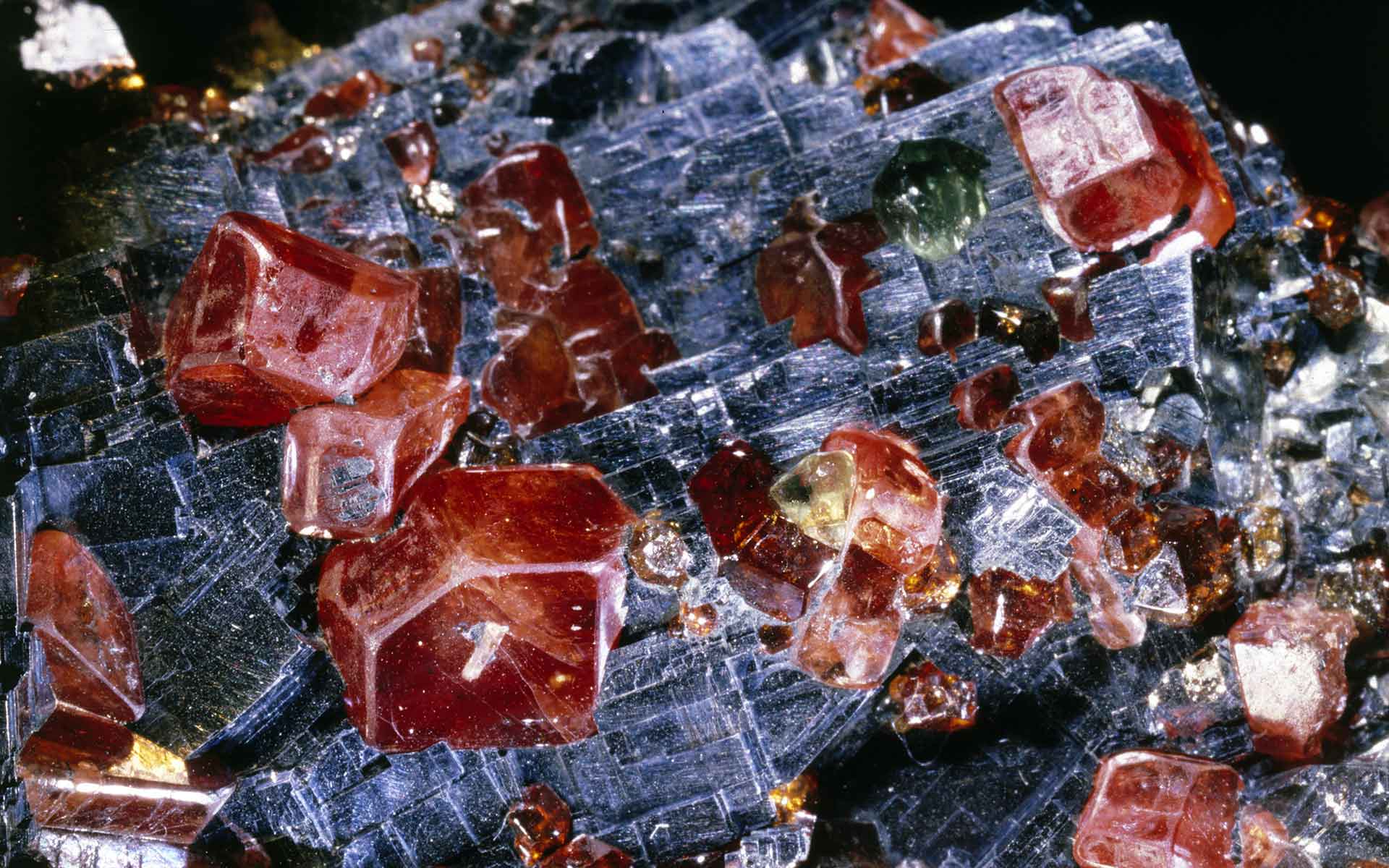
Photo: IUGS Geoheritage
Search for specimens: View all rhodonite specimens from Broken Hill, Australia
Broken Hill lies in far western New South Wales, near the Barrier Ranges and not far from the South Australian border. The mining field follows the Line of Lode, the great arc-shaped orebody that made the city. In specimen labels, “Broken Hill” may refer broadly to the Broken Hill district, but important rhodonite labels are usually more specific: North Mine, Zinc Corporation Mine, Broken Hill Proprietary Mine, Broken Hill South Mine, Central Mine, Block 14, Kintore, Blackwood, British Mine or related workings along the lode.
The primary geological setting is a high-grade metamorphosed, stratabound lead-zinc-silver deposit hosted in Proterozoic metasedimentary rocks of the Willyama Supergroup. The ore lenses were intensely folded, recrystallized and remobilized during granulite-facies metamorphism. That metamorphic overprint is central to the locality’s specimen character: galena and sphalerite are coarse, manganese silicates are abundant, and rhodonite occurs as part of a larger suite of Mn-Ca-Fe silicates and pyroxenoids rather than as a simple vein mineral. Broken Hill rhodonite is therefore a gangue mineral of the sulfide orebody, not an accessory afterthought.
The rhodonite most prized by collectors came principally from the primary sulfide zone, especially the North Mine and the Zinc Corporation Mine. Early mineralogical descriptions placed fine rhodonite in the sulfide zone with galena, blende and garnet; later gemological work focused on transparent crystals from the North Mine. The North Mine’s 3 Lens and 2 Lens lead lodes were especially important. During the 1970s, miners working the 25, 26 and 27 levels of No. 3 shaft, about 350 m below surface, reportedly made a deliberate effort to save rhodonite crystals by separating them carefully from sulfide ore. Those crystals included intense pinkish to brownish red tabular crystals to 10 cm, with smaller pockets of transparent crystals about 1 cm wide.
Mining history at Broken Hill begins with the 1883 pegging of the orebody and the rapid rise of BHP. The North Mine site, originally Block 17 at the northern end of the lode, was pegged in 1883 and sold to the Broken Hill North Silver Mining Company in 1885. It struggled early with sulfide-ore treatment and did not pay its first dividend until 1899, but later became one of the major mines, with peak ore production in the 1920s. No. 2 shaft became operational in 1928; a concentration mill followed in 1939; and No. 3 shaft, begun in 1948 and commissioned in 1962, reached about 1,600 m depth. North Broken Hill Ltd. closed its operations in 1993.
Other parts of the lode have separate collecting histories. The Zinc Corporation Mine produced the celebrated Albert Chapman rhodonite specimens from the 1700 ft level. MMM later operated open pits in the old southern leases: the Kintore pit across Blocks 9, 10 and 11, Blackwood on the old British Mine, and a smaller pit in Block 14. MMM acquired Broken Hill South’s interests in 1972, operated open cuts between 1976 and 1991, ceased open-pit mining in 1991 and closed operations in March 1992. Those open cuts are famous especially for oxidized-zone minerals, but they are part of the same collector landscape and locality nomenclature.
Modern collecting access is limited. Broken Hill is not an open casual collecting ground in the way older literature can make nineteenth- and twentieth-century mine culture sound. Some sites are active industrial operations, some are heritage features, and some are not accessible to the public. The current Rasp Mine is an operating silver-lead-zinc mine in central Broken Hill, with underground mining and flotation processing; it is not a public collecting locality. The most realistic path to classic rhodonite is through old collections, established dealers, deaccessions, documented field-collected material from past access, or specimens handled through the Broken Hill mineral community. Local clubs and museums remain important because they preserve knowledge of old mine names, levels and specimen styles that cannot be reconstructed from a vague “Broken Hill” label alone.
The finest Broken Hill rhodonite crystals are deep red, cherry-red, blood-red, brownish red or rose-red. Unlike the massive pink-and-black rhodonite common in lapidary material, Broken Hill’s collector-grade material is valued for crystal form and translucency. Good crystals can glow red-orange to pinkish red under backlighting. The best small crystals are transparent enough to be considered gem material, and a handful have been faceted.
Crystal habit is typically tabular to prismatic. Older descriptions emphasize crystals extended parallel to one axis, with common faces giving a bladed or tabular look; specimen descriptions often mention rounded edges, contact terminations, etched or corroded-looking surfaces, and partial replacement by galena or sphalerite. This “corroded” or embedded character is not necessarily damage. It is part of how the rhodonite interacted with the metalliferous sulfide assemblage.
Size is one of the locality’s distinctions. Gemmy crystals on display specimens are often in the millimeter to low-centimeter range, and transparent pocket crystals around 1 cm are highly desirable. The GIA study of North Mine material recorded transparent rhodonite crystals of 5–25 mm in the specimens examined and noted polished ore samples containing rhodonite crystals from 2–70 mm. Larger tabular crystals to about 10 cm are documented from the North Mine’s preserved 1970s material, though truly aesthetic, undamaged crystals of that size are exceptional. Dealer and collection records occasionally describe very large individual pieces, but for serious collectors the practical sweet spot is a small, richly colored crystal with strong form and a reliable old Broken Hill provenance.
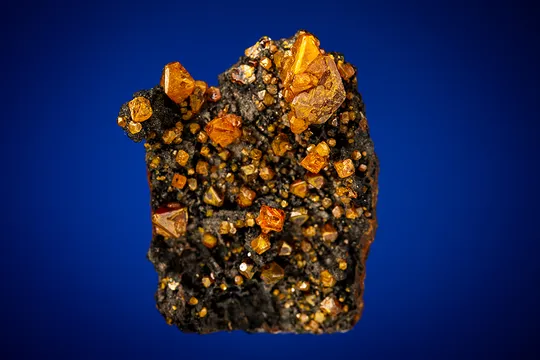
Matrix is a major quality factor. Galena is the classic contrast: bright metallic grey against transparent red rhodonite is the signature Broken Hill look. Sphalerite is also part of the ore assemblage, though less visually dramatic than galena. Spessartine garnet can make superb combination pieces, especially when orange-red dodecahedrons sit with rhodonite in galena. Calcite is another important associate, particularly for Zinc Corporation and North Mine pieces. Documented associated minerals also include bustamite, hedenbergite, fluorapatite, fluorite, quartz, pyroxroite or pyroxmangite-related species, pyrosmalite-(Fe), arsenopyrite, chalcopyrite and rare rhodonite-group material such as ferrorhodonite.
Color and transparency separate the best specimens from merely representative ore. A massive red manganese-silicate fragment from Broken Hill can be interesting; a lustrous, gemmy, well-terminated red crystal on galena is a classic. Backlighting is useful when evaluating a piece: strong Broken Hill rhodonite often reveals internal fire even when the surface appears dark brown-red. However, backlighting should not be used to excuse poor crystallization or heavy damage. The finest pieces show both color and form without needing theatrical illumination.
Condition must be read carefully. Many crystals are embedded, contacted or naturally etched, and old-time Broken Hill rhodonites can show contacts where the crystal grew against or was freed from galena. A contacted base or matrix-side attachment is normal; broken terminations, bruised edges, glued crystals and loose galena are more serious. Galena matrix can cleave, crumble or bruise during trimming and shipping, so an apparently “minor” matrix weakness may become a major conservation problem if the specimen is handled roughly.
Chemically, Broken Hill rhodonite can be iron- and calcium-bearing. Published work on transparent material reports compositions commonly in the range of 50–70 mol.% MnSiO3, 18–20 mol.% CaSiO3 and 10–20 mol.% FeSiO3, with possible traces of Zn and Mg. That chemistry helps explain why Broken Hill material may grade visually and chemically toward related manganese-calcium-iron silicates, and why analytical caution is appropriate for unusual pieces. Some red material from Broken Hill that collectors historically called rhodonite may prove to be ferrorhodonite, pyroxmangite or another Mn-silicate if tested.
The first collector question is locality precision. “Broken Hill” is a strong label, but “North Mine, 25/26 level,” “North Mine, 27 level,” “Zinc Corporation Mine, 1700 ft level,” or “Broken Hill Proprietary Mine” is far stronger. Many classic specimens were saved decades ago by miners and passed through local families, Australian collections, or international dealers. Provenance matters because current mine access is restricted and the great rhodonite finds are not a regular modern supply.
No widely documented, locality-specific fake treatment epidemic is associated with Broken Hill rhodonite in the way that some colorful minerals have known artificial-growth or dyeing problems. The more realistic concerns are misidentification, mislocality, repairs and over-optimistic descriptions. Massive pink rhodonite from elsewhere, dyed or polished rhodonite sold in the metaphysical market, or generic “Australian rhodonite” should not be confused with classic Broken Hill crystal specimens. Broken Hill pieces should look like orebody specimens: red crystals or crystal fragments in galena, sphalerite, calcite or manganese-silicate matrix, often with spessartine or other Broken Hill associates.
Misidentification is a genuine mineralogical issue. Bustamite, pyroxmangite, manganhedenbergite, ferrorhodonite and rhodonite can be visually confusing in the Broken Hill assemblage, especially as massive or granular red-brown material. A crystal sold as rhodonite is more convincing when it has the classic red tabular or prismatic habit in galena or calcite and matches known North Mine or Zinc Corporation styles. For important purchases, analytical support is reasonable, particularly for isolated fragments, unusual brown-red masses or pieces claimed as ferrorhodonite.
Condition problems are common enough to affect price sharply. Look for bruised crystal edges, missing terminations, cleaved galena matrix, reglued rhodonite crystals and unstable sulfide edges. Because many good crystals are partly embedded, sellers sometimes photograph only the best face; ask for views of the back, base and termination. A crystal can be incomplete yet still highly collectible if the display face is strong and the contact is clearly natural. A repair, however, should be disclosed.
The market treats Broken Hill rhodonite as a classic rarity. Small representative specimens still appear, but the best material is usually old collection material. Gemmy red crystals on galena, especially from the North Mine, are far less available than their reputation might suggest. The strongest prices attach to crystals with rich red color, translucency, intact faces, attractive contrast on metallic galena, specific mine and level information, and an older provenance. Zinc Corporation crystal groups, particularly blood-red bladed specimens comparable in style to the Albert Chapman examples, are major Australian classics. Faceted stones from Broken Hill are a specialized gem-collector category; the number of documented faceted examples is very small, and the locality is better known to mineral collectors for crystals than for commercial gems.
Broken Hill’s rhodonite story is not only a mineralogical one; it is also a story of miners carrying beauty out of an orebody built for tonnage. In the 1970s, at the North Mine, the memorable setting was not a sunlit collecting pocket but the 25, 26 and 27 levels of No. 3 shaft, roughly 350 m below the surface. There, in the 3 Lens lead lode, miners encountered intense pinkish to brownish red rhodonite crystals in the sulfide ore. The crystals could reach 10 cm, and the best pockets held transparent crystals about 1 cm wide. Rather than let them vanish into ore chutes, miners made an effort to separate and preserve them. That single decision is why many of the finest North Mine rhodonites exist outside the smelter record at all.
The specimen culture around Broken Hill grew as soon as mining began. In later recollections from local collectors, minerals were not abstract scientific objects; they were things on mantels, in sheds, above stoves, in miners’ cottages and in the hands of children whose fathers worked underground. Trevor Dart, president of the Broken Hill mineral club, recalled a small blood-red rhodonite crystal that sat above the stove at his parents’ home. When his father told him he could have the collection, that rhodonite was one of the first pieces he received. Dart’s family connection to the mines ran deep: his father and grandfather both worked at the North Mine, with 70 years underground between them.
Ross Clark, a retired science teacher, remembered arriving in Broken Hill in 1969 and seeing the material coming out of the mines. The colors seemed almost unbelievable: greens, blues and red crystals from a landscape outsiders might imagine as all dust and ore. He described it as a passion that some might call an obsession. That is exactly how Broken Hill has worked on collectors for generations. The city’s great orebody paid dividends in lead, zinc and silver, but it also paid private dividends in shockingly beautiful small things.
One of the most repeated Broken Hill collecting stories belongs to the Duke of Cornwall Hotel. Edward Aldridge, the publican, is said to have acquired mineral specimens from miners in exchange for beer. In one telling, the “old publican at the Duke of Cornwall” traded billies of beer for specimens to build up different mineral varieties. The image is irresistible: miners coming in from the lode with pockets or tins of crystals, the publican adding them to a growing hoard, and scientifically important pieces being saved by barter rather than by museum policy. Over time, such miner-saved material drew visitors from institutions overseas, including the British Museum and the Smithsonian.
The fate of the Milton Lavers collection shows how fragile locality heritage can be after the miners and collectors are gone. Lavers, a former Broken Hill resident, assembled his collection from crystal fragments found while he worked in the mines. After his death in 2014, the collection was sold. Broken Hill City Council hoped to raise $1.3 million to keep it in the city but could not proceed. UK dealers Crystal Classics bought the collection, and a local action group later raised funds to buy a small portion back. In 2016, the council donated $5,670 so that the remaining selected minerals would not have to be returned to London. The issue was not just ownership; it was whether pieces formed in the Broken Hill lode and saved by Broken Hill miners would remain visible to the people of Broken Hill.
The Australian Museum’s Albert Chapman rhodonite adds another chapter. The specimen came from the 1700 ft level of the Zinc Corporation Mine and was bought by Chapman from a Broken Hill miner around 1965. It is only about 5 x 3 x 0.7 cm, but its blood-red, sharp parallel blades made it internationally famous. Registered in 1996 as D.49966 in the Albert Chapman Collection, it later appeared on the front cover of the 2020 Mineralogical Record supplement on mineral collections in Australia. A small crystal group passed from miner to collector to museum to publication cover: that is the Broken Hill specimen story in miniature.
C. Anderson (1908), “Mineralogical notes. No. VII. Rhodonite, Broken Hill, New South Wales,” Records of the Australian Museum, 7(2), 129–133 — Early crystallographic and descriptive study of Broken Hill rhodonite from the sulfide zone, associated with galena, blende and garnet.
Paul W. Millsteed, Terrence P. Mernagh, Vincent Otieno-Alego and Dudley C. Creagh (2005), “Inclusions in Transparent Gem Rhodonite from Broken Hill, New South Wales, Australia,” Gems & Gemology, 41(3), 246–254 — Essential gemological study of transparent North Mine rhodonite, including inclusions, faceted stones, chemistry and the 1970s preservation of crystals from the 25–27 levels.
Nadezhda V. Shchipalkina et al. (2017), “Ferrorhodonite, CaMn3Fe[Si5O15], a new mineral species from Broken Hill, New South Wales, Australia,” Physics and Chemistry of Minerals, 44, 323–334 — Description of ferrorhodonite, the Fe-ordered analogue in the rhodonite group, from Broken Hill manganese-rich metamorphic rocks.
Ian R. Plimer (1984), “The mineralogical history of the Broken Hill Lode, NSW,” Australian Journal of Earth Sciences, 31(4), 379–402 — Important paper on Broken Hill’s metamorphic and mineralogical evolution, including high-grade assemblages and the complex oxidized zone.
B.R. Frost, S.M. Swapp and R.W. Gregory (2005), “Prolonged existence of sulfide melt in the Broken Hill orebody, New South Wales, Australia,” The Canadian Mineralogist, 43(1), 479–493 — Geological context for sulfide melting and remobilization in the high-grade Broken Hill orebody.
W.D. Birch (1999), Minerals of Broken Hill, Broken Hill City Council in conjunction with Museum Victoria — The standard modern locality reference, cited by the IUGS geoheritage account for Broken Hill.
Australian Museum specimen D.49966, Rhodonite, 1700 ft level, Zinc Corporation Mine, Broken Hill — The celebrated Albert Chapman Collection blood-red rhodonite crystal group, purchased from a Broken Hill miner around 1965.
Australian Museum blog: “Sparkling Treasures: International coverage for Australian Museum Mineral Collection” — Notes the D.49966 Broken Hill rhodonite’s appearance on the front cover of the 2020 Mineralogical Record supplement Mineral Collections in Australia.
Mindat occurrence entry: Rhodonite from Broken Hill, Broken Hill district, Yancowinna Co., New South Wales, Australia — Useful occurrence record with associated minerals, locality hierarchy and reference trail.
“Rhodonite with Calcite North Mine (North Broken Hill Mine), Broken Hill, Australia” — Vimeo — Short specimen video of a North Mine rhodonite with calcite, useful for seeing luster, form and matrix in motion.
“Beer traded for treasure: Outback town home to some of the world's most valuable minerals” — ABC Broken Hill / Aimee Volkofsky — Local-media feature on Broken Hill specimen culture, including Ross Clark holding rhodonite crystals in galena and recollections of miners saving material.
“Council donation saves part of Milton Lavers' mineral collection from leaving Broken Hill” — ABC Broken Hill / Declan Gooch — Story of the effort to keep part of the Milton Lavers mineral collection, including North Mine rhodonites, in Broken Hill.
IUGS Geoheritage: The Broken Hill Pb-Zn-Ag deposit — Concise authoritative overview of the deposit’s geology, mineral diversity, type minerals and geoheritage significance.
Mindat: Broken Hill rhodonite occurrence — Best quick locality database entry for rhodonite associations, mine sublocalities and references.
Australian Museum: Rhodonite — Features the Albert Chapman Collection Zinc Corporation Mine rhodonite and specimen details.
GIA: “Inclusions in Transparent Gem Rhodonite from Broken Hill, New South Wales, Australia” — Essential reading for transparent North Mine rhodonite, faceted stones, inclusions and preservation history.
National Museum of Australia: Founding of BHP — Clear historical account of Charles Rasp, the Syndicate of Seven, the 1885 silver discovery and BHP’s origins.
Visit Broken Hill: Mining & Geology — Accessible locality history covering the Line of Lode, mining innovation and early mineral collectors.
Visit Broken Hill: North Mine — Useful historical note on the North Mine, including Block 17, shaft history and production milestones.
Visit Broken Hill: MMM Dumps — Background on the Kintore, Blackwood and Block 14 open-cut era and MMM’s 1976–1991 operations.
Broken Hill Mines: Rasp Mine — Current operating-mine information for the central Broken Hill silver-lead-zinc project and modern mining context.
Wikimedia Commons: Rhodonite-24629 — Image record for a classic gem rhodonite crystal from Broken Hill, credited to Rob Lavinsky, iRocks.com.
Wikimedia Commons: Rhodonite-211554 — Image record for an old-time Broken Hill rhodonite specimen with rose-red crystals in a vug.