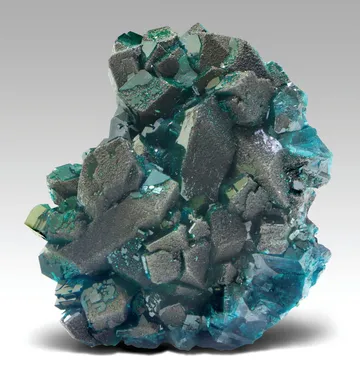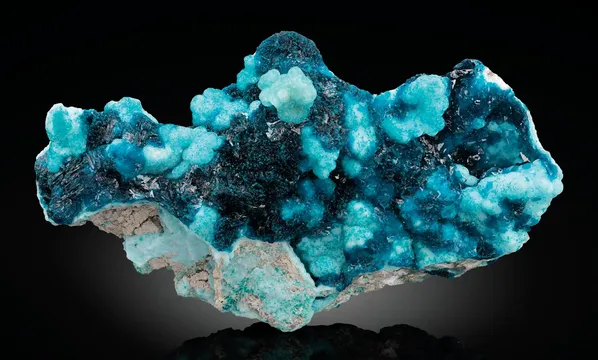
Yanga Koubenza quarries, Republic of the Congo - rising modern secondary-mineral locality prized for blue smithsonite, aurichalcite, and mimetite bonanza.
Key facts
Yanga Koubenza has moved with unusual speed from an obscure Congolese zinc-lead occurrence to one of the most watched modern secondary-mineral localities in Africa. The quarry lies near M’fouati in Bouenza Department, in the Niari Basin metallogenic belt of the Republic of the Congo, where Neoproterozoic carbonate rocks of the West Congo Supergroup host structurally controlled Cu-Pb-Zn mineralization. For collectors, its importance is not simply that the ore is rich in zinc and lead; it is that mining has intersected karstic, supergene pockets lined with unusually colorful and sometimes startlingly fresh secondary minerals.
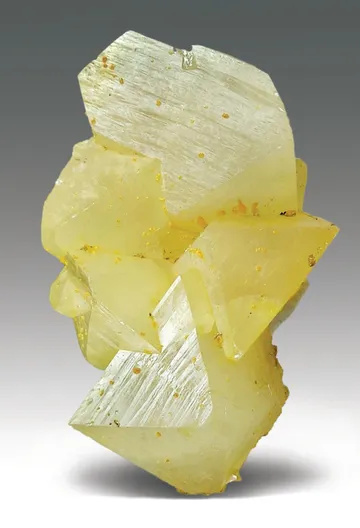
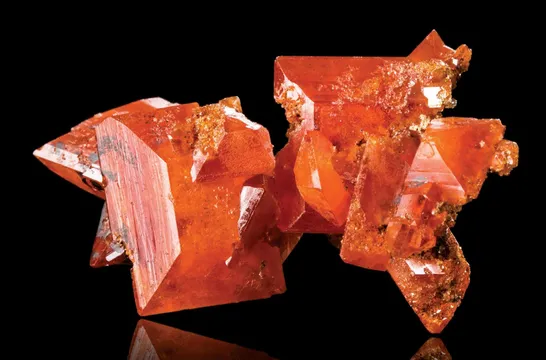
The first specimens to establish Yanga Koubenza in the international trade were blue to blue-green smithsonites, many of them mammillary, botryoidal, waxy to satin-lustrous, and colored by intimate aurichalcite inclusions. Good pieces can look uncannily like classic Kelly Mine smithsonite in miniature-to-cabinet form, but with an African locality pedigree and, at times, more complex associations: aurichalcite, rosasite, hemimorphite, azurite, malachite, cerussite, and later mimetite. The locality’s reputation broadened dramatically with the 2024 “Mimetite Bonanza,” a restricted zone in the western part of the deposit that produced gemmy yellow to orange mimetite, rare mimetite on vivid blue philipsbornite, unusually large visible crystals of duftite, fine pyromorphite, and highly sculptural cerussite twins.
Regional View
Country View
The best Yanga Koubenza specimens have a distinctly “new locality” freshness: turquoise smithsonite skins over brown iron-rich matrix, blue-green aurichalcite in velvety seams, glossy white cerussite snowflakes against dark azurite, and bright yellow mimetite crystals standing on blue philipsbornite carpets. They are products of a working industrial mine, not a collector dig, which helps explain both their excitement and their uneven survival. Many pockets were intersected by heavy equipment and ore handling; intact, well-trimmed specimens are the survivors of a much larger volume of mineralized rock.
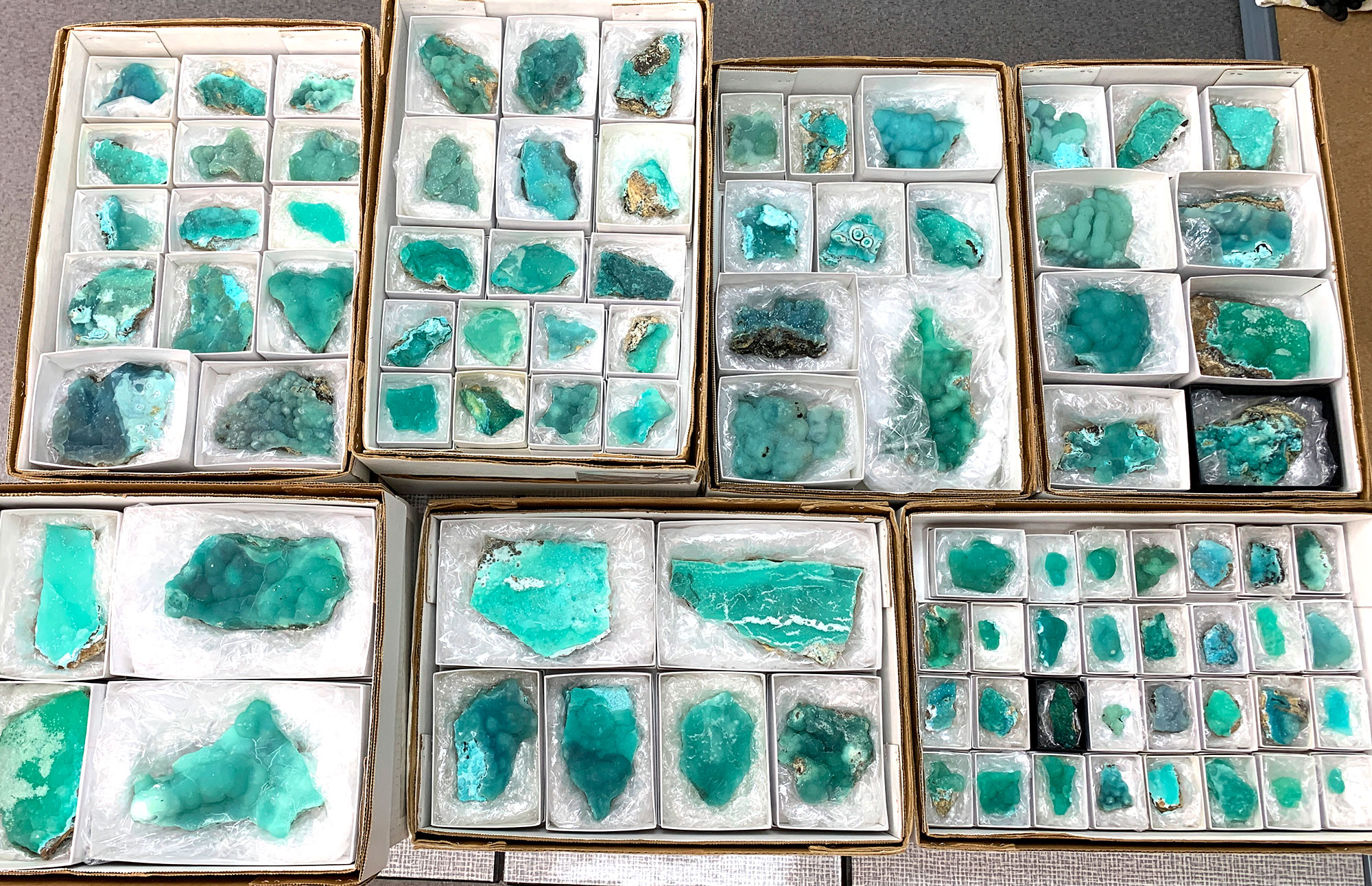
Photo: Spirifer Minerals
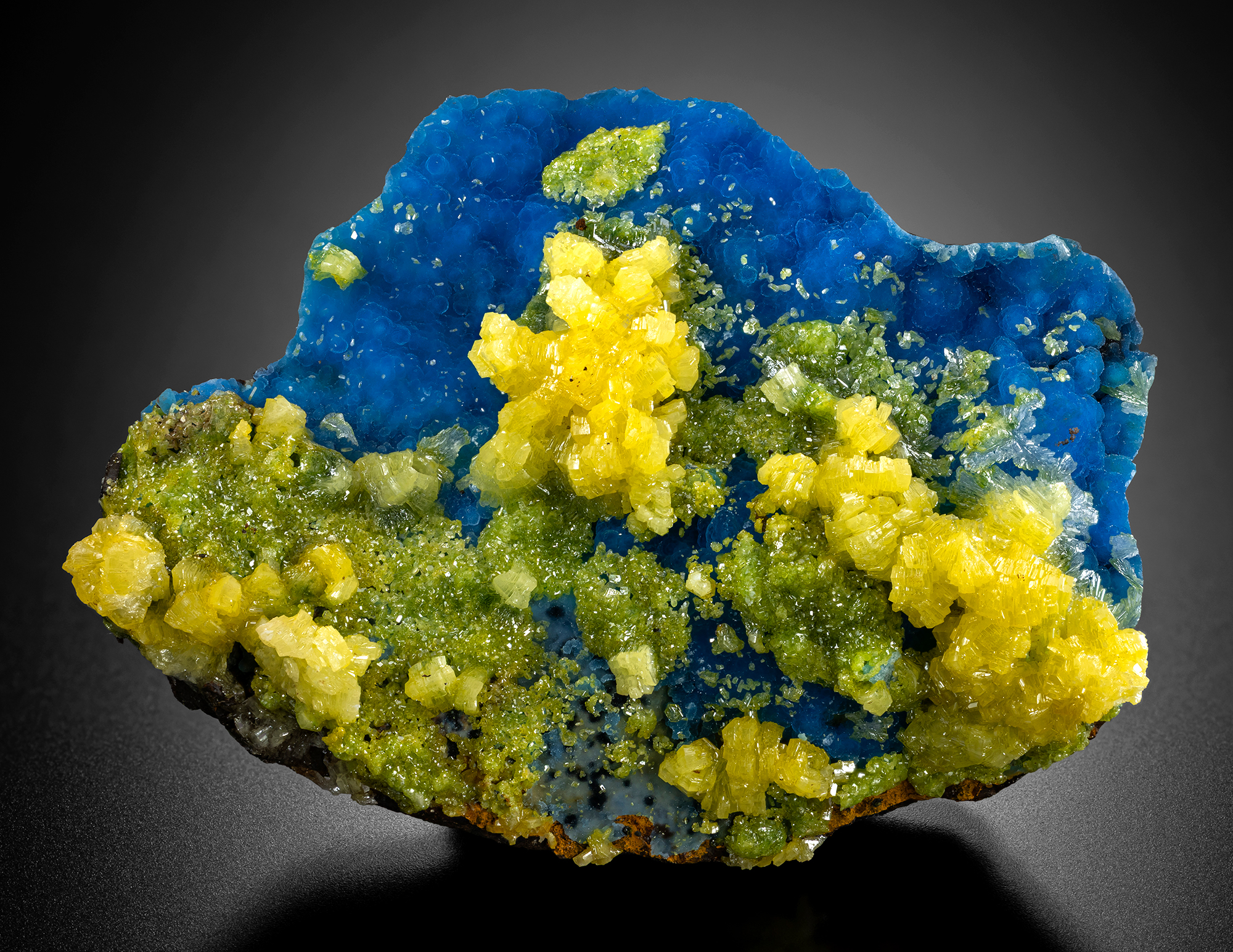
Photo: Spirifer Minerals
Search for specimens: View all specimens from Yanga Koubenza quarries, Republic of the Congo
Yanga Koubenza is a quarry complex near Mfouati, Bouenza Department, in the Republic of the Congo. The deposit is part of the Yanga-Koubenza-Palanda area on the southern Congolese Cu-Pb-Zn belt, a district that includes such collector-familiar names as Mfouati, Palabanda, Mindouli, Kimbedi, and Renéville. The mine is active, large, and industrial in character; it is not a public collecting locality.
Geologically, the deposit belongs to the Niari Basin, a northwest-southeast-trending sedimentary basin with numerous copper, zinc, and lead occurrences. Yanga Koubenza is hosted in carbonate rocks of the upper Schisto-Calcaire Group, especially the SCII Subgroup, formerly known in older literature as C4 or SC4. The host rocks are shallow-marine dolomites, locally silicified, broken by steep fault systems and altered by karstification. The specimen pockets occur where carbonate dissolution, collapse brecciation, and supergene mineralizing fluids created open or partly open spaces in iron-rich residual material and dolomite.
The ore is strongly oxidized. Historic descriptions emphasize smithsonite, hemimorphite, and cerussite as principal zinc-lead oxidation products, with sulphides scarce or absent in the visible pit during earlier evaluations. Later large-scale mining revealed a more varied supergene assemblage: blue and green smithsonite, aurichalcite, rosasite, malachite, azurite, cerussite, mimetite, pyromorphite, duftite, kipushite, and philipsbornite. The deposit shows a vertical and lateral zonation of ore types: hematite-rich lead ochre in the upper central zone, lead carbonate ore rich in cerussite, lead-copper carbonate zones surrounding the central ore, and zinc carbonate ore toward the periphery, where smithsonite and hemimorphite dominate in plastic clays.
The mining history is longer than the specimen history. Work at Yanga Koubenza began in 1932–1933, when underground galleries and shafts proved oxidized lead-zinc ore. Further exploration and mining followed from 1938 to 1941, with more galleries, shafts, stripping, and trial mining of calamine ore, chiefly smithsonite. A later campaign in the 1950s identified additional oxidized lead ore, and by December 1958 the deposit was evaluated as three ore bodies containing oxidized lead ore. BRGM mapped the district in 1960, and drilling from 1967 to 1975 eventually brought cumulative drilling to about 13,000 m. Modern summaries give a larger resource estimate of about 5.53 million tonnes grading roughly 8% lead, 7% zinc, and 1.9% copper.
Industrial development accelerated in the 2010s under SOREMI, Société de Recherche et d’Exploitation Minière. Mine infrastructure, including processing facilities, began to take shape around 2015; mining started slowly in 2016 and entered fuller production in 2017. SOREMI’s Boko-Songho and Yanga-Koubenza operations have been associated with copper cathode and zinc ingot production, with lead recovery planned or developed as part of the broader polymetallic project. The modern open pit has expanded enormously from the earlier small workings, reaching the scale of a large benched quarry with processing infrastructure nearby.
For specimen collectors, the modern era began after the industrial reopening. Smithsonite specimens appeared soon after mining advanced into suitable zinc-carbonate zones, with important blue and blue-green production in 2020–2021, a small but excellent deep-blue pocket in 2022, further smithsonite material in 2025, and intermittent finds of malachite, azurite, rosasite, cerussite, hemimorphite, and aurichalcite. Because the mineralization is pockety and structurally controlled, specimen production is episodic: a single face or narrow zone may yield memorable material for a short time and then disappear entirely.
Access today should be regarded as controlled industrial access only. Published field accounts note that specimen collecting is generally forbidden by mine management, and that recovery has depended on brief opportunities after machinery has exposed or disturbed mineralized zones. Collectors should not attempt to visit or collect without formal permission from the mine and mineral-rights holders, and any specimen from Yanga Koubenza should be judged as a market specimen recovered from an active mine, not as material from an open collecting site.
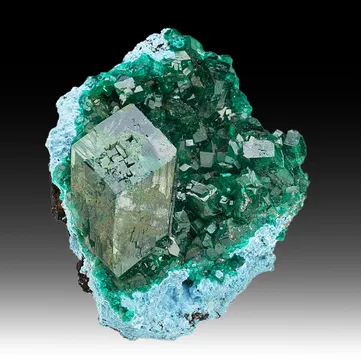
Smithsonite is the species that first put Yanga Koubenza on the modern collector map, especially the 2020–2021 production and later 2022 and 2025 finds of blue, blue-green, sea-blue, gray-blue, and green material. The best examples are mammillary to botryoidal crusts and rounded knobs on iron-rich matrix, often with a waxy, satin, or wet-looking luster; some larger examples reached cabinet size, and reported smithsonite spheres reached about 3 cm across on vivid blue-green crusts. The blue color is not a simple body color of pure ZnCO3 but is tied to aurichalcite inclusions and intergrowths, so the most desirable pieces tend to show saturated turquoise to deep blue smithsonite with visible aurichalcite, rosasite, hemimorphite, azurite, or green copper minerals adding contrast. Ordinary pieces are pale, massive, chalky, bruised, or only locally botryoidal; the standout Yanga Koubenza smithsonites combine strong color, complete undamaged botryoidal surfaces, clean trimming, and a balanced matrix-to-mineral composition that preserves the vug geometry rather than reducing the piece to a polished slab.
Aurichalcite at Yanga Koubenza is both a collectible species in its own right and a key colorant and associate of the celebrated smithsonites. It occurs as soft blue to turquoise-blue acicular, fibrous, velvety, banded, and locally botryoidal aggregates, commonly on or beneath smithsonite and sometimes with rosasite, malachite, azurite, and hemimorphite in the same oxidation assemblage. The 2021 smithsonite-aurichalcite pockets yielded showy blue-green combinations, while earlier mine observations placed aurichalcite toward the outer limits of the pit’s zinc carbonate mineralization. Fine aurichalcite pieces from this locality are judged less by large single crystals than by richness, color saturation, undisturbed velvety texture, and pleasing contrast with waxy smithsonite or darker green-blue rosasite; weak specimens are typically powdery, pale, rubbed, or hidden only as small tufts on the reverse of a smithsonite.
Mimetite is the great later revelation of Yanga Koubenza: first noticed only as minor material around 2022–2023, then produced spectacularly in the restricted 2024 “Mimetite Bonanza” zone in the western part of the deposit. The pocket system was small, flat, narrow, and hosted by rusty gossan, crumbly limonite, and locally solid hematite, yet it produced an extraordinary range of habits and colors: gemmy short-prismatic to tabular crystals, elongated prismatic crystals approaching acicular form, hopper crystals, scepters, rosettes, drusy coatings, dendritic aureoles, split and parallel growths, and at least two generations of mimetite. Colors range from bright yellow and yellowish-green through orange-yellow and vivid orange to reddish-orange and reddish-brown; the finest gem crystals are transparent, lustrous, flawless, and reach about 2 cm, with some broken crystals yielding faceted stones over 1 ct. Associations include cerussite, duftite, clay minerals, and, most famously, vivid blue philipsbornite; yellow mimetite on blue philipsbornite is the signature combination, known from only a very small number of high-quality specimens. The best pieces preserve undamaged individual crystals or coherent carpets on contrasting matrix; many otherwise promising plates were damaged by industrial recovery and had to be trimmed into smaller but more perfect specimens.
Hemimorphite is part of the primary zinc-oxide specimen suite at Yanga Koubenza and was already recognized in the oxidized ore, where smithsonite and hemimorphite form the zinc carbonate-silicate component of the peripheral ore zones. Collector specimens are known as white to blue and sky-blue crystalline or spherical aggregates, commonly in association with smithsonite and rosasite; one widely illustrated style shows pale blue hemimorphite clusters over darker green-blue rosasite-coated matrix, while other examples place hemimorphite directly on blue smithsonite. Because nearby Palabanda is famous for vivid blue hemimorphite, Yanga Koubenza material deserves careful identification: some blue drusy material from the mimetite zone was first suspected to be hemimorphite before XRD and Raman work proved it to be philipsbornite. Good Yanga Koubenza hemimorphite should show crisp sparkle or well-defined botryoidal/spherical growth, attractive blue-white contrast, and verified association data; lesser pieces are massive, chalky, or visually confused with smithsonite, aurichalcite, or philipsbornite.
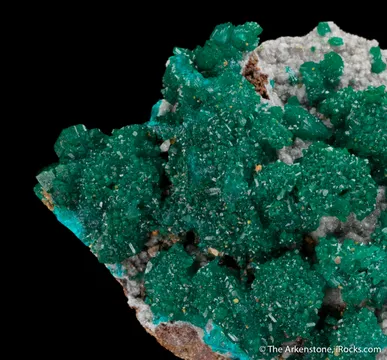
Pyromorphite was present at Yanga Koubenza before the mimetite bonanza, but the best documented high-quality pyromorphite came from the same broader mining area that yielded the 2024 mimetite-zone material. It does not occur with mimetite in that find, instead occupying a slightly different zone and most often forming monomineralic specimens in which apple-green, yellowish-green, deep green, or brownish-green prismatic crystals carpet the matrix. Typical crystals are well formed, subtly barrel-shaped from slightly curved faces, and commonly 5–15 mm long; a much rarer morphotype consists of parallel aggregates of highly elongated crystals exceeding 5 cm. Fine Yanga Koubenza pyromorphite is about sharpness, luster, saturated green color, and complete coverage without excessive damage; identification should be conservative because some mimetite and pyromorphite colors and habits can be visually difficult to separate without analytical context.
Cerussite is an important lead mineral at Yanga Koubenza both as ore and as a display species, occurring in the older oxidized lead-carbonate zones and in several modern specimen styles. In the mimetite zone it forms white to beige, rarely colorless, lustrous twins ranging from small reticulated “snowflake” forms to complex three-dimensional twins; most are a few millimeters to about 1 cm, some reach 2 cm on azurite-malachite specimens, and exceptional mimetite-zone twins reach about 3 cm. The most recognizable pieces are white cerussite snowflakes scattered across sparkling dark azurite or green malachite carpets, a “night sky” contrast that gives the best pieces strong cabinet presence even at miniature size. Cerussite also grows on yellow mimetite and is in some cases overgrown by later gemmy mimetite. The premium specimens have isolated, undamaged twins with strong contrast and clean matrix; ordinary examples are incomplete, rubbed, beige and dull, or crowded into broken limonitic pockets.
Other documented minerals from Yanga Koubenza include azurite, malachite, rosasite, duftite, kipushite, philipsbornite, and clay minerals, with hematite- and limonite-rich gossan forming much of the mimetite-zone matrix. The most important rarities are duftite and philipsbornite: duftite here occurs not merely as dust but as sharp pseudo-octahedral crystals to about 4 mm associated with yellow to orange tabular mimetite, while philipsbornite forms blue drusy carpets, locally 1–3 mm thick, in hematite-rich pockets with mimetite. The blue philipsbornite was initially suspected to be hemimorphite before analytical work confirmed its identity, and the finest Yanga Koubenza philipsbornite specimens, especially those with yellow mimetite, rank among the most desirable modern examples of the species. No type-locality mineral is presently the reason collectors pursue Yanga Koubenza; its importance lies instead in superb, newly documented expressions of uncommon secondary Pb-Cu-Zn arsenate, phosphate, carbonate, and silicate species.
The principal authenticity issue for Yanga Koubenza is not widespread fakery but accurate labeling and identification. Labels should place the locality in the Republic of the Congo, Congo-Brazzaville, near Mfouati in Bouenza Department—not in the Democratic Republic of the Congo, Katanga, or the Copperbelt. Because the two Congos are easily confused in the mineral trade, “Congo” alone is inadequate data for a serious specimen.
Species identification also matters. Blue botryoidal material may be smithsonite, hemimorphite, aurichalcite, rosasite, or philipsbornite depending on habit and association. In the mimetite-zone material, blue drusy philipsbornite was initially mistaken for hemimorphite until XRD and Raman spectroscopy confirmed the species, and yellow-green arsenate/phosphate habits can make mimetite and pyromorphite difficult to distinguish visually. For high-value mimetite, pyromorphite, philipsbornite, or duftite specimens, preference should be given to pieces with strong provenance from a knowledgeable dealer, analytical confirmation, or a well-documented find association.
Condition is a major value factor. Much Yanga Koubenza material came from an active industrial mine, so specimens may show contact damage from equipment, bruised botryoids, abraded aurichalcite fibers, broken mimetite terminations, sheared matrix edges, or repaired-looking trimmed surfaces. Many good mimetite specimens were intentionally trimmed from larger damaged plates; good preparation is acceptable, but fresh fractures through key crystals are not. Inspect the high points of smithsonite botryoids, the tips of mimetite and pyromorphite prisms, and the edges of cerussite twins.
Treatments are most relevant in the smithsonite suite. Some thick layered smithsonite-aurichalcite material was cut and polished to reveal intense internal blue banding; this can make a beautiful lapidary specimen but should be disclosed as cut or polished. Natural cabinet specimens should retain original botryoidal or vug surfaces. Stabilization or glue should be checked on fragile aurichalcite, rosasite, and crumbly limonitic matrix, especially where specimens were recovered from broken gossan pockets.
Handling should be gentle. Aurichalcite, rosasite, and some clay-rich matrices are friable; cerussite is comparatively soft and dense; mimetite and pyromorphite contain lead, and mimetite and duftite contain arsenic. These minerals are stable as display specimens, but avoid dust generation, do not lick or soak them, wash hands after handling, and keep small broken fragments away from children and pets. Store vivid blue and green specimens away from abrasion, because many of the most attractive surfaces are microcrystalline carpets rather than robust large crystals.
Market availability is unusually good for a locality that only recently became famous, but top pieces are scarce. Smithsonite with aurichalcite has appeared in enough quantity to be obtainable in thumbnail through cabinet sizes, with prices rising sharply for saturated color, size, and undamaged botryoidal surfaces. Mimetite from the 2024 bonanza entered the European market in 2024, appeared in small numbers at Tucson in 2025, and received a larger specialist debut in 2026 after export, transport, and preparation delays. The best mimetite on philipsbornite, gem mimetite, crystallized duftite, and fine pyromorphite should be regarded as limited-find material rather than routine production.
Yanga Koubenza’s modern specimen story begins with a stark before-and-after image: a hill east of the road between Louete and M’fouati, once worked by small underground campaigns, transformed into a broad industrial quarry with benches, processing infrastructure, a flotation pond, and large machinery. The old mine had numbers, but not a collector legend: 759 m of galleries and 71 m of shafts in 1932–1933; another 923 m of galleries and 98 m of shafts from 1938 to 1941; 15 drill holes and new shafts in the 1950s; and eventually about 13,000 m of drilling from 1967 to 1975. For decades, those figures lived more comfortably in geological reports than in display cases.
The specimens changed that. In the early modern years, smithsonite came first—boxes of blue-green pieces that suddenly made the locality recognizable across a show table. Some were smooth, rounded, and sea-blue, others sparkled with finer crystallization, and the best had the look of wet turquoise wax over rust-brown matrix. The color was familiar enough to remind collectors of the Kelly Mine, but the locality was new enough that nearly every good piece carried a sense of discovery.
The 2024 mimetite zone was different in character. It was not a grand cavern lined with large crystals, but a relatively small western zone, only a few dozen meters across, in rusty gossan and residual material. The pockets were small, flat, narrow, and numerous, controlled by the layered, crumbly nature of the limonitic host. Where slightly larger cavities collapsed, breccia fragments became little islands, overgrown on all sides by mimetite and its companions. The result was a find of extraordinary variety from physically unforgiving spaces: gem crystals, hopper crystals, scepters, rosettes, dendritic aureoles, tabular forms, prismatic forms, and color changes over very short distances inside the same pocket system.
The recovery was not romantic hand-mining in a collector’s tunnel. The mine was a large operation moving ore, and mineral specimens were incidental to that work. Heavy equipment could expose a pocket and destroy it in the same sequence. Good material had to be recognized, rescued, packed, exported, cleaned, and then—often most critically—trimmed. Some of the best mimetite pieces started as damaged plates attached to unwieldy chunks of host rock. In the laboratory, the work became almost surgical: study the broken zones, decide where the eye of the specimen really was, and cut away damage to save a smaller but far finer piece. In one documented example, a mimetite-on-philipsbornite specimen with central damage was planned, divided, and prepared into separate finished specimens rather than left as a compromised larger plate.
The most memorable visual moment of the find may be the yellow mimetite on blue philipsbornite. The blue material was not obvious at first. In a district already known for blue hemimorphite, it was natural to suspect hemimorphite, but the analytical work changed the story: XRD and Raman spectroscopy confirmed philipsbornite. That shifted the specimens from attractive blue-and-yellow associations to one of the great modern rare-species combinations. In the best pieces, glossy yellow mimetite rises from a deep blue drusy carpet only a millimeter or two thick, an association documented as unique to this occurrence. Very few high-quality examples survived; the number of top combinations is small enough that each one feels less like production and more like a named pocket specimen.