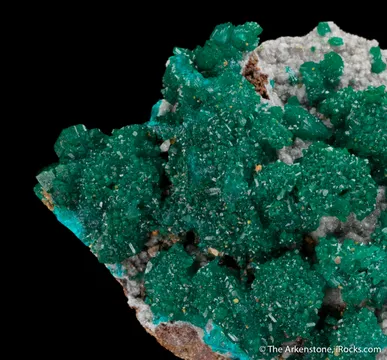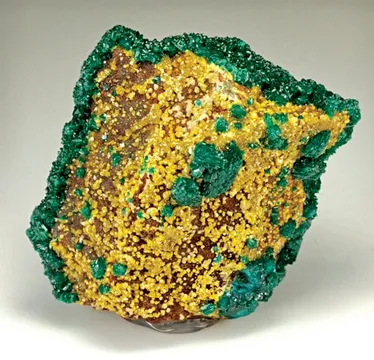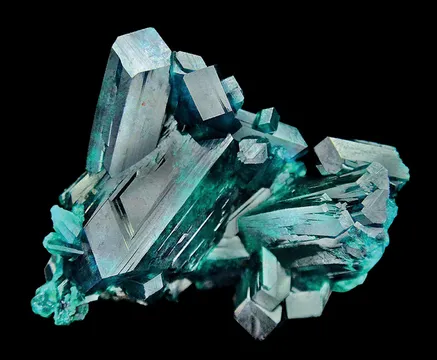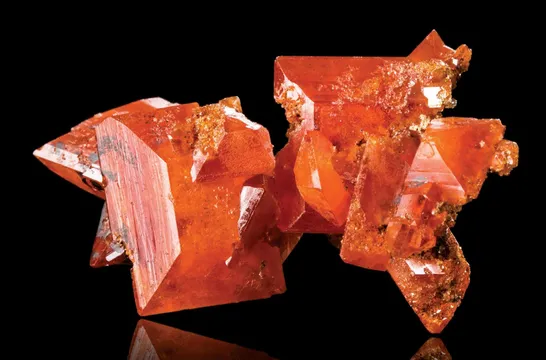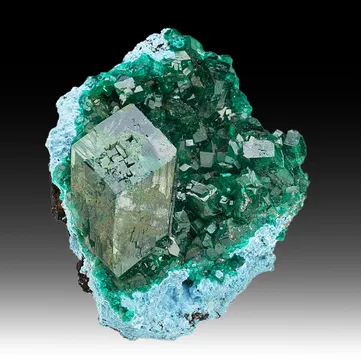
Kimbedi, Republic of the Congo — a premier dioptase locality with emerald-green crystals from the Kimbanga prospects, often on plancheite, prized by collectors.
Key facts
Kimbedi is one of the modern collector names that changed how serious dioptase buyers think about the Republic of the Congo. The locality is a small village in the Mindouli District of Pool Department, on the railway between Mindouli and Lutete, but the collecting significance lies in the oxidized copper-lead-zinc mineralization developed in carbonate rocks of the broader Niari–Mindouli metallogenic belt. At Kimbedi itself, the most important specimen ground is the Kimbanga group of prospects southeast of the village, where dioptase has been recovered from vertical and bedding-plane fractures in massive limestone. That simple geological sentence explains the look of the best pieces: brilliant emerald-green trigonal crystals perched in cavities and seams, sometimes on pale blue plancheite, white to cream carbonate, quartz, or pale lead-zinc oxidation products.
Regional View
Country View
The Kimbedi material belongs to the same broad mineralogical story that made Mindouli famous to mineralogists more than a century ago: supergene copper silicates forming from copper-rich sulfide mineralization in faulted carbonate and sandstone sequences. The district’s old literature centers on Mindouli rather than the later-labelled Kimbedi prospects, but the collector market now treats Kimbedi as a distinct and desirable source of high-color, glassy dioptase. The best examples are not merely green crusts. They show individual, lustrous, transparent to translucent crystals large enough to read as sculptural mineral specimens rather than coatings, and the most exciting pieces add a sharp chromatic contrast—deep green dioptase on powder-blue plancheite, or dark green crystals rising from pale carbonate and quartz.

Photo: Wikimedia Commons
Kimbedi also matters because it sits at the intersection of three histories. One is scientific: the Mindouli area is tied to the early study of Congolese dioptase and to the description of plancheite from nearby Sanda Hills. Another is industrial and archaeological: the Niari Basin copper deposits were exploited long before European colonial mining, and the Mindouli area has yielded evidence for medieval copper production. The third is very recent and purely collector-driven: local small-scale extraction around Kimbedi has brought out a run of specimens that collectors immediately compared with the classic dioptase localities of Tsumeb, Altyn-Tyube, and the Kaokoveld.
Search for specimens: View all specimens from Kimbedi, Republic of the Congo
Kimbedi is a village locality in the Mindouli District, Pool Department, Republic of the Congo, recorded at approximately 4° 17' 59" S, 13° 58' 0" E. The village lies on the Congo–Ocean railway corridor between Mindouli and Lutete. In specimen usage, “Kimbedi” commonly refers not only to the village label but also to the nearby Kimbedi-area workings and prospects, especially the Kimbanga prospects and the Mpita prospect.
The most specimen-productive documented Kimbedi sublocality is the Kimbanga group of prospects, about 3 km southeast of the village. These workings are described as three small open quarries, named from north to south Songo, Songo II, and Pata. The field description that matters most to collectors is that dioptase is mined there from vertical fractures and bedding-plane fractures in massive limestone. In hand specimens, that mode of occurrence is exactly what one sees: crystals developed on open fracture surfaces, in narrow seams, and in pockety limestone cavities, with the surrounding carbonate and siliceous matrix often left as a natural pedestal.
The Kimbedi occurrences belong to the broader Mindouli–Niari copper-lead-zinc system. Regional studies describe the Niari Syncline deposits as complex Cu-Pb-Zn mineralization associated with ENE-WSW to N60E fault systems, carbonate rocks, sandstones, karstic openings, and strong supergene alteration. In the Mindouli district, hypogene sulfides such as chalcocite, bornite, digenite, covellite, pyrite, sphalerite, and galena supplied the metals; oxidation by meteoric waters produced the copper silicates and carbonates that collectors prize. Koud’s work on Mindouli emphasized that dioptase, chrysocolla, and plancheite make up the principal supergene copper-silicate phases, with chalcocite especially important as a sulfide precursor altered directly to copper silicates.
For Kimbedi proper, the documented mineral list is much shorter than the full Mindouli district list but extremely collector-friendly: dioptase, cerussite, dolomite, goethite, hemimorphite, mottramite, plancheite, quartz, and wulfenite. Mpita is recorded for dioptase and cerussite. Kimbanga, including Songo, Songo II, and Pata, is recorded principally for dioptase. Some Kimbedi labels in commerce are intentionally broad, so the distinction between “Kimbedi,” “Kimbanga,” “Songo,” “Pata,” and “Mpita” is worth preserving whenever an old label or dealer provenance supplies it.
The industrial mining history is better documented for Mindouli than for Kimbedi’s specimen quarries. The Mindouli copper deposit was known before the colonial period and was part of a copper-production landscape that supplied regional exchange networks. European accounts describe the deposits by the late nineteenth century, with Barrat’s 1895 description often cited in later summaries. The early twentieth century saw colonial-era extraction and shipment of copper-bearing material from Mindouli, while modern academic work has linked the area to much older copper metallurgy, including activity in the 13th–14th centuries AD. Kimbedi’s modern specimen production, however, is a small-scale story: a local miner, Antoine Kitona, is specifically recorded as occasionally mining dioptase from the Kimbanga quarries.
Collecting access should be treated as restricted. These are not casual public collecting sites. The workings are small, local, and mineral-rights dependent; the ground is in a tropical savanna climate with wet-season access complications; and open fractures, old cuts, unstable limestone blocks, and private or customary land considerations all argue against uninvited collecting. Collector specimens reaching the market should be bought through established channels with provenance, not by assuming that the quarries are open to visitors.
The most notable Kimbedi finds are modern pocket and fracture finds rather than a single well-published museum pocket. Material circulated by major dealers and collectors before 2010 established the look: sharp emerald-green dioptase, sometimes on soft blue plancheite. Later material, including pieces described as 2012–2013 finds and larger pieces on the market around 2016–2020, broadened the size range and kept Kimbedi visible. A 7 cm dioptase-on-quartz specimen has been recorded as a Kimbedi Mine specimen from a 2012–2013 find, while a Kimbedi dioptase with cerussite measuring 120 x 100 x 50 mm reached the retail market at cabinet-specimen scale. The best pieces combine crystal size, transparency, luster, and intact crystal terminations; ordinary examples tend to be darker, more granular, more bruised, or less three-dimensional.
Kimbedi dioptase is prized for rich emerald to blue-green color, vitreous luster, and crystals that can stand individually rather than disappearing into drusy crust. The strongest specimens show sharp trigonal crystals in the centimeter class or groups of smaller gemmy crystals lining limestone fractures and vugs; a fine thumbnail may consist of just a few 1.4–1.7 cm crystals spraying from a common base, while cabinet pieces can be broad plates or pockets of crystals on carbonate, quartz, blue plancheite, or associated cerussite. Kimbanga’s Songo, Songo II, and Pata workings are specifically tied to dioptase in massive limestone fractures, while Mpita adds a dioptase-cerussite association. Good Kimbedi pieces are separated from routine Congo dioptase by clean terminations, glassy faces, visible transparency, strong contrast against pale or blue matrix, and minimal edge wear; the lesser pieces often have iron staining, contacted tips, incomplete crystals, or a porous matrix that has been over-cleaned.
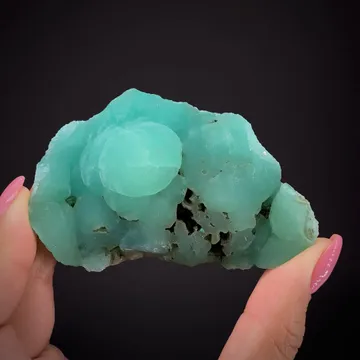
Beyond dioptase, Kimbedi is documented for cerussite, dolomite, goethite, hemimorphite, mottramite, plancheite, quartz, and wulfenite. The hemimorphite-wulfenite association is especially noteworthy because it shows the lead-zinc side of the oxidation system, not just the copper-silicate side. Plancheite is a particularly important name in any Kimbedi discussion because the blue copper silicate is a classic Mindouli-region mineral: Kimbedi itself is not the type locality, but nearby Sanda Hills in the Mindouli district is the type locality for plancheite, first described by Alfred Lacroix in 1908. On Kimbedi specimens, plancheite’s soft blue color can provide the ideal visual foil for dioptase, making small-cabinet pieces look far more dramatic than their size alone would suggest.
The first collector concern with Kimbedi is locality precision. “Congo dioptase” can mean Republic of the Congo, Democratic Republic of the Congo, Renéville, Mindouli, N’tola, Sanda, Kimbedi, Gotala, Mpita, Kimbanga, or a vaguely labelled Pool Department occurrence. Kimbedi is in the Republic of the Congo, not the Democratic Republic of the Congo, and a careful label should ideally retain the hierarchy: Kimbedi, Mindouli District, Pool Department, Republic of the Congo, with Kimbanga, Songo, Songo II, Pata, or Mpita if known.
Documented fakery around Congo dioptase is not rampant, but it is real enough to justify caution. A Mindat fakes discussion from 2011 describes a Congo dioptase crystal on pale blue matrix suspected of being planted with a glue or cement ring, and another collector in the same discussion reported an outright fake made from an emerald-green synthetic zircon crystal glued to a quartzite matrix coated with blue shattuckite-like material. That story is not a blanket condemnation of Kimbedi material, but it is a useful warning: oversized isolated green “crystals” sitting unnaturally on blue matrix, especially at implausibly low prices, deserve close inspection under magnification and long-wave UV for adhesive halos.
Condition is the second issue. Dioptase has perfect cleavage and is brittle, so even fine Kimbedi pieces may show minute tip contacts under close-up photography. Matrix can also be fragile. A collector discussion specifically about cleaning a large Kimbedi dioptase noted that the matrix was porous and could become brittle during treatment, and that a previous spot-cleaning gun had removed coating in one area but left the luster ruined. Avoid acids, aggressive water-jet cleaning, ultrasonic cleaning, and experimental iron removers unless the piece is expendable and the treatment has been tested on an inconspicuous area. A beautiful but slightly iron-stained Kimbedi specimen is usually preferable to a “cleaned” one with dead luster.
Kimbedi dioptase is available often enough that advanced collectors can be selective, but fine examples are not common. Since the major modern waves of production, ordinary thumbnails and small cabinet pieces have appeared steadily, while large, sharp, lustrous, undamaged examples on contrasting matrix have become much harder to replace. Prices rise sharply for crystal size, transparency, undamaged terminations, and blue plancheite contrast. Cut dioptase from Kimbedi is unusual but documented; the rough is generally far more valuable and meaningful as crystallized specimen material than as gem cutting stock.
The oldest stories attached to the Mindouli–Kimbedi mineral belt read like the beginning of African dioptase science. In 1890 and 1891, Edouard Jannettaz published short notes on dioptase and native silver from the French Congo. A few years later, the explorer Thollon—identified by Lacroix as the man who discovered the deposit—returned from another Congo journey with a substantial suite of specimens. He entrusted them to Alfred Lacroix, who used them to deepen the mineralogical study of the deposit. By 1908, Lacroix could write that the Muséum had been enriched by an “extremely precious” series from the same mine: not just dioptase, but a range of associated minerals that had not yet been properly reported. Much of that later material, Lacroix noted, came through the generosity of M. Lucas. The passage is a reminder that Congolese dioptase entered science not as isolated green crystals in dealer trays, but as a full mineral assemblage carried from a remote colonial field area into the Paris museum world.
The second story belongs to the ground itself. The old descriptions of Mindouli do not present a tidy vein but a weathered, broken, oxidized metal system. Barrat’s late-nineteenth-century description, preserved in later mining summaries, recorded dioptase and native silver in a stream, a light gray rock exposed in the bed, a blackish copper-manganese layer protruding from a hillside, and chalcedonic geodes with dioptase and malachite. Later geology translated those field impressions into faults, karst-like pockets, black earths, oxidized sulfides, and supergene copper silicates. To a mineral collector, that is the physical reason the specimens are so varied: one pocket gives glassy green dioptase, another gives blue plancheite, another adds cerussite, hemimorphite, or wulfenite, and another is merely black, earthy, and industrial.
The modern Kimbedi story is more intimate. The Kimbanga prospects are not described as a grand industrial mine but as three small open quarries southeast of the village: Songo, Songo II, and Pata. Demetrius Pohl’s field note gives the human scale of the locality. A local resident, Antoine Kitona, occasionally mined the dioptase from vertical and bedding-plane fractures in massive limestone. That is the sort of sentence collectors should hold onto when looking at a Kimbedi specimen. The green crystals did not come from a mechanized bench designed for specimen recovery; they came from small fracture systems, pried from hard carbonate by people who knew which seams were worth following.
The most surprising story is older than mineral collecting. Archaeological and geological work in the Niari Basin has shown that Mindouli-area copper was not merely a colonial or modern resource. Copper deposits in the basin were known from written sources by the 16th century, and surveys at Mindouli, Boko-Songho, and Mfouati identified copper-production sites near the ore deposits. The Mindouli area, where the Cu-Pb-Zn mineralization is widely exposed, was actively exploited in the 13th–14th centuries AD, at the same time regional kingdoms were rising. Kimbedi’s dioptase specimens therefore come from a landscape where green copper minerals are not just aesthetic objects; they are the oxidized surface expression of deposits that once fed long-distance metal circulation in Central Africa.