Mfouati, Republic of the Congo — Niari Basin locality known for bright wulfenite, blue hemimorphite, smoky cerussite, and an array of rare secondary minerals p…
Key facts
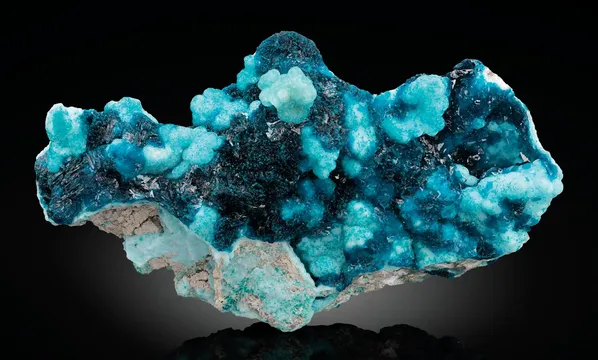
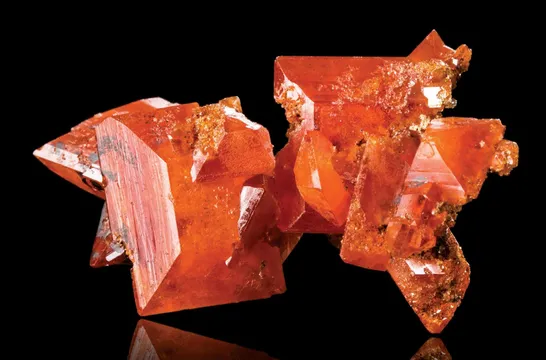
Mfouati is one of the great African secondary lead-zinc localities: a weathered polymetallic system in the Niari Basin where carbonate host rocks, faulting, karst cavities, manganese wad, iron oxides, and tropical supergene alteration combined to make specimens far better than the modest historical tonnage would suggest. For collectors, the name is inseparable from bright wulfenite, smoky and reticulated cerussite, blue hemimorphite, smithsonite, and a suite of less common Cu-Pb-Zn secondary minerals that has continued to grow as nearby Palabanda and Yanga Koubenza have been opened, closed, reworked, and quarried in the modern period. The classic look is immediately recognizable: orange to red-orange wulfenite plates or stout tabular crystals, often partly or wholly frosted by drusy quartz; smoky cerussite twins perched on quartz or iron-stained matrix; pale to intense blue hemimorphite botryoids; and, more rarely, green dioptase adding a copper note to the lead-zinc palette.
Regional View
Country View
Geologically, Mfouati sits within the broader Niari metallogenic belt of southern Republic of the Congo, a belt of Cu-Pb-Zn deposits hosted in Neoproterozoic carbonate and siliciclastic rocks of the West Congo Supergroup. The important specimen-producing zones are not simple veins in the collector’s sense but broken, altered, and locally cavernous carbonate masses: dolomite and limestone cut by faults and fractures, locally silicified, decalcified, brecciated, and stained by limonite and manganese oxides. Hypogene sulfides such as galena, sphalerite, chalcopyrite, and pyrite supplied the metals; the collector minerals are overwhelmingly products of oxidation and supergene reworking.
Historically, Mfouati occupies an unusual place. It is both an old mining district, worked industrially for oxidized lead and zinc ores in the 20th century, and a modern specimen district whose best material has reached the international market only episodically. The original M’Fouati hill produced the classic wulfenite-cerussite-quartz pieces, while the nearby Palabanda and Yanga Koubenza quarries have recently expanded the meaning of “Mfouati” on specimen labels, adding blue hemimorphite, high-quality smithsonite, rare phosphates, malachite-cerussite combinations, and the spectacular Yanga Koubenza mimetite-philipsbornite-duftite assemblage.
Search for specimens: View all specimens from Mfouati, Republic of the Congo
Mfouati is best understood as a district rather than a single collecting hole. The historic M’Fouati mine lies on a prominent limestone hill near the town, with mineralized satellite areas within a few kilometres, including Palabanda and Yanga Koubenza. This is why old and modern labels may read “M’Fouati,” “Mfouati Mine,” “M’Fouati hill,” “Mfouati District,” “Palabanda,” or “Yanga Koubenza,” and why the same specimen style may be catalogued at slightly different geographic levels. The central mine has also appeared historically as “Mvouti,” and, because of longstanding confusion between Congo-Brazzaville and Congo-Kinshasa, many older dealer labels wrongly place specimens in the Democratic Republic of the Congo.
The deposit is a weathered polymetallic Pb-Zn-Cu system hosted by carbonate rocks of the Schisto-Calcaire Group. The classic descriptions of the M’Fouati hill place the ore in fractures and folded carbonate horizons, with a surface footprint roughly on the scale of a kilometre-long hill. The old workings included hilltop open cuts in oxidized ore, horizontal galleries on the flanks, and connecting underground development. Manganese wad-filled fractures are characteristic of the old mine, and collectors should think of the best specimen pockets as oxidized cavities and fracture openings rather than clean, open alpine-style veins.
The principal mined metals at the historic M’Fouati mine were lead and zinc, mostly as oxidized ore. Cerussite supplied much of the lead, while the zinc ore was the traditional “calamine” of mining literature: mainly smithsonite and hemimorphite rather than a single mineral species. Willemite was also reported in the oxidized assemblage. Copper was subordinate at the main hill but becomes more conspicuous in the broader district, especially in malachite, azurite, dioptase, chrysocolla, aurichalcite, rosasite, and the phosphate assemblages of Palabanda and Yanga Koubenza.
Industrial mining began after the deposit was recognized in the early 20th century. The Compagnie Minière du Congo Français, created in 1911, became the major colonial operator in the region and developed infrastructure to move ore from isolated Niari deposits toward rail and river transport. At M’Fouati, the mine was worked from the 1930s and entered sustained production in 1937; it closed in 1961 after roughly two decades of output. Contemporary summaries place total metal production from the historic M’Fouati operation at about 60,000 to 65,000 tonnes, mostly as cerussite lead concentrate and calamine zinc concentrate, with the Pb:Zn ratio strongly weighted toward lead. The shutdown reflected both depletion of the accessible oxidized reserves and unfavorable lead prices.
A second phase of exploration followed after independence. Soviet-assisted work in the late 1960s reopened and extended parts of the old mine and drilled additional holes. The broader M’Fouati-Boko-Songho-Yanga Koubenza zone was revisited repeatedly by state and foreign programs, and a treatment plant was built at Mfouati in the 1970s for regional polymetallic ores. Modern mining shifted much of the action eastward and northeastward, especially to Palabanda and Yanga Koubenza, where SOREMI began large-scale work in the late 2010s. Yanga Koubenza in particular became an active open pit and ore-processing center, producing copper cathode and zinc metal while, intermittently and often accidentally, releasing specimens.
For collectors, access today is not a casual field-collecting proposition. The historic M’Fouati hill has old workings and gossanous material, but the most important recent production has come through local miners, specimen-focused crews, and material rescued from active or recently abandoned industrial workings. At Palabanda, good specimens appeared after quarrying had exposed mineralized breccias and after industrial activity slackened or ceased; at Yanga Koubenza, specimen recovery is constrained by modern mine management, heavy equipment, and the reality that an ore mine is not run for the benefit of collectors. Pieces reach the market in pulses, usually when a small pocket zone is cut and specimens are recognized before crushing or weather damage destroys them.
The classic M’Fouati hill can be divided informally by specimen style. The western part of the hill is famous for red to orange wulfenite and smoky cerussite, including reticulated cerussite in situ and quartz-coated wulfenite on matrix. The eastern part is better known for blue hemimorphite, mimetite, and additional cerussite. Many specimens from the old hill show strong etching and rounding; the finest pieces are those in which the crystals survived both geologic corrosion and mining intact. Nearby Palabanda added two very different collector zones only metres apart: a malachite-cerussite zone with fragile velvet-green malachite and white reticulated cerussite “snowflakes,” and a larger hemimorphite-rich zone producing blue hemimorphite, veszelyite, kipushite, zincolibethenite, smithsonite, and aurichalcite. Yanga Koubenza, now a major open-pit operation, has produced blue and green smithsonite, malachite-cerussite combinations, pyromorphite, azurite, rosasite, aurichalcite, and, most famously in 2024, the “Mimetite Bonanza.”
Mfouati wulfenite is the district’s signature mineral and ranks among the most desirable African occurrences of the species. The best pieces show orange, red-orange, or reddish tabular to blocky tetragonal crystals, commonly on quartz or iron-stained oxidized matrix; some of the most distinctive examples are almost completely mantled by white to colorless drusy quartz, leaving the orange wulfenite glowing through the coating. Crystals range from small sparkling plates to major individuals several centimetres across, with exceptional quartz-coated crystals reported around 5 cm. The western part of the M’Fouati hill is especially associated with the red wulfenite style, while broader Mfouati labels may also include quartz-wulfenite-dioptase and wulfenite-cerussite combinations. A top piece here has undamaged sharp crystal geometry, saturated color, attractive spacing, and enough matrix or quartz contrast to keep the specimen from reading as a corroded ore fragment; ordinary pieces are commonly rounded, etched, incomplete, or visually confused by heavy coatings.
Mfouati cerussite occurs as smoky, colorless, white, and pale translucent twins, from compact groups to reticulated “snowflake” forms, and it is especially valued when paired with wulfenite, quartz, hemimorphite, mimetite, or malachite. On the old M’Fouati hill, smoky twinned cerussites to roughly 3 cm are known from both western and eastern workings, including specimens on quartz with wulfenite and calcite; in the wider district, Palabanda and Yanga Koubenza produced flattened white reticulated twins on velvety malachite, commonly in the 5–20 mm range and rarely larger. Good pieces are judged by transparency, luster, completeness of the cyclic twin, and contrast—smoky cerussite over quartz or wulfenite is the classic M’Fouati look, while the malachite-hosted “snowflakes” rely on crisp white geometry against green velvet. The principal weaknesses are etched surfaces, broken twin arms, bruised high points, and fragile malachite or hemimorphite substrates.
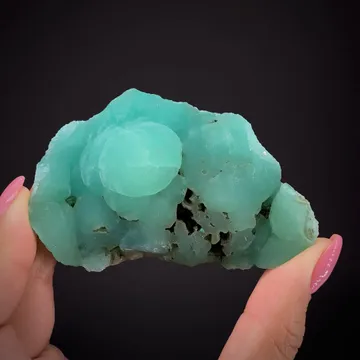
Hemimorphite from Mfouati ranges from colorless and white crusts to strongly blue botryoidal and spheroidal aggregates, with the modern blue material giving the locality a fresh identity beyond its older wulfenite and cerussite fame. On the M’Fouati hill, the eastern part is known for blue hemimorphite with yellow mimetite and cerussite; documented specimens include 6–7 cm examples of spheroidal blue hemimorphite on colorless hemimorphite or associated with mimetite. In the Palabanda hemimorphite zone, hemimorphite coats breccia clasts and cavity walls as layered crusts of parallel tabular crystals, commonly 1–5 mm thick and locally thicker, with colors from colorless and white through gray-blue to intense sky blue; green tints may come from included secondary Cu-Zn species such as zincolibethenite. The best collector pieces combine saturated blue color, undamaged botryoidal surfaces, visible crystalline sparkle, and associations with mimetite, cerussite, smithsonite, or rare phosphates; lesser examples are chalky, bruised, dull, or simply massive coating.
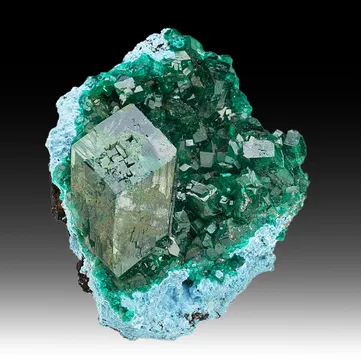
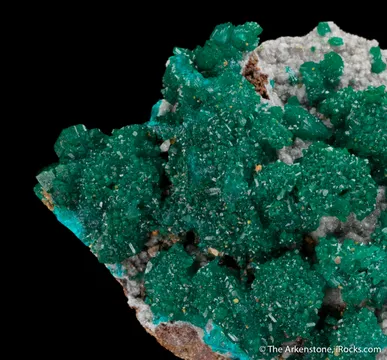
Dioptase is much less abundant at Mfouati than at classic Congolese copper localities such as Renéville, Mindouli, and some Sanda-area workings, but it gives the best Mfouati district specimens a striking green counterpoint to the lead-zinc assemblage. At the historic M’Fouati mine, dioptase is a subordinate copper mineral in the oxidized suite; collectible pieces are typically small, deep green crystals or druses associated with quartz, wulfenite, azurite, malachite, or pyromorphite rather than large standalone dioptase plates. Dealer-documented examples include compact cabinet specimens of dioptase with lamellar wulfenite and analyzed pyromorphite coatings, and forum-documented material records dioptase on wulfenite with azurite from M’Fouati. A good Mfouati dioptase is not judged by sheer crystal size but by freshness, contrast, and rarity of association—especially green dioptase against orange wulfenite or pale quartz—while ordinary pieces may be sparse, microcrystalline, or visually dominated by darker oxidized matrix.
Other documented minerals from Mfouati and its immediate district include aurichalcite, azurite, chrysocolla, cuprite, galena, malachite, mimetite, shattuckite, smithsonite, wad, and willemite at the historic mine level, with the broader district adding calcite, descloizite, dolomite, duftite, hydrozincite, kipushite, native silver, philipsbornite, phosphohedyphane, pyromorphite, quartz, rosasite, veszelyite, and zincolibethenite. The Palabanda quarries are especially important for the rare phosphate association of blue veszelyite, kipushite, and green zincolibethenite on hemimorphite; Yanga Koubenza has become notable for world-class mimetite diversity and unusually fine philipsbornite and duftite. Mfouati itself is not presently a type locality for a valid mineral species, but the district has become a first-rank modern source for several minerals that are rare in aesthetic cabinet specimens.
The first label issue is political geography. Mfouati is in the Republic of the Congo, also called Congo-Brazzaville, not the Democratic Republic of the Congo. Numerous dealer, auction, and collection labels—especially older or casual ones—say “DR Congo,” “Zaire,” or simply “Congo,” even when the specimen is plainly from M’Fouati, Bouenza Department, Republic of the Congo. Correcting that label matters, because the mineralogical context is Niari Basin Pb-Zn-Cu carbonate-hosted supergene mineralization, not the Katangan Copperbelt.
The second label issue is scale. “Mfouati” may mean the old M’Fouati hill, the town-level locality, or the wider Mfouati District. A wulfenite with smoky cerussite on quartz is likely from the classic hill; blue hemimorphite with veszelyite, kipushite, or zincolibethenite is more likely Palabanda; vivid mimetite with philipsbornite, duftite, or pyromorphite points to Yanga Koubenza. For serious cataloguing, keep the most specific locality supplied by a reliable source, but do not over-refine an old label unless the specimen style supports it.
No well-documented Mfouati-specific fake industry is known, but the species involved invite normal caution. Blue hemimorphite is widely faked or dyed in the broader mineral market, and Mfouati-Palabanda’s genuinely blue material means buyers should not assume every bright blue botryoid is natural without provenance, magnification, and, for expensive pieces, analytical confidence. Genuine Mfouati hemimorphite commonly shows layered growth, natural color zoning, and associations with mimetite, cerussite, smithsonite, or rare Cu-Zn phosphates; suspiciously uniform electric-blue color, dye in cracks, colored mounting residue, or color bleeding onto matrix are warning signs.
Condition is the real challenge. Mfouati wulfenite is often etched, rounded, quartz-coated, or partly dissolved; the difference between a characterful classic and a tired specimen is the preservation of faces and edges. Cerussite twins are brittle and easily bruised, and the reticulated forms can lose arms invisibly unless inspected from all angles. Palabanda malachite-cerussite pieces can be extremely fragile, especially where the malachite is hairy or velvety. Blue hemimorphite botryoids bruise and dull along high points, while rare phosphate coatings may be sub-millimetric and easily mistaken for color zones or dirt.
Fluorescence is worth checking but should not be oversold. Willemite from Mfouati is fluorescent and has appeared in documented assemblages with mimetite; some quartz-wulfenite or cerussite-quartz specimens from the district have been described as showing minor fluorescence under longwave and shortwave ultraviolet light. Because many Mfouati pieces are mixed supergene assemblages, fluorescence can be patchy and species-dependent. Use ultraviolet testing as a bonus observation, not as a primary authentication tool.
Market availability is episodic. Classic wulfenite and cerussite from old M’Fouati are consistently known but not abundant in top quality; excellent wulfenite with strong color, sharp form, and quartz aesthetics commands a premium. Blue hemimorphite has become more available in recent years, but the best saturated, undamaged pieces are still competitive. Palabanda rare phosphates and Yanga Koubenza mimetite-suite specimens are very modern-market sensitive: when a pocket is fresh, pieces circulate widely; once the zone is exhausted, high-end examples quickly concentrate in private collections and museum-level displays.
The recent collecting history of Mfouati reads less like the rediscovery of one mine than the reawakening of an entire mineral belt. When the Spirifer Minerals team began working seriously in the Republic of the Congo around 2017, M’Fouati was already the best-known name on the labels, but much of the district’s specimen potential was still hidden in ore quarries, old workings, and small zones that had never been treated as collector ground. The team’s account of the old hill is wonderfully concrete: a drone view over M’Fouati village and the old mines; the hill itself mined over decades by French, Russian, and Congolese operations; a western sector famous for red wulfenite; smoky reticulated cerussite still visible in the workings; and freshly collected blue hemimorphites with yellow mimetite and cerussite from the eastern part of the hill.
One of the most memorable details from the old M’Fouati hill is the way good and bad preservation sit side by side. The same workings that yielded attractive smoky cerussite with wulfenite on quartz also produced many rounded, strongly etched crystals. In the field photographs and specimen descriptions, the hill seems almost to argue with the collector: the chemistry was generous, but the tropical weathering was severe. That is why a sharp red wulfenite, a smoky reticulated cerussite, or a clean quartz-coated wulfenite from Mfouati has more significance than a casual glance might suggest—it survived both the oxidizing ground and the mining.
Palabanda supplied one of the great recent surprises. The quarry had been explored in earlier decades, but the decisive modern episode came after SOREMI’s large-scale development in the late 2010s. Industrial work exposed the brecciated carbonate zones, then the quarry was largely abandoned. Local small-scale miners first followed malachite as ore; while digging the green copper mineral they broke into voids lined with cerussite. Those first Palabanda collector specimens appeared as early as mid-2018: white reticulated cerussite “snowflakes” sitting on velvety malachite. Security then returned and digging became impossible for a time.
Late 2019 changed the story again. The quarry became accessible, and the first blue hemimorphite specimens were collected. Around November 2019, miners found blue unknown crystals on hemimorphite. The early photographs were poor, and several species were considered possible. The Spirifer crew began more systematic digging in early January after the local New Year festivities, which the account notes can last two weeks. For five months they chased the zone. After three months it appeared exhausted, but they kept working nearly two more months, finding very little more. The result was extraordinary: roughly 1,500 kg of specimens, ranging from small pieces to large rock lumps needing serious trimming, described by the discoverers as probably the largest veszelyite find in history by volume.
The physical setting of the Palabanda find is one of the most instructive specimen stories in the district. Two mineralized zones lay only a few metres apart in the northwest corner of the quarry, yet they made completely different specimens. One was the malachite-cerussite zone, with green velvet crusts up to 1–2 cm coating breccia clasts and white cerussite twins perched on top. The other was the hemimorphite zone, larger and more mineralogically complex, with open pockets over 50 cm across, layered hemimorphite crusts, green zincolibethenite bands, blue veszelyite, and late sugary kipushite. It is a perfect example of why “same quarry” is not the same as “same pocket.”
Yanga Koubenza then shifted the district’s center of gravity again. Historically, the hill had been discovered and worked in 1932–1933, with hundreds of metres of galleries and shafts. It was explored repeatedly in the mid-20th century, then entered a modern phase when SOREMI began infrastructure construction in 2015, mining started in 2016, and full production followed in 2017. By the mid-2020s the open pit was on the scale of a kilometre by three-quarters of a kilometre, a modern ore operation with benches, machinery, a plant, and a flotation pond. That scale is part of the tragedy for collectors: an enormous mine capable of producing superb specimens, but with recovery windows measured in moments after heavy equipment passes.
The Yanga Koubenza “Mimetite Bonanza” of 2024 is already one of the district’s defining episodes. Mimetite had been seen only as small, insignificant specimens during research in 2022–2023. Then mine development intersected a small western zone in rusty gossans and residual deposits—earthy, crumbly limonite locally hardening into hematite. The productive area was only a few dozen metres wide. It contained many small, flat, narrow pockets, and some collapsed pockets where breccia fragments had been coated on all sides by mimetite and associated minerals. For several months, the zone produced. Several thousand specimens were collected, but most were damaged or low grade; only a few hundred were considered higher quality, and only a few dozen truly outstanding.
The best Yanga Koubenza mimetites have the drama of a mineralogical unveiling. A few specimens reached Sainte-Marie-aux-Mines in 2024 through Congolese dealers, and a small number appeared at Tucson in 2025, but export, sea transport, preparation, and trimming delayed the full presentation. Tucson 2026 became the official premiere. The preparation work was part of the story: many specimens were damaged or attached to large host-rock fragments and needed careful trimming. Some good pieces had to be split into smaller, more perfect specimens after evaluating where the damage lay. One documented example shows a mimetite on philipsbornite specimen with central damage, then the trimming plan, then the finished pieces.
The mineralogy of that bonanza was compact but remarkable: cerussite, clay minerals, duftite, mimetite, philipsbornite, and pyromorphite were confirmed analytically. The duftite was exceptional because it occurred not merely as dust or coatings but as sharp, visible crystals, described as among the largest known for the species. Philipsbornite formed vivid blue carpets, and the best Yanga Koubenza specimens with yellow mimetite on blue philipsbornite are among the most striking lead arsenate combinations produced in recent collecting. One standout mimetite-on-philipsbornite specimen documented by Spirifer measured 13.1 cm, while several of the best philipsbornite specimens ranged from about 5 cm to more than 10 cm.