A collector's guide to M’Fouati mine, Republic of the Congo: its geology, mining history and notable minerals, illustrated with the 77 specimens documented from this locality on EarthWonders.
Key facts
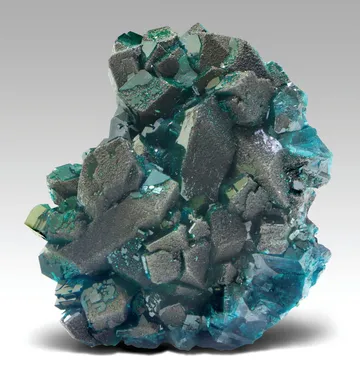
M’Fouati is the great lead-zinc oxidation locality of the Republic of the Congo: a hill of fractured carbonate rock in the Bouenza Department whose old workings and nearby prospects have supplied a remarkably distinctive suite of supergene minerals. For collectors it sits in that small class of African localities whose specimens are instantly recognizable once you have handled enough of them—smoky reticulated cerussite, large and sometimes quartz-coated wulfenite, turquoise to robin’s-egg-blue hemimorphite, yellow mimetite, brown-orange willemite, rare dioptase, and occasional pyromorphite, smithsonite and copper secondaries from the same broader mineralized belt.
Geologically, M’Fouati belongs to the Niari Basin, a Neoproterozoic carbonate-siliciclastic province along the southern part of Congo-Brazzaville. The collector minerals are not products of a fresh sulphide orebody; they are the bright residue of oxidation, dissolution, karstic voids, manganese wad and base-metal solutions moving through faulted limestone and dolomite. That setting explains both the beauty and the capriciousness of the specimens: open cavities gave crystals room to grow, but weathering also etched, rounded, coated and overgrew them. The best pieces combine crisp crystallography with the locality’s characteristic color contrasts—white or smoky cerussite against blue hemimorphite, orange wulfenite against quartz, deep green dioptase in vugs, or yellow mimetite sparkling across darker gossan.
Historically, M’Fouati mattered first as an ore mine. After prospecting in the early 1930s, industrial exploitation began in 1937, with the Compagnie Minière du Congo Français producing lead and zinc concentrates from oxidized ore. Production was substantial enough for the mine to appear repeatedly in French colonial and postwar mining literature, and the locality remained active or revisited in different ways into later decades. For mineral collectors, however, its fame rests on two overlapping reputations: old spectacular wulfenites, including very large crystals coated by quartz, and the more recent wave of blue hemimorphite, cerussite, willemite, mimetite and dioptase specimens that returned the locality to serious collector attention in the 2010s and 2020s.
Regional View
Country View
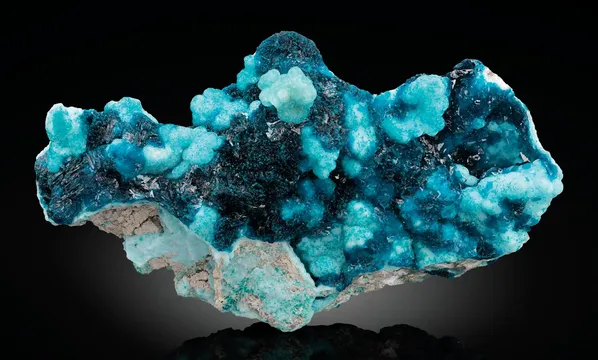
The finest M’Fouati specimens are not merely “Congo secondaries.” They have their own visual grammar. Cerussite commonly appears as reticulated cyclic twins—snowflake-like forms, sometimes colorless, white, or smoky—perched in vugs or across blue hemimorphite. Wulfenite ranges from sharply formed orange to reddish crystals through older, thicker, grey-brown or quartz-dusted crystals of extraordinary mass. Hemimorphite may form bubbly, spheroidal, banded, or botryoidal crusts in luminous blue tones, occasionally with contrasting mimetite, cerussite or willemite. These combinations are the reason M’Fouati has become a locality that serious collectors now ask about by name rather than accepting vague labels such as “Congo” or “Brazzaville.”
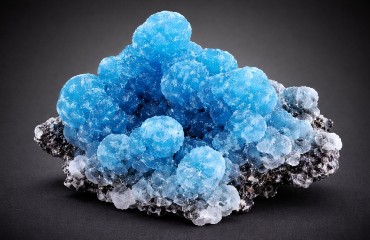
Photo: The Assay House
Search for specimens: View all specimens from M’Fouati mine, Republic of the Congo
M’Fouati lies in the Bouenza Department of the Republic of the Congo, west of the better-known Mindouli copper district. The classic locality is the M’Fouati hill, historically also encountered on labels as Mfouati, M’Fouati Hill, and Mvouti. The hill and the surrounding few kilometres should be treated carefully on labels: some specimens genuinely come from the old M’Fouati mine workings, while others sold under the broad “M’Fouati” name may come from nearby prospects or quarries in the same district, including Palabanda and Yanga-Koubenza. That distinction matters increasingly as modern finds from neighbouring operations have added rare phosphates and zinc-copper minerals to the regional specimen trade.
The deposit is a carbonate-hosted Pb-Zn-Cu occurrence in the Niari Basin. The host rocks are part of the West Congo Supergroup, especially the Schisto-Calcaire carbonate sequence, a Neoproterozoic marine succession of limestones, dolomites, marls and siliciclastic rocks. Mineralization is structurally controlled: fractures, folds, faults and karstic dissolution cavities localized both ore and later specimen pockets. At M’Fouati itself, manganese wad-filled fractures in a large limestone hill were important, while lead and zinc minerals formed the principal economic target and copper was subordinate. The oxidized zone produced the collector suite; deeper or less-altered zones are interpreted as related to sulphide mineralization, with galena and sphalerite-type Pb-Zn sources altered upward into cerussite, smithsonite, hemimorphite, willemite, wulfenite and other secondaries.
French geological literature describes M’Fouati as an oxidized Pb-Zn concentration in tight folds and carbonate units, associated with ENE-trending faults. The ore was sufficiently rich and accessible to be mined both by open-cut and underground methods. Reports from the 1950s describe oxidized lead and zinc in the upper part of the mineralized zones and sulphide ore in lower parts of neighbouring sectors, while later regional syntheses emphasized that surface oxidation and the absence of an obvious deep root made M’Fouati a key example for understanding Niari Basin metallogeny.
Modern collecting interest is tied to cavities in the oxidized zone. The western part of the hill is especially associated with red to orange wulfenite and smoky reticulated cerussite, while the eastern part has been described as more productive for blue hemimorphite, mimetite and additional cerussite. The best specimen zones are not uniform ore faces but irregular pockets in gossan, manganese wad, silicified or altered carbonate, and vuggy material. Some crystals are brilliantly sharp; others are rounded, etched, or partially coated by quartz or pyromorphite, a texture that can be characteristic rather than necessarily a defect.
Industrial production began after 1932–1933 prospecting, with the mine opening in 1937. By 1938, company reports record thousands of tonnes of lead concentrate and zinc ore. The operation included a treatment plant at M’Fouati, and later modernization introduced mechanical equipment, stripping capacity and renewed work in adjacent deposits such as Hapilo. In the early 1950s the Compagnie Minière du Congo Français entered agreements involving Newmont Mining Corporation, French overseas mining institutions and financial partners to support deeper exploration in the Niari Basin, while M’Fouati itself remained a core company property. By the mid-1950s, however, the mine was already described as approaching exhaustion, and Hapilo was being prepared to succeed it.
A regional geographical synthesis states that M’Fouati produced more than 100,000 tonnes of 50-percent concentrate before closing from exhaustion. Dealer, collector and publication records then point to intermittent later activity and specimen recovery, particularly old wulfenite material from around the mid-20th century and renewed specimen extraction in the 2010s. By the 2013–2014 period, new collecting and re-mining efforts were bringing out blue hemimorphite, cerussite, willemite, wulfenite and dioptase combinations, and by the mid-2020s M’Fouati material was again a noticeable presence in the fine-mineral trade.
Collecting access today should be considered restricted, permission-based and locality-sensitive. This is not a casual public collecting site. The mine and adjacent prospects involve old workings, private or locally controlled ground, active or recently active small-scale extraction in parts of the district, and safety issues typical of oxidized carbonate pits: unstable gossan, cavities, loose blocks, old underground workings and seasonal access problems. For most collectors, the responsible route is through reputable dealers who can distinguish M’Fouati mine material from broader M’Fouati district, Palabanda, Yanga-Koubenza, Mindouli, Sanda or DRC material.
M’Fouati wulfenite is the locality’s historical showpiece: old finds included extraordinarily large crystals, some reported from 1960 as reaching 10 cm across and 1–2 cm thick beneath a thin sugary quartz coating, while more recent specimens tend to be smaller but vividly orange to reddish, often as blocky, thick tabular, square, or distorted crystals on quartz, cerussite, hemimorphite or dark oxidized matrix. The western part of M’Fouati hill is particularly associated with red wulfenite, and good pieces are judged by crystal completeness, saturated color, freedom from edge bruising, and whether any quartz or pyromorphite coating enhances rather than obscures the form; ordinary pieces may be rounded, etched, dull, or so heavily coated that the wulfenite reads only as a ghost of its original shape.
M’Fouati cerussite is best known as reticulated cyclic twins—white, colorless, or smoky “snowflake” forms—found in vugs and on contrasting blue hemimorphite, malachite, quartz, mimetite, willemite and gossanous matrix. The western workings have yielded smoky reticulated cerussite with wulfenite on quartz, while the eastern part of the hill has produced twinned cerussite associated with hemimorphite and mimetite; the most desirable examples show crisp, lustrous, undamaged open lattices rather than chalky, incomplete or compressed aggregates, and locality confidence is especially important because similar reticulated cerussite also occurs at nearby Palabanda and other Congo-Brazzaville carbonate-hosted prospects.
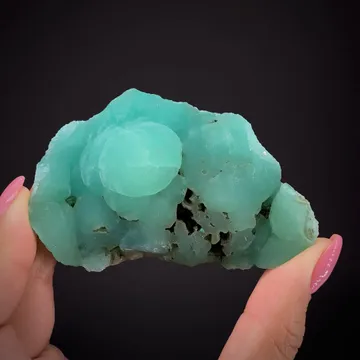
Hemimorphite from M’Fouati is the modern collector favorite: blue to blue-green, robin’s-egg, turquoise, pale sky-blue, white or colorless material in botryoidal crusts, spheroidal aggregates, bubbly bands, sprays and crusts of tiny tabular crystals, commonly on heavy dark gossan or willemite-rich matrix and locally accompanied by cerussite, mimetite or smithsonite. The eastern part of M’Fouati hill is particularly associated with blue hemimorphite and mimetite, and notable old and modern specimens can reach cabinet size; the best examples combine intense even color, sparkling luster, sculptural vug form and attractive contrast, while lesser pieces may be massive, abraded, contacted on the high points, or visually confused with Palabanda/Yanga-Koubenza material if the label history is weak.
Quartz at M’Fouati is usually an association and texture mineral rather than the headline species, but it is critical to the look of the locality: thin drusy coatings on large wulfenite, quartz-lined geodes carrying cerussite and wulfenite, and sparkling crusts or perimorphic surfaces in oxidized carbonate cavities. The most interesting quartz-bearing pieces preserve the underlying species clearly—especially wulfenite forms visible through or beneath a fine quartz skin—whereas ordinary examples are simply pale drusy matrix; collectors should inspect such pieces closely because quartz coatings can either authenticate an old classic M’Fouati style or conceal damage, etching and incomplete crystals.
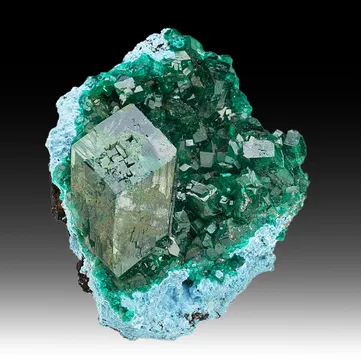
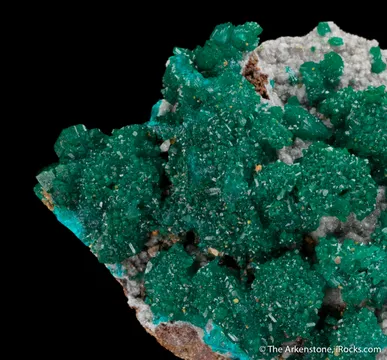
Dioptase is uncommon and highly desirable from M’Fouati because the locality is principally a Pb-Zn deposit with subordinate copper, not one of the Republic of the Congo’s classic copper-dominant dioptase localities. Documented specimens show lustrous emerald-green to deep green crystals in vugs, sometimes with quartz, wulfenite, pyromorphite coatings, cerussite or willemite; crystals to about the centimetre scale are significant for M’Fouati, and a specimen with sharp, translucent, undamaged green crystals in an open pocket is far more important than a merely green copper stain or massive crust. Because Congo-Brazzaville also has Mindouli, Renéville, Sanda and other dioptase-producing areas, precise provenance is especially important for this species.
M’Fouati willemite occurs as a zinc silicate component of the oxidized Pb-Zn system, most memorably as brown, orange-brown, cream, or pale barrel-shaped to pseudo-stalactitic aggregates and small lustrous crystals associated with blue hemimorphite, reticulated cerussite and mimetite. Some of the 2010s combinations show cerussite and hemimorphite coating or decorating willemite “fingers,” creating sculptural specimens that are far more distinctive than isolated willemite fragments; the best pieces have readable willemite form, strong contrast and minimal breakage to the protruding columns, while ordinary examples can look like heavy gossan unless examined under magnification for sparkling microcrystalline willemite.
Other minerals documented from M’Fouati include aurichalcite, azurite, chrysocolla, cuprite, galena, malachite, mimetite, shattuckite, smithsonite and manganese wad, with pyromorphite and related lead phosphates reported on some specimens in the trade. Plattnerite is historically important because M’Fouati was already listed among the known occurrences of tetragonal PbO2 by 1959. In the wider M’Fouati district, especially Palabanda and Yanga-Koubenza, the suite broadens to include notable modern rarities such as veszelyite, kipushite and zincolibethenite on hemimorphite; these are excellent Congo-Brazzaville specimens, but they should not be silently collapsed onto the old M’Fouati mine label without evidence.
M’Fouati demands label discipline. The most common problem is not fakery in the theatrical sense, but geographic imprecision. Specimens may be labelled M’Fouati mine, M’Fouati district, M’Fouati, Brazzaville, Republic of Congo, Congo, or—incorrectly—DR Congo. The correct country for the classic mine is the Republic of the Congo, also called Congo-Brazzaville, not the Democratic Republic of the Congo. A further complication is that modern material from Palabanda and Yanga-Koubenza, both in the M’Fouati district, has sometimes circulated at first as “M’Fouati” before more precise attribution became clear. For ordinary blue hemimorphite this may not trouble every buyer, but for rare phosphates, unusual copper associations or high-value specimens it matters greatly.
Condition issues are predictable for oxidized-zone specimens. Wulfenite edges chip easily, and older large crystals may show natural etching, abrasion, bruising under quartz coatings, or repairs that are not immediately obvious. Cerussite is dense but brittle; reticulated twins snap at junctions and should be checked with side lighting for missing lattice segments. Hemimorphite botryoids and spheroidal aggregates often have contacted high points, bruised knobs, clay-filled recesses or stabilized matrix. Willemite-bearing pseudo-stalactites are especially vulnerable where protruding fingers have been broken and then partly concealed by blue hemimorphite or cerussite. Dioptase should be inspected for tiny cleavages and edge bruises, particularly in open vugs.
No well-established locality-wide treatment problem defines M’Fouati material, but washing, trimming, stabilization and occasional repair are realistic possibilities. Heavy gossan pieces can hide glue, fills or reinforced backs. Quartz-coated wulfenite should not automatically be dismissed as altered or treated—the quartz coating is part of the classic M’Fouati habit—but it can make repairs and damage harder to see. Blue hemimorphite should be evaluated in natural and strong white light; some pieces photograph more saturated than they appear in hand, while others show their best color only when clean and well lit.
Fluorescence is worth testing but should not be used as a simple authenticity test. Willemite from many localities can fluoresce strongly, but M’Fouati combinations are variable and may include multiple zinc phases, iron-rich gossan, hemimorphite and coatings that complicate response. Treat any ultraviolet reaction as useful descriptive data, not proof of species or locality. As always with lead minerals such as wulfenite, cerussite and pyromorphite, normal collector hygiene is sufficient: avoid inhaling dust, do not lick or acid-test specimens, wash hands after handling, and keep fragile pieces out of reach of children.
Market availability is better now than it was for much of the late 20th century, but it is uneven. Blue hemimorphite and hemimorphite-cerussite-willemite combinations appear periodically from modern finds and dealer inventories. Good wulfenite is much scarcer, particularly sharp, complete, saturated crystals with reliable M’Fouati mine provenance. Large old quartz-coated wulfenites and major historic pieces belong in the classic category and are rarely offered. Dioptase from M’Fouati is uncommon enough that fine examples should be considered locality specimens first and dioptase specimens second. The best buying opportunities are well-labelled pieces with old collection provenance, Spirifer-era field attribution, publication history, or enough matrix and associations to make the M’Fouati style convincing.
The modern story of M’Fouati is as much about detective work as digging. For years, Congo-Brazzaville specimens reached the international market under loose labels—“Congo,” “Brazzaville,” “Mindouli area,” or simply “M’Fouati.” That vagueness was understandable: the Niari Basin is a long belt of small deposits, old workings, abandoned quarries and fault-controlled mineralized pockets, and many of the collector minerals are visually related. But it left serious collectors with a problem. A blue hemimorphite might be M’Fouati, Palabanda, Yanga-Koubenza or another carbonate-hosted occurrence; a dioptase might be from Mindouli, Renéville, Sanda, M’Fouati or N’tola; and a wulfenite coated by quartz might point to one very specific history if the label could be trusted.
Spirifer Minerals’ field work in the Republic of the Congo brought unusual detail to that problem. Their crews spent repeated field seasons in the Niari Basin, visiting old and new workings, checking outcrops, comparing geology and trying to attach real places to specimen types. Their account is full of the unglamorous realities behind fine-mineral labels: negotiating with local partisans, coping with bad roads, working around unreliable cars, hauling essential equipment into a country where good tools were hard to buy, and operating through wet-season weather. Those details matter because the specimens did not emerge from a well-organized specimen mine with neat benches and pocket logs; they came from a landscape of old ore extraction, dense vegetation, gossan diggings and small mineralized pockets scattered through carbonate hills.
At M’Fouati hill itself, the field distinction is striking. The western part of the hill is described as the area famous for red wulfenite crystals. There, the pockets yielded smoky reticulated cerussite in situ, twinned cerussite fresh from the workings, and the classic pairing of smoky cerussite with wulfenite on quartz. Many crystals from the locality are naturally rounded or etched, a feature that can surprise collectors expecting textbook-sharp Arizona-style wulfenite or Tsumeb-style cerussite. The M’Fouati look is more weathered, more oxidized, and sometimes more sculptural: the chemistry kept working after the crystals grew.
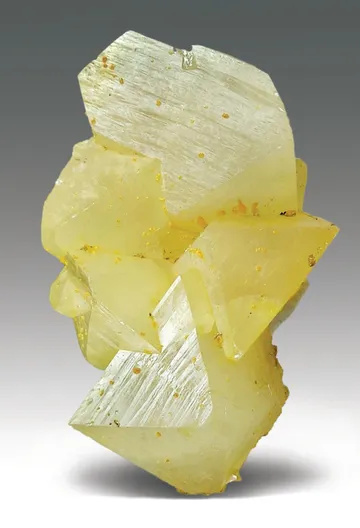
The eastern part of the hill tells a different story. That side is known for hemimorphite, mimetite and cerussite. Field photographs and specimen descriptions show blue hemimorphite with yellow mimetite and cerussite, spheroidal blue hemimorphite on colorless hemimorphite, mimetite specimens recovered from gossan, and “snowflake” cerussite with calcite. It is the source of the color combinations that have made modern M’Fouati desirable: soft blue zinc silicate against acid-yellow lead arsenate, white or smoky lead carbonate sitting across a bubbly blue surface, and gossan matrix heavy enough to remind you this was an ore mine before it was a collector locality.
The nearby Palabanda episode is a cautionary and exciting chapter in the same district. Soon after SOREMI abandoned quarry operations, local miners first pursued malachite as copper ore and unexpectedly encountered voids with cerussite. Later, after access changed again, blue hemimorphite began to appear, followed around November 2019 by unknown blue crystals on hemimorphite. At first the identification was uncertain, based on poor miners’ photographs and competing guesses. When systematic digging began after the New Year period, the zone was worked for months with simple tools. After three months it seemed exhausted, yet digging continued for nearly two more months with almost no further recovery. The result was about 1,500 kg of specimen material, including what has been described as probably the largest known find by volume of veszelyite. For collectors of “M’Fouati” material, that story is invaluable: it explains why rare phosphate specimens initially travelled under broader M’Fouati labels before being more precisely tied to Palabanda.
The older wulfenite story has a different scale. In June 1961, specimens discovered in 1960 were presented to the Société française de Minéralogie et de Cristallographie: M’Fouati wulfenite crystals reaching 10 cm across and 1–2 cm thick, covered with a thin quartz layer. Those dimensions still sound improbable if your mental image of wulfenite is a delicate thumbnail. They help explain why major museum pieces and old collection specimens from M’Fouati carry a special aura. This is not a locality that produced a few orange blades on matrix and vanished; it produced wulfenites so large that “M’Fouati” became a name to remember in the literature of giant molybdate crystals.