A collector's guide to N'tola Mine, Republic of the Congo: its geology, mining history and notable minerals, illustrated with the 30 specimens documented from this locality on EarthWonders.
Key facts
N'tola is one of the locality names that serious dioptase collectors had to learn quickly in the late 2010s. The mine lies at Mindouli in Pool Department, within the Niari Basin copper-lead-zinc province of the Republic of the Congo — Congo-Brazzaville, not the Democratic Republic of the Congo. Its specimens are products of the supergene, void-rich portion of a fault-controlled base-metal system developed in Neoproterozoic carbonate and siliciclastic rocks of the West Congo Belt. For collectors, that geology matters because N'tola did not merely produce green crusts: it produced open-space mineralization, with dioptase, mimetite, duftite and dolomite lining cavities, casts, pocket walls and thin plates.
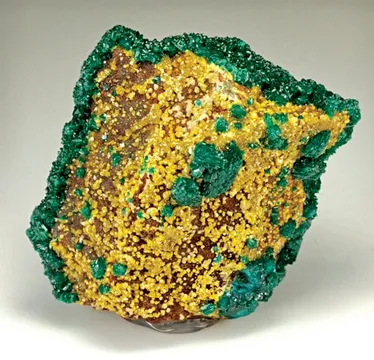
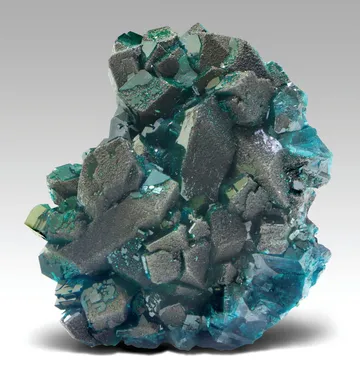
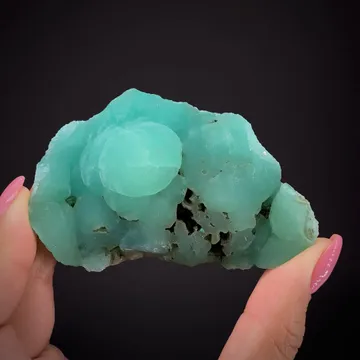
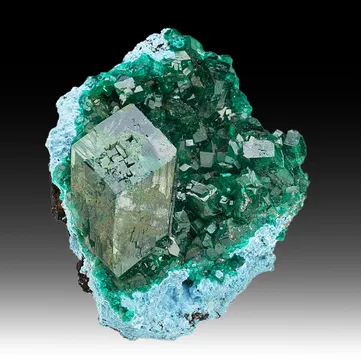
The best N'tola specimens have a distinctive look. Many are made of bright emerald-green dioptase microcrystals to small crystals covering white to pale pink dolomite druse, sometimes with pinpoints to small pyramids of yellow-orange mimetite and apple- to olive-green duftite. The locality’s signature pieces are hollow, rounded, cup-like or shell-like dioptase casts — perimorphs or epimorphs after an unknown earlier mineral, often suggested by collectors and dealers to have been a botryoidal copper silicate such as chrysocolla, plancheite or shattuckite. These are not Tsumeb-style isolated rhombohedral giants; N'tola’s magic is texture, sparkle, contrast and sculptural form, especially where green dioptase forms bubbly, radiating, honeycomb or cup-shaped masses over pale carbonate matrix.
Regional View
Country View
Historically, N'tola belongs to the wider Mindouli mining district, an old copper-producing area of the Niari Basin. Modern geological work on the district treats Ntola together with Mindouli, M’Passa, Mfouati and Boko-Songho as part of a complex, multiphase Cu-Pb-Zn system: deeper hypogene sulphides, karst and fault-related permeability, and later supergene mineralization responsible for the collector minerals. The locality became especially visible to the specimen trade around 2016-2019, when unusual dioptase casts and dioptase-mimetite combinations began to appear after earlier being circulated under vaguer “Mindouli area” attributions and, in some cases, the wrong mine name.
Search for specimens:
N'tola Mine is recorded at Mindouli, Mindouli District, Pool Department, Republic of the Congo, with the alternative spelling Ntola also widely used on labels. It sits in the metalliferous Niari Basin, a NW-SE-trending Neoproterozoic basin in southern Congo-Brazzaville. Regional work places the important Cu-Pb-Zn deposits in carbonate-rich units of the Schisto-Calcaire Group, historically also described with terms such as Lukala limestone, together with associated sandstones of the Mpioka succession. The deposits are structurally controlled: regional faulting, brecciation, karstic dissolution and porous contacts created the open spaces that later became specimen-bearing cavities.
The ore system is best understood as two superimposed stories. First came deeper, hotter, saline hydrothermal fluids that introduced Cu-Pb-Zn sulphide mineralization into faulted carbonate and sandstone rocks, with massive sulphides and sulphide-cemented breccias exposed in the Mindouli area. Later erosion, weathering and circulation of meteoric waters oxidized and remobilized those metals, producing the upper supergene assemblage. That supergene stage is the collector’s N'tola: dioptase from copper and silica, mimetite and duftite from lead-arsenic-bearing solutions, and dolomite as the pale carbonate druse and host surface on which the color show developed.
The mining history of N'tola itself is less fully published than that of the broader Mindouli district, but the district’s importance is old. Archaeometallurgical studies of the Niari Basin document copper production and trade from the 13th to 19th centuries CE, with Mindouli among the principal areas investigated for ore, slags, metal and production remains. Colonial and later geological work treated the Mindouli deposits as part of a base-metal belt rather than as specimen localities. N'tola’s modern mineralogical fame is much more recent: specimens entered the international collecting market in the 2016-2018 period as dioptase-lined casts and plates, followed in 2019 by more matrix specimens with dioptase, dolomite and scattered yellow mimetite. Field accounts from the Spirifer team describe the mine as closed by 2019.
The most important specimen pockets were in underground workings rather than a casual roadside outcrop. Field photographs and accounts describe the main adit, partly flooded tunnels, dioptase visible on walls and ceiling, and pockets containing dark green dioptase, bright dolomite, bright green duftite and yellow mimetite. Good pieces from these pockets range from small, glittering plates to cabinet-sized masses. One documented N'tola dioptase crystal on dolomite measured about 2 cm tall, an unusually prominent individual for a locality better known for microcrystalline sparkle, radial clusters and hollow casts. Other documented pieces include an 8.6 cm dioptase-mimetite perimorph and a 4.7 cm dioptase perimorph on dolomite, both described as after an unknown kidney-shaped mineral.
Collecting access today should be treated as closed and not public. The mine is underground, at least partly flooded in documented field visits, and lies in a region where access depends on land, mineral-rights and local permissions. Collector material now reaches the market through older parcels, dealer-held stocks, secondary sales and occasional dispersals, not through reliable hobby collecting.
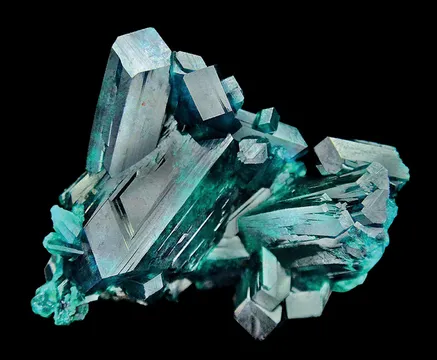
N'tola dioptase is prized less for huge isolated crystals than for intense emerald-green sparkle and unusual morphology: tiny to small sharp trigonal crystals, rich druses, radial “ball-shaped” aggregates, bubbly crusts, honeycomb-like plates and hollow shell-like casts. The earliest market material from about 2016-2018 was often composed of dioptase-lined casts or thin plates, many apparently off matrix; the 2019 material more commonly showed matrix, especially dolomitized rock with white rhombic dolomite microcrystals, plus scattered yellow to orange mimetite and occasional duftite. Fine pieces have saturated color, glossy luster, open cavities that catch light from multiple angles, intact cup-like forms, and minimal pocket-contact abrasion. Ordinary pieces are usually darker, more crusty, more heavily scuffed, or visually flat; the best N'tola examples preserve the locality’s distinctive hollow, spherical, shell or cast habit while still displaying bright individual crystal faces.
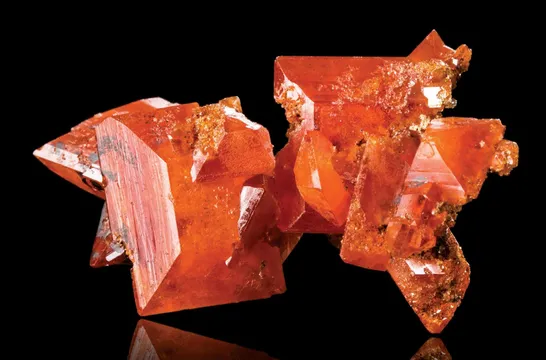
Mimetite from N'tola is chiefly an accessory mineral, but a very important one visually: tiny yellow, yellow-orange to orange crystals and aggregates scattered among green dioptase and pale dolomite, sometimes so small that a lens is needed to appreciate their form. The common described habit is pyramidal to microcrystalline, with small crystals sprinkled through dolomite druse or along the margins and interiors of dioptase-lined cavities; some pieces show mimetite coating or underlying the matrix on which ball-shaped dioptase aggregates sit. It is especially desirable at N'tola because dioptase-mimetite is an uncommon and colorful association compared with plain dioptase, and because the yellow-orange points make the green casts and white carbonate matrix read immediately as Congo-Brazzaville rather than a generic dioptase locality. The best mimetite pieces show clean, bright contrast without mud, iron staining or excessive abrasion, and with the mimetite distributed visibly enough to affect the specimen’s overall composition.
The core documented N'tola assemblage is compact: dolomite, duftite, mimetite and dioptase form the standard locality list, while photo-based associations also include wulfenite, quartz, calcite and limestone. Duftite is a key accessory, appearing as small apple-green to olive-green spherical aggregates among dioptase and mimetite; dolomite supplies the pale drusy matrix that makes many cabinet specimens attractive. Some trade listings and field discussions from the N'tola area mention rarer or less consistently documented species such as mottramite, calcio-duftite, hemimorphite, malachite, aurichalcite and veszelyite, but these should be treated cautiously unless supported by analysis or a reliable provenance trail. No type-locality mineral is established for N'tola Mine itself; nearby Congo-Brazzaville localities have their own type-locality and classic-mineral histories, but N'tola’s reputation rests on its distinctive dioptase casts and dioptase-mimetite-duftite-dolomite combinations.
The principal authenticity issue for N'tola is not faking in the usual sense, but locality accuracy. Early and secondary-market specimens have been reported as coming from “Mindouli area,” “Mpita Mine,” “Mpita Prospect,” or simply “Republic of Congo,” and some later corrections placed the material at N'tola. Because the Republic of the Congo and the Democratic Republic of the Congo are also frequently confused in the trade, labels should be read carefully: N'tola is in Pool Department, Republic of the Congo, Congo-Brazzaville. A strong specimen should ideally have a provenance chain through a knowledgeable dealer or collector familiar with the 2016-2019 finds.
Condition is the great practical concern. N'tola dioptase is often made of tiny, bright crystals on thin hollow crusts or on delicate cast surfaces; the forms that make the locality special are easily scuffed. Many pieces show contact damage at the edges, broken bubbles, abraded high points, or sawed and trimmed backs from recovery and preparation. This is common enough that modest edge scuffing should not automatically disqualify a specimen, but on top-quality pieces the central display face should still show crisp luster and intact crystal coverage. Hollow cast specimens should be inspected for structural weakness, repaired breaks, concealed glue, and pressure points from old mounts.
Treatments are not widely documented for N'tola material, but cleaning and trimming are routine possibilities. Watch for stubborn clay or iron-rich dirt in cavities, glossy wet-looking residues from over-cleaning, and hot-glue scars from acrylic bases. Because mimetite and duftite contain lead and arsenic, specimens should be handled like other lead-arsenate minerals: wash hands after handling, avoid generating dust, do not lick or soak indiscriminately, and keep fragments away from children and pets. Dioptase itself is brittle, and the best microcrystalline surfaces should not be brushed.
Market availability is intermittent but real. N'tola appeared as a “new find” locality in the late 2010s, and parcels still circulate through dealers, auctions and collection resales. Ordinary thumbnails and miniatures are available from time to time; rich cabinet plates with strong color, good dolomite contrast and minimal damage are scarcer; the most collectible pieces are the hollow cast or perimorph forms with visible yellow mimetite and green duftite accessories. Compared with classic Tsumeb dioptase, N'tola remains less famous, but knowledgeable collectors already recognize its morphology as locality-specific.
The modern N'tola story begins with a problem familiar to anyone who has tried to make sense of central African mineral labels: beautiful specimens were moving, but the real source was vague. Material was being called “unknown location in the Mindouli area,” and some specimens were even attached to the wrong mine name. The Spirifer team, led by Tomasz Praszkier, spent repeated field seasons in the Niari Basin trying to sort out exactly where the new Congo-Brazzaville minerals were coming from. Their account says they were the first westerners to track the origin of the mystery Mindouli dioptase material to N'tola and the first, or among the first, western visitors to the mine itself.
The fieldwork was not a polished collecting tour. The team described months in Congo as a mixture of bureaucracy, poor roads, unreliable cars, hardware-store improvisation and mineral hunting. They wrote of negotiating with local partisans, dealing with “really bad roads,” wet-season weather, local beer, improvised food and animals turning up in hotel rooms. Even basic equipment was a problem: good tools were hard to buy locally, so essentials had to be brought in piece by piece in luggage. That background helps explain why so many N'tola specimens show rough extraction marks. These were not removed from a clean, mechanized specimen operation; they came from difficult ground, simple tools and real underground workings.
At N'tola, the field photographs are unusually evocative: the mining camp, the portal, the main adit, the crew preparing to go underground, then the darker passages where water covered parts of the floor. One caption notes unusual fungi inside the mine. Another shows “abundant dioptase” in a flooded part of the workings, with the green mineral visible overhead. The team documented dioptase masses on the walls and small dioptase crystals in cracks in limestone, then an in situ pocket with bright dolomite, dark green dioptase and bright green duftite — essentially the N'tola collector assemblage still attached to the mine.
The pocket material explains the specimens. Some pieces were ordinary only in the sense that they were typical: green dioptase on white dolomite, with yellow mimetite scattered like sparks. Others were startling. One photographed specimen showed a well-formed dioptase crystal about 2 cm tall with mimetite aggregates on white dolomite, unusually bold for N'tola. Still more distinctive were the hollow perimorphs: rounded, kidney-shaped forms coated with dioptase and sometimes mimetite, after an unknown precursor. Spirifer suggested chrysocolla or plancheite as possibilities; other dealers and collectors have also suggested shattuckite, calcite, aragonite or even gas-bubble-related forms. Whatever the original template was, the result is unmistakable — a locality whose best specimens look grown around vanished bubbles.