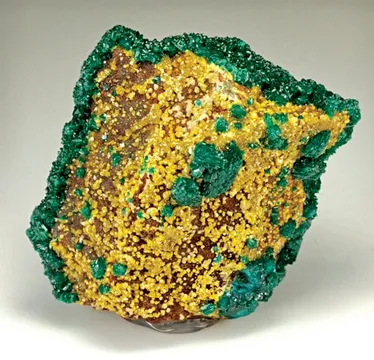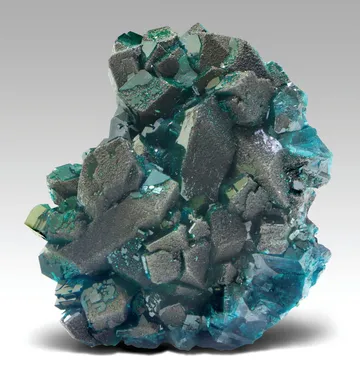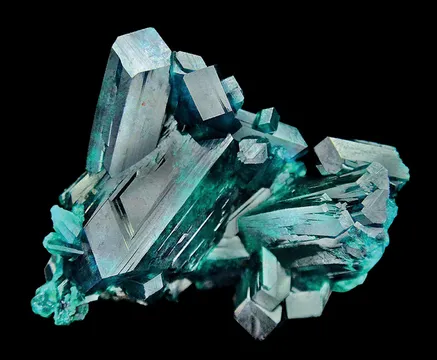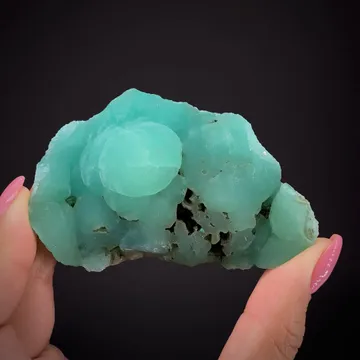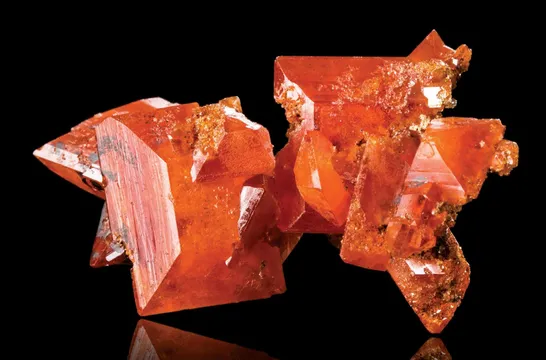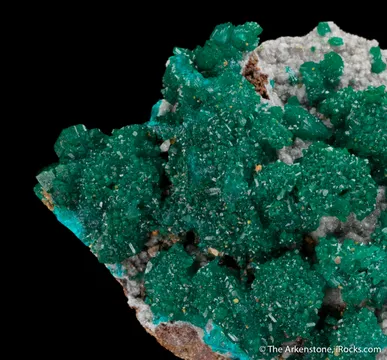
Sanda Hills, Republic of the Congo - a key collector locality, source of type-local plancheite and Congo dioptase, with emerald-green dioptase on quartz.
Key facts
The Sanda Hills occurrences are among the defining collector localities of the Mindouli copper district in Pool Department, Republic of the Congo: a compact but historically important belt of Pb-Zn-Cu mineralization exposed in silicified Neoproterozoic carbonate rocks near the town of Mindouli. For collectors, Sanda matters for three intertwined reasons. It is the type locality for plancheite, it is a classic source of Congo-Brazzaville dioptase, and it has produced the modern “Sanda” style that advanced collectors immediately recognize: emerald-green dioptase crystals scattered across sparkling quartz, the quartz in turn lying over or enclosing soft blue plancheite.
The setting is not a single neat mine in the Tsumeb sense, but a string of prospects, old cuts, collapsed shafts, declines, adits, and natural outcrops along the Sanda Hills limestone escarpment behind Mindouli. The mineralization belongs to the Niari Basin’s structurally controlled supergene Pb-Zn-Cu systems, where deeper sulfide ores and oxidized near-surface assemblages gave rise to copper silicates, carbonates, oxides, and lead minerals. The best Sanda specimens have a layered look: grey silicified limestone or quartzose matrix, powder-blue to saturated blue plancheite, glassy clear to smoky quartz druse, and crisp green dioptase set off like jewels on a pale blue ground.
Regional View
Country View
Historically, the Sanda-Mindouli mineral field entered mineralogical literature early. In 1890, Édouard Jannettaz reported Mindouli dioptase at the Muséum in Paris and noted its association with hyaline quartz and sometimes chrysocolla. Alfred Lacroix followed with important work on Mindouli dioptase and its associated minerals, including his 1908 description of plancheite from material supplied from the French Congo. That combination of early European scientific attention and renewed small-scale specimen production in the 21st century gives Sanda a rare dual status: a venerable type locality that also continues to feed the contemporary market with showy cabinet pieces.
Search for specimens: View all specimens from Sanda Hills occurrences, Republic of the Congo
The Sanda Hills occurrences lie at Mindouli in Pool Department, Republic of the Congo, at roughly 4°16'20" S, 14°21'8" E. Labels may read Sanda Hills, Sanda Mine, Sanda quarry, Sanda carrière, Mindouli, or simply “Congo-Brazzaville.” The latter qualifier matters: this is the Republic of the Congo, not the Democratic Republic of the Congo, and not the Katanga Copperbelt. Mislabelled “DR Congo” examples do circulate, especially when dealers abbreviate or confuse the two Congos.
Geologically, Sanda belongs to the Mindouli portion of the Niari Basin, where Cu-Pb-Zn mineralization is hosted in Neoproterozoic sedimentary rocks of the West Congo Supergroup, especially carbonate-rich units of the Schisto-Calcaire succession and related silicified limestones, dolomites, marls, sandstones, and argillaceous layers. The Mindouli deposit sits near the transition between the schisto-calcaire and schisto-gréseux ensembles, in a sedimentary package described as beginning with dolomites, passing into limestones and red argillites, and ending with massive siliceous dolomites and sandstones. At the specimen scale this is crucial: Sanda’s best pieces owe their visual character to the availability of silica, copper, and open space along fractures, faults, vugs, and pocket walls.
The ore bodies are not broad, uniform masses. The most useful collector description is of mineralized ground cropping out for about three kilometres along the limestone escarpment behind Mindouli. Historical and field accounts describe a number of open cuts, exploration tunnels, shafts, declines, and exposed faces rather than one continuous mine. The larger old open cut was reportedly known as the Sanda carrière. Modern interpretations place Sanda among the fault-vein style specimen occurrences in the Niari Basin: structurally controlled supergene mineralization in voids and veins, with the collector minerals forming chiefly in the oxidized zone above or adjacent to deeper sulfide bodies.
The primary and hypogene component included copper sulfides such as chalcocite, with galena, possible sphalerite, and other sulfide associations documented historically in the broader Mindouli system. Supergene alteration produced the mineral suite collectors prize: dioptase, plancheite, chrysocolla, malachite, cuprite, quartz, cerussite, wulfenite, and rarer arsenates and vanadates. Koud’s petrographic study of Mindouli copper silicates emphasized dioptase, chrysocolla, and plancheite as the main supergene copper-silicate phases, and noted the direct alteration of chalcocite toward copper silicates. That alteration pathway helps explain why Sanda specimens can be rich in copper silicates but also carry lead minerals such as cerussite and wulfenite in the same district.
Mining history at Mindouli reaches far back. Archaeological work in the Niari copper zones has identified ancient copper production in the region, with activity around Mindouli and related deposits in the 13th-14th centuries CE. Colonial industrial activity followed much later. Copper in the Niari valley was noted in the late 19th century, and the Compagnie Minière du Congo Français worked Mindouli from the early 20th century; period summaries describe shipments of ore to Brazzaville and the construction of railway infrastructure to move heavy material. Later French mining is recorded between 1948 and 1960 at the Sanda-Mindouli copper occurrences, with additional postwar attempts in the wider district. By the late 20th century, industrial output had become small, irregular, or exhausted in the classic Mindouli workings, though exploration and selective small-scale activity have continued episodically.
Specimen production is more recent and more selective than ore production. The finest modern Sanda pieces have come from pocketed zones where quartz, plancheite, and dioptase were preserved rather than crushed as ore. Spirifer Minerals’ field reports on the Republic of the Congo describe the Sanda style as dioptase on drusy quartz, dioptase with wulfenite, smoky twinned cerussite on quartz, and the now-classic dioptase-on-quartz-over-blue-plancheite association. The best documented high-end examples are large plates rather than isolated single crystals: one 21.0 x 25.0 x 4.0 cm EarthWonders specimen carries water-clear quartz, bright blue plancheite inclusions, and dioptase crystals to 1.6 cm; a 15.7 x 14.1 x 5.8 cm Mineral Auctions specimen was described as a large cabinet plate of gemmy emerald dioptase sprays to 1.1 cm on smoky quartz over light-blue botryoidal plancheite.
Access today should be treated as restricted and permission-based. The old workings include collapsed shafts and declines, unstable cuts, and mineral rights or exploration interests. Collectors should not regard Sanda as an open collecting locality. Modern specimens reach the market through Congolese miners, local intermediaries, and specialist dealers who have worked in the Niari Basin; field collecting without local authorization, mining rights clarity, and safety preparation would be irresponsible.
Sanda dioptase is the locality’s show mineral: sharp to elongated trigonal crystals in rich emerald green, commonly lustrous to gemmy, scattered or draped across quartz and blue plancheite rather than sitting on white calcite as at many classic localities. Documented modern specimens show individual crystals from millimetre size to about 1.6 cm, with better plates carrying well-distributed, damage-free crystals that sparkle against glassy clear or smoky quartz; the finest pieces are not merely “green on blue,” but layered combinations in which quartz partly encloses spheroidal plancheite or rests over a blue plancheite substrate. Ordinary examples show sparse dioptase, damaged terminations, or visually flat massive blue matrix; superior Sanda pieces have sharp isolated crystals, intense color, lively luster, strong contrast with quartz, and minimal bruising along pocket-wall edges.
Plancheite is Sanda’s mineralogical signature because the Sanda Hills occurrences are its type locality, described by Alfred Lacroix in 1908 from French Congo material supplied by François Gilbert Planche. At Sanda it appears as pale to vivid blue fibrous, botryoidal, spheroidal, and veinlet material, commonly forming the velvety or powder-blue layer beneath quartz and dioptase; collector descriptions also document small rounded blue aggregates enclosed within quartz crystals, a distinctive feature that gives some pieces their “blue included quartz” appeal. Better plancheite specimens from Sanda are not simply massive blue crusts: they show fresh color, fine fibrous or botryoidal texture, obvious association with quartz and dioptase, and enough exposure at the edges or in windows through quartz to read the paragenesis clearly.
Quartz at Sanda is important less as a stand-alone species than as the stage on which the copper silicates perform. It occurs as drusy to individually terminated crystals, commonly clear to smoky, coating plancheite-rich pocket walls and in some specimens enclosing blue plancheite spheres, wisps, or patches; large plates may show glittering quartz points over blue plancheite with dioptase perched on top. The best quartz-bearing Sanda specimens have sharp, glassy terminations, bright luster, and enough transparency to reveal blue inclusions or underlayers, while lesser pieces tend toward broken druse, dull crusts, or quartz so dense and opaque that it hides the plancheite rather than enhancing the specimen.
The formal Sanda Hills mineral list is compact but choice: cerussite, dioptase, duftite, plancheite, quartz, and wulfenite are documented for the specific locality, with plancheite the valid type-locality mineral. Cerussite is known as smoky to colorless twinned crystals, including V-shaped and reticulated forms in the Mindouli district, and Sanda wulfenite provides a valued lead-molybdate accent on quartz or in dioptase-bearing cavities. Duftite is a much scarcer label-confirmed component, and dealer records also note unusual combinations involving mottramite-like tan to yellow material with dioptase and plancheite. In the broader Mindouli/Sanda field, collectors should also be aware of related occurrences of chrysocolla, malachite, cuprite, native copper, native silver, chalcocite, chalcopyrite, pyrite, hematite, goethite, libethenite, azurite, and other secondary species, but those should not automatically be assigned to Sanda unless the specimen’s provenance is specific and credible.
The first authenticity issue is locality accuracy. “Sanda,” “Mindouli,” “Kimbedi,” “Gautala,” “N’tola,” “Renéville,” and “Republic of Congo” are often used loosely in the market, and some labels incorrectly state Democratic Republic of the Congo. For Sanda Hills specifically, the classic visual association is dioptase on quartz over blue plancheite, sometimes with plancheite inclusions in quartz; a vague “Congo dioptase” label is not enough to establish Sanda provenance. The Republic of the Congo and the DRC both produce dioptase, and the collector value of a type-locality plancheite association depends on keeping those labels straight.
No well-documented treatment industry is known for Sanda material, but confusion among blue copper silicates is a real concern. Plancheite, shattuckite, chrysocolla, and bisbeeite-like material can be visually difficult, especially where the blue phase is massive, fibrous, or included in quartz. The safest Sanda plancheite labels are those with a reliable old provenance, analytical support, or a reputable specialist dealer history. Bright blue inclusions in quartz are attractive but should not be assumed to be plancheite without context.
Condition is central to value. Dioptase is brittle and often chipped on exposed terminations; many Sanda specimens were separated from tight pocket walls, so edge bruising and peripheral contact are common. Quartz druse hides small breaks but also takes bruises along ridges and high points. Plancheite can be fibrous and velvety, so avoid aggressive cleaning, ultrasonic baths, and unnecessary handling of delicate blue surfaces. A soft brush, air bulb, or careful dusting is safer than wet scrubbing. Plancheite is not known for useful collector fluorescence, and the principal handling considerations are mechanical rather than optical or chemical.
Rarity is tiered. Small Sanda dioptase pieces appear periodically and remain obtainable, especially as modern Congo-Brazzaville material has circulated through specialist dealers. Fine cabinet plates with abundant gemmy dioptase on sparkling quartz over visible blue plancheite are genuinely scarce. Large, aesthetic pieces with blue plancheite inclusions in quartz, complete dioptase crystals over 1 cm, wulfenite accents, or strong provenance to a documented pocket command a premium. Recent public sales show the spread clearly: modest miniatures and small cabinets may sell in the low hundreds, while major large-cabinet quartz-plancheite-dioptase plates have reached several thousand dollars and can be valued in the low five figures when exceptional.
In the earliest printed accounts, the Sanda-Mindouli story arrives in Paris by way of travelers and museum cases. Édouard Jannettaz wrote in 1890 that M. Thollon had displayed at the Muséum “un assez grand nombre” of Congo dioptase crystals and crystallized specimens from his travels. The comparison he chose was telling: they could rival the Siberian dioptases then familiar to European mineralogists. Those first specimens were already showing the association that still defines the district for collectors more than a century later: dioptase with hyaline quartz and sometimes chrysocolla. Jannettaz placed the mine at Mindouli, between Bouanza and Brazzaville, in what was then French Congo.
Lacroix’s 1908 paper deepened the picture. He credited Jannettaz with first signaling dioptase and native silver from Mindouli, noted that Thollon had discovered the deposit, and described how the Muséum’s holdings had grown through a series of specimens. The result was not just a better description of a green copper silicate locality. It was the setting for plancheite itself: a blue copper silicate from the French Congo that Lacroix named in honor of Planche, the industrialist and political figure tied to the Congo mining enterprise and the Mindouli railway world. The mineral entered literature not as an abstract formula, but as a product of a specific colonial-era copper field where scientific collecting, transport infrastructure, and ore extraction were all entangled.
The modern field story is equally practical and gritty. Spirifer Minerals’ Republic of the Congo work began as an attempt to understand where specimens were really coming from in a country whose labels had often been vague or wrong. Their team described the Niari Basin as rich but under-documented, with countless outcrops, old workings, quarries, and mines to be checked one by one. They wrote of bad roads, unreliable vehicles, wet-season misery, bureaucratic formalities, local negotiations, and equipment brought in luggage because good tools were nearly impossible to buy locally. Against that backdrop, the Sanda material stands out in their report as one of the recognizable Mindouli-Loutete styles: gemmy green dioptase on drusy quartz, blue plancheite beneath or inside quartz, wulfenite combinations, and smoky twinned cerussite.
One particularly memorable Sanda specimen history comes from a Mindat-registered piece acquired from Tomasz Praszkier of Spirifer at Tucson in 2020. The specimen, 11.5 x 9.6 x 4.5 cm, combined emerald dioptase, scintillating drusy quartz, sky-blue plancheite, and chrysocolla around the perimeter. Its owner recorded that it was “the only one of its style in a whole pocket” recovered during a Spirifer mining operation in summer 2019. That is exactly the kind of detail that separates Sanda from generic Congo dioptase: not just the colors, but the pocket-by-pocket individuality of a small, structurally controlled deposit.