A collector's guide to Palabanda quarries, Republic of the Congo: its geology, mining history and notable minerals, illustrated with the 80 specimens documented from this locality on EarthWonders.
Key facts
Palabanda is one of the modern surprise localities of the Niari Basin, the Neoproterozoic carbonate belt in southern Republic of the Congo whose old M’Fouati, Mindouli, Sanda, and Renéville names have long circulated among collectors of secondary copper-lead-zinc minerals. The quarries lie near M’Fouati in Bouenza Department, close to the Yanga Koubenza workings and the SOREMI processing complex, in a district where zinc-lead-copper mineralization occupies fault-controlled, karstified dolomites of the Schisto-Calcaire Group. For collectors, Palabanda matters because a short-lived, small-volume collecting episode transformed a utilitarian polymetallic quarry into a world-class source of vivid blue hemimorphite with deep blue veszelyite, plus a separate and visually distinct malachite-cerussite suite.
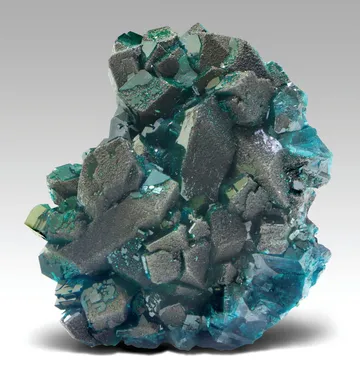
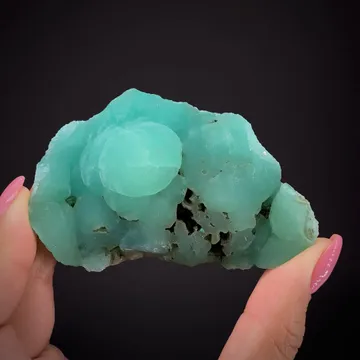
The essential Palabanda look is not a single mineral but a color relationship: botryoidal to crustiform hemimorphite in white, pale blue, blue-green, and strong sky-blue bands, sprinkled or locally crusted with darker, sharper, more saturated blue veszelyite. The best specimens are miniature to cabinet pieces with strong topographic relief, uninterrupted blue hemimorphite surfaces, and naked-eye veszelyite crystals that sparkle rather than merely dust the matrix. A second Palabanda style, from only a few meters away in the quarry, shows velvety green malachite coating breccia fragments and pocket walls, accented by flattened, reticulated, white-to-translucent cerussite twins — the “snowflake” pieces that are fragile but highly distinctive when preserved.
Regional View
Country View
The locality is also important historically because it arrived late. Although the Palabanda-Yanga Koubenza area was investigated in earlier phases of Niari Basin base-metal exploration, the specimen-producing quarry faces are products of recent industrial work. Large-scale development by SOREMI began in the late 2010s, with quarries, plant, and flotation pond rapidly established in the M’Fouati district. The specimen story followed the mining story: malachite and cerussite began to appear after quarrying exposed oxidized pockets, and the hemimorphite-veszelyite zone was recognized only after the quarry had already been largely abandoned for industrial purposes.
In the broader canon of veszelyite localities, Palabanda stands with the few names serious collectors immediately recognize. Black Pine in Montana gave the species stature, and Chinese finds made it more available, but Palabanda’s contribution is the spectacular contrast of dark blue copper-zinc phosphate against glowing blue zinc silicate in sizable, sculptural pieces. The find was not a broad, persistent orebody of specimen pockets. It was a small, irregular, supergene concentration within a hemimorphite zone, and that limited geography is part of why undamaged, well-composed examples remain so desirable.
Search for specimens: View all specimens from Palabanda quarries, Republic of the Congo
Palabanda is a supergene specimen locality developed in an oxidized Zn-Cu-Pb system of the Niari Basin. The host sequence belongs to the upper part of the West Congo Supergroup, especially the Schisto-Calcaire Group, a thick Neoproterozoic marine carbonate-siliciclastic succession that includes dolomites, limestones, marls, shales, and sandstones. At Palabanda and nearby Yanga Koubenza, the mineralized interval is described in the upper Schisto-Calcaire, in the SCII subgroup, where shallow-marine dolomites are locally silicified, intensely karstified, brecciated, and cut by steep structures. The specimen pockets occupy voids in these collapse and dissolution breccias rather than broad open fissures in fresh rock.
The ore is the old miners’ “calamine” in the European sense: a zinc-rich oxidized ore dominated by smithsonite and hemimorphite, replacing carbonate and filling fractures and cavities. The mineralized horizon in the Palabanda-Yanga Koubenza area is irregular and roughly tens of meters thick. Primary sulfide mineralization in the Niari Basin is interpreted as deeper hypogene Cu-Pb-Zn mineralization related to fault systems and later strongly overprinted by meteoric supergene processes. The collectible minerals at Palabanda are almost entirely products of that oxidized zone: carbonates, silicates, phosphates, and related secondary species developed where fluids could move through brecciated dolomite.
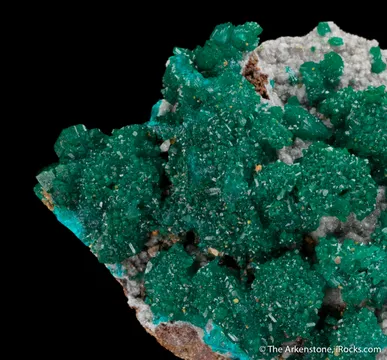
Within the quarry, the key collecting ground is in the northwestern corner, where two contrasting specimen zones occur only a few meters apart. One is the malachite-cerussite zone. There, malachite coats breccia clasts and cavity surfaces as vivid green acicular to velvety crusts, locally dense and durable but elsewhere hairlike and easily bruised. Cerussite grew on this malachite as flattened, cyclic, reticulated twins, generally white to translucent and commonly in the millimeter to low-centimeter range. These specimens can resemble material from the Boko-Songho area, but the Palabanda examples tend to be remembered for their vivid green malachite and snowy, delicate cerussite morphology.
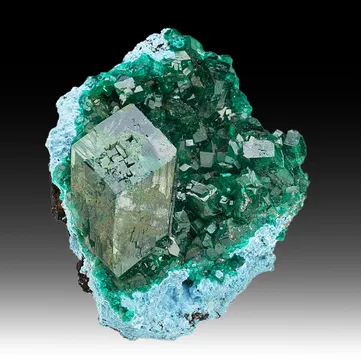
A short distance away is the larger and more mineralogically important hemimorphite zone. In this zone, open pockets reached more than 50 cm across, and hemimorphite coated clasts and pocket walls as layered crusts. The crusts may be only a millimeter thick, but locally reach much greater thickness, with individual bands of white, colorless, gray, pale blue, blue-green, and rich sky-blue hemimorphite. Some layers contain thin green horizons of zincolibethenite, and later rare phosphates, especially veszelyite and kipushite, occupy the most celebrated paragenesis. In larger pockets the hemimorphite could form broad, smooth, slightly undulating surfaces; on better collector pieces it developed a botryoidal or spheroidal relief that gives the blue color exceptional liveliness under light.
The famous veszelyite occurrence was not spread across the whole quarry. It was a small, irregular portion of the hemimorphite zone, reportedly on the order of a meter in extent, with very uneven distribution. In some crevices, dark blue veszelyite formed dense crusts a few centimeters thick; in other places, it appeared as separated crystals or small aggregates perched on hemimorphite. This patchy distribution explains the wide range in quality: many specimens are essentially blue hemimorphite with minor blue specks, while the finest are true combination pieces with isolated, well-formed, lustrous veszelyite crystals set against contrasting sky-blue botryoidal hemimorphite.
Industrial activity in the area accelerated in the late 2010s under SOREMI, the Société de Recherche et d’Exploitation Minière. Ore plant, flotation pond, and quarries were constructed in a short period after 2016, and early plant feed reportedly came largely from the Boko-Songho deposit. Palabanda quarrying was concentrated around 2017–2018 and then abandoned as an industrial quarry. Government and industry reporting for the broader Mfouati district continues to identify SOREMI with copper and zinc production from the Boko-Songho and Yanga Koubenza operations, but specimen accounts describe Palabanda itself as no longer an active industrial collecting quarry.
The first Palabanda specimens came from local small-scale activity after the quarry was abandoned. Local ore diggers first pursued malachite as copper ore and opened the malachite-cerussite pockets around mid-2018. Security later interrupted access, but the quarry became accessible again in late 2019, when blue hemimorphite pieces appeared. Around November 2019, miners noticed blue crystals on hemimorphite that were initially uncertain from photographs; these were later confirmed as veszelyite. Organized specimen digging by the Spirifer Minerals team began in early January 2020 and continued for several months, using simple tools in difficult conditions. That effort produced the bulk of the hemimorphite-veszelyite material known from Palabanda.
Collecting access today should be treated as closed, uncertain, and locally controlled. Palabanda is an industrial mining area, not a recreational collecting site. The quarry has been described as abandoned for industrial purposes, but on mining permits and in a district where SOREMI activity, local ore digging, security, and government restrictions have all affected access. Later reports and dealer notes indicate that occasional malachite-cerussite specimens have still appeared from people probing the quarry margins, but this is opportunistic recovery rather than open collecting. Serious collectors should regard legally sourced, well-provenanced specimens already in the market as the realistic way to acquire Palabanda material.
Palabanda hemimorphite is the matrix and visual engine of the locality’s best pieces: layered crusts of parallel tabular crystals lining karstic breccia cavities, commonly with botryoidal, grape-like, spheroidal, or locally flat surfaces in colorless, white, gray, pale blue, blue-green, and unusually strong sky-blue tones. Crusts are typically millimeters thick, though exceptional material is thicker, and the finest specimens show saturated, natural blue color across an undamaged, lustrous surface rather than patchy pale blue or dull, broken crust. Its most coveted association is dark blue veszelyite, with lesser kipushite, zincolibethenite, smithsonite, and aurichalcite in the same hemimorphite-zone paragenesis; good Palabanda hemimorphite stands out by relief, wet-looking luster, internal white-blue banding, and clean display composition, while ordinary pieces are paler, flatter, or merely sprinkled with subvisual phosphate.
Palabanda’s veszelyite came from a very small, irregular area within the hemimorphite zone, where it grew on hemimorphite or, less commonly, directly on breccia fragments, ranging from submillimeter sparkling druse to individual and composite crystals approaching about 2 cm. The crystals are typically pseudo-octahedral to tabular, commonly in parallel or skeletal intergrowths; small, thin crystals may be transparent sky-blue, while thicker crystals deepen to sapphire blue and, in the largest or densest areas, blue-black. Most collector specimens show dark blue crystals or crusts on baby-blue to sky-blue botryoidal hemimorphite, with kipushite and zincolibethenite as important rarities in the paragenesis. The best pieces have isolated, lustrous, naked-eye crystals with sharp form and strong spacing over contrasting blue hemimorphite; lesser pieces show only dark blue crusty patches, scattered microcrystals, or crystals masked by later coatings.
Palabanda malachite is the signature mineral of the quarry’s separate malachite-cerussite zone, where it coats breccia clasts, voids, and fracture surfaces as vivid green crusts built from fine acicular crystals. Some surfaces are densely packed and relatively firm, while others are velvety to hairy and extremely vulnerable to rubbing, which is why undamaged examples with intact nap are far better than scuffed or matted pieces. Its principal Palabanda association is cerussite, especially white to translucent reticulated “snowflake” twins scattered across the green surface; the collector appeal lies in contrast, intact velvety texture, and balanced placement of cerussite, not in large individual malachite crystals. Pieces from nearby Yanga Koubenza can be similar, but Palabanda malachite is especially noted for its bright green color and more visibly hairy surface.
Cerussite from Palabanda is known chiefly from the malachite-cerussite zone rather than the hemimorphite-veszelyite zone, where it forms white to translucent, flattened, cyclic, reticulated twins set on velvety malachite. The classic crystals are millimeter to low-centimeter “snowflakes,” commonly around 5–20 mm in the documented material, and their flattened reticulated habit gives Palabanda pieces an airy, lace-like appearance very different from stout prismatic cerussites. The best specimens show numerous lustrous, well-formed twins sitting proud on undamaged green malachite, with open spacing and little abrasion; ordinary examples suffer from broken twin edges, rubbed malachite, or a confused, fragile matrix that cannot display the cerussite clearly. Because the twins grew on delicate secondary copper crusts in brecciated dolomite pockets, preservation is a central part of quality.
Other documented Palabanda minerals make the locality especially attractive to specialists in supergene Cu-Zn phosphates. Kipushite occurs as small sugary pale blue to blue-green aggregates, locally visible to the unaided eye but often better appreciated under magnification, and can overgrow hemimorphite, veszelyite, and other earlier phases. Zincolibethenite is a key green phosphate in the hemimorphite zone, appearing as crusts, spheroidal aggregates, or microscopic intergrowths, and in some specimens it forms a thin deep green layer within hemimorphite crusts. Smithsonite is important as ore but less common in open cavities, where it appears as small white elongated rhombohedrons or grows with aurichalcite east of the principal hemimorphite zone. Aurichalcite occurs as blue acicular radial aggregates and bladed crusts, sometimes overgrown by smithsonite. Additional Palabanda records and market specimens document willemite and the rare chromate-arsenate fornacite, extending the locality’s interest beyond the celebrated hemimorphite-veszelyite pairing.
Palabanda is a locality where provenance matters. Early hemimorphite-veszelyite parcels were reportedly circulated as M’Fouati Mine material before the quarry source was clarified, and some dealer listings have also confused Republic of the Congo with the Democratic Republic of the Congo. Labels should ideally read Palabanda quarries, Mfouati, Mfouati District, Bouenza Department, Republic of the Congo, or a close equivalent; “M’Fouati, Congo” alone may be imprecise rather than wrong, but it loses the locality significance that gives these pieces their identity.
No Palabanda-specific dyed or fabricated hemimorphite episode is documented in the sources consulted, but the wider hemimorphite market has been affected by notorious dyed blue material from other localities. That history makes cautious buying sensible. Natural Palabanda blue tends to occur as growth-banded, cavity-lining hemimorphite in association with the quarry’s secondary Zn-Cu minerals, especially dark blue veszelyite, kipushite, zincolibethenite, smithsonite, and aurichalcite. Warning signs would include unnaturally even color soaked into broken matrix, dye concentration in cracks, lack of plausible surface crystallization, or a label that shifts between Mexico, China, DRC, and “Congo” without documentation.
Condition is central. Hemimorphite crusts can be bruised or chipped along high points, and the best botryoidal surfaces lose much of their appeal if the luster is abraded. Veszelyite crystals may be tiny, skeletal, or perched on exposed surfaces; isolated crystals should be examined under magnification for chipped tips and rubbed edges. On malachite-cerussite specimens, damage is almost expected unless the piece was collected and packed with unusual care. Hairy malachite mats crush easily, and reticulated cerussite twins are vulnerable along their thin arms. A few small imperfections are normal, but wholesale rubbing of malachite nap or broken cerussite lace sharply lowers desirability.
Specimens should be stored dry and handled minimally. The phosphates and carbonates are not generally a handling hazard in normal cabinet use, but Palabanda pieces are mechanically delicate. Avoid ultrasonic cleaning, aggressive brushing, water soaking, or chemical cleaning unless performed by someone experienced with porous secondary minerals. Dust removal is best done with a hand blower or very soft brush, keeping contact away from velvet malachite and exposed veszelyite crystals. Display lighting should be gentle; the visual strength of these specimens comes from luster and color contrast, not from backlighting or intense heat.
Market availability is real but limited. The main hemimorphite-veszelyite find placed a meaningful number of pieces into the collector market, including thumbnails, miniatures, and small-cabinet specimens, but the productive zone was small and appears to have been largely exhausted. Ordinary blue hemimorphite, pieces with sparse micro-veszelyite, and small malachite-cerussite specimens appear periodically. High-end pieces with strong blue hemimorphite and sharp, isolated, well-distributed veszelyite remain costly and are absorbed quickly by collectors of rare phosphates and modern African classics. Malachite-cerussite examples are less globally famous than the veszelyites but can be quite scarce in truly undamaged condition.
The Palabanda story begins in the awkward space between industrial mining and specimen collecting. SOREMI’s quarrying exposed the right oxidized cavities, but the company’s goal was polymetallic ore, not cabinet minerals. When the quarry was abandoned, local diggers returned looking for value in the remaining rock. Their first prize was malachite, useful as copper ore, and while following the green crusts they opened pockets lined with delicate white cerussite. Those early pieces, collected around mid-2018, were not born as curated specimens. They came out of brecciated dolomite with hand tools, from a quarry that was still subject to security and mining-control issues, and their fragility tells that history plainly.
The second episode is the more famous one: the blue unknown. In late 2019, as access became possible again, blue hemimorphite started appearing from the quarry. Then miners’ photographs showed something darker and sharper sitting on the hemimorphite — a blue mineral that could not be confidently identified from poor images alone. Several possibilities were considered before analytical work and field study established it as veszelyite. For collectors, that uncertainty is easy to forget now that Palabanda has become a familiar name, but at the start it was exactly the kind of moment modern mineral collecting thrives on: a small, anonymous patch of oxidized ground producing images of a rare species from a country whose specimen geography was still being actively corrected.
The organized digging that followed was slow, physical, and remarkably finite. The Spirifer crew began more extensive work in early January 2020, after the long New Year holiday period, and spent about five months exploring the zone with simple tools. After roughly three months the productive ground looked exhausted, but they kept working for nearly two more months and found almost nothing else. In the end, the operation yielded about 1500 kg of material — not 1500 kg of trimmed masterpieces, but raw specimen-bearing rock ranging from small pieces to large lumps that required serious trimming. That combination of a small pocket area, a large bulk weight, and a short productive life explains the market: enough pieces exist for Palabanda to be known broadly, but the finest combinations are a narrow selection from a one-time event.
The quarry itself adds a memorable geological detail: the great finds were only a few meters apart, but they looked as though they belonged to different localities. One side produced green malachite and white cerussite “snowflakes.” A few meters away, the hemimorphite zone produced blue zinc silicate and rare phosphates. In the field photographs described by Spirifer, the two zones were marked separately in the northwest corner of the quarry — a blue star for the hemimorphite-veszelyite area and a green star for the malachite-cerussite zone. For a collector looking at a display case, that distance matters. It is the difference between a delicate green-and-white carbonate association and one of the most important blue phosphate-on-hemimorphite finds of the modern era.
The fieldwork also sits within a larger Congolese collecting narrative. The same exploration program had to disentangle mistaken locality attributions, revisit old districts, and work in a country where collecting infrastructure was thin. Accounts from the Spirifer team describe bad roads, unreliable vehicles, wet-season difficulties, improvised equipment logistics, and negotiations with local groups and authorities. Those details are not decorative; they help explain why Republic of the Congo specimens remained under-documented for so long despite a mineralized basin with famous old names. Palabanda became important not merely because the minerals were beautiful, but because someone took the time to locate the quarry, follow the pockets, analyze the strange blue minerals, and separate Palabanda from the older blanket label of M’Fouati.
Tomasz Praszkier, “Veszelyites from Palabanda, and other recent finds from the Republic of the Congo,” Spirifer Minerals, 2020. Field-based locality article documenting the geology, quarry zones, paragenesis, collecting history, analytical work, and specimen styles of Palabanda. https://www.spiriferminerals.com/196,Veszelyites-and-other-minerals-from-Congo.html
Tomasz Praszkier, “Veszelyit und Hemimorphit aus Palabanda im Kongo,” Lapis, 46(5), 2021, pp. 18–27. German-language article cited in Mindat’s Palabanda occurrence records for the veszelyite-hemimorphite find. https://www.mindat.org/locentry-1413451.html
Mindat occurrence record, “Veszelyite from Palabanda quarries, Mfouati, Mfouati District, Bouenza Department, Republic of the Congo.” Useful concise record of the species occurrence, reported habits, associated minerals, photo count, and references. https://www.mindat.org/locentry-1413451.html
Mindat locality record, “Palabanda quarries, Mfouati, Mfouati District, Bouenza Department, Republic of the Congo.” Principal public locality database entry for species and locality hierarchy. https://www.mindat.org/loc-402988.html
Thomas P. Moore, “What’s New in the Mineral World,” The Mineralogical Record Online Report 68, 2023. Notes the Palabanda occurrence in the market context of recent fine veszelyite, including the 2021 and 2022 material and the character of the best specimens. https://mineralogicalrecord.com/wp-content/uploads/2023/12/Toms-Online-Report-68.pdf
Stijn Dewaele, Florias Mees, Philippe Muchez, and Thierry De Putter, “Cu-Pb-Zn mineralization in the West-Congo belt: Bas-Congo (DRCongo) and the Niari Basin (Rep. of the Congo),” 5th International Geologica Belgica Meeting, 2016. Regional geological context for Niari Basin base-metal mineralization, fault control, hypogene sulfides, karstification, and supergene overprint. https://www.researchgate.net/publication/283461270_Cu-Pb-Zn_mineralization_in_the_West-Congo_belt_Bas-Congo_DRCongo_and_the_Niari_Basin_Rep_of_the_Congo
U.S. Geological Survey, “The Mineral Industry of Congo (Brazzaville) in 2022.” Government-industry reference for SOREMI ownership and production at the Boko-Songho and Yanga-Koubenza polymetallic operations in Bouenza Department. https://d9-wret.s3.us-west-2.amazonaws.com/assets/palladium/production/s3fs-public/media/files/myb3-2022-congo-brazzaville.pdf
Fédération des Mines Solides du Congo, “Rapport Fédération AG 2024.” Current industry context for SOREMI’s ongoing broader Mfouati-area activity, exploration, and illegal artisanal mining concerns. https://www.unicongo.cg/wp-content/uploads/2024/11/Mines-Solides-Rapport-Federation-AG-2024.pdf
Spirifer Minerals — Veszelyites from Palabanda, and other recent finds from the Republic of the Congo — The essential field article for Palabanda, with geology, quarry photographs, paragenesis, and collecting history.
Mindat — Palabanda quarries locality page — The main locality database entry for Palabanda’s species list, locality hierarchy, coordinates, and references.
Mindat — Veszelyite from Palabanda quarries — Focused occurrence record for Palabanda veszelyite, including habit notes and associated minerals from photo data.
The Mineralogical Record Online Report 68 — Market-oriented note on Palabanda’s modern veszelyite specimens and their quality relative to other recent occurrences.
Dewaele, Mees, Muchez & De Putter — Cu-Pb-Zn mineralization in the West-Congo belt and Niari Basin — Regional geological framework for the Niari Basin ore systems that host Palabanda.
USGS — The Mineral Industry of Congo (Brazzaville) in 2022 — Production and operator reference for SOREMI and the Mfouati-area polymetallic mines.
Fédération des Mines Solides du Congo — Rapport Fédération AG 2024 — Recent mining-sector context for SOREMI’s ongoing district activity and access complications.
Marin Mineral Company — Veszelyite on Hemimorphite, Palabanda — Dealer archive showing sizes, prices, and descriptive quality range for Palabanda hemimorphite-veszelyite specimens.
Mineral Auctions — Veszelyite on Copper-bearing Hemimorphite — Auction record documenting Palabanda provenance clarification, market availability, and specimen character.
Mineral Auctions — Cerussite on Malachite, Palabanda — Useful illustrated market record for the malachite-cerussite suite and current collecting-access remarks.
Crystal Classics — Hemimorphite from Palabanda quarries — Dealer record emphasizing pure blue hemimorphite, internal white layering, and the limited nature of the 2020 find.