A collector's guide to Pune District, India: its geology, mining history and notable minerals, illustrated with the 445 specimens documented from this locality on EarthWonders.
Key facts
Pune District is one of the classic collecting districts of the Deccan Traps, the vast flood-basalt province of western India whose vesicles, flow-top breccias, and late hydrothermal cavities have supplied generations of zeolite and associated mineral specimens. The district’s fame rests on two overlapping identities: the old Pashan quarries, celebrated for bright vanadium-green apophyllite and superb mesolite on heulandite and stilbite, and the Wagholi quarry complex east of Pune, the modern legend for electric-blue cavansite and pentagonite on pale zeolite matrices. These are not ore deposits in the usual sense. They are specimen-producing cavity systems in basalt, exposed incidentally by quarrying for road metal and building stone.
Regional View
Country View
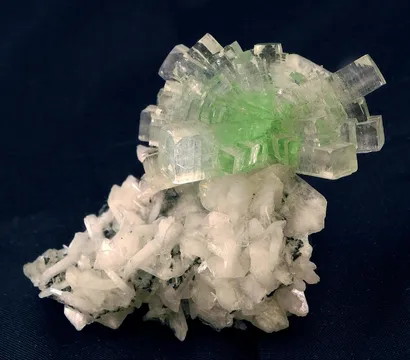
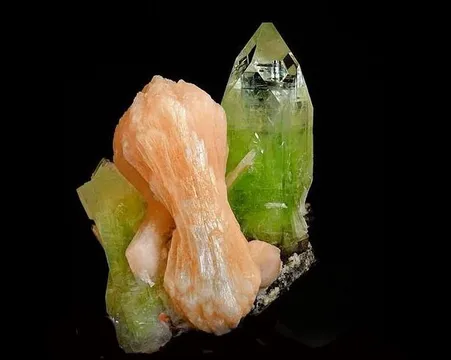
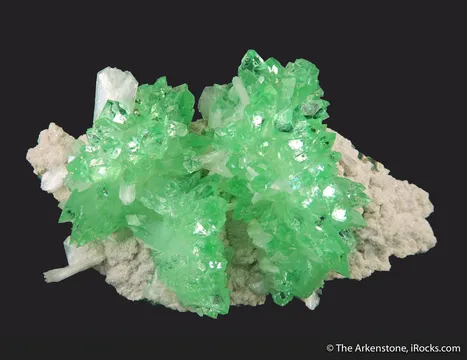
The best Pune specimens have a look that is unmistakable: pale, sparkling heulandite or stilbite forming the stage; glassy green apophyllite crystals rising like miniature pagodas at Pashan; delicate white mesolite balls and sprays tucked into heulandite-lined cavities; and, from Wagholi, saturated blue cavansite rosettes or sharper pentagonite sprays poised against white stilbite, heulandite, calcite, or fibrous mordenite. The contrast is what made the locality famous—blue on white, green on white, silky needles against basalt—and the finest pieces succeed as both mineralogical documents and natural sculpture.

Photo: Wikimedia Commons

Photo: Wikimedia Commons
Historically, Pune belongs in any serious account of Indian zeolite collecting. Older labels often read “Poona,” the former English spelling of Pune, and many early exported specimens were imprecisely labeled simply “Poona, India” even when they came from distinct quarry fields. That vagueness still matters: a Pashan green apophyllite, a Wagholi cavansite, and a Lonavala zeolite specimen may all circulate under broad Pune or Poona labels, but they represent different pockets, quarry histories, and specimen aesthetics.
Search for specimens: View all specimens from Pune District, India
Pune District is underlain overwhelmingly by Deccan Trap basalt. The specimen deposits occur where gas cavities, amygdules, fractures, vesicular flow tops, and brecciated zones remained open long enough for mineral-bearing fluids to circulate. In the broad Deccan model, early alteration of basalt supplied clay minerals and silica; later Ca-rich fluids deposited zeolites such as heulandite, stilbite, scolecite, mesolite, and mordenite; and still later hydrothermal fluids introduced or remobilized components responsible for minerals such as apophyllite, calcite, chalcedony, quartz, cavansite, and pentagonite. The Pune assemblage is therefore a cavity-mineral assemblage in volcanic rock, not a vein-ore field.
At Wagholi, modern work has clarified a deposit that collectors long interpreted from pocket experience. The productive cavansite–pentagonite mineralization is concentrated in flow-top breccias and irregular interconnected open spaces in tholeiitic basalt. The solid grey basalt was the commercial quarry product and generally did not contain cavansite or pentagonite. The useful specimen zones were the altered, porous, red-brown breccias and open cavities—geologically important to collectors, but economically inconvenient to quarrymen seeking compact stone. The mineralization is strongly localized rather than continuous: some pockets are rich, some nearby cavities contain only ordinary zeolites, and some quarries in the same complex produced little or no blue mineral.
The Wagholi quarry complex lies near the village of Wagholi, east to northeast of Pune, along the Pune–Ahmednagar road. Important named sublocalities include the Dhoot Quarry, Chavan quarry, Bhawadi Quarry, Para Plateau Quarry, Quarry no. 4, and other small workings. Recent geological study of the area focused on sections at the Dhoot, Para Plateau, and Bhawadi quarries and described two largely horizontal lava flows, with the lower flow containing the flow-top breccias that host the famous blue minerals. At Dhoot, a 2–5 m flow-top breccia was exposed at the quarry floor, and pits dug below floor level produced rich cavansite finds.
The internal zoning at Wagholi is one of the keys to understanding its specimens. Heulandite is the consistent early wall-lining mineral and may occur even where later display minerals are absent. Stilbite is common in upper portions of the breccia system, where heulandite and stilbite can occur without blue minerals. Cavansite becomes important in intermediate zones and is commonly associated with heulandite, stilbite, calcite, and mordenite. Pentagonite and mordenite become more prominent in deeper or later-exploited zones, especially toward parts of the complex where quarrying advanced after the first great cavansite discoveries. Cavansite and pentagonite can occur together, but the combination is much less common than specimens dominated by one or the other.
The classic collecting era at Wagholi began with late-1980s discoveries, became internationally visible by the 1989 Tucson shows, and continued through the 1990s and early 2000s as quarrying exposed new breccia pockets. Dhoot is central to the locality’s early fame, and the story of its mineralized “pillar” or pipe-like breccia zone has become part of Wagholi lore. Later interpretation treats that feature not as a true volcanic vent or feeder dyke, but as a highly mineralized breccia ramp or mound with stockwork extending into jointed basalt. Once that feature was quarried away, collectors followed the same practical rule that has governed Deccan collecting for decades: the pockets belonged to the sequence of blasting, digging, and stone extraction, and when the productive horizon was removed or buried, the specimen source changed.
Pashan, closer to Pune city, represents an older classic locality. The Pashan quarries were basalt quarries used for road building and other construction purposes. They produced amygdaloidal cavities large enough in places to crawl into, and they became especially famous for dark to bright green apophyllite colored by vanadium, commonly on white heulandite and stilbite, with very fine mesolite. The Pashan quarry field is no longer a practical collecting locality: published locality records describe the quarries as built over or flooded, and modern photographs record flooded inactive quarry remnants.
Other Pune-area records include Lonavala, Indori near Talegaon Dabhade, Chakan, Rajgurunagar, Narayangaon, Sus, Moshi, and Yedgaon Dam Quarry. Their labels appear on zeolite, quartz, chalcedony, gyrolite, mordenite, and related Deccan Trap specimens, but the two names every collector should separate first are Pashan and Wagholi. Pashan is the great green apophyllite and mesolite locality of Pune; Wagholi is the blue cavansite–pentagonite locality.
Collecting access today should be treated as restricted. These are active, inactive, flooded, built-over, or privately controlled quarry lands, not public collecting grounds. Quarry faces, flooded pits, blasting areas, unstable benches, and urban development all make casual collecting unsafe and often illegal without permission. Serious collecting is therefore mostly through older collections, dealers, estate material, and specimens recovered by local workers when quarrying or construction exposes new pockets.
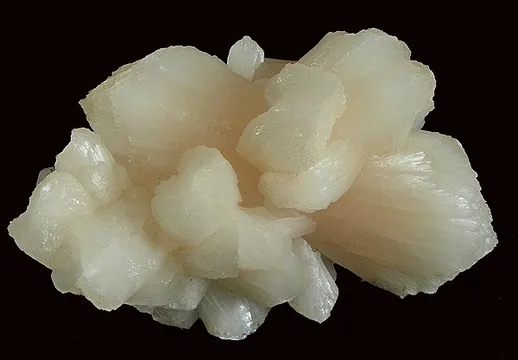
Heulandite is the foundation mineral of many Pune specimens, especially at Wagholi and Pashan, where it commonly forms the early lining of basalt cavities before later zeolites, silica minerals, calcite, cavansite, pentagonite, or apophyllite appear. Wagholi studies show heulandite as the one mineral that can occupy isolated vesicles throughout the breccia zones, while the more prized later minerals form in interconnected open spaces; this makes heulandite-rich pieces especially useful for reading the pocket sequence. Collector-grade Pune heulandite is usually white, cream, colorless, or pale pinkish, forming pearly tabular to sheaf-like crystals and drusy linings on basalt; the best pieces are not merely matrix but aesthetic platforms carrying green apophyllite from Pashan or blue cavansite and pentagonite from Wagholi, with sharp, lustrous, undamaged faces and minimal iron staining.
Stilbite-Ca is one of Pune District’s most important display minerals because it provides the classic white to cream, pearly, bladed matrix for both Pashan apophyllite and Wagholi cavansite. At Wagholi it occurs in cavity zones in Deccan Trap basalt and is especially prominent in upper mineralized zones with heulandite; in the cavansite-bearing zones it may host bright blue rosettes, penetrate around them, or form the sparkling white “snow” that makes the blue appear almost unreal. Good Pune stilbite specimens show crisp bow-tie, sheaf, or bladed aggregates with clean luster and strong contrast; ordinary pieces are massive, chalky, iron-stained, or too broken to frame the associated mineral well.
Cavansite is the mineral that made Wagholi a world locality: vivid sky-blue to deep teal-blue Ca(VO)Si4O10·4H2O in compact rosettes, hemispheres, balls, bladed clusters, and rarer stalactitic or bow-tie-like forms on heulandite, stilbite, calcite, and mordenite. Early reports placed Indian cavansite in Pune District before Arvind Bhale’s work located the source at Wagholi, where the material proved markedly superior to the earlier Oregon specimens in size, abundance, and display quality. Fine Wagholi cavansite aggregates are typically small, commonly millimetric to around 1–2 cm, but exceptional matrix specimens with multiple complete blue rosettes on pale zeolite are among the most recognizable modern Indian classics; the best pieces have saturated even color, intact outer tips, natural attachment, and a clean pale matrix that has not been visually overwhelmed by mordenite, brown staining, or repairs.
Apophyllite from Pune District is most celebrated from Pashan, where bright green fluorapophyllite-(K) and related apophyllite-group specimens occur on white heulandite and stilbite in basalt cavities. George R. Rossman’s optical study of green apophyllite from Poona showed that vanadium, principally as the vanadyl ion, is responsible for the green color and dichroism, overturning the older assumption that the color was caused by iron. Pashan produced sharp pyramidal to prismatic, lustrous, transparent to translucent green crystals, in some cases several centimeters across, with the most desirable pieces showing saturated color, glassy faces, strong contrast on pale zeolite, and undamaged terminations; commoner Pune apophyllite is paler, smaller, colorless, or more heavily contacted.
Calcite is a recurring Pune cavity mineral and an important accessory at Wagholi, where it may occur as early crystals before or during cavansite growth and also as later rhombohedral crystals perched on blue aggregates or associated zeolite. The most attractive Wagholi calcite pieces combine transparent to translucent yellowish, colorless, or pale rhombs with cavansite or pentagonite, creating sharp geometric contrast against radiating blue vanadosilicates and fibrous white mordenite. As a primary display species from Pune, calcite is less famous than the zeolites or cavansite, so quality depends on association and placement: clean rhombs on undamaged blue mineral are desirable, while isolated ordinary calcite from basalt cavities is far less distinctive.
Pentagonite, the dimorph of cavansite with the same formula Ca(VO)Si4O10·4H2O, is one of Wagholi’s great rarities and one of the reasons Pune District remains important to advanced collectors rather than just to zeolite specialists. At Wagholi it forms sharper, more open sprays, elongated prismatic clusters, and twinned aggregates that can show the apparent fivefold character behind the name; modern work shows that pentagonite becomes more prominent in lower parts of the breccia system and in zones where mordenite is abundant, and that it is not simply a smaller or inferior habit of cavansite. Good Pune pentagonite has crisp, separated, lustrous blue crystals with minimal broken tips, a natural matrix of heulandite, stilbite, calcite, or mordenite, and a credible identification, because color alone cannot reliably distinguish it from sharp cavansite.
Chalcedony in Pune District belongs to the late silica story of the Deccan Trap cavities, occurring as linings, crusts, and fracture or amygdule fillings in basalt at localities including Wagholi and Pashan. At Wagholi, modern paragenetic interpretation places opal and chalcedony after earlier blue vanadosilicate growth in some sequences, with opal later converting toward quartz; this makes chalcedony a useful marker of late-stage silica rather than just a decorative accessory. Collector pieces from Pune are best when chalcedony adds botryoidal texture, pale translucency, or a clean quartzose frame to zeolites or vanadosilicates; ordinary massive agate-like fillings without sharp associated crystals are less important in the fine-mineral market.
Scolecite is documented from the Pune region as part of the Ca-rich Deccan zeolite suite and is historically tied to “Poona” labels, with the old synonym poonahlite reflecting the importance of the Pune-area basalts in early scolecite collecting. In Pune specimens it is expected as white, silky, acicular to prismatic sprays or fibrous radiating groups in basalt cavities, usually in association with heulandite, stilbite, mesolite, calcite, or other zeolites. The best Pune scolecite pieces show intact, lustrous needles or spray balls with no bruising, dusting, or collapse; because white acicular zeolites are easily confused on old Indian labels, well-documented provenance and careful separation from mesolite and natrolite-series material matter.
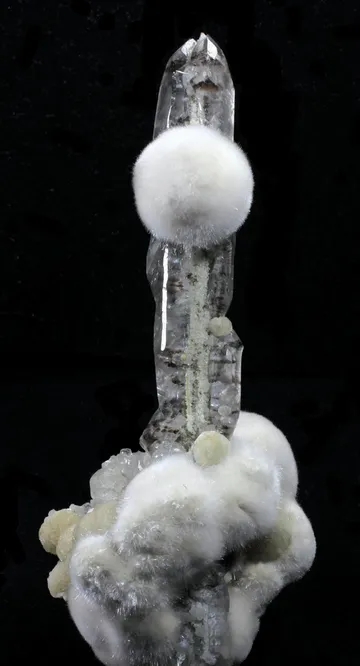
Mesolite is one of the signature Pashan minerals and occurs as white, transparent, or locally orange-tinted ball-shaped sprays composed of long, slender needles that converge to a central point. Pashan material is known from heulandite-lined cavities with stilbite and apophyllite, and the locality produced large, handsome clusters that helped define the classic “Poona” zeolite aesthetic long before Wagholi cavansite dominated collector attention. Good Pune mesolite has complete spherical sprays, silky luster, clean separation from the matrix, and no crushed needle tips; ordinary material is matted, greyed by dust, partly collapsed, or broken where the sprays projected into the cavity.
Quartz from Pune District is a late silica mineral in the basalt-cavity sequence, occurring as drusy coatings, clear to pale crystals, chalcedony-related overgrowths, and varieties such as amethyst, citrine, smoky quartz, agate, and chalcedony in district records. At Wagholi, quartz appears in the paragenetic discussion as part of the late silica system following opal and chalcedony, and it can accompany pentagonite, mordenite, calcite, or other cavity minerals. Fine Pune quartz is usually valued for association rather than size: sparkling druse that frames blue cavansite or pentagonite, or clean quartz points on zeolite matrix, is far more desirable than common isolated basalt amygdule quartz.
“Zeolite” on Pune labels usually refers to mixed or undetermined zeolite-group specimens from Deccan basalt cavities, most often involving heulandite, stilbite, mesolite, scolecite, mordenite, or related Ca-rich species. Pune’s zeolite assemblages are products of low-temperature to hydrothermal cavity mineralization in tholeiitic basalt, and the district’s importance lies in how the zeolites act as both principal species and matrix for apophyllite, cavansite, pentagonite, calcite, quartz, okenite, and gyrolite. The best “zeolite” specimens from Pune should be judged by identifiable component minerals, crystallinity, pocket aesthetics, and provenance; vague “Poona zeolite” labels are common, but a specimen becomes much more collectible when tied to Pashan, Wagholi, Lonavala, or another specific Pune locality.
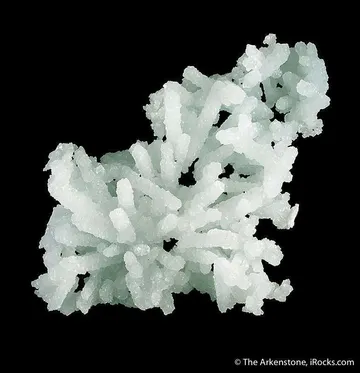
Mordenite is a confirmed and important Wagholi mineral, commonly appearing as white fibrous coatings, hair-like sprays, tufts, and spheres associated with cavansite, pentagonite, calcite, and stilbite. In the Wagholi breccia system, mordenite becomes especially prominent in zones where pentagonite is more abundant, and it may overgrow or partly obscure earlier blue minerals. Fine Pune mordenite specimens are those where the fibrous mineral adds texture without hiding the blue vanadosilicates; heavily felted coatings can be scientifically interesting but less aesthetic when they dull, bury, or visually flatten cavansite and pentagonite.
Okenite is a soft, delicate Ca-silicate accessory in Pune District cavity assemblages, documented from the Wagholi area and long associated in the Deccan Traps with zeolites, apophyllite, calcite, and related late-stage minerals. Pune okenite typically appears as white cottony balls, fibrous mats, or silky hemispheres in basalt cavities, and it may occur with heulandite, stilbite, gyrolite, prehnite, or cavansite-bearing associations depending on the pocket. Good collector pieces preserve complete, clean, untouched okenite balls with no matting or dust; ordinary pieces are easily degraded by handling, water, brushing, or vibration, and even minor compression can permanently ruin the surface.
Gyrolite is recorded from Pune District localities including Pashan and Lonavala and occurs in the same broad Deccan Trap family of Ca-silicate cavity minerals as okenite, prehnite, apophyllite, and zeolites. Pune gyrolite is generally seen as rounded, radiating, pearly to silky white or pale greenish aggregates on zeolite-bearing basalt matrix, sometimes in specimens that also carry heulandite, stilbite, mordenite, laumontite, or apophyllite. The best examples show isolated, well-rounded balls with a clean, sparkling surface and pleasing distribution across matrix; less desirable material is massive, chalky, stained, or confused with other white fibrous Ca-silicates without adequate provenance.
Prehnite is a minor but documented Pune District species in the Deccan basalt cavity environment, where it belongs to the calcium-rich silicate assemblage that may accompany zeolites, gyrolite, okenite, mordenite, calcite, and occasional late minerals. Collector specimens from Pune are generally pale green, white, or translucent, forming rounded crystalline crusts, botryoidal surfaces, or small lustrous aggregates rather than the large dramatic prehnite plates known from other world localities. Good Pune prehnite is valued for association—especially with gyrolite, okenite, mordenite, or unusual Wagholi combinations—and for clean, undamaged surfaces; vague or visually uncertain “prehnite” on old Poona labels should be checked carefully because pale Ca-silicates from Deccan cavities can be deceptively similar.
Other documented Pune District minerals and variants include fluorapophyllite-(K), hydroxyapophyllite-(K), laumontite, epistilbite, stellerite, chabazite-group minerals, cowlesite from the Lonavala area, cristobalite, opal, celadonite, smectite-group minerals, nontronite, native copper, djurleite, malachite, hydrohalite, levyne-Ca, talc, plagioclase, pyroxene, and olivine-group minerals. No major type-mineral reputation attaches to Pune District in the way that Wagholi attaches to world-class cavansite and pentagonite, whose type locality is Oregon, but the district is unquestionably a reference locality for collector-quality Indian cavansite, pentagonite, green apophyllite, and Pashan mesolite.
Pune District labels require attention. Older specimens may be labeled “Poona,” “Poonah,” “Puna,” “Pune,” or simply “India,” and many were exported before locality precision mattered to the trade. For value and historical accuracy, try to separate Pashan, Wagholi, Lonavala, and other Pune-area sources. A green apophyllite labeled only “Poona” is not automatically Pashan, but the best old bright green, pyramidal apophyllites on white heulandite or stilbite are commonly associated with the Pashan quarries. A blue vanadosilicate labeled only “Pune” is often Wagholi, but the exact quarry or sublocality may be lost.
The most common authenticity problem with Wagholi blue minerals is misidentification, not synthetic material. Cavansite and pentagonite have the same formula and very similar color, and both occur at Wagholi. Cavansite typically forms compact rosettes, balls, hemispheres, parallel aggregates, and less commonly bladed or stalactitic forms. Pentagonite more often forms sharper, more open, elongated sprays and twinned aggregates. These are useful visual tendencies, not absolute proof. Expensive pentagonite specimens, ambiguous sharp blue sprays, and unusual cavansite–pentagonite combinations merit expert confirmation by habit, provenance, and, when needed, Raman or X-ray methods.
Repairs and stabilization are a real Wagholi issue. The blue aggregates are composed of fine radiating crystals and were recovered from hard basalt with heavy tools. Field stabilization with cyanoacrylate-type glue has been described in the collecting literature, especially for fragile pocket pieces. Stabilization is not automatically fraud, but it must be disclosed and distinguished from repair or assembly. Inspect the contact between blue mineral and matrix under magnification. Look for glossy halos, unnatural gaps, clear films, detached rosettes glued into unrelated stilbite, or matrix relationships that do not make geological sense.
Condition is critical. Cavansite and pentagonite tips chip easily. Damage commonly appears as flattened blue high points, abraded outer surfaces, missing needle tips, or broken spheres showing radial interiors. Pentagonite sprays are especially vulnerable because individual crystals project outward. On Pashan green apophyllite, check for bruised terminations, contacted pyramids, edge chips, internal cracks, and repaired crystal clusters. On mesolite, scolecite, okenite, and mordenite, damage may be subtle: collapsed sprays, dust-matted fibers, flattened balls, or broken needles can reduce a specimen’s quality even when it looks intact at first glance.
Color should be judged in person or from well-balanced photographs. Wagholi cavansite can be sky blue, royal blue, teal blue, or greenish blue; a teal cast is not necessarily evidence of alteration. Pashan apophyllite can range from pale mint to saturated emerald-green, with the color caused by vanadium rather than dye. Over-saturated photographs are common in the online market, so ask for neutral-light images when buying high-value specimens.
Cleaning should be conservative. Do not soak cavansite, pentagonite, mesolite, okenite, or fibrous mordenite. Avoid ultrasonic cleaners entirely. Use air bulbs, very soft brushes, and stable display boxes. Okenite and mesolite should be protected from dust and handling; once fine fibers are matted, they cannot be restored. Cavansite and pentagonite are display minerals, not handling minerals, and detached thumbnails should be mounted so the crystals cannot rub against lids, cotton, foam, or labels.
Market availability is uneven. Small Wagholi cavansites remain available because decades of production supplied the market, but superb matrix pieces from the best old pockets are increasingly classic and harder to replace. Pentagonite is much rarer and often commands a premium when identification and condition are strong. Pashan green apophyllites are old classics from closed or inaccessible quarries; fine, saturated, undamaged examples with good provenance are much scarcer than the general abundance of Indian apophyllite might suggest. Pashan mesolite, especially large clean spray balls on heulandite-stilbite matrix, is also underappreciated relative to its historical importance.
A modern Pune collector story begins far from the quarries, in a museum case in London. Pune-based blogger Ranjit Ghatge saw a turquoise crystalline specimen at the Natural History Museum and was startled by the label: “Beautiful Cavansite from Wagholi quarry of Pune, India.” He had grown up in Pune without knowing that one of the world’s most recognizable blue collector minerals came from the edge of his own city. That surprise captures a recurring irony of the locality: Wagholi’s fame was often greater in Tucson, London, and Toronto than among people living beside the basalt quarries themselves.
The discovery story is just as local. In 1988, a miner working in a Wagholi quarry noticed radiant blue mineral pieces among the stone and contacted geologist Arvind Bhale, a Pune collector and field geologist with a taste for traveling across India in search of minerals. Bhale arrived with hammer and chisel, collected samples, and sent material for study abroad because the necessary optical and mineralogical facilities were limited locally at the time. The quarry owner, remarkably, was one of Bhale’s school friends, and that personal link helped open the way for extraction. Between 1989 and 1995, Wagholi produced cavansite in quantities that astonished visiting collectors and researchers, and Bhale became known in the mineral world as the “Cavansite man.”
The Dhoot Quarry pillar is one of the great small dramas of Indian mineral collecting. The quarry’s target was black basalt for construction, while the altered brecciated rock was commercially less useful. A standing pillar or pipe-like breccia zone remained after quarrying, partly because it served a mundane bureaucratic purpose: officials could sit on it while surveying the quarry and assessing royalties on the removed stone. When the quarry owner decided to remove the pillar, blue crystals began to appear. Deeper down, the material improved, and near the bottom the blue became the kind of cavansite that would make Wagholi famous. Later geological interpretation recast the “pipe” not as a true feeder vent, but as a mineralized breccia ramp or mound with stockwork extending into jointed basalt—less romantic in volcanic terms, perhaps, but even more revealing as a pocket-forming structure.
The 1989 Tucson appearance of Wagholi cavansite turned a quarry discovery into an international sensation. Collectors were suddenly confronted with rounded, electric-blue aggregates on white zeolite matrix—specimens that looked too saturated to be real and yet were entirely natural. One early descriptive phrase, “liroconite-blue 2-cm spherical crystal aggregates on white stilbite crystals,” still conveys the shock of the material: the color of a treasured copper arsenate rarity, but in rounded Deccan Trap blossoms that could be held in the hand.
The actual extraction was rougher than the finished specimens suggest. Wagholi pockets were described as sinuous, twisting cavities that changed unpredictably in height and width. Poor cavities might contain scattered isolated blue spheres on white zeolite matting; rich cavities could show clusters and partially intergrown rosettes over broader surfaces. Collectors used heavy tools, including a 10-kg sledgehammer and a long, thick chisel, because lighter blows caused vibration and jumping that could pop fragile blue spherules off the matrix. The paradox of Wagholi collecting is that the most delicate-looking blue rosettes often survived only because they were removed with decisive, controlled force.
Money changed the quarry floor. A few good specimens sold to a local runner could be worth more to a worker than a month of quarry labor, so a blue pocket could interrupt the normal rhythm of stone production. Workers wanted to recover the mineral before the day ended; quarry owners worried about lost time and production quotas. The specimens that now sit in fine collections emerged from that tension between industrial basalt extraction and the sudden discovery of something far more valuable, at least to mineral people, than road metal.
Another old Pune story belongs to the railway age. During construction of the Bombay–Pune railway through the Khandala ghat section, workers encountered a cavity filled with sparkling crystals. Excitement spread because people thought they had found diamonds. Crowds began to gather, obstructing the work, and the railway authorities eventually sealed the area; before doing so, they removed the mineral, much of which reportedly went to England. The “diamonds” were white apophyllite, not gemstones, but the episode foreshadows the whole Deccan Trap collecting story: ordinary engineering work cuts basalt, basalt reveals cavities, and the cavities briefly stop everyone in their tracks.