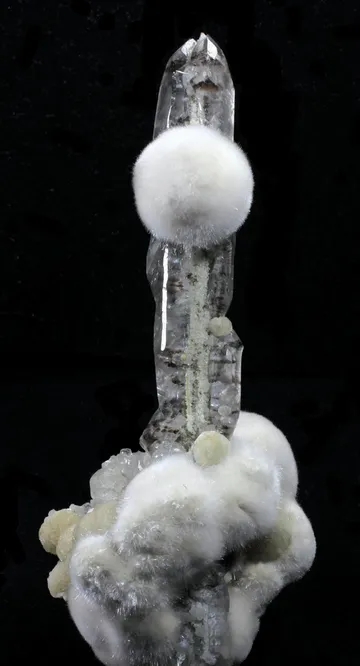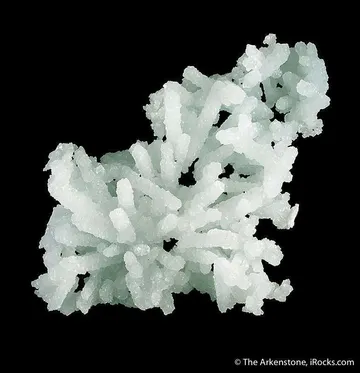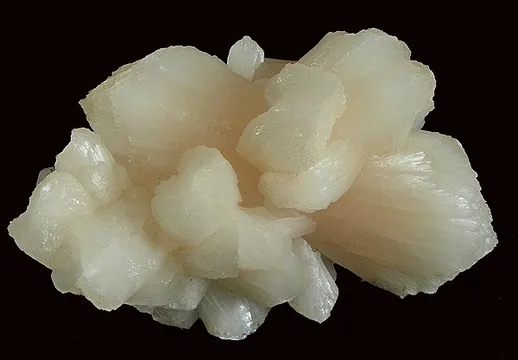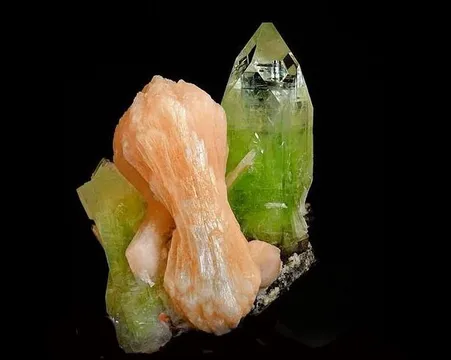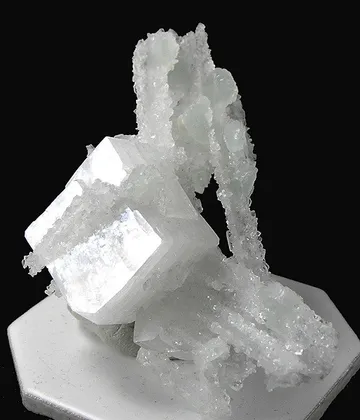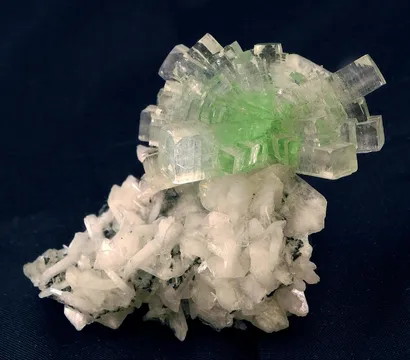
Pashan quarries, India — classic Pune-area zeolite locality famed for green apophyllite and mesolite on stilbite, prized by collectors for color and form.
Key facts
The Pashan quarries are one of the classic Pune-area zeolite localities of the Deccan Traps, and for collectors their name still carries a very specific visual memory: mint- to emerald-green apophyllite crystals rising from pale stilbite-coated basalt, with mesolite sprays and heulandite sometimes completing the association. These were not ore mines in the usual sense, but basalt stone quarries cut into amygdaloidal Deccan lava flows near Pashan, now a suburb of Pune in Maharashtra. Quarrying for road metal and building stone opened cavities in the basalt—some reported large enough to crawl into—and those vesicles and joints were the specimen source. The best pieces show glassy, sharply terminated green fluorapophyllite-(K) standing upright in sprays or “hedgerows” on white to cream stilbite; the locality is also remembered for superb mesolite balls and sprays, including large, delicate clusters that belong among India’s most admired zeolite specimens.
Regional View
Country View
Pashan belongs to the great western Indian specimen province created by the Deccan Volcanic Province, where late fluids exploited cavities in tholeiitic basalt and deposited zeolites, silica, calcite, and apophyllite over multiple mineralizing episodes. In the Pune field, Pashan and Wagholi occupy different reputational niches: Wagholi is inseparable from cavansite and pentagonite, while Pashan is the older name collectors associate with vanadium-green apophyllite and mesolite. Much of the historic Pashan material entered collections under the older labels “Poona” or “Pashan Hills,” and the best examples from the late 1970s and 1980s remain instantly recognizable beside later green apophyllites from Jalgaon, Nashik, Lonavala, or Rahuri.

Photo: Wikimedia Commons
The green color is not merely a dealer’s adjective. George R. Rossman’s 1974 optical study of green apophyllite from Poona showed that the color and dichroism were chiefly due to tetravalent vanadium rather than iron. That result has become part of the lore of Pashan specimens: the finest crystals have a cool, lively green that can look more like mint glass than the yellower green of many later Indian finds.
Search for specimens: View all specimens from Pashan quarries, India
The Pashan quarries are recorded as a group of basalt quarries at Pashan, Pune District, Pune Division, Maharashtra, with coordinates near 18°32'57'' N, 73°47'04'' E. Their geological setting is the Deccan Traps Large Igneous Province, a vast pile of Late Cretaceous flood basalts whose western Indian flows are particularly rich in amygdaloidal cavities. At Pashan, the productive “ore bodies” for collectors were not veins of metal but mineralized vesicles, cavities, and openings in basalt. The same quarrying that supplied stone for roads and construction broke into these pockets and revealed the secondary mineral suite.
The mineralization is typical of the collector-grade Deccan cavity environment but with a distinctly Pashan signature. Documented minerals include fluorapophyllite-(K), hydroxyapophyllite-(K), stilbite-Ca and the stilbite subgroup, mesolite, heulandite-Ca and the heulandite subgroup, laumontite, gyrolite, quartz, and chalcedony. Broader Pune listings in the modern Deccan secondary-mineral literature also record apophyllite, calcite, cavansite, heulandite, mesolite, stellerite, and stilbite-subgroup minerals from the Pashan/Pune field, but the established collector identity of the Pashan quarries rests on green apophyllite, stilbite, mesolite, and heulandite.
The cavities were formed as gas bubbles and open spaces in cooling basalt flows and were later filled by low-temperature hydrothermal and burial-related fluids. In Deccan-Trap cavities, earlier clay minerals, calcite, silica, and zeolites can be followed by later apophyllite; the large, clean apophyllite crystals prized by collectors are products of this late-stage open-space growth. Calcium-rich zeolites dominate because the basaltic host rock is rich in calcium-bearing plagioclase. At Pashan the common display combinations are green apophyllite on white stilbite, apophyllite with heulandite, and mesolite with apophyllite and/or stilbite.
The quarrying history is tied to Pune’s expansion. These were building-stone and road-metal quarries, not specimen mines, and the great pockets were encountered as an incidental gift of industrial blasting. The quarries operated for decades on what was once the edge of the city; as Pune grew outward, the same land became valuable for housing and urban development. Sources on the Pune quarry belt describe Pashan, Erandwana, Chinchwad, and Wagholi as localities whose quarrying was curtailed or ended under the combined pressure of town-planning controls, environmental restrictions, and rapid urbanization. Mindat now records the Pashan quarries as flooded and inactive, and notes that the old quarries are either built over or flooded.
The classic collecting period for the material most collectors seek is the 1970s through late 1980s, with important old pieces still circulating from private collections and dealer stocks. The “Pashan #2 Quarry” label appears on some of the most famous apophyllite specimens; material from that specific quarry is documented with fluorapophyllite-(K) and stilbite-Ca. Labels may read “Pashan Hills,” “Pashan Quarry,” “Pashan #2 Quarry,” “Poona,” “Pune,” or simply “India,” and older Western labels often retain the former city name Poona. That historical labeling is part of the charm but also a practical challenge: many Deccan apophyllites are superficially similar, and a precise Pashan attribution is strongest when supported by old labels, collection history, or unmistakable style.
The notable pockets were those that produced upright rows and sprays of green apophyllite crystals on rolling white stilbite-coated basalt, and the larger mesolite-bearing cavities with ball-shaped sprays in heulandite-rich pockets. Some Pashan cavities yielded specimens with green apophyllite crystals to several centimeters; published and dealer-described examples include small-cabinet to large-cabinet pieces, a 29.1 x 15.8 x 10.7 cm large cabinet specimen from #2 Quarry, and individual green crystals around 3 cm on that piece. Other documented market specimens report green crystals to about 2.4 cm on 6.7 x 5.5 x 3.5 cm specimens, and large display pieces with apophyllite-stilbite associations weighing several pounds.
Collecting access today should be considered effectively closed. The quarries are inactive, flooded, built over, or within heavily urbanized surroundings, and no responsible collector should attempt access without explicit legal permission from the landholder and awareness of flooded quarry hazards, unstable faces, and local restrictions. For practical purposes, Pashan is now a collection locality rather than a field-collecting destination.
Pashan stilbite is best known as the pale architectural stage on which the green apophyllite performs: white, cream, pale peach, and occasionally pinkish stilbite-Ca occurs as lustrous blades, bow-tie aggregates, sheaf-like clusters, and sparkling coatings over basalt. Fine Pashan pieces show sharp, pearly stilbite crystals with enough relief and order to read as individual sprays rather than a sugary crust, and the most desirable combinations contrast fresh white stilbite with clean mint-green apophyllite. In mesolite pockets, stilbite may occur with heulandite and later acicular mesolite; in apophyllite pockets, it forms rolling, bladed carpets that frame upright green crystals. Ordinary Pashan stilbite is common-looking and easily confused with broader Pune or Nashik material, but top examples have old Poona/Pashan provenance, undamaged blades, pleasing three-dimensional matrix, and a balanced apophyllite association rather than crowded or bruised quarry rubble.
Apophyllite is the mineral that made Pashan famous: sharply terminated green fluorapophyllite-(K), commonly in prismatic to pseudo-cubic crystals with steep pyramidal terminations, set on white stilbite or associated with heulandite and mesolite. The classic color is a cool mint to deep emerald green caused by vanadium, and the best crystals are transparent to translucent, glassy, bright, and undamaged, with a lively contrast against pale zeolite matrix. Pashan crystals are commonly in the thumbnail to miniature range, but important cabinet specimens carry rows, sprays, or clustered “flowers” of crystals to several centimeters; the old #2 Quarry style is especially prized for upright, repeated crystals on rolling stilbite-coated basalt. Good Pashan apophyllite is separated from ordinary Indian material by provenance, sharpness, color purity, open composition, and the unmistakable older style—mint-green, sparkly crystals rising cleanly from white bladed stilbite rather than modern bulkier, mixed-locality green apophyllite.
Other documented Pashan minerals include mesolite, heulandite-Ca, hydroxyapophyllite-(K), laumontite, gyrolite, quartz, and chalcedony. Mesolite is the great sleeper species here: Pashan produced large ball-shaped sprays and clustered white to transparent and sometimes orange-toned needles, commonly in heulandite cavities and associated with stilbite and apophyllite. Heulandite appears as small white to pale crystals and cavity linings, important both aesthetically and paragenetically because it commonly hosts mesolite and accompanies the green apophyllite-stilbite combinations. Gyrolite and laumontite are much less commonly encountered on the market with reliable Pashan labels. No valid type-locality mineral species is established from Pashan in the standard references checked; its importance is instead as a world-class occurrence for specific Deccan-Trap specimen styles.
The first authenticity issue with Pashan is locality, not treatment. Green Indian apophyllite on stilbite has come from many Maharashtra localities, and loose “Pune,” “Poona,” or “India” labels are often not enough to prove Pashan. The strongest attributions are attached to old labels naming Pashan, Pashan Hills, Pashan #2 Quarry, or Poona/Pashan; collection pedigrees from recognized dealers or collectors are valuable. Be cautious with specimens sold as Pashan solely because they are green apophyllite on stilbite. Later finds from Jalgaon, Nashik, Lonavala, Rahuri, and other Deccan localities can be beautiful but are not interchangeable with old Pashan material.
The second issue is nomenclature. Older labels may say “apophyllite,” “apophyllite-KF,” “fluorapophyllite,” “natroapophyllite,” or “hydroxyapophyllite.” Modern names should be used carefully. Pashan is documented for fluorapophyllite-(K) and hydroxyapophyllite-(K), while older “apophyllite” labels are often best retained historically unless the specimen has been analyzed. Color alone is not species determination.
Condition matters greatly. Apophyllite has perfect cleavage and can lose corners or terminations; even small chips are conspicuous on glassy green crystals. Stilbite blades bruise along edges and can be crushed where they project from matrix. Mesolite is far more delicate: loose balls and sprays snap, shed needles, and collect dust. Unsupported mesolite “puffballs” or sprays are best kept in a box or on a stable mount, handled by the matrix only, and never cleaned aggressively. Do not use ultrasonic cleaners on mesolite-rich specimens; even on sturdier apophyllite-stilbite pieces, test cleaning should be conservative because hidden fractures and altered zeolites can fail.
There are no well-documented, locality-specific fakes from Pashan in the sources checked, but generic risks apply: reattached apophyllite crystals, glued mesolite balls, composite matrix pieces, and vague upgraded localities. Examine crystal contacts under magnification for glue shine, unnatural gaps, mismatched dust, or broken-and-reset stilbite around the base of an apophyllite spray. The most convincing Pashan specimens have coherent basalt matrix, natural stilbite continuity, and an old style that matches historical material.
Market availability is finite but not extinct. Because the quarries are closed, essentially all fine Pashan material is old stock or recycled collection material. Small to modest green apophyllite-stilbite pieces still appear regularly, but top #2 Quarry cabinet specimens with undamaged mint-green crystals and old labels are scarce and command a premium. Mesolite from Pashan is also desirable, especially intact spherical sprays of significant size; condition and support dominate value. Large, aesthetic, old-label pieces with provenance to known collections can move far above the price of comparable mixed-locality Indian zeolites.
One of the most memorable Pashan stories is not a single pocket but a change in geography. The old quarry district was once far enough from Pune’s urban center that blasting for basalt could continue for road and building stone. Then the city arrived. Quarry zones around Pune—Pashan Hills, Erandwana, Chinchwad, and Wagholi among them—were squeezed by apartment blocks, planning regulations, environmental pressure, and the rising price of land. The transformation was abrupt in collector terms: a locality that had fed Western mineral shows with fresh green apophyllite became, within a generation, a flooded and built-over memory.
The emotional core of Pune collecting is captured by M. F. Makki of Matrix India Minerals, who described the thrill of opening Deccan cavities as something that “gave me goosebumps.” His recollection belongs especially to the Pune mineral world that produced cavansite, green apophyllite, mesolite, and other Deccan classics. The phrase is apt for Pashan: imagine a basalt quarry face split open for road metal, and behind the hammering lies a hollow lined with white zeolite, green glassy apophyllite, and delicate needles that would not survive careless handling.
The old Pashan #2 Quarry apophyllites inspired a different kind of story among dealers and collectors. A large cabinet specimen photographed by Rob Lavinsky is described as coming from the era when Pashan material was “first starting to come out in quantity,” during the 1970s and early 1980s. Its style is unforgettable: rows of mint-colored apophyllite crystals standing on white stilbite, compared in the description to “hedgerows” on rolling hills. The specimen measures 29.1 x 15.8 x 10.7 cm, and the crystals reach about 3 cm; it was compared to a famous example from the same pocket that had appeared on a Mineralogical Record cover. The line that still rings true for Pashan is simple: “Pretty specimens are common - Great specimens are not.”
There is also a scientific story inside the color. For years, green apophyllite could easily be assumed to owe its color to iron, as many green silicates do. Rossman’s 1974 study changed that for Poona apophyllite. A transparent green crystal supplied through R. H. Currier was examined optically and chemically; the analysis found 1600 ppm vanadium, 350 ppm manganese, and only 70 ppm iron. The result tied the Pashan/Poona green to vanadium and gave collectors a rare pleasure: an aesthetic feature—the cool green color—also had a precise mineralogical explanation.
Rossman, George R. (1974). “Optical Spectroscopy of Green Vanadium Apophyllite from Poona, India.” American Mineralogist, 59, 621–622. Important color-origin paper demonstrating that vanadium, not iron, is chiefly responsible for the green color and dichroism of Poona apophyllite.
Ottens, Berthold (2003). “Minerals of the Deccan Traps, India.” The Mineralogical Record, 34(1), 1–82. The essential modern collector reference for Deccan-Trap minerals, including Pashan Hills and other Pune-area localities.
Indian Zeolites and Related Species, The Mineralogical Record, Vol. 34, No. 1, January–February 2003. Back-issue listing for the special Deccan/Indian zeolite issue containing Ottens’ major article.
Ottens, Berthold; Götze, Jens; Schuster, Ralf; Krenn, Kurt; Hauzenberger, Christoph; Benkó, Zsolt; Vennemann, Torsten (2019). “Exceptional Multi Stage Mineralization of Secondary Minerals in Cavities of Flood Basalts from the Deccan Volcanic Province, India.” Minerals, 9(6), 351. Open-access technical study of Deccan secondary-mineral formation, listing Pashan hill among the Pune occurrences and discussing the multistage cavity-mineral model.
Branoiu, Gheorghe; Ramadan, Ibrahim (2019). “Rietveld Structure Refinement of the Stilbite Crystals from Deccan Traps (India) Using X-ray Powder Diffraction Data.” Revista de Chimie, 70(7), 2379–2384. Structural study of stilbite from the Pune region, useful for the apophyllite-stilbite association and Deccan stilbite crystal chemistry.
Sukheswala, R. N.; Avasia, R. K.; Gangopadhyay, M. (1974). “Zeolites and associated secondary minerals in the Deccan Traps of Western India.” Mineralogical Magazine, 39(306), 658–671. Foundational scientific treatment of western Indian Deccan zeolites and associated minerals.
Wikimedia Commons: “Natroapophyllite-tuc09108c.jpg,” #2 Quarry, Pashan, Pune District, Maharashtra, India, 29.1 x 15.8 x 10.7 cm; photo by Rob Lavinsky, iRocks.com. Documented large-cabinet Pashan #2 Quarry apophyllite specimen with an extended historical description of the classic old style.
Mindat specimen record DJQ-FRA: Stilbite and Apophyllite, ex John Sinkankas collection. A useful cautionary record for old labels: the specimen was recorded with a confusing “Nasik Quarry, Pashan, Pune” locality, while Mindat resolves it to Nashik quarries, illustrating why old Deccan labels must be read critically.
Mindat: Pashan quarries, Pashan, Pune District, Pune Division, Maharashtra, India Core locality page with coordinates, current inactive/flooded status, mineral list, and gallery links.
Mindat: #2 Quarry, Pashan, Pune District, Pune Division, Maharashtra, India Specific sublocality page for the famous #2 Quarry apophyllite-stilbite material.
Mindat: Mesolite from Pashan quarries Focused occurrence page for Pashan mesolite, including associations and collecting/handling notes.
Mindat: Apophyllite Group from Pashan Occurrence page documenting apophyllite-group material and photo-based associations from Pashan.
Mindat Best Minerals: Apophyllite-(KF) Collector-oriented discussion noting the importance of the Pashan Hills green apophyllite quarries.
CaltechAUTHORS: Rossman, “Optical Spectroscopy of Green Vanadium Apophyllite from Poona, India” Authoritative metadata and abstract for the classic 1974 vanadium-color paper.
MDPI: “Exceptional Multi Stage Mineralization of Secondary Minerals in Cavities of Flood Basalts from the Deccan Volcanic Province, India” Open-access technical background on Deccan cavity mineralization and the broader Pune/Pashan setting.
The Mineralogical Record: Indian Zeolites and Related Species, Vol. 34 No. 1 Back-issue page for the indispensable 2003 Indian zeolite special issue.
Indian Express: “Pune Know Your City: Cavansite, a rare turquoise-hued mineral unique to Pune” Useful local context on Pune mineral collecting, M. F. Makki, and the closure of quarry districts including Pashan Hills.
Wikimedia Commons: Pashan #2 Quarry apophyllite photograph Freely licensed image and historical description of a major old-style Pashan specimen.
MineralAuctions: “Fluorapophyllite with Stilbite,” Pashan Quarry Closed auction archive documenting a 6.7 x 5.5 x 3.5 cm classic Pashan specimen and price history.
FossilEra: Green Apophyllite, Heulandite & Stilbite Association, Pashan Hill Quarry Retail archive illustrating a typical smaller Pashan apophyllite-heulandite-stilbite association.