A collector's guide to Jalgaon, India: its geology, mining history and notable minerals, illustrated with the 74 specimens documented from this locality on EarthWonders.
Key facts
Jalgaon District, in northern Maharashtra, is one of the great collector names of the Deccan Traps. Its best-known specimen source is the Savda/Sawda quarry area near Jalgaon city, where quarrying in basalt opened the kind of vesicles, amygdales, and larger flow-core cavities that made western India famous for zeolites and associated secondary minerals. The deposit is not an ore mine in the conventional sense; it is a basalt-cavity specimen locality, with crystals grown from mineralizing fluids moving through open spaces in tholeiitic flood basalts.
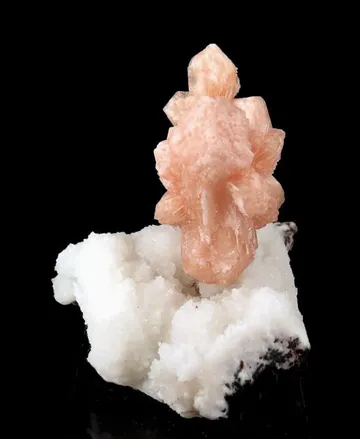
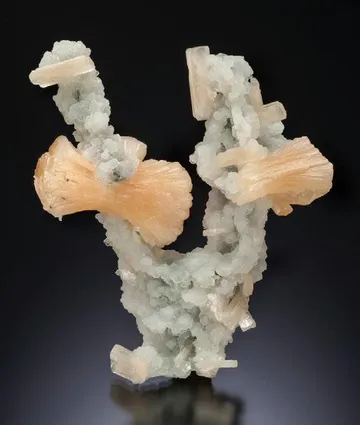
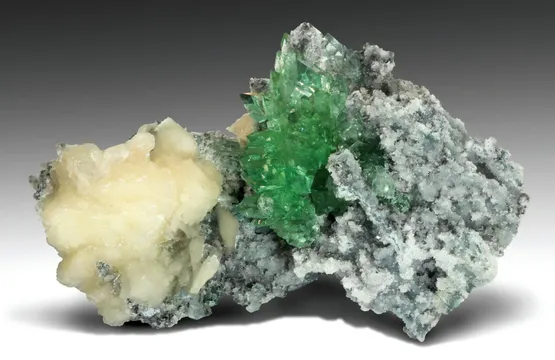
The classic Jalgaon look is architectural: glassy colorless to mint-green fluorapophyllite-(K), peach to salmon stilbite-Ca, reddish to orange-brown heulandite, sparkling chalcedony and quartz crusts, and later calcite set against dark basalt. Good specimens have separation between species and real pocket geometry—a freestanding stilbite bow-tie on drusy chalcedony, green apophyllite perched above warm heulandite, or calcite rising cleanly from a zeolite-coated vug. Ordinary pieces are attractive; the best Jalgaon specimens look composed, with contrast, depth, and intact crystal edges.
Scientifically, Jalgaon is important because the Savda quarry complex preserves a unusually legible mineralization sequence. Published work on the locality documents early clay minerals and subsurface filamentous fabrics, followed by calcite and zeolite generations, chalcedony and quartz, later heulandite and stilbite, calcite, powellite, and apophyllite. That sequence makes Jalgaon more than a commercial source of pretty apophyllite-and-stilbite plates: it is one of the localities where the timing and conditions of Deccan Trap secondary mineralization can be read directly from hand specimens.
Regional View
Country View
In the broader collector trade, “Jalgaon” may mean district-level material, but the more precise and better-documented name is Savda, also seen as Sawda or Savada. Older labels are often brief: “Jalgaon,” “Maharashtra,” or simply “India.” That looseness reflects the way Deccan Trap specimens entered the market through quarrymen, local buyers, exporters, and international dealers, rather than through a single formally named specimen mine.

Photo: Wikimedia Commons
Search for specimens: View all specimens from Jalgaon, India
Jalgaon District lies in the Nashik Division of Maharashtra, north of the main Western Ghats zeolite belt but firmly within the Deccan Volcanic Province. The district geology is dominated by Deccan Trap basalt, with alluvium along major drainage systems and basalt exposed in quarries, road cuts, and construction-stone workings. For collectors, the important material comes from cavities in basalt flows rather than from a metal-bearing vein, pegmatite, or skarn.
The Savda quarry complex near Jalgaon is the best-documented sublocality. Published coordinates for the investigated quarry complex are about 20°59′N, 75°27′E, at roughly 230 m elevation. Mindat records the locality as Savda, Sawade Pr Chandsar, Jalgaon District, and lists it as a quarry with aggregate stone and mineral specimens as recorded commodities. That is the essential point for field interpretation: basalt was the practical quarry product, and crystals were a by-product of blasting and breaking rock for construction material.
The specimen-bearing cavities are controlled by lava-flow structure. At Savda, individual flows are subhorizontal and commonly around several meters thick. The upper parts of flows contain abundant smaller vesicles, often millimeters to a few centimeters across, filled or lined by clay minerals, chalcedony, heulandite, epistilbite, and related secondary minerals. The denser core zones of the flows can contain much larger cavities, several decimeters to more than a meter across, commonly with a rim of celadonite or smectite. These larger cavities produced the cabinet-scale combinations that made Jalgaon famous.
The paragenesis is unusually well documented. Early clay minerals and subsurface filamentous fabrics lined cavities and were then overgrown by calcite and silica. Chalcedony commonly protected earlier features as crusts from about 1 to 20 mm thick and in some specimens records a transition from amorphous silica to cryptocrystalline chalcedony and macrocrystalline quartz. Later generations introduced heulandite-Ca and stilbite-Ca on chalcedony or calcite, followed by calcite, powellite, and apophyllite from later hydrothermal fluids. That staged history explains why a single Jalgaon plate may show basalt wall rock, green clay, chalcedony stalactites, reddish heulandite, peach stilbite, pale calcite, and green apophyllite in a coherent order rather than as random decoration.
The documented collecting history is modern. Jalgaon material was well enough known by the mid-1990s to merit focused treatment in European mineral literature, and additional publications in 2000, 2003, 2011, 2017, and 2019 show that the locality remained important both scientifically and commercially. Field observations cited in the main modern scientific study span 1996 to 2016, with Savda material collected for detailed study in February 2013. Dealer and auction records show Jalgaon specimens circulating continuously into the 2020s, including older collection material from the 1990s and early 2000s.
No single operating company is established in the mineralogical literature as “the” Jalgaon specimen operator. The locality is better understood as a quarry complex and district-level specimen source where commercial quarrying exposed cavities, and mineral recovery depended on workers, local collectors, exporters, and dealers recognizing and preserving crystal-bearing pockets. Access today should be treated as private, quarry-dependent, and permission-only. Active basalt quarries are industrial sites; collectors should not assume that a named Jalgaon or Savda locality is open to casual collecting.
The notable finds are cavity finds: large heulandite-lined basalt pockets, chalcedony stalactite plates carrying stilbite and heulandite, green apophyllite with peach stilbite, calcite on stilbite and apophyllite, and rarer powellite associated with stilbite and later apophyllite. The most desirable pieces preserve the original vug architecture. A sawn-looking or crowded plate may still be decorative, but the serious collector wants the evidence of a natural pocket: basalt back, clay or chalcedony lining, open space, and crystals that grew freely without being crushed by later extraction.
Jalgaon apophyllite is usually fluorapophyllite-(K) in collector usage, occurring as lustrous tetragonal crystals that range from colorless and water-clear to pale mint and more saturated green, often with steep pyramidal terminations, blocky prisms, stacked forms, or doubly terminated crystals perched on stilbite, heulandite, chalcedony, quartz, calcite, or dark basalt. In the Savda sequence, apophyllite is a late mineral, following major zeolite and calcite events, and dated apophyllite from the Savda/Jalgaon quarry complex records mineralization long after the Deccan eruptions themselves. Typical cabinet specimens carry apophyllite crystals from small accent crystals to several-centimeter individuals; the best pieces combine glassy faces, undamaged terminations, attractive green or limpid clarity, and a natural relationship to peach stilbite or reddish heulandite rather than a crowded carpet of damaged crystals.
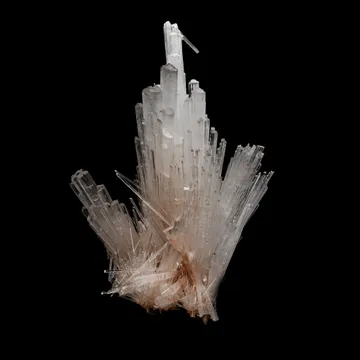
“Zeolite” on Jalgaon labels is often a trade shorthand for mixed Deccan Trap cavity assemblages rather than a single species, and it may include stilbite-Ca, heulandite-subgroup minerals, mordenite, scolecite, epistilbite, stellerite, and related minerals with apophyllite, calcite, and chalcedony as important associates. At Savda, the confirmed zeolite story is staged: early mordenite, heulandite and stilbite can be overgrown by chalcedony, while later heulandite-Ca and stilbite-Ca grew on chalcedony or calcite in the large flow-core cavities. Good “zeolite” specimens from Jalgaon are not just fluffy mixed plates; they show identifiable species, clean crystal habits, pocket contrast, and undamaged sprays or blades, ideally with a label that separates actual zeolites from apophyllite and calcite rather than calling the whole specimen “zeolite.”
Jalgaon stilbite is the calcium-dominant species stilbite-Ca in the documented Savda material, typically forming salmon-pink, peach, cream, tan, or pale brown blades, bow-ties, wheat-sheaves, rosettes, and curved plate-like intergrowths on chalcedony, calcite, basalt, heulandite, and apophyllite-bearing matrix. Published work on Savda records common salmon-pink stilbite-Ca reaching crystals up to about 5 cm, rarely as ideally isolated individuals and more often as curved, pseudo-orthorhombic blade aggregates. The strongest specimens have complete bow-tie geometry, pearly luster, separation from heulandite, and an attractive stage of dark basalt or sparkling chalcedony; broken blade edges, crushed spray tips, dull cleaning, and ambiguous “pink zeolite” labeling push a piece into the ordinary category.
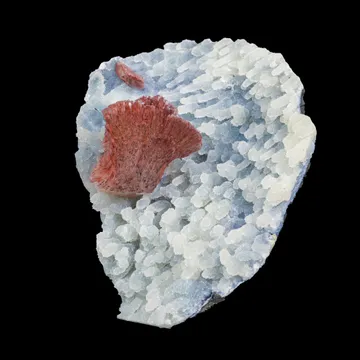
Jalgaon heulandite is prized for thick tabular to wedge-shaped crystals, fan-shaped groups, saddles, and stacked blades in peach, salmon, orange-red, reddish brown, chocolate brown, pale translucent, and occasional greenish tones, commonly on chalcedony or quartz and associated with stilbite, apophyllite, mordenite, calcite, and basalt. In the large Savda flow-core cavities, heulandite-Ca formed well-developed individual crystals reported up to about 10 cm, a scale and quality not typical of the small millimeter wall linings in upper-flow vesicles. Fine Jalgaon heulandite should have glossy faces, sharp unbruised edges, attractive fan architecture, and visible contrast against chalcedony or basalt; drusy crusts and cleaved, dull tabular masses are far less desirable even when the color is good.
Chalcedony is one of the structural minerals of Jalgaon specimens: it forms white, gray, blue-gray, greenish, drusy, botryoidal, stalactitic, and sugary crusts that line cavities, encrust earlier minerals, and provide the sparkling stage on which heulandite, stilbite, calcite, and apophyllite are displayed. In the Savda mineralization sequence, chalcedony overgrew earlier clay minerals, zeolites, and first-generation calcite, with crusts documented from about 1 to 20 mm thick and with transitions from microcrystalline silica toward macrocrystalline quartz. The best chalcedony-bearing pieces are sculptural rather than merely crusted: stalactitic curtains, rounded knobs, and glittering druses give depth and contrast, while broken stalactite ends, dull silica skin, or heavy featureless coatings make a specimen less compelling.
Jalgaon calcite occurs in multiple generations and can be far more interesting than a casual glance suggests: early Savda calcite formed unusual twinned and distorted crystals, commonly up to about 15 cm long, that were later overgrown by chalcedony, while later calcite generations include colorless to light yellow rhombohedra and attractive pale lemon to honey crystals associated with stilbite, apophyllite, chalcedony, and basalt. Collectors especially value clean, transparent calcite rising above peach stilbite or sparkling apophyllite, and specimens that preserve the relationship between calcite and chalcedony-coated cavity surfaces. Ordinary calcite plates are common; superior Jalgaon calcite has glassy faces, minimal cleavage damage, balanced placement, and a visible connection to the locality’s zeolite-paragenesis rather than being just another loose calcite on basalt.
Other documented Jalgaon minerals include fluorapophyllite-(K), mordenite, epistilbite, stellerite, scolecite, thomsonite-Ca and thomsonite-subgroup minerals, chabazite, fluorite, fluorapatite, quartz including amethyst and chalcedony, opal and opal-CT, cristobalite, hematite, ilmenite, rutile, chromite, celadonite, saponite, montmorillonite, smectite-group minerals, anorthite, labradorite, augite, and primary basalt minerals. Powellite is the standout rarity in the Savda story: pale yellow to nearly colorless tetragonal dipyramidal crystals have been documented there, in places partly embedded in stilbite and recognizable by their habit and short-wave UV fluorescence.
The first collecting issue with Jalgaon specimens is not usually outright fakery; it is label precision. Older labels reading “Jalgaon,” “Maharashtra,” or “India” can be perfectly legitimate, but they may not prove a Savda origin. Conversely, “Savda,” “Sawda,” and “Savada” are spelling variants encountered for the important quarry area. For common miniatures this may not matter much, but for high-value pieces—large green apophyllite, exceptional heulandite, sculptural chalcedony-stilbite plates, or powellite associations—ask for old labels, dealer history, and any specific quarry attribution.
Misidentification is common. Apophyllite is often sold with zeolites but is not itself a zeolite. Stilbite and heulandite can be confused on mixed plates, especially where crystals are pale peach and bladed. Stellerite and stilbite are visually similar in some habits, and older labels may not reflect modern species-level identification. “Zeolite from Jalgaon” is acceptable as a broad decorative trade label, but serious collectors should prefer identified stilbite-Ca, heulandite-subgroup, mordenite, scolecite, or epistilbite where the habit supports the name.
No reliable locality-specific epidemic of dyed Jalgaon stilbite or heulandite is established in the serious mineralogical literature, but the broader market for Indian zeolites does include dyed, repaired, and assembled material. Treat overly vivid, uniform, or unnatural colors with caution, especially hot orange, purple, or heavily saturated tones that do not fit the soft peach-salmon-brown-green Jalgaon palette. Watch for dye concentrated in cracks, on broken edges, or in porous matrix. With green apophyllite, distinguish natural color zoning and celadonite-influenced associations from suspicious surface staining or lighting-enhanced photographs.
Repairs and reattachments are a real concern because Deccan Trap pockets are commonly opened by quarry blasting, and many good pieces begin life as broken cavity sections. A disclosed repair on a major display specimen may be acceptable; an undisclosed glued bow-tie, reattached apophyllite, or composite “floating” cluster is not. Inspect contacts under magnification. Natural contacts should show continuity of growth, druse, or matrix; glue lines often hide under crushed zeolite debris, white powder, or suspiciously convenient drusy patches.
Condition is critical. Stilbite has fragile blade edges and bruises easily. Heulandite has excellent cleavage and can lose corners or tips. Apophyllite commonly cleaves at corners or shows rubbed pyramidal faces. Calcite can be nicked or etched, and chalcedony stalactites can snap at narrow necks. Because Jalgaon specimens often have several species on one matrix, judge condition species by species: a perfect central apophyllite can be acceptable with minor peripheral stilbite wear, but a crushed main bow-tie or cleaved central heulandite crystal is a major value loss.
Fluorescence is useful but limited. Powellite is the most important UV-responsive species to consider at Jalgaon and may fluoresce under short-wave ultraviolet light. Do not use fluorescence alone to identify a specimen, but do test suspected powellite associations carefully, especially small pale yellow tetragonal crystals on stilbite. Handle all Jalgaon specimens gently, keep them away from aggressive chemical cleaning, and avoid soaking mixed plates where zeolites, calcite, clay minerals, and fragile chalcedony structures occur together.
Market availability remains good for ordinary to attractive Jalgaon combinations. Miniatures and small cabinet pieces with apophyllite, stilbite, heulandite, chalcedony, and calcite appear regularly. The selective material is much harder: undamaged green apophyllite groups with strong color, large complete heulandite fans, sculptural chalcedony-stalactite vugs, clean calcite-on-zeolite combinations, and powellite-bearing specimens with convincing provenance. Those behave less like bulk Indian zeolite stock and more like classic locality specimens.
The most vivid Jalgaon story is written in the walls of the Savda quarries. Imagine a basalt quarry face roughly seven meters high, cut through a series of subhorizontal lava flows. Near the top are the small vesicles expected in a cooling flow, but in the dense core zone the rock opens into a different world: irregular cavities several decimeters across, sometimes more than a meter wide, rimmed with green or brown clay and carrying centimeter-sized euhedral crystals. The published field photographs describe arched-roof cavities, round cavities, cavities with flat bottoms, and “skirted” forms with upward-convex shapes. For a collector, that geometry matters; it is the difference between a flat plate of crystals and a preserved room inside a lava flow.
One of the most remarkable features documented at Savda is the presence of long subsurface filamentous fabrics, abbreviated SFF. These are not showy in the way a mint-green apophyllite crystal is showy, but they are part of what makes the locality scientifically compelling. Some filaments run from a few millimeters to more than 100 cm, with round or irregular cross-sections, ribbon-like mats, and clay-rich cores later protected by chalcedony. Under the microscope, the inner cores can be only tens of micrometers across, surrounded by clay minerals and silica. On a specimen table this history may appear simply as chalcedony-coated strings or stalactitic forms; under study, it becomes a record of early cavity-wall mineralization in freshly cooled basalt.
The February 2013 fieldwork at Savda gave researchers a rare chance to connect hand specimens, quarry observations, and laboratory data. Samples were taken from freshly opened large cavities in the flow core, while comparative material came from other Deccan Trap outcrops such as Nashik and Jamner. The result was not a simple “one fluid, one event” story. Jalgaon apophyllite, for example, gave ages clustering around 44–48 Ma and 25–28 Ma, much younger than the main Deccan eruptions. That means the crystals collectors prize were not merely the last breath of cooling lava; at least some formed from later hydrothermal events, long after the basalt itself had erupted.
The powellite puzzle is another memorable episode. Basalt is poor in molybdenum, yet the Savda cavities produced rare calcium molybdate crystals, pale yellow to almost colorless, tetragonal and dipyramidal, in places associated with stilbite and overgrown by apophyllite. The published interpretation is cautious, but the implication is striking: hydrothermal fluids must have scavenged, transported, and concentrated enough molybdenum from large volumes of basalt to grow visible powellite crystals in open cavities. On a Jalgaon specimen, a small UV-reactive powellite is not just a rarity—it is evidence of a chemically selective late pulse in a basalt system that should not, at first glance, have been generous with molybdenum.
The collector story is equally modern. Since the 1970s, new Deccan Trap occurrences and a booming specimen trade changed the way mineral collectors understood western India. Jalgaon became one of the names that moved from exporter boxes into serious collections, auctions, museum displays, and publications. Many of the best pieces are not huge in mineralogical terms, but they have stage presence: a 3 to 5 cm stilbite blade poised over chalcedony, a heulandite fan sitting in a dark basalt pocket, a lemon calcite beside peach stilbite, or apophyllite crystals so glassy they seem out of place on rough black trap rock. The best Jalgaon pieces succeed because the quarry did not merely produce crystals; it produced natural compositions.
Ottens, Berthold. “Jalgaon. Eine neue Fundstelle im indischen Dekkan-Trapp.” Lapis 21(9), 13–22, 58, 1996. A key early locality article introducing Jalgaon as a new Deccan Trap specimen source.
Ottens, Berthold. “Neuigkeiten aus dem Indischen Dekkan Trapp.” Mineralien-Welt 11(1), 48–62, 2000. A follow-up report on new Indian Deccan Trap mineral finds, including Jalgaon-area material.
Ottens, Berthold. “Minerals of the Deccan Traps, India.” The Mineralogical Record 34(1), 1–82, 2003. The major collector-oriented reference for Deccan Trap minerals, cited for Jalgaon District and Savda records.
Ottens, Berthold. “Aktuelle Mineralfunde aus dem indischen Dekkan-Trapp.” Lapis 36(10), 29–38, 2011. Later German-language reporting on current Deccan Trap finds, cited for Savda apophyllite-group records.
Born, Nicolas. “Escapade minéralogique en Inde. Le Maharashtra et ses minéraux: aperçu de l'état de quelques sites en 2017.” Le Règne Minéral 23(136), 5–32, 2017. Field-oriented overview of Maharashtra mineral sites, listed among Jalgaon District references.
Golekar, R.B.; Patil, S.N.; Joshi, Mrunali; Vaidya, Aakanksha; Kamble, Pooja; Ambure, Rohini Ranjit. “Chemico-Mineralogical and Petrographical Study of Natural Zeolites and Apophyllite in Basalts from Deccan Trap, Northern Maharashtra (India).” Bulletin of Pure and Applied Sciences – Geology 37F(1), 1–17, 2018. DOI: 10.5958/2320-3234.2018.00001.X. Analytical study of Savada/Savda-area zeolites and apophyllite using microscopy, XRD, and FE-SEM.
Ottens, Berthold; Götze, Jens; Schuster, Ralf; Krenn, Kurt; Hauzenberger, Christoph; Zsolt, Benkó; Vennemann, Torsten. “Exceptional Multi Stage Mineralization of Secondary Minerals in Cavities of Flood Basalts from the Deccan Volcanic Province, India.” Minerals 9(6), 351, 2019. DOI: 10.3390/min9060351. The essential modern scientific paper on Savda/Jalgaon paragenesis, cavity geometry, fluid inclusions, isotopes, and apophyllite geochronology.
Mindat: Jalgaon District, Nashik Division, Maharashtra, India. District-level locality page listing recorded minerals, rock types, commodities, references, and sublocalities.
Mindat: Savda, Sawade Pr Chandsar, Jalgaon District, Nashik Division, Maharashtra, India. Sublocality page for the important Savda quarry area, with species list and reference trail.
“Calcite on Stilbite & Apophyllite” — Wilensky Minerals, Vimeo. Video of a Jalgaon District cabinet specimen with a pale lemon calcite, peach stilbite, and sparkling apophyllite, listed as 14 cm wide by 10.8 cm tall.
“Apophyllite, stilbite & heulandite” — Old Earth Minerals, Vimeo. Short specimen video featuring the classic Jalgaon combination of apophyllite, stilbite, and heulandite.
Wikimedia Commons: “Apophyllite, Stilbite & Heulandite J1+.jpg” — Jamain. High-resolution Creative Commons photograph of a 7.0 cm Savada, Jalgaon District combination specimen.
Wikimedia Commons: “Stilbite-Ca-Heulandite-Ca-Apophyllite-223942.jpg” — Rob Lavinsky / iRocks, via Wikimedia Commons. Photograph of a 9.2 x 6.2 x 4.8 cm Jalgaon District stilbite-Ca, heulandite-Ca, and apophyllite specimen.
Mindat: Jalgaon District, Nashik Division, Maharashtra, India — Best starting point for the district-level mineral list, references, photos, commodities, and sublocalities.
Mindat: Savda, Sawade Pr Chandsar, Jalgaon District — The key Savda/Sawda quarry locality page for the most important documented Jalgaon specimen source.
Mindat: Apophyllite Group from Savda — Species-occurrence page tying apophyllite-group specimens specifically to Savda and listing associated minerals.
Ottens et al., 2019, Minerals: “Exceptional Multi Stage Mineralization of Secondary Minerals in Cavities of Flood Basalts from the Deccan Volcanic Province, India” — Essential open-access scientific treatment of Savda/Jalgaon cavity mineralization, paragenesis, and dating.
ResearchGate record for Ottens et al., 2019 — Useful alternate access point with figure captions and article metadata.
Golekar et al., 2018, IndianJournals.com abstract — Abstract and bibliographic information for the chemico-mineralogical and petrographical study of Savada/Savda zeolites and apophyllite.
Government of Maharashtra Gazetteer: Jalgaon Geology — Regional geological background for Jalgaon District and its Deccan Trap basalt setting.
Government of Maharashtra Mining Department: Resources of Important Minerals — State-level context for Maharashtra mineral resources, including agate occurrences in Jalgaon District and the broader role of building stone.
District Industrial Profile: Jalgaon District — Administrative and regional context, including the district’s construction-stone resources and absence of major economic ore deposits.
Wikimedia Commons: Minerals of Jalgaon District — Large image category with many specimen photographs from Jalgaon District.
Wikimedia Commons: Apophyllite, Stilbite & Heulandite J1+.jpg — High-resolution photograph of a Savada combination specimen with locality and license information.
Mineral Auctions: Heulandite, Stilbite & Chalcedony, Jalgaon District — Useful market record for a cabinet specimen showing chalcedony stalactites, heulandite, and stilbite from Jalgaon.
Mineral Auctions: Stilbite and Heulandite on Chalcedony stalactite, Jalgaon — Good visual and descriptive example of Jalgaon’s sculptural chalcedony-stalactite style.
Mineral Auctions: Heulandite, Stilbite & Chalcedony pocket, Jalgaon District — Market example documenting a basalt-pocket specimen with heulandite, stilbite, and chalcedony.
UC Minerals: Apophyllite, Stilbite, Heulandite from Jalgaon — Current dealer example of a Jalgaon combination specimen with size, price, and species description.
Vimeo: “Calcite on Stilbite & Apophyllite” by Wilensky Minerals — Short video showing a high-end Jalgaon calcite-stilbite-apophyllite specimen.