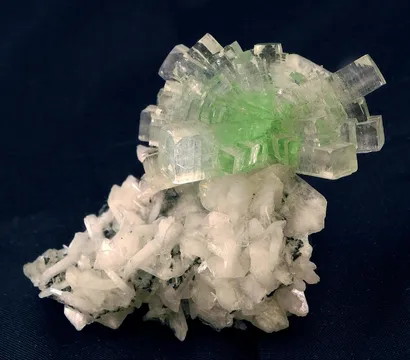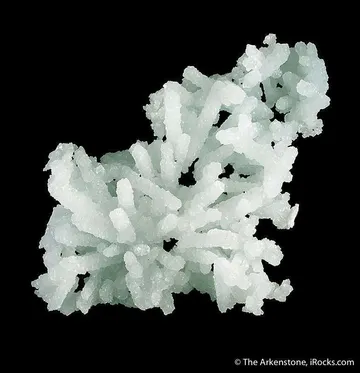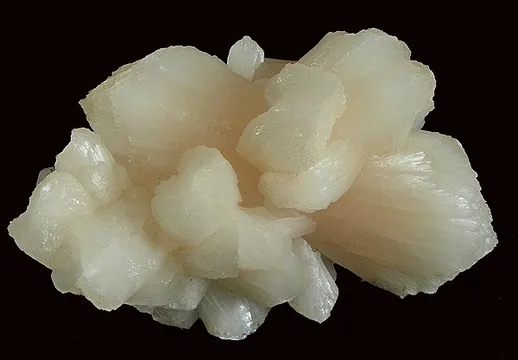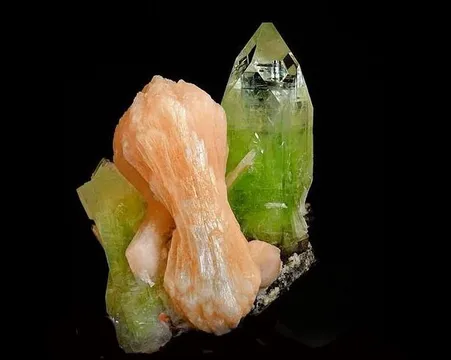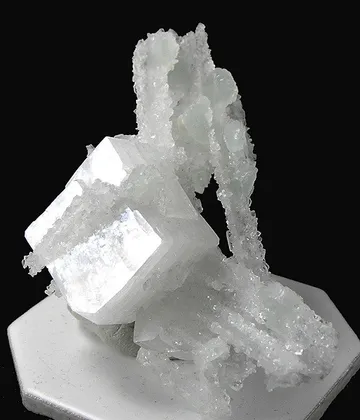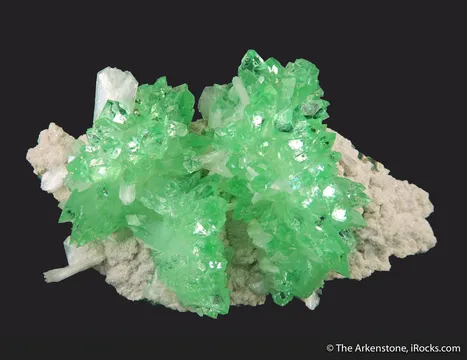
Bombay Quarry, India — a classic Deccan Trap locality yielding white okenite puffballs and gyrolite spheres in dark basalt, with cavities prized by collectors.
Key facts
Bombay Quarry is one of the classic old names in the Indian Deccan Trap mineral trade: a Bombay/Mumbai basalt quarry locality whose best specimens helped define the modern collector’s image of “Indian zeolites.” The quarry lies in the Mumbai district/suburban belt on Salsette Island, where late Cretaceous to early Paleogene basaltic volcanism, submarine pillow structures, spilitic alteration, and hyaloclastite breccia produced an unusually distinctive suite of cavity minerals. For collectors, Bombay Quarry matters less as an ore deposit than as a building-stone quarry complex that happened to open pockets of superb secondary minerals: white okenite puffballs, pearly gyrolite spheres, mint-green prehnite casts after laumontite, quartz-lined cavities, calcite, apophyllite-group minerals, and rare zeolites such as yugawaralite.
The look of a fine Bombay Quarry specimen is unmistakable. The matrix is dark basalt or altered basalt, usually forming a broken geode, plate, or floater from a vesicle or void between basalt pillows. The mineralization tends to be layered and late-stage: quartz or chalcedony lining the cavity, laumontite or prehnite forming the early architecture, and then soft-looking white okenite, lustrous gyrolite balls, calcite, and blocky apophyllite crystals perched across the surface. The best pieces are not merely “white balls on basalt”; they have sculptural pocket geometry, crisp contrasting species, undamaged okenite fibers, and enough open space that the viewer can read the growth sequence at a glance.
Regional View
Country View
Historically, Bombay labels are complicated. Specimens may appear as Bombay Quarry, Bombay Quarry No. 10, Malad, Kandivali or Khandivali, Kurar, Kurad, or Kandivli-Damupada, depending on the dealer, period, and how finely the quarry complex was being subdivided. That imprecision is part of the locality’s story. The quarries were worked primarily for basalt and construction aggregate, not for mineral specimens, and the specimen trade attached practical field names to a changing, merging set of pits around the Malad-Kandivali area.

Photo: Wikimedia Commons

Photo: Wikimedia Commons
Search for specimens: View all specimens from Bombay Quarry, India
Bombay Quarry belongs to the Salsette-Mumbai part of the Deccan Volcanic Province. The productive rock was not an ore body in the usual mining sense but vesicular, amygdaloidal, and locally pillow-structured basalt altered to spilite and cut by cavity systems and voids in hyaloclastite breccia. The secondary minerals formed in open spaces: pillow cavities, drained cavities, vesicles, fractures, and voids between basalt pillows. These cavities acted as chemical traps for hydrothermal and late post-volcanic fluids, producing layered assemblages dominated by calcium silicates, zeolites, silica, calcite, and apophyllite-group minerals.
The geological setting is the reason Bombay Quarry specimens differ so much from the more familiar stilbite-heulandite-apophyllite plates of other Deccan Trap districts. On Salsette Island, amygdaloidal tholeiitic basalt occupies much of the eastern part of the island, while spilitic pillow basalt is widespread along the western slopes of the central north-south hill range. Modern work on the Salsette-Mumbai pillow basalts places the important quarry localities, including Dahisar, Damupada, Kurar, Pathanwadi, and Amboli, within this altered pillow-basalt system. The Kurar quarry is especially important to collectors because it has also been recorded under the Kurad, Khandivali, and Malad names.
The mineralization is best understood as a sequence rather than a simple list. In void spaces within hyaloclastite breccia, chlorite and early laumontite formed first, followed by calcite, larger laumontite, quartz, babingtonite, yugawaralite, prehnite overgrowing laumontite, julgoldite, later calcite, additional laumontite, gyrolite, okenite, and apophyllite-(K). In pillow cavities, the sequence differed: chlorite, early calcite, laumontite, quartz, larger laumontite and prehnite, later calcite, ilvaite, pumpellyite, gyrolite, later laumontite, okenite, natrolite or scolecite, heulandite-Ca, stilbite-Ca, epistilbite, apophyllite-(K), and chabazite-Ca. For collectors, those two environments explain why one Bombay specimen may be a clean quartz-lined okenite geode while another is a strange mint-green lattice of prehnite after dissolved laumontite.
The quarrying itself was for construction stone and aggregate. Greater Mumbai’s quarry industry supplied basalt, andesite, and granophyric trachyte for building and road material; the collectible minerals were a by-product of opening fresh basalt cavities. Salsette Island basalt was quarried at several places until the late twentieth century, with modern geological sources noting construction-stone quarrying until 1997 and the loss or inaccessibility of many outcrops through heavy urbanization. Mineral labels and trade accounts do not point to a single enduring mining company as “operator” in the way one might expect for a metal mine. Instead, the historical record is a web of locality names, quarry numbers, local workers, specimen runners, and dealers.
Production for collectors accelerated after Indian Deccan Trap specimens became regular commercial goods in the 1960s and 1970s. By the 1970s and early 1980s, Malad-Kandivali material was moving through dealers in India and into European and American collections in quantity. Some of the most admired Bombay-type pieces date to that period: large okenite geodes, gyrolite balls with calcite, laumontite crystals carrying okenite and gyrolite, and prehnite casts after laumontite. The quarries near Malad were described by Rock Currier as a numbered series that gradually merged into one another, making old quarry-number labels useful but not always precise.
Access today should be considered closed for practical collecting. The old quarry complex is within an intensely urbanized part of Mumbai, and the classic pits are described in mineralogical sources and collector accounts as closed, built over, destroyed, or highly inaccessible. Modern collecting from the original pockets is not a realistic expectation; available specimens are overwhelmingly from old collections, dealer stock, or material recycled from the long-established Indian zeolite trade.
Notable pockets were those that preserved open, undamaged cavity interiors. The best okenite pockets yielded hollow basalt vugs lined with snow-white radiating balls, sometimes several centimeters across. The best gyrolite finds produced lustrous spheres, white to tan, perched on calcite, quartz, prehnite, or laumontite. The prehnite pockets were different: they record a chemical afterlife, in which laumontite crystals were coated by prehnite and later dissolved or dehydrated away, leaving mint-green hollow casts, tubes, ribs, and latticework. Bombay Quarry No. 10 is especially associated in the specimen literature with okenite-gyrolite-calcite combinations and with striking yugawaralite pieces, although the broader Malad-Kandivali quarry complex is the collector’s frame into which most of these labels fit.
Prehnite from Bombay Quarry is most prized when it preserves the ghost of laumontite: pale mint-green to green, hollow casts and perimorphs that retain the prismatic architecture of an earlier laumontite crystal but are surfaced with tight granular to sparkling prehnite. In the Salsette-Mumbai pillow-basalt system, prehnite occurs both as small rhombic to tabular curved crystals forming spherical aggregates, typically only millimetric, and as more substantial masses and casts in void spaces of hyaloclastite breccia; the green color is tied to iron content and is strongest in the void-space prehnites. Fine Bombay pieces are architectural rather than merely massive: open frameworks, slender stalks, and complete casts with undamaged edges, ideally carrying contrasting gyrolite balls, apophyllite-group crystals, quartz, or okenite, are far superior to broken, chalky, or nondescript green crusts.
Okenite is the species that made Bombay Quarry instantly recognizable to non-specialists: snow-white, silky, radiating “puffballs” growing in basalt vugs, on quartz, or over earlier calcium-silicate and zeolite assemblages. Salsette okenite occurs commonly in pillow cavities as white fibrous aggregates with individual fibers reaching roughly 20 mm in the modern descriptions, and also as smaller spherical aggregates in void spaces where it may sit on prehnite. Classic cabinet specimens can show balls to several centimeters across in hollow basalt geodes, commonly with gyrolite, quartz, calcite, laumontite, and apophyllite-group crystals. Quality depends overwhelmingly on preservation: the finest pieces have clean white fibers, full rounded balls, protected open cavities, and sharp species contrast, while ordinary pieces are rubbed, greyed by dust, crushed at the ball edges, or so crowded that the okenite loses its airy cotton-like character.
Gyrolite from Bombay Quarry is the pearly, spherical counterpoint to okenite: white, cream, tan, pale green, or brown balls made of micaceous platy aggregates rather than soft fibrous hair. In the Salsette-Mumbai assemblage it is common in both pillow cavities and void spaces, forming late overgrowths on earlier minerals such as quartz, calcite, prehnite, laumontite, and sometimes alongside okenite and apophyllite-group crystals. Collector-quality pieces from the Bombay/Malad-Kandivali complex are judged by sphere form, luster, separation, and contrast: lustrous rounded balls on dark basalt or sparkling quartz are much better than flat encrusting patches, and combinations with white okenite puffballs or amber calcite are among the most desirable locality styles.
Quartz at Bombay Quarry is rarely the headline species, but it is fundamental to the best specimens because it lines cavity walls, forms sparkling druses beneath okenite and gyrolite, and records an early to intermediate stage in the pocket history. In the Bombay laumontite-prehnite zone, quartz and chalcedony commonly coat vesicle walls or earlier linings before later minerals are deposited; okenite photo records from the locality frequently show quartz as an association, including amethyst and chalcedony varieties in the broader Bombay Quarry photo data. The most attractive quartz-bearing Bombay pieces are not large single crystals but finely crystallized linings that brighten the cavity and set off white okenite, pearly gyrolite, or green prehnite casts; dull silica films, broken crusts, and quartz hidden under later overgrowths are far less desirable.
Other minerals documented from Bombay Quarry and its immediate labelled variants include calcite, laumontite, natrolite, and apophyllite-group species; broader Malad-Kandivali records also include rare or important species such as yugawaralite, babingtonite, ilvaite, pumpellyite, julgoldite, chabazite, heulandite, stilbite, scolecite, pyrite, hematite, and gypsum. No verified valid mineral species in the sources used has Bombay Quarry itself as its type locality; the type-locality story for yugawaralite belongs to Yugawara Hot Spring in Japan. Nevertheless, Bombay-Khandivali-Malad specimens made yugawaralite a celebrated collector rarity, especially when it occurs as large, lustrous, off-white to clear blades in basalt cavities.
Bombay Quarry authenticity is usually a locality-label problem rather than a fake-mineral problem. The same specimen style has been sold as Bombay, Malad, Kandivali, Khandivali, Kurar, Kurad, Kandivli-Damupada, Bombay Quarry, or Bombay Quarry No. 10. These names are not automatically fraudulent; they often reflect the messy reality of a quarry complex that was worked under different local and trade names. A label claiming an exact quarry number, however, deserves more scrutiny than a broader Bombay/Malad-Kandivali label unless it comes with older provenance.
Condition is the central issue. Okenite is extremely vulnerable to touch, dust, brushing, and packing abrasion. A single careless cleaning can turn a superb puffball into a matted grey wad. Never wash okenite unless you are willing to risk irreversible damage, and do not blow compressed air into fibrous balls at close range. Prehnite casts after laumontite can be hollow and delicate, so broken tips and missing ribs are common. Gyrolite spheres can detach from matrix or bruise along exposed high points. Quartz druse and calcite are tougher, but they often serve as the substrate for much more fragile minerals.
Laumontite deserves special caution. Fresh laumontite may be attractive, but it readily dehydrates to leonhardite-like material, turns opaque, and may crumble. Old Bombay/Malad specimens showing laumontite are sometimes lacquered, soaked, repaired, or stabilized with resin or polyurethane. Such treatment is not always intended to deceive; in many cases it was a practical attempt to keep a naturally unstable mineral from falling apart. Collectors should still expect disclosure, especially for glossy laumontite, suspiciously tough crystals, or pieces with visible coating in cracks.
Mislabelling of species also occurs. White fibrous or spherical materials from the Deccan Traps are too often sold generically as “zeolite,” but okenite, gyrolite, prehnite, and apophyllite are not all zeolite species. Older literature also records confusion between mordenite and mesolite in collections from the Deccan Trap region. For Bombay Quarry specimens, the most common modern mistakes are calling every white ball okenite, confusing compact gyrolite spheres with okenite puffballs, or treating prehnite casts as original laumontite crystals rather than perimorphs or pseudomorph-style replacements after laumontite.
Market availability is finite but not vanishing. Bombay/Malad-Kandivali material was produced in large enough quantity that specimens still appear regularly from old collections, estate dispersals, and specialist Indian-zeolite inventories. Exceptional pieces are much less common: large undamaged okenite geodes, lustrous separated gyrolite balls, sharp prehnite-after-laumontite casts with good three-dimensional form, and credible old yugawaralite specimens all command stronger attention. The locality is closed or built over in practical collecting terms, so fresh production should not be assumed when evaluating a newly offered “Bombay Quarry” specimen.
To reach the famous quarries in their productive years, the collector’s trail did not begin with GPS coordinates or a neat mine office. It began at Malad station. Rock Currier’s field notes describe the practical route used by specimen runners: get off the train at Malad, then walk or catch a motorcycle rickshaw roughly 3 km east to the quarries. If one came by car, the approach often shifted northward toward Kandivli or Khandivili, then southeast toward the pits. The geography became embedded in labels. Malad was the railway name, Kandivali the village or administrative reference, Kurar and Kurad alternate quarry names, and “Bombay” the export label that Western collectors could immediately place.
The quarry complex itself resisted tidy cataloguing. Currier described seven quarries near Malad, numbered from No. 1, but the numbering became less useful as the pits enlarged and merged. One account singled out the No. 2 quarry as the source of all or almost all the yugawaralite specimens; other labels and photo records point to Bombay Quarry No. 10 for exceptional yugawaralite and okenite-gyrolite-calcite combinations. That is why old Bombay labels should be read as field history, not merely as clerical data. A specimen might have passed through a local worker, a runner, an Indian dealer, a foreign wholesaler, and several collectors before someone tried to standardize the name decades later.
One preserved photo caption from the old Malad production years catches the rough immediacy of the place better than any polished locality summary: “Some specimens of Okenite just dug out of a pocket by a miner.” Another Currier photograph shows a quarry worker bathing; the memorable detail is that rocks in the little shower stall itself carried crystals from the abundant pockets in the quarry. In a locality famous for fragile white puffballs and pearly spheres, that image is grounding: these were not museum pockets opened under controlled conditions, but working stone quarries where mineral specimens emerged in the same industrial landscape as water, dust, quarrymen, and broken basalt.
The trade history has its own vivid cast of characters. Currier recorded Bombay zeolite shipments from Hussein Tyebjee and Salim Tyebjee, and individual specimens from those shipments still circulate with notes describing laumontite sprays, okenite balls, gyrolite spheres, and apophyllite crystals. One Malad laumontite specimen in his photo notes had been obtained in 1978 from Salim Tyebjee; another, with a 6.5 cm laumontite crystal carrying okenite and tan gyrolite, came in a shipment from Hussein Tyebjee. These are the names behind many old Indian zeolite labels: not mining-company operators, but the dealer network that moved fragile basalt-pocket minerals from Mumbai quarries into international collections.
A particularly evocative Bombay Quarry No. 10 specimen passed through Ed Ruggiero’s collection: a 9.0 x 6.5 x 5.5 cm piece with three snow-white okenite puffballs, two pale amber calcite crystals, and a cluster of lustrous white gyrolite balls. The caption notes that Ruggiero bought it from the Zweibels of Mineral Kingdom in 1980, while the Malad quarries near Bombay were producing fine specimens. That date matters. It places the specimen in the great productive window before urban growth closed the quarry landscape and before such combinations became old-collection material.
The most dramatic Bombay No. 10 rarity is yugawaralite. One documented specimen measured 8.0 x 6.5 x 5.5 cm and carried a 3.5 cm lustrous off-white blade in a basalt vug, ex George Feist Collection. For a mineral that is normally a specialist’s rarity, that is a commanding size, and it explains why Bombay-Malad-Khandivali yugawaralite has such a strong reputation despite not being the species’ type locality. The great visual appeal lies in the contrast: a single bladed zeolite, pale and lustrous, set inside the dark volcanic cavity that preserved it.
W. A. K. Christie, “Gyrolite and Okenite from Bombay,” Records of the Geological Survey of India, 56, 199–203, 1925. A foundational early record for the two calcium silicate species that became signature Bombay collector minerals. Google Books record
R. N. Sukheswala, R. K. Avasia, and M. Gangopadhyay, “Zeolites and Associated Secondary Minerals in the Deccan Traps of Western India,” Mineralogical Magazine, 39, 658–671, 1974. Important regional study discussing Bombay’s laumontite-prehnite-quartz-calcite-gyrolite-okenite assemblage, the laumontite zone, and the spilitic/hyaloclastite setting. RRUFF PDF
William S. Wise, “Mineralogical Notes — Yugawaralite from Bombay, India,” The Mineralogical Record, 9(5), 296, 1978. The key collector-literature note for Bombay/Malad yugawaralite. Mindat reference/locality record
Indian Zeolites and Related Species, The Mineralogical Record, 34(1), 2003. Special issue cited in locality records for the Malad-Kandivali quarry complex and its distinctive suite, including prehnite after laumontite, calcite, gyrolite, laumontite, babingtonite, and ilvaite. Mindat commodity/reference record
Berthold Ottens, Ralf Schuster, and Zsolt Benkó, “The Secondary Minerals from the Pillow Basalt of Salsette-Mumbai, Deccan Volcanic Province, India,” Minerals, 12(4), 444, 2022. The most useful modern scientific synthesis for the Salsette-Mumbai quarry suite, including mineral sequences, pillow cavities, hyaloclastite void spaces, and analytical data. MDPI article
Berthold Ottens, Jens Götze, Ralf Schuster, Kurt Krenn, Christoph Hauzenberger, Zsolt Benkó, and Torsten Vennemann, “Exceptional Multi Stage Mineralization of Secondary Minerals in Cavities of Flood Basalts from the Deccan Volcanic Province, India,” Minerals, 9(6), 351, 2019. Broader Deccan Trap context for multistage cavity mineralization. MDPI article
“Yugawaralite,” Handbook of Mineralogy. Includes the Khandivali quarry chemical analysis and notes on Bombay-area associations with zeolites, gyrolite, okenite, prehnite, quartz, and calcite. Handbook PDF
Wikimedia Commons specimen record, “Yugawaralite-122188.jpg.” Documents an 8.0 x 6.5 x 5.5 cm Bombay Quarry No. 10 yugawaralite specimen with a 3.5 cm lustrous off-white blade, ex George Feist Collection. Wikimedia Commons
Bombay Quarry on Wikimedia Commons — Open-license specimen photographs of classic Bombay Quarry okenite, quartz, and prehnite material.
Bombay Quarry No. 10 on Wikimedia Commons — Useful image set for Bombay No. 10 okenite-gyrolite-calcite combinations and yugawaralite specimens.
Bombay Quarry, Mumbai District, Maharashtra on Mindat — Mineral list and basic locality framework for the Bombay Quarry label.
Malad Quarry on Mindat — Essential for understanding the Malad/Kandivali/Kurar/Kurad naming overlap and the old quarry complex.
Ottens, Schuster, and Benkó, 2022, Minerals: The Secondary Minerals from the Pillow Basalt of Salsette-Mumbai — Best modern geological and paragenetic treatment of the Salsette-Mumbai secondary minerals.
Sukheswala, Avasia, and Gangopadhyay, 1974, Mineralogical Magazine: Zeolites and Associated Secondary Minerals in the Deccan Traps of Western India — Classic paper placing Bombay’s laumontite-prehnite-quartz-calcite-gyrolite-okenite suite within Deccan Trap zeolite zoning.
Gyrolite mineral page on Mindat — Includes reference history for Bombay gyrolite and Christie’s 1925 “Gyrolite and okenite from Bombay.”
Okenite mineral page on Mindat — Useful species reference with Bombay Quarry among the important Indian localities.
Yugawaralite mineral page on Mindat — Clarifies the Japanese type locality while showing the Bombay/Malad-Khandivali importance for collector specimens.
Yugawaralite, Handbook of Mineralogy — Concise mineral data sheet including Khandivali quarry analysis and distribution.