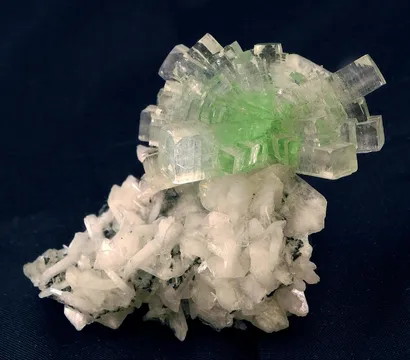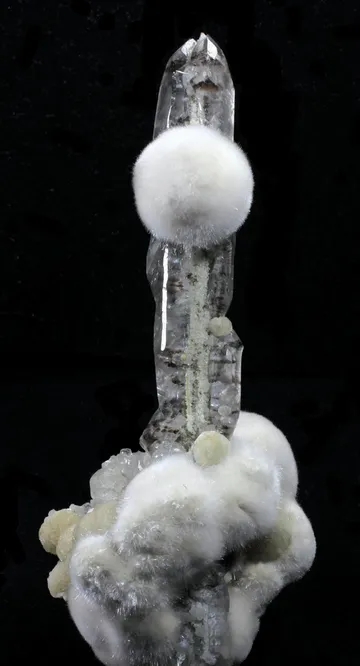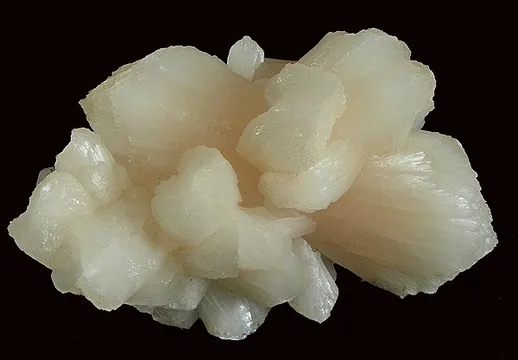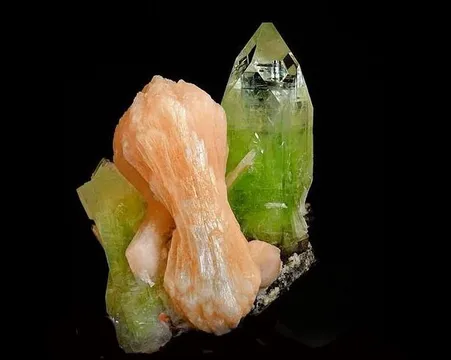
Malad Quarry, India — Deccan locality famed for zeolite-bearing cavities in altered basalt, exposing prehnite after laumontite, gyrolite, and okenite crystals.
Key facts
Malad Quarry is one of the classic names of the Indian Deccan specimen trade, not because it was a precious-metal mine, but because ordinary construction-stone quarrying opened extraordinary cavities in the altered basalt of northern Mumbai. The locality appears on old labels as Malad, Kurar, Kurad, Khandivali, Kandivli-Damupada, and sometimes simply “Bombay,” a tangle of names that reflects both local geography and the way specimens moved from quarrymen to runners to dealers during the great rise of Indian zeolites in the 1970s and 1980s.
Geologically, Malad belongs to the Salsette-Mumbai part of the Deccan Volcanic Province, where tholeiitic basalt, pillow basalt, pillow breccia, and hyaloclastite formed in a shallow-water volcanic setting along the western margin of India. That setting is the key to the specimens. The cavities and spaces between pillows acted as miniature reaction vessels: early chlorite, calcite, laumontite, and quartz were followed by Ca-Fe silicates, prehnite, gyrolite, okenite, apophyllite, and rarer zeolites. The result is an assemblage that does not look quite like the better-known Jalgaon, Nashik, Pune, or Aurangabad material. Malad pieces are often architectural rather than merely sparkling: sea-foam prehnite casts, broken-looking “jackstraw” sprays after laumontite, white okenite puffballs, pearly gyrolite spheres, yellowish calcite, and, on the rarest labels, clear bladed yugawaralite.
Regional View
Country View
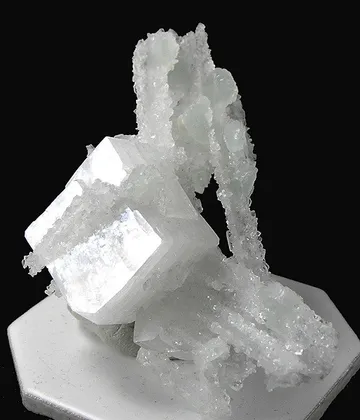
The locality’s signature specimen is prehnite after laumontite. In the best examples, the original laumontite geometry survives as long, tapering, blade-like forms, now replaced, coated, or cast by translucent pale green prehnite. Good pieces stand up like skeletal coral or a frozen pile of mint-green twigs; ordinary pieces are chalkier, more massive, broken at the terminations, or flattened into less legible aggregates. Another unmistakable Malad look is the okenite-gyrolite association: soft white okenite balls, sometimes large and felt-like, set against hard pearly gyrolite spheres and quartz-lined basalt cavities.

Photo: Didier Descouens / Wikimedia Commons

Historically, Malad matters because it helped teach Western collectors that the Deccan Traps were not a source of anonymous “zeolites,” but a province of individual localities with distinct parageneses and specimen styles. The quarry complex was active when the Indian zeolite trade was becoming international, and many of the best pieces now on the market are old-collection specimens collected or exported when the Mumbai quarries were still accessible. Today the locality is essentially an urban fossil: the quarries are closed, built over, or inaccessible, and fresh production in the classic sense is not expected.
Search for specimens: View all specimens from Malad Quarry, India
Malad Quarry was not an ore mine but a group of basalt quarries in the Malad-Kandivali-Kurar area of northern Mumbai, on Salsette Island, Maharashtra. The working quarries supplied crushed and building stone, and mineral specimens were a byproduct of blasting and breaking altered basalt. The standard collector coordinates place the locality near 19°10'59"N, 72°52'0"E, roughly east of the Malad railway station and within the old northern Bombay quarry belt. Older labels may read “Bombay,” “Mumbai,” “Kandivali,” “Khandivali,” “Kandivli,” “Kurar,” “Kurad,” or “Kandivli-Damupada”; for collector purposes these usually refer to the same Malad-area quarry system, though not always to the same individual pit.
The host rock is part of the Salsette-Mumbai volcanic sequence of the Deccan Volcanic Province. Unlike many inland Deccan quarries where amygdaloidal subaerial lava flows dominate, the Salsette occurrences include spilitized pillow basalt, pillow breccia, and hyaloclastite formed where basaltic lava interacted with brackish to fresh water in a shallow coastal or lagoonal environment. The cavities that produced specimens occur both within pillows and in voids between pillows, and those two micro-environments explain much of Malad’s mineralogical personality. Pillow cavities commonly show early wall linings of laumontite, calcite, and quartz, later carrying prehnite, calcite, Ca-Fe silicates, gyrolite, okenite, natrolite/scolecite, heulandite, stilbite, epistilbite, apophyllite, and chabazite. Interpillow breccia voids produced especially important laumontite and prehnite relationships, including the famous prehnite perimorphs and pseudomorphs after laumontite.
The mineralization is a secondary, low-temperature to moderate-temperature hydrothermal assemblage rather than an ore deposit. Early fluids altered basaltic glass and rock margins, forming chlorite, laumontite, calcite, and quartz. Later episodes introduced the spectacular collector suite: prehnite, babingtonite, ilvaite, julgoldite, pumpellyite, gyrolite, okenite, apophyllite, and rare yugawaralite. Analytical work on Salsette-Mumbai specimens has shown that the sequence was not a single simple event. Some early mineralization is tied to the cooling and alteration history of the basalt itself, while later mineral growth, including apophyllite-bearing assemblages, records post-volcanic events millions of years after eruption.
The quarrying history is inseparable from Mumbai’s urban growth. The Salsette quarries were worked for construction material through the late twentieth century, with major basalt quarrying in the greater area continuing until 1997. An environmental management report for Sanjay Gandhi National Park listed active Malad stone quarry leases near the park boundary under the names Shri V. Narayan Raju and Shri T. Chaube on Survey No. 42/A, and noted that such quarries were licensed by the District Collector of Mumbai. Those names should not be read as specimen-label certainties for every Malad mineral piece, because collector specimens usually moved through quarry workers, runners, wholesalers, and exporters rather than through formal mine-lot documentation. Still, they illustrate the practical reality of the locality: these were urban-edge aggregate quarries, not specimen mines operated for collectors.
Field accounts describe a cluster of several Malad-area quarries east of the railway corridor. Rock Currier recorded that runners used the Malad station and then walked or took motorcycle rickshaws eastward to the quarries, while visitors arriving by car often approached through Kandivli and drove southeast. He also noted that seven quarries were once recognized in the Malad area and that quarry number 2 produced all, or nearly all, of the yugawaralite specimens. Over time, the individual pits lost their clear boundaries as quarrying expanded and merged workings, which is why old numbers are useful historically but dangerous if treated as precise modern locality names.
Collecting access today should be considered closed. The quarries are shut, heavily urbanized, built over, or otherwise inaccessible, and collecting in the old manner is no longer a realistic option. Modern “new finds” from Malad should be treated cautiously unless they come with convincing provenance; most fine examples are old-stock pieces, estate specimens, or material recycled through the specimen market. The best documented finds are the prehnite after laumontite pockets, the okenite-gyrolite vugs, calcite and hydroxyapophyllite-bearing pieces collected in the 1970s, and the rare yugawaralite-bearing breccia cavities from the numbered quarry system.
Prehnite is the defining Malad mineral, most admired as pale mint-green to sea-foam prehnite replacing, coating, or casting elongated laumontite crystals from interpillow breccia voids; in pillow cavities it more commonly forms spherical aggregates on quartz rather than true laumontite perimorphs. The classic pieces range from thumbnails of clustered “sticks” to cabinet plates and exceptional large specimens, with Mineralogical Record indexing noting prehnite casts after prisms to 22 cm and a white 15 cm cluster from the Malad-Kurar quarries. The best specimens preserve the original laumontite architecture as open, sculptural jackstraws with translucent, sparkling prehnite and minimal broken tips; lesser examples are massive, chalky, badly bruised, or lack the unmistakable pseudomorphic form. Associations include hydroxyapophyllite-(K), gyrolite, okenite, calcite, quartz, and locally rarer Ca-Fe silicates, and good contrast with white gyrolite or clear apophyllite can lift a specimen from merely representative to genuinely classic.
Laumontite at Malad is both a mineral in its own right and the ghost behind the quarry’s most famous prehnites. Research on the Kurar-Malad quarry material distinguishes early laumontite as thin crusts, roughly 1 mm thick, beneath quartz linings, and later laumontite as large monoclinic crystals in voids and pillow cavities; crystals reached as much as 15 cm in interpillow breccia voids and about 5 cm in pillow cavities. Fresh laumontite from opened cavities was described as transparent, pink, and sharply edged, but the species loses water in dry air and degrades, which is why intact, attractive laumontite from Malad is much scarcer in collections than prehnite after laumontite. Good examples show preserved prismatic form, freshness, and association with quartz, gyrolite, okenite, or prehnite; ordinary or neglected examples become dull, friable, and difficult to distinguish from pale alteration material.
Quartz is the quiet foundation of many Malad specimens. In the commonest habit, clear crystals up to about 5 mm line cavity walls, overlying a thin laumontite layer and forming the substrate on which most later minerals grew. More dramatic quartz occurred in fractured, light gray, strongly altered hyaloclastite breccia at Kurar-Malad, where voids contained crystals up to 5 cm long associated with natrolite/scolecite and apophyllite-(K). A particularly interesting habit consists of broken mineralized crusts welded into clusters: one side may carry quartz crystals with short prisms and diameters around 3 cm, while the other side is covered by shorter 5 to 10 mm quartz, prehnite, and apophyllite. Collectors prize Malad quartz less as a standalone species than as a clean, sparkling stage for okenite, gyrolite, calcite, laumontite, and rare yugawaralite.
Okenite is one of Malad’s great visual minerals, occurring as white to off-white acicular radial balls and felted puffballs in vugs, commonly with gyrolite, quartz, apophyllite, calcite, prehnite, and sometimes laumontite. In the Salsette paragenesis it is a late mineral, tending to occupy bottom or side positions in cavities rather than coating every wall uniformly, which helps explain the dramatic protected vugs in which okenite balls stand out from quartz or gyrolite-lined basalt. Collector specimens commonly show balls around 2 to 3 cm, while exceptional Malad pieces have documented okenite aggregates around 4 cm and even larger compound puffballs on major cabinet specimens. The finest examples are undyed, snowy, three-dimensional, and protected from abrasion, with separate balls rather than matted fuzz; ordinary pieces are crushed, dusty, stained, or reduced to flattened white patches.
Other documented Malad minerals include calcite, hydroxyapophyllite-(K), gyrolite, hematite, pyrite, gypsum, andradite, ilvaite, pumpellyite-(Fe2+), babingtonite, julgoldite-(Fe2+), ferberite, epistilbite, heulandite subgroup minerals, stilbite subgroup minerals, natrolite, scolecite, chabazite, and yugawaralite. Malad is not best known as a type locality; its importance is as a benchmark occurrence for unusual associations and world-class habits, especially gyrolite-okenite combinations, prehnite after laumontite, and rare clear bladed yugawaralite. Yugawaralite is the great rarity: clear, striated bladed crystals to about 3 cm were described from breccia cavities, and the old quarry numbering tradition assigns nearly all of the known Malad yugawaralite to quarry number 2. The Ca-Fe silicates are also important scientifically, because babingtonite, ilvaite, julgoldite, pumpellyite, and andradite record oxidizing, Ca-Fe-rich cavity fluids unlike the simpler zeolite pockets that collectors associate with many other Deccan localities.
Malad specimens should be judged first by locality credibility. Because the same quarry system appears under several legitimate old names, a label reading Kandivali, Khandivali, Kurar, Kurad, Kandivli-Damupada, Bombay, or Mumbai is not automatically wrong. In fact, those labels may be exactly what one wants on an old specimen. The problem is vagueness: “India zeolite,” “Bombay zeolite,” or “Deccan Traps” without a more specific old label can hide material from other Maharashtra districts. Prehnite after laumontite with the characteristic Malad jackstraw habit is often recognizable, but okenite, gyrolite, apophyllite, and calcite need more cautious comparison because similar-looking species occur elsewhere in the Deccan province.
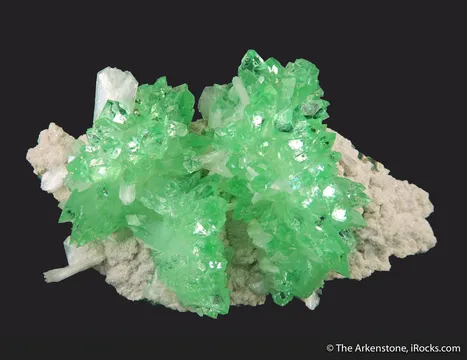
The most notorious treatment issue is dyed okenite. Natural Malad okenite is white to off-white, sometimes slightly creamy. Bright yellow, green, blue, lavender, pink, orange, or red okenite sold as natural should be regarded as artificially colored unless proven otherwise, and the fuzzy structure of okenite makes it easy for dye to penetrate. Dyed Indian okenite has circulated for decades, including specimens sold through international internet markets; some were even advertised under Malad or India names. Avoid any brightly colored “cotton ball” okenite unless you are buying it explicitly as a curiosity or teaching example of treatment.
Condition is central. Okenite is fragile and catches dust permanently; even gentle brushing can break the acicular fibers. Display it under a cover, away from direct handling, vibration, smoke, kitchen grease, and open shelves. Laumontite is more chemically vulnerable: it dehydrates in dry air, becomes dull, and may crumble or craze, so sharp fresh laumontite from Malad is much rarer than labels suggest. Prehnite is harder and more durable, but Malad prehnite after laumontite fails at the terminations; the long pseudomorphic fingers chip easily, and many attractive examples have bruised tips. Gyrolite spheres look tougher than okenite but may be pearly, platy, and edge-fragile. Quartz and calcite associations add sparkle, but calcite may be cleaved, etched, or repaired on larger old specimens.
Some Malad okenite, gyrolite, and quartz assemblages show fluorescence, including blue and creamy-yellow responses under longwave and shortwave ultraviolet light, but fluorescence is not a reliable locality test. It is a useful display feature and a good reason to inspect pieces under UV for hidden repairs, glue, or dye concentrations. Repairs are not unusual on large Deccan specimens, especially where open vugs or projecting puffballs were extracted from tough basalt; ask directly about restoration, stabilization, and reattachment. Sawn backs and trimmed basalt bases are normal for old Indian material and should not be confused with fakery.
Market availability is uneven. Small to medium prehnite after laumontite pieces still appear regularly, but clean sculptural examples with translucent color, open form, and old labels are increasingly chased. Large okenite-gyrolite vugs from Malad are much less common than generic Indian okenite, and the finest old pieces tend to emerge from named collections rather than fresh supply. True Malad yugawaralite is rare enough that any good specimen deserves scrutiny, especially if it lacks a convincing old label, publication history, or dealer provenance. For serious collectors, the strongest Malad purchases combine diagnostic habit, conservative color, old locality wording, and no-treatment disclosure.
The most vivid way to understand Malad is to imagine the route before the skyline closed in. Rock Currier described the working rhythm of the locality from the specimen trade’s point of view: a runner dealing in “zeolite” specimens would get off at Malad railway station, then walk or catch a motorcycle rickshaw roughly 3 km east to the quarries. A visitor with a car took a slightly different approach, driving farther north toward Kandivli and then southeast into the quarry ground. That simple logistical detail explains why “Malad” became the market name. It was not necessarily the administrative name of every pit; it was the railway stop, the collector’s handle, the word that traveled with the sacks and flats.
The quarry numbers became their own little folklore. Seven quarries were once distinguished near Malad, numbered in sequence, but the practical value of those numbers faded as quarrying enlarged the excavations and pits merged into one another. One number survived in collector memory because of a mineral: quarry number 2 was said to have produced all, or almost all, of the yugawaralite specimens. That is the kind of detail old labels rarely spell out but specialists remember, because yugawaralite from Malad is not just another zeolite. Fine clear blades to several centimeters are among the pieces that turned this urban quarry belt into a locality of international consequence.
There is also a before-and-after quality to old Malad specimens. Dealers and collectors who handled the material in the 1970s and early 1980s were seeing pieces from a northern Bombay landscape that was not yet swallowed by the modern city. One later recollection described the area as “almost rural” in those days, while later quarry ground became closed, inaccessible, or covered by housing. That change is visible in the specimens themselves: the old ones often carry handwritten Bombay or Kandivli labels, sometimes with understated prices, from a time when even excellent okenite and gyrolite combinations were simply part of the flood of new Indian material. Today those same pieces look less like common stock and more like documents from a vanished collecting landscape.
One Rock Currier specimen from Malad, a 1975 calcite, hydroxyapophyllite-(K), and gyrolite combination, carried a particularly prescient label note. Currier wrote that specimens of that kind would “disappear quickly” because they were inexpensive while being produced, easily dirtied, and likely to be discarded; someday, he warned, they would be rare. That observation has aged well. The market now proves the point whenever a clean old Malad okenite-gyrolite vug or prehnite after laumontite cluster appears with a serious provenance. What was once a byproduct of blasting basalt for construction has become a finite historical resource.