






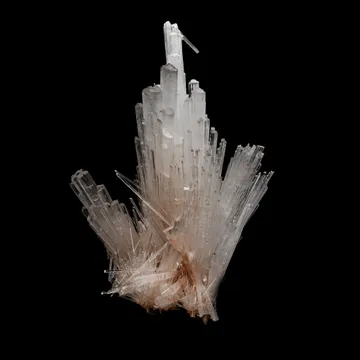
Scolecite: a calcium zeolite famed for acicular sprays and starburst clusters, pinkish hues; formed in volcanic basalts, prized by zeolite collectors.
Key facts
Scolecite is a calcium zeolite (natrolite group) beloved for its elegant sprays of acicular crystals and radiant “starburst” clusters. Most crystals are colorless to snow-white, occasionally faintly pink, peach, or honey-toned from inclusions. It forms in open cavities of volcanic basalts and andesites, often alongside India’s classic apophyllite and stilbite. Aesthetic scolecite specimens range from delicate bow-tie sheaves to dramatic, palm-sized radiating suns, often perched on contrasting basalt, drusy quartz, or pastel stilbite blades. While abundant in the Deccan Traps, truly fine, undamaged sprays with balanced composition and top luster are surprisingly hard to find and remain very collectible.
Among zeolite collectors, scolecite holds a special place for its serene, sculptural beauty. Indian discoveries since the 1980s—especially from the Pune–Mumbai corridor—flooded the market with zeolites, but the finest scolecites quickly separated themselves: long, glassy needles with mirror-bright terminations, dramatic symmetry, and striking contrasts against green apophyllite or salmon-pink stilbite. Because sprays are fragile, pristine pieces are prized, and larger starbursts or undamaged bow-ties command strong prices. Entry-level specimens are widely available, but superb display pieces—especially older classics from now-inactive quarries—are much scarcer than the species’ notoriety might suggest.
While scolecite occurs in many basalt-hosted zeolite regions worldwide, India’s Deccan Traps have produced the definitive standard. Below are important and well-documented localities with distinctive styles valued by collectors.
Jalgaon District is a broad zeolite belt with many productive quarries and road cuts. Scolecite from here spans from fine single sprays to large, dramatic starbursts associated with superb apophyllite and heulandite-stilbite combinations. Expect diversity: some clusters are snow-white and silky, others show clearer, glassier needles. Balanced compositions on basalt plates or in open vugs with contrasting species make Jalgaon pieces highly displayable.
Scolecite is moderately soft (about 5–5.5) and very brittle, with delicate, acicular tips—handle with great care.
By focusing on pristine terminations, elegant symmetry, strong luster, and an attractive matrix association, you can assemble a scolecite suite that exemplifies the serene beauty and poetry of the zeolite world.