






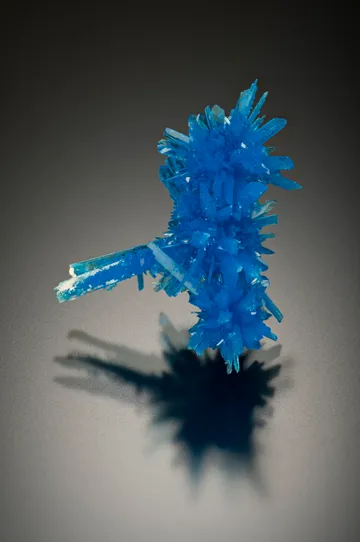
Cavansite - vivid royal-blue rosettes of hydrated calcium vanadyl silicate; prized for striking color, delicate blade formations, and limited Indian and Oregon…
Key facts
Cavansite is a vivid blue, hydrated calcium vanadyl silicate, Ca(VO)Si4O10·4H2O, famed for its brilliant color and elegant rosette crystal clusters. Typically forming as radiating sprays and spherical to hemispherical “pom‑pom” aggregates of slender bladed crystals, cavansite occurs in basaltic amygdales of the Deccan Traps and other zeolite-rich environments. Its electric royal‑blue hue contrasts spectacularly against pale host minerals—especially white or peach stilbite and heulandite—creating some of the most eye-catching display pieces in modern mineral collecting.
Crystals are usually millimeter-scale blades, but rosettes can reach several centimeters across in the best Indian specimens. A classic companion is pentagonite, a dimorph with the same chemistry but different structure and habit; pentagonite’s spiky, starburst sprays can occur on the same matrix as cavansite, and both share the same intense blue color. Cavansite is relatively soft and brittle (roughly Mohs 3–4), so undamaged clusters, well-isolated on attractive matrix, are particularly prized.
Once an extreme rarity known mainly from the type locality near Owyhee Dam, Oregon, cavansite became an international sensation when the Maharashtra (Pune District) quarry fields in India began producing in quantity during the 1990s–2000s. The best Indian finds—deep blue, lustrous rosettes on snowy stilbite or heulandite—instantly elevated the species to centerpiece status for contemporary collections. Production has been sporadic and subject to quarry closures and development pressures; as access has diminished, top-quality, unrepaired, well-composed matrix pieces have become harder to obtain and values have risen accordingly.
Because cavansite combines unmistakable color, pleasing geometry, and strong contrast, it appeals to both new and advanced collectors. Beginners can find smaller rosettes at approachable prices, while advanced collectors compete for large, isolated “flowers” with perfect luster on dramatic, undamaged matrix—a recipe for cabinet-level showpieces.
The Wagholi quarry complex produced the world’s finest cavansite specimens. Classic pieces show intensely saturated royal-blue rosettes—often 1–3 cm, rarely larger—perched on white to pale-peach stilbite or heulandite. The best are exquisitely isolated, with mirror-bright luster and symmetric radiating form. Variations include hemispherical “pom-poms,” flattened rosettes, and aesthetic groupings of several rosettes of differing sizes. Associations with apophyllite, mordenite, and occasionally pentagonite add interest and contrast.
Collectors favor Wagholi for its combination of color, size, and composition: a single, sharply isolated, deep-blue rosette on clean white matrix is the archetype. Because pocket extraction often broke clusters, expertly repaired specimens exist and should be disclosed; truly unrepaired pieces, excellent from all angles, command strong premiums. As quarry activity has waned, availability of top pieces has diminished, cementing Wagholi’s status as the definitive cavansite source.
Color and Saturation:
Crystal Form and Symmetry:
Luster and Surface Quality:
Matrix and Composition:
Condition:
Cavansite vs. Pentagonite:
Common Repairs:
Cleaners and Alterations:
Best Practice:
Handling:
Cleaning:
Light, Heat, and Environment:
Storage and Display:
By focusing on saturated color, crisp radial symmetry, strong matrix contrast, and pristine condition—while remaining vigilant for repairs—you can select cavansites that capture the species’ trademark “electric blue bloom” and hold enduring appeal in any collection.