






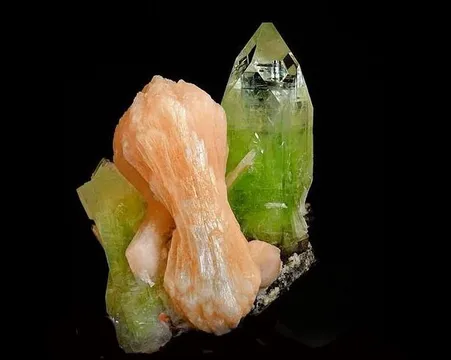
Rahuri, India — Deccan Traps locality yielding green fluorapophyllite-(K) rosettes on stilbite; historic 2001 finds and striking disco-ball crystals for collec…
Key facts
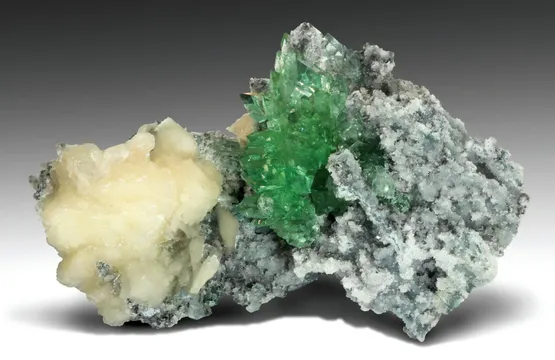
Rahuri is one of the small but unforgettable names in the modern Deccan Traps zeolite story. Its reputation rests not on a long-lived quarry or a metal mine, but on a handful of water-well cavities at Momin Akhada, a village west of Rahuri in Maharashtra’s Ahilyanagar District. These wells cut into vesicular basalt of the Deccan Volcanic Province, where late, low-temperature fluids deposited zeolites and associated hydrous silicates in open spaces left by gas-rich lava flows. In collecting terms, Rahuri means green fluorapophyllite-(K) in radial, hemispherical to nearly spherical “disco ball” aggregates, perched on pale cream, ivory, beige, or faintly pink stilbite blades.
The finest Rahuri specimens have a look unlike the broader run of Indian apophyllite. Instead of isolated blocky crystals or simple plates, the best pieces show dense rosettes of short tetragonal prisms, their flat pinacoidal terminations flashing like a cut-glass dome. Many crystals are water-clear at the tips and mint green toward the cores or bases, creating a soft internal glow rather than a painted-looking surface color. The classic matrix is a crust of pearly stilbite over basalt; on top of that pale base the green apophyllite balls look improbably engineered, as if a crystalline sea urchin had been set on a cream-colored pedestal.
Historically, Rahuri is important because the great find of 2001 became one of the most widely discussed Indian specimen discoveries of the early twenty-first century. Momin Akhada had not been known as a high-quality producer before that well was opened, yet within a single pocket it yielded a style of apophyllite that immediately became a modern classic. Later finds in nearby wells, especially Well No. 2 and Well No. 3, added material in related but subtly different habits, and also created a long-running problem for collectors: many green apophyllites from elsewhere in Maharashtra were subsequently labelled, or mislabelled, “Rahuri” or “Momin Akhada.”
Regional View
Country View

Photo: Wikimedia Commons
The Rahuri suite is a pocket-mineralization story, not a broad mining camp story. Its fame comes from single openings at specific depths in basalt, especially the 2001 cavity at Well No. 1 and the later finds at Wells No. 2 and No. 3. That is why the best labels matter. “Rahuri” on a specimen is useful; “Momin Akhada, Well No. 1,” “Well No. 2,” or “Well No. 3” is much better when backed by old dealer, collector, or publication provenance.
Search for specimens: View all specimens from Rahuri, India
Rahuri lies in the Deccan Traps, the immense continental flood-basalt province that underlies much of western and central India. The specimen deposits are secondary mineral cavities in basalt: vesicles, amygdules, and larger open voids where hydrothermal to low-temperature circulating fluids deposited zeolites, apophyllite, silica minerals, calcite, and related hydrous silicates. In the regional Deccan literature, the important mineralizing environment is the vesicular top and fractured portions of basalt flows, where glassy and altered basalt supplied Ca, Al, Si, alkalis, water, and volatiles to late-stage cavity fillings.
There are no ore bodies at Rahuri in the usual mining sense. The recorded commodity is mineral specimens, and the productive “bodies” were pockets encountered during well excavation. The best-documented source area is Momin Akhada, with Well No. 1, Well No. 2, Well No. 3, and a listed Well No. 4 in the locality hierarchy, though the published collecting story consistently treats the truly important specimen-producing wells as the first three. Well No. 3 is mapped as a well at Momin Akhada near Rahuri, with basalt recorded as the rock type and apophyllite group, fluorapophyllite, and stilbite subgroup recorded from that specific sublocality.
The decisive discovery came in 2001, when a water well being dug for Momin Akhada broke into a basalt cavity at roughly the familiar Deccan pocket horizon. Contemporary and later accounts describe the original cavity as a large open space whose walls, ceiling, and floor were lined with pale stilbite, with green apophyllite aggregates concentrated especially on the walls and floor. The best groups were hemispherical, symmetrical, lustrous, and composed of short, flat-terminated apophyllite crystals. Sizes ranged from a few centimeters to about 15 cm across, with many of the memorable “balls” around 7 to 10 cm.
The recovery was handled as a specimen operation rather than a conventional mine. Muhammad Fasi Makki of Matrix India Minerals, Pune, and later Sami Makki, are central to the documented history of the find. The first well was registered and worked under local permission, with arrangements made with village people and miners. The specimens were then prepared for the international market, where they caused a sensation at major shows. A second important find followed in 2004, and Well No. 3 was discovered in March 2013. Mindat’s locality note places Well No. 3 about 100 m from the original Well No. 1 and about 50 m from Well No. 2, and records that all three cavities were worked by the father-and-son Makki team.
Today Rahuri should be treated as a closed, private, and essentially historical specimen locality unless one has explicit permission from landowners and any relevant local authorities. These were not public collecting quarries; they were wells in a village setting. In practical collecting terms, nearly all serious Rahuri pieces now come from old collections, dealer backstock, auctions, and recycled show material. Newer Rahuri-labelled pieces appear occasionally, but the most desirable examples are those with convincing provenance to Momin Akhada and, ideally, to one of the numbered wells.
Stilbite from Rahuri is chiefly valued as the pale, pearly stage on which the green apophyllite performs: white, cream, ivory, beige, and locally pinkish blades coat basalt matrix as dense crusts, sheaves, and bladed aggregates, commonly in the 1–2 cm range in the original pocket descriptions but forming larger display matrices on cabinet specimens. The best Rahuri stilbite is not merely filler; it provides clean contrast, architectural lift, and a soft lustre that frames the apophyllite without visually overwhelming it. Fine pieces show undamaged, fresh-looking stilbite blades with a sculptural rise under the apophyllite spray or ball, while ordinary examples have flattened, bruised, dirty, or sawn-looking matrix that turns the apophyllite into a detached-looking accent rather than an integrated Deccan pocket specimen.
Rahuri apophyllite is the locality’s defining mineral, especially fluorapophyllite-(K) in mint-green to colorless, glassy tetragonal crystals forming radial sprays, bow-ties, hemispheres, and the coveted “disco ball” aggregates. Classic Well No. 1 material consists of short, flat-terminated crystals of fairly uniform length, commonly clear at the tips and green through the bodies, grouped into lustrous domes from miniature size to roughly 15 cm in the largest reported aggregates; later Well No. 2 and Well No. 3 material continued the radial theme, with Well No. 3 documented as producing striking green to colorless spherical sprays from a 2013 water-well find. The best pieces have a complete or nearly complete ball, strong three-dimensional placement on a clean stilbite pedestal, intact pinacoidal terminations, and a fresh mint-green internal color; lesser examples are partial sprays, loose hemispheres, chipped clusters, or pieces whose labels simply say “Maharashtra” or “Rahuri” without credible Momin Akhada provenance.
Other minerals documented from Rahuri include calcite, fluorapophyllite-(K), gyrolite, heulandite subgroup minerals, mesolite, natrolite, okenite, quartz including amethyst and chalcedony, scolecite, stilbite-Ca, and the stilbite subgroup. Scolecite is the most important visual associate on some combination specimens, appearing as white sprays or wheat-sheaf clusters against tan to cream stilbite and green apophyllite. Gyrolite and okenite link Rahuri to the broader Deccan secondary-mineral assemblage, but they are not what drives the locality’s collector identity. Rahuri is not known as a type locality for a valid mineral species; its importance is specimen-aesthetic and historical rather than nomenclatural.
The central authenticity issue is locality, not species identity. Green apophyllite on stilbite is widespread in Maharashtra, and attractive Deccan Traps specimens are routinely sold with vague labels such as “India,” “Maharashtra,” “Poona,” “Nasik,” or “Rahuri.” True Momin Akhada “disco ball” material has a specific look: short, glassy, flat-terminated, radiating fluorapophyllite crystals, often mint-green in the cores and colorless toward the tips, sitting on pale bladed stilbite over basalt. Elongated, darker green apophyllites with mesolite, or green spheroidal apophyllite on pink thomsonite, have been specifically noted in the literature as material that has been misattributed to Rahuri or Momin Akhada, even though such finds likely came from elsewhere in the region.
Condition is decisive. Apophyllite has perfect cleavage and the Rahuri habit exposes many small terminations at the surface of a dome, so edge bruises, cleaved crystal tips, and contact scars are common. A truly fine piece should be inspected under strong side lighting: missing flat terminations break the sparkle, and repairs can hide among the crowded radial crystals. Stilbite matrix is also vulnerable; bruised blades, rubbed pearly surfaces, and broken matrix edges are frequent on specimens that were extracted in haste or trimmed for shipment. Sawn backs and sawn matrix peripheries occur on some display pieces and are not necessarily disqualifying, but they should be disclosed and should not intrude on the display face.
The best Rahuri specimens are scarce. Complete, undamaged, well-positioned disco balls from the 2001 find are now largely locked in established collections and appear mainly through estate dispersals, major dealer releases, and auctions. Partial sprays, bow-tie clusters, and later-well pieces are more obtainable, but even those are less common than generic Indian apophyllite. Strong provenance matters: an old Matrix India, Pala International, iRocks, John Betts, Weinrich, Quebul, or noted collection label can add real confidence. For buying, favor pieces with named sublocality and well information, a coherent visual match to published Rahuri material, and unambiguous photographs from multiple angles.
No widespread dyeing or artificial coloring problem is specifically documented for Rahuri material, and the green color should be internal and subtle rather than surface-stained. Avoid pieces with oddly uniform green coating in cracks or on matrix, excessive oil-like gloss, or suspicious residue between crystals. Fluorescence is not a major collecting feature for the locality; handling and display concerns are more important. Keep specimens dry, dust them with air rather than a brush when possible, and avoid ultrasonic cleaning, acid treatments, and rough water washing that can damage stilbite, loosen pocket debris, or exploit cleavage in apophyllite.
The Rahuri story begins the way many great Deccan mineral stories do: not with a planned collecting expedition, but with a practical village excavation. When workmen and well-diggers in Maharashtra broke into mineralized cavities, word often moved quickly through local “runners” to trusted mineral dealers. At Momin Akhada, the message reached Muhammad Fasi Makki of Matrix India Minerals in Pune. Makki had been in the mineral business since the 1970s and already understood something that many outsiders missed: the Deccan’s finest pockets did not come only from big aggregate quarries. Road cuts, construction holes, and water wells could intersect the same hidden, crystal-lined cavities.
When Makki arrived at the 2001 well, he was lowered into it by a small crane used like a lift. The well was about 15 m deep at that stage, and the pocket was at the bottom. Inside was a cavity about 1.5 m high, 2.4 m wide, and 9 m long—large enough for several people to work in at once. The walls, floor, and ceiling were irregular and coated with white to cream stilbite crystals roughly 1–2 cm across. Then the torchlight caught the green apophyllites: lustrous spheroidal clusters sparkling from the walls and floor. For Makki, who had seen decades of Indian zeolites, the quality, color, and form were startling.
The first pocket produced the habit that gave the locality its fame. Most of the apophyllite aggregates were hemispherical, highly symmetrical, and bright on the flat pinacoid faces. They ranged from small groups only a few centimeters across to large domes approaching 15 cm, with many falling in the 7–10 cm range. Some were beautifully isolated on matrix, not merely broken balls crowded together. The strongest examples looked like green crystal fireworks frozen above a pale stilbite base.
Makki’s first response was not to empty the pocket immediately. He registered the find, paid tax, obtained local collecting permission, and made arrangements with the village people and miners. Only then did recovery begin. That legal and logistical step matters in the Rahuri story because the material was not coming from an anonymous quarry face; it was coming from a village well, with property, access, and local relationships all tied to the fate of the specimens.
When the first Rahuri pieces reached Europe, the reaction was immediate. At the Munich show, dealers crowded around as the specimens were unpacked, trying to reserve the best pieces before they were even laid out properly. In the account published in Minerals, the rush was so intense that “in 45 minutes” everything was sold, even before the show had properly started. Some pieces changed hands again at the same show. One of the most famous examples—a large green disco ball on a small white “trunk” of stilbite—was bought second-hand there by Bill Larson and became one of the most published icons of the find.
The same success also triggered one of the darker episodes in modern specimen collecting. While Makki was in Europe, a competitor returned to the well and worked it illegally for a short time. The work was hurried and careless. The rival team reportedly collected between 100 and 200 specimens, then destroyed the remaining in-situ disco balls when it became clear they would have to leave. When Makki returned from Germany, he counted about 200 ruined apophyllite groups still in the pocket. The dispute went to court and lasted eight years; the competitor was convicted and sentenced to eight months in prison before an out-of-court settlement led to the case being dismissed on appeal.
The second major discovery, Well No. 2, carried its own drama. Because the court case from the first-well incident was still underway, Makki’s competitor could not safely appear at the site himself, so his brother was sent instead. One attempt to slow the work reportedly involved placing a lock on the crane above the workings. Later, according to Makki’s account, one of his drivers was bribed while transporting specimens from the well to Pune, and the boxed material in the car disappeared. These details explain why early Rahuri provenance can be complicated: the specimens moved quickly, under pressure, through a competitive local trade network before becoming international show trophies.
Nine years passed between the second and third major discoveries. In March 2013, Well No. 3 was found about 100 m east of Well No. 2. Preliminary drilling indicated mineralization at the familiar depth of about 15 m, suggesting another pocket on the same general horizon. But the miners encountered a surprise: a significant green-apophyllite pocket at only about 9 m depth. Photographs associated with the find show the vertical well environment, miners at the bottom, views from the pocket into the shaft, and even the use of a mirror to throw sunlight into the working space. These are not romantic quarry benches under open sky; they are confined basalt holes where world-class specimens had to be removed piece by piece.
R. N. Sukheswala, R. K. Avasia, and Maya Gangopadhyay, “Zeolites and associated secondary minerals in the Deccan Traps of Western India,” Mineralogical Magazine, 39, no. 306, 1974, pp. 658–671 — Foundational regional paper on Deccan zeolite zoning, secondary mineral assemblages, and hydrothermal interpretation.
R. N. Sukheswala, R. K. Avasia, and Maya Gangopadhyay, full PDF via RRUFF — Open PDF of the 1974 Mineralogical Magazine article, useful for the original text on Western Deccan zeolite zones and paragenesis.
Thomas P. Moore, “What’s New in Minerals — Tucson Show 2002,” The Mineralogical Record, 33, no. 3, 2002, pp. 261–275 — Cited by Mindat for Well No. 3/Momin Akhada and relevant to the early reporting of the Rahuri material at major shows.
Muhammad F. Makki, “Der Fund der neuen Apophyllite aus den Basalten des indischen Dekkan Trapp,” Mineralien-Welt, 13, no. 3, 2002, pp. 56–62 — Early German-language publication on the new apophyllite find from Deccan basalt, cited in the Mindat reference list for Well No. 3.
M. F. Makki and S. Makki, “Neufund grüner Apophyllite in Form von ‘Diskokugeln’ aus Rahuri, Maharashtra, Indien,” Mineralien-Welt, 24, no. 6, 2013, pp. 90–97 — Publication specifically addressing the later green apophyllite “disco ball” find from Rahuri.
Tomasz Praszkier and Joanna Gajowniczek, “Disco Balls from Rahuri, India,” Minerals, issue 7 — Detailed, illustrated account of the Momin Akhada wells, the Makki recoveries, pocket dimensions, Munich-show response, mislabelling issues, and later finds.
Carnegie Museum of Natural History specimen CM27888, fluorapophyllite-(K) with stilbite-Ca from Momin Akhada, Rahuri, listed in the Mindat gallery — Museum-documented Rahuri cabinet specimen in the Hillman Hall of Minerals and Gems.
“FW1501 APOPHYLLITE on Stilbite, Momin Akhada, India,” Crystal Classics, Vimeo — Short specimen video showing an apophyllite-on-stilbite piece from Momin Akhada.
“IMG_E2470,” Weinrich Minerals specimen video, Vimeo player — Video linked from a Weinrich Minerals Rahuri fluorapophyllite-with-stilbite specimen page.
Mindat: Rahuri, Ahilyanagar District, Nashik Division, Maharashtra, India — Best starting point for the locality hierarchy and mineral list for Rahuri and its sublocalities.
Mindat: Well No. 3, Momin Akhada, Rahuri — Key sublocality page with coordinates, basalt rock type, mineral list, and note on the 2013 well discovery.
Mindat gallery: Momin Akhada/Rahuri fluorapophyllite and stilbite — Useful visual reference for the classic Rahuri disco-ball habit and labelled Well No. 2 and Well No. 3 specimens.
Wikimedia Commons: Minerals of Rahuri — Open image category containing Rahuri apophyllite photographs, including Rob Lavinsky images released under CC-BY-SA.
Wikimedia Commons: Apophyllite-(KF)-131740.jpg — Classic 2001-style radial apophyllite cluster from Rahuri, with size, authorship, and license information.
Wikimedia Commons: Apophyllite-(KF)-168059.jpg — Another illustrated Rahuri disco-ball apophyllite, useful for studying the short, flat-terminated radial habit.
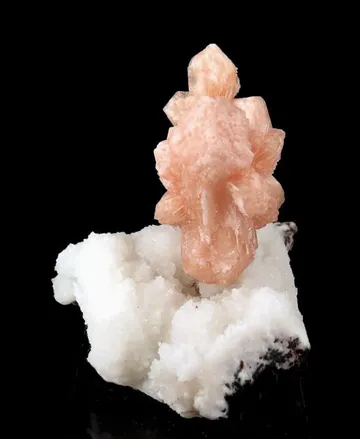
Mineralogical Record: What’s New in the Mineral World? Report #31 — Includes a concise note on the August 2001 Momin Akhada well and later pinkish apophyllite material.
Cambridge Core: Zeolites and associated secondary minerals in the Deccan Traps of Western India — Regional scientific context for Deccan zeolite formation and zoning.
RRUFF PDF: Zeolites and associated secondary minerals in the Deccan Traps of Western India — Downloadable version of the 1974 Mineralogical Magazine paper.
MineralAuctions: 2024 Well No. 1 fluorapophyllite-(K) “disco ball” on stilbite — Market reference for a high-end, well-labelled 2001 Momin Akhada example.
MineralAuctions: 2025 Momin Akhada fluorapophyllite-(K) on stilbite-Ca — Recent auction example illustrating availability, condition language, and partial-spray versus complete-ball distinction.
Weinrich Minerals: Apophyllite-(KF) with stilbite from Rahuri — Dealer archive example of a 6 cm disco-ball-style spray on stilbite matrix.
Weinrich Minerals: Fluorapophyllite with stilbite from Momin Akhada, Rahuri — Large-cabinet archived specimen page with dimensions, collection information, and video link.
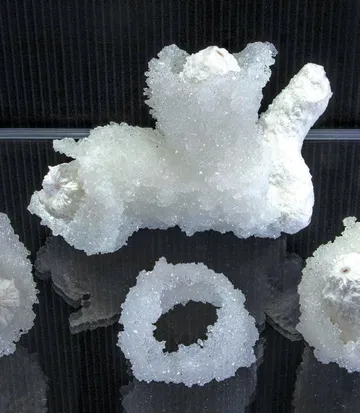
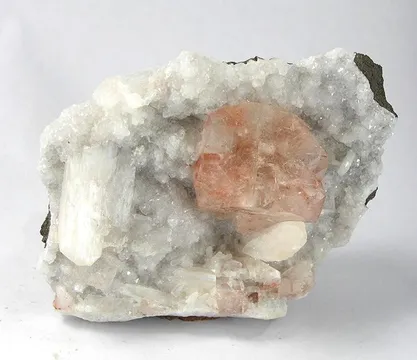
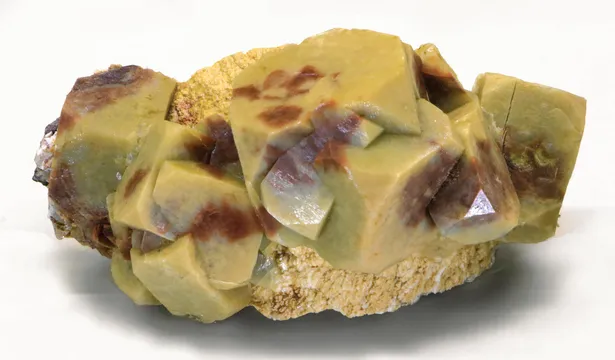
-131740.jpg)
-168059.jpg)