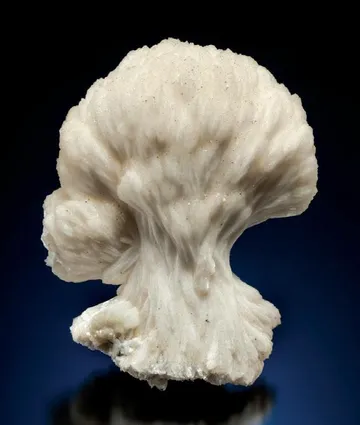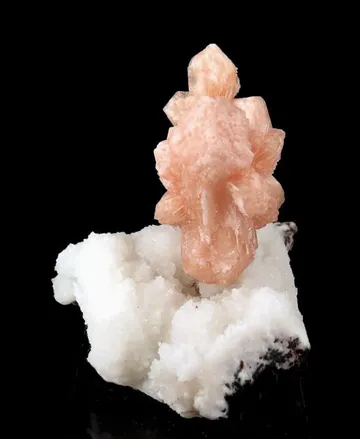
Stilbite — a zeolite famed for bow-tie crystals, pastel colors from white to peach, formed in basalt cavities; prized for form, color, and provenance.
Key facts
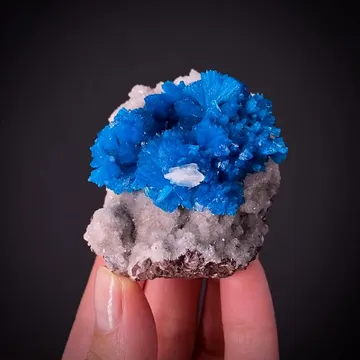
Stilbite is a beloved zeolite-group mineral celebrated for its graceful “sheaf,” “bow-tie,” and radiating fan crystal aggregates. Typically forming in cavities of basalt and other volcanic rocks, stilbite’s silky to vitreous luster and pastel palette—white, creamy beige, peach, salmon, pink, and occasionally orange—make it an aesthetic staple in mineral cabinets. Individual crystals can be blocky-tabular or blade-like, often twinned, producing the iconic wheat-sheaf forms. Associations with bright mint-green apophyllite, glassy quartz, and other zeolites (heulandite, scolecite, mesolite, cavansite, mordenite) can create striking, highly displayable combinations.
While the species is common, top specimens stand out by balance, color, luster, and arrangement on contrasting matrix. India’s Deccan Traps have set the modern standard, producing museum-scale bow-tie sprays and elegant intergrowths perched on dark basalt. Classic material from the Atlantic basalt provinces—Nova Scotia, the Faroe Islands, and New Jersey trap rock quarries—remains historically important and highly collectible.
Stilbite’s enduring popularity rests on three pillars:
The very best Indian specimens—large, undamaged, intensely lustrous fans or elegant sheaves in warm peach to salmon hues—can command serious prices. Meanwhile, early locality pieces from Nova Scotia and New Jersey carry strong provenance and are prized for historical significance.
Below are renowned, ID-verified localities that have produced distinctive, collectible stilbite. Each locality is known for particular habits, colors, or associations that define its appeal.
Jalgaon District in Maharashtra is the modern benchmark for world-class stilbite. Cavities in Deccan Trap basalts have yielded large, lustrous bow-ties and radiating fans in creamy white, peach, and salmon hues, frequently in dramatic association with glassy green apophyllite, quartz, and other zeolites. Classic compositions feature a central, undamaged fan poised on dark basalt for maximum contrast. The best pieces show razor-sharp tips, excellent translucency, and strong three-dimensional geometry. Jalgaon specimens range from elegant cabinet displays to show-size centerpieces, and fine, unrepaired examples with balanced aesthetics are avidly sought.
The Wagholi basalt quarries near Pune are famous for superb bow-tie stilbite clusters, often in warm cream-to-peach tones with silky luster. Classic pieces show intergrown sprays rising from basalt, sometimes complemented by apophyllite, heulandite, and mesolite. Wagholi is also known for sculptural arrangements—multiple fans at varying heights—and for excellent luster on the blades. Peach hues, symmetric form, and pristine terminations define the most desirable examples.
One of the storied trap-rock quarries in New Jersey’s Watchung basalts, Prospect Park produced classic white to peach stilbite with prehnite, calcite, and datolite. Aggregates may be smaller and more delicate than Indian material, but they hold strong historical value. Choice specimens show perfect bow-ties on contrasting, dark matrix, with bright luster and minimal bruising—hard to find today since most trap-rock localities are inactive or off-limits.
Color and Luster:
Form and Aesthetics:
Size and Integrity:
Matrix and Trimming:
Provenance:
Repairs:
Composite Assemblies:
Polishing/Coatings:
Stilbite is relatively soft (Mohs ~3.5–4) and brittle, with perfect cleavage. Treat it gently.
Handling:
Cleaning:
Light and Temperature:
Storage:
By focusing on sharp, undamaged bow-tie form, luminous luster, pleasing composition, and honest provenance, collectors can build a beautiful and instructive suite of stilbite—from the Atlantic basalt classics to the modern Indian masterpieces.