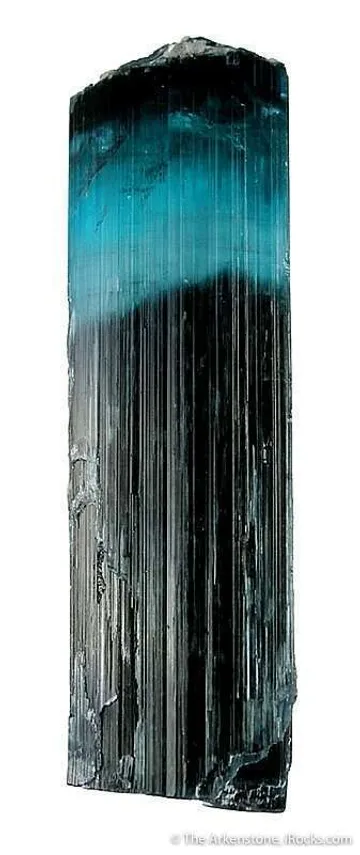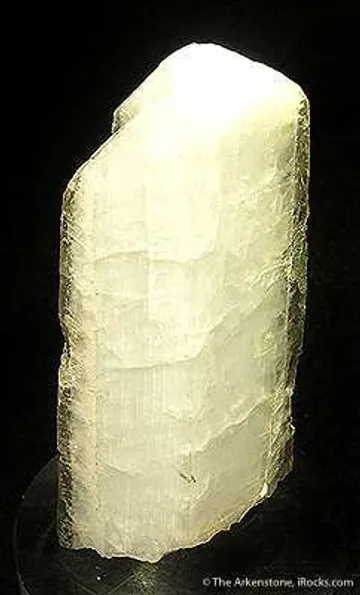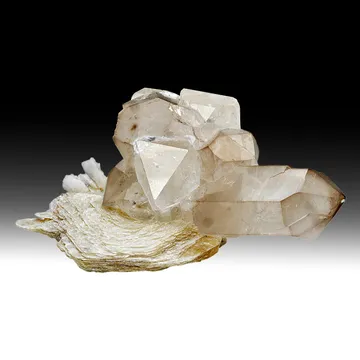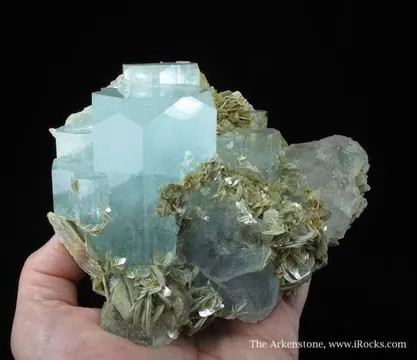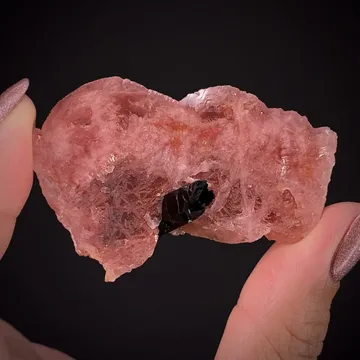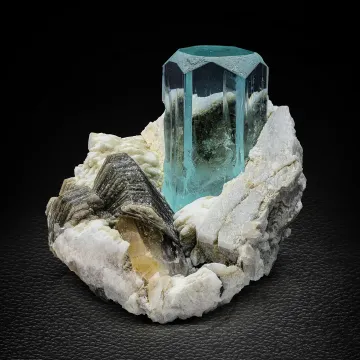
Gilgit-Baltistan, Pakistan — renowned gem pegmatites yield aquamarine, topaz, spessartine, fluorapatite; cabinet-quality crystals and high collector appeal.
Key facts
Gilgit-Baltistan is not a single mine but a mountain province of pegmatites, alpine clefts, marbles, skarns, river placers, and metamorphic fissures spread through the Karakoram, western Himalaya, and Hindu Kush collision zone. For collectors, however, its name is shorthand for one of the great modern specimen-producing belts: the northern Pakistan gem pegmatites that yield aquamarine, goshenite, topaz, schorl, elbaite, spessartine, fluorapatite, fluorite, albite, muscovite, quartz, microcline, and rarer Be-Li-Nb-Ta species. The best specimens are instantly recognizable: icy blue aquamarine crystals standing from white albite or silvery muscovite; sherry, colorless, or pale yellow topaz on cleavelandite; wine-red spessartine tucked into feldspar; color-zoned Stak Nala tourmalines on sugary albite; and, from Chilas, red-brown zircon crystals with the sharpness of small architectural models.
Geologically, the collector classics come mainly from complex, zoned granitic pegmatites and miarolitic pockets formed in the high-grade rocks of an active Himalayan–Karakoram orogen. In the Shigar Valley, pegmatites cut rocks of the Karakoram Metamorphic Complex near the Main Karakoram Thrust; in the Haramosh and Stak Nala area, younger pegmatites are tied to the Nanga Parbat–Haramosh Massif; in Nagar and Hunza, high pegmatite fields such as Chumar Bakhoor have produced cabinet-quality aquamarine, fluorapatite, and fluorite on mica-rich matrix. These are not bulk ore deposits in the usual sense. Their value lies in pockets: cavities in coarse pegmatite where slow, volatile-rich crystallization left freestanding crystals with natural terminations, luster, and matrix contrast.
Regional View
Country View
Historically, Gilgit-Baltistan helped change the way collectors viewed Pakistani mineral specimens. Early geological notes had already recognized aquamarine in the Dassu pegmatites, and by the 1980s and 1990s the Shingus-Dassu, Shigar, Stak Nala, Chumar Bakhoor, and related localities were appearing in serious international literature and in high-end collections. The region then moved from being a gem rough source to a specimen source of global stature: crystals were increasingly trimmed, cleaned, and preserved on matrix instead of being broken for cutting. That shift is why today’s best Gilgit-Baltistan aquamarines and topazes compete not merely as gems, but as sculptural pegmatite specimens.

Photo:
The region’s collecting personality is broad. Shigar and Braldu are the great aquamarine-topaz stage; Stak Nala is the classic color-zoned tourmaline locality; Chumar Bakhoor is a high-altitude Nagar pegmatite field famous for aquamarine, pink fluorapatite, and fluorite on coarse muscovite; Chilas is a distinctive source of sharp zircon; Alchuri and Hashupa add alpine and metamorphic species such as zoisite, clinozoisite, axinite, and epidote-group minerals. Older labels may read “Northern Areas,” “Skardu,” “Gilgit,” “Baltistan,” “Shigar River Valley,” “Hunza,” or simply “Pakistan,” and exact sublocality matters greatly to value and scholarship.
Search for specimens: View all specimens from Gilgit-Baltistan, Pakistan
Gilgit-Baltistan’s specimen deposits are dominated by gem-bearing granitic pegmatites, especially complex or zoned bodies with miarolitic cavities. The Shigar Valley pegmatites are hosted by metasedimentary and meta-igneous rocks of the Karakoram Metamorphic Complex and are regarded as part of the Karakoram Axial Batholith system. They occur in a tectonically spectacular setting: the Shigar Valley follows the Main Karakoram Thrust, separating Asian-plate metasediments to the north from the Kohistan-Ladakh arc terrane to the south. In collector terms, that geology produced the right combination of granitic melt, volatile enrichment, fracturing, and open space for pocket crystallization.
The Shigar pegmatites are not all equally productive. Field studies divide them into gemstone-bearing and gemstone-barren types. The productive bodies are very coarse-grained, zoned muscovite-schorl-beryl-garnet pegmatites, commonly with a fine-grained border zone, an intermediate zone, and in some bodies a central quartz zone. Gem crystals occur most typically in the intermediate zone and along the core-margin zone, especially in rounded or ovoid cavities packed with crystals and pale clayey pocket material. The practical exploration lesson is simple and important: Shigar’s gemstone-bearing pegmatites tend to be muscovite-rich and biotite-poor, whereas many biotite-bearing pegmatites are barren or far less productive.
The major Shigar-Braldu-Basha specimen districts include Dassu, Yuno, Mungo, Kashmol, Goyungo, Nyit Bruk, Baha, Niaslo, and related localities. Dassu has long been important for aquamarine and topaz; Yuno is documented for aquamarine, apatite, garnet, topaz, fluorite, and muscovite associations; Kashmol has produced beryl, schorl, colorless topaz, and fluorite; Baha and Nyit Bruk appear repeatedly in the pegmatite-mineral assemblage. Specimens from Braldu and Basha localities have often been marketed simply as “Shigar Valley,” which is understandable commercially but inadequate for serious locality collections.
Northwest of Shigar, the Nagar-Hunza side of the province contributes another famous pegmatite style. Chumar Bakhoor, above the Sumayar-Nagar area, is a high-altitude pegmatite field known for aquamarine, fluorapatite, and fluorite associated with coarse muscovite. Its cabinet specimens often have a different look from classic Shigar pieces: aquamarine or fluorapatite standing from sparkling mica plates, sometimes with pink to green fluorite and feldspar. Fine Chumar Bakhoor fluorite, particularly pink and multicolored crystals on muscovite, is a major sub-specialty of Pakistani collecting.
The Haramosh and Stak Nala area is another essential part of the Gilgit-Baltistan story. At Stak Nala, miarolitic granitic pegmatites form flat-lying sills ranging from less than 1 m to more than 3 m thick, with symmetrical internal zoning. The sequence passes inward from feldspar-quartz border zones to coarser wall zones with schorl, then to late albitized and pocket zones where cleavelandite, F-rich muscovite, and elbaite occur. The famous color-zoned tourmalines developed in pockets where late Fe-poor fluids could produce elbaite after earlier schorl had removed much of the iron from the evolving system. Stak Nala is also scientifically important as the type locality for billwiseite, a rare Sb-Nb-Ta-W oxide.
Chilas, in Diamer District, is best known to collectors for zircon rather than aquamarine. Sharp reddish brown to orange-red zircon crystals occur in matrix with calcite, albite, muscovite, and locally spessartine, and some older market pieces were among the first recognizable Pakistani zircons to reach collectors in the 1990s. Because Chilas is also an administrative center, some labels bearing only “Chilas” may refer to material from elsewhere in Diamer District; precise documentation is valuable.
Mining is largely small-scale and seasonal. Many workings are high, remote, and dependent on road access, weather, local knowledge, and laborious pocket extraction rather than continuous industrial production. Blasting, hand drilling, chiseling, and careful pocket work all occur; the best operators understand that a single intact matrix specimen may be worth more than the cut stones it could yield. Production is episodic: years may pass with only small crystals and damaged pocket material, followed by a single cavity that supplies a suite of important specimens. This is why Gilgit-Baltistan material remains available on the market but truly great, undamaged, well-documented matrix pieces are scarce.
Collecting access today should be treated as a mining-rights and safety matter, not as casual field collecting. Many localities are active claims, community-controlled workings, or dangerous high-altitude excavations. Foreign visitors should not assume that a locality name on a label implies public access. The practical collecting route is usually through reputable Pakistani dealers, established international dealers, or documented older collections rather than direct field collecting.
Gilgit-Baltistan aquamarine is best known from Shigar, Braldu, Hunza-Nagar, and related pegmatite fields, where it forms long hexagonal prisms ranging from small gem crystals to cabinet-size crystals more than 10 cm long; documented Shigar material includes pale greenish blue, pale blue, nearly colorless, translucent, and transparent crystals, and the Dassu pegmatites have long been noted for transparent light blue crystals in the 5–15 cm range, with later reports of crystals up to about 16 cm long and 7 cm wide. The classic collector piece is an upright, terminated pale blue beryl on white albite, bladed cleavelandite, muscovite, quartz, schorl, or feldspar; Chumar Bakhoor examples often rise from glittering muscovite, while Shigar-Braldu specimens more often show albite, quartz, schorl, microcline, topaz, or fluorapatite. Good aquamarines here are judged by undamaged terminations, transparency, even blue color rather than washed-out goshenite-like paleness, crisp hexagonal form, and natural matrix balance; ordinary pieces are abundant, but well-composed matrix specimens with a single sharp crystal or a balanced cluster remain the benchmark.
Beyond aquamarine, Gilgit-Baltistan beryl includes colorless goshenite and occasional morganite from the Skardu-Shigar pegmatite district, with studied Shigar beryls coming from Yuno, Kashmol, and Nyit and showing the same fundamental pegmatite habit: prismatic crystals in cavities near the core-margin zone or in coarse intermediate pegmatite. Goshenite is most attractive when it is truly transparent and sharply terminated rather than merely pale broken beryl, and morganite is much scarcer in fine specimens than aquamarine. Matrix associations mirror the broader pegmatite assemblage—albite, muscovite, schorl, quartz, apatite, microcline, and topaz—and the best beryl specimens retain their natural pocket context, showing why the crystal grew where it did rather than appearing as an isolated, cuttable prism.
Quartz is the structural backbone of the Gilgit-Baltistan pegmatites: it forms central quartz zones, pocket crystals, and matrix for aquamarine, topaz, albite, muscovite, schorl, and feldspar, with Shigar-Dassu examples ranging from colorless rock crystal to smoky quartz and, more rarely, amethyst. In the best specimens, quartz is not merely white gangue but a display mineral—doubly terminated crystals, glassy points, or architectural masses supporting aquamarine, albite, topaz, or schorl. Quartz from alpine-type clefts in the broader Shigar-Basha-Haramosh setting can also occur with actinolite, calcite, epidote-group minerals, titanite, rutile, and other fissure species, giving it a different personality from the pegmatite-pocket material. For collectors, clean luster, undamaged points, clarity, and a balanced relationship to associated species separate fine Gilgit-Baltistan quartz from ordinary pegmatite matrix.
Gilgit-Baltistan zircon is most recognizable from Chilas in Diamer District, where sharp reddish brown to orange-red crystals occur as well-formed dipyramidal to pyramidal crystals on calcite-, albite-, and muscovite-rich matrix, sometimes with spessartine. Good specimens are small but forceful: a lustrous, partly gemmy red-brown crystal sitting in strong contrast to pale matrix, with intact edges and no bruising on the pyramidal faces. Chilas labels require care because the town is an administrative center and some material may have been grouped under that name commercially, but documented Chilas zircons include crystals around the 1–2 cm range, and the finest examples are prized precisely because Pakistan is far better known for aquamarine and tourmaline than for attractive zircon specimens.
Albite is the pale stage on which many Gilgit-Baltistan specimens perform, especially in the Shigar-Braldu-Dassu and Stak Nala pegmatites. It occurs as white to creamy masses, tabular crystals, and the bladed cleavelandite habit so characteristic of late pocket assemblages, commonly associated with aquamarine, topaz, schorl, elbaite, muscovite, quartz, spessartine, fluorapatite, microcline, and fluorite. At Stak Nala, late platy albite formed during volatile-rich pocket stages after albitization of earlier feldspars, while in Shigar it is a common matrix and pocket mineral in the gem-bearing pegmatites. The best albite specimens are not simply matrix: they show bright, undamaged blades or plates with clean contrast and three-dimensional composition, particularly when they frame blue aquamarine, dark schorl, sherry topaz, or red garnet.
Muscovite is one of the key visual and geological indicators in Gilgit-Baltistan pegmatite specimens. In the Shigar gemstone-bearing pegmatites, high muscovite content and the near absence of biotite help distinguish productive muscovite-schorl-beryl-garnet pegmatites from poorer bodies, and in specimens the mica appears as silvery books, bronze to beige plates, bladed aggregates, and rosette-like nests around aquamarine, topaz, fluorapatite, fluorite, schorl, albite, quartz, and garnet. Chumar Bakhoor is especially noted for aquamarine, fluorapatite, and fluorite on coarse muscovite matrix, whereas Shigar pieces often use muscovite as a sparkling secondary accent to albite and feldspar. Fine muscovite specimens here are judged by fresh luster, sculptural books, undamaged edges, and whether the mica enhances rather than hides the principal gem crystals.
Schorl is ubiquitous in the gem-bearing pegmatites of Shigar and is also fundamental to the Stak Nala story, where early iron-rich tourmaline helped set the chemical stage for later color-zoned elbaite. In Shigar, schorl occurs in the pegmatite groundmass, border zones, intermediate zones, and core-margin areas, with documented gem-quality black crystals showing trigonal habit, prismatic faces, and longitudinal striations; Kashmol has produced black schorl crystals associated with albite, muscovite, aquamarine, and quartz. Good schorl from Gilgit-Baltistan has sharp terminations, strong luster, crisp striations, and high contrast against albite or quartz; ordinary material is abundant as broken black rods or embedded masses, but aesthetic matrix pieces with aquamarine, topaz, quartz, or albite are far more desirable.
Feldspar in Gilgit-Baltistan includes albite, microcline, orthoclase, K-feldspar, and adularia-style alpine-cleft material, and it is both a rock-forming mineral and an important display component. In the Shigar pegmatites, feldspar occurs in border, wall, intermediate, and core zones, with albite and K-feldspar helping define the internal architecture of the bodies; plagioclase in the productive pegmatites is commonly albite, while microcline and orthoclase may form blockier white to cream matrix. The best feldspar specimens from the region are clean, geometric, and compositionally useful: white feldspar plates or blocky crystals setting off aquamarine, schorl, spessartine, topaz, quartz, and muscovite. Undistinguished feldspar matrix is common, but fine feldspar with sharp form, pearly luster, and balanced associations is essential to the classic Gilgit-Baltistan look.
Spessartine in Gilgit-Baltistan is best understood through the Shigar gemstone-bearing pegmatites, where garnet occurs in Dassu and Yuno as small euhedral crystals, commonly reddish brown, translucent, and dodecahedral. Chemical work on Shigar garnets shows almandine-spessartine compositions, with studied garnets carrying a substantial spessartine component and some Dassu crystals increasing in MnO from core to rim, so many collector labels simplify a chemically mixed garnet story into “spessartine.” The finest specimens show wine-red to reddish brown garnet crystals sharply perched on white albite or feldspar, ideally with quartz or schorl accents; large gemmy crystals are rare here, and most good examples are valued for color contrast, crystal completeness, and matrix aesthetics rather than size alone.
Gilgit-Baltistan topaz is a signature Shigar-Braldu-Dassu mineral, occurring in pegmatites at Yuno, Kashmol, Dassu, Nyit Bruk, and Goyungo as colorless and light yellow crystals, with market specimens also known in sherry to pale golden tones. Documented Shigar topaz includes colorless crystals around 1 x 3 cm from Kashmol, Yuno, and Goyungo, usually associated with albite, quartz, and muscovite, while collector pieces from Dassu may show transparent, beveled, highly lustrous crystals on cleavelandite, quartz, fluorite, or mica. Good Gilgit-Baltistan topaz is glassy, complete, sharply terminated, and protected from light if it has attractive sherry or yellow color, because some Pakistani topaz colors can fade toward colorless with exposure; matrix specimens are much scarcer and more desirable than loose broken crystals.
Tourmaline from Gilgit-Baltistan spans black schorl in Shigar to the famous color-zoned elbaite of Stak Nala, with the latter among Pakistan’s most recognizable non-aquamarine specimens. Stak Nala tourmalines may show dark green, blackish green, apple green, pale green, pink, colorless, pale blue, or multicolored zoning, commonly with albite, cleavelandite, quartz, and lepidolite; the best crystals are doubly terminated, lustrous, translucent to gemmy, and naturally positioned on contrasting white albite. Shigar tourmaline is more commonly schorl, occurring with aquamarine, albite, muscovite, and quartz, but even there the best specimens have sharp trigonal terminations and strong surface striation. Fine Gilgit-Baltistan tourmaline is judged by color separation, termination quality, transparency, and matrix, while broken rods and detached fragments remain comparatively ordinary.
Other documented Gilgit-Baltistan minerals broaden the region far beyond the eleven most common EarthWonders entries. Shigar pegmatites and associated metamorphic rocks have yielded fluorapatite, fluorite, zoisite, clinozoisite, axinite-(Fe), epidote, bavenite, hydroxylherderite, tantalite-(Mn), columbite-group minerals, triplite, titanite, rutile, tremolite, actinolite, vesuvianite, allanite-(Ce), and rare Be-Nb-Ta phases. Chumar Bakhoor is important for fluorapatite and fluorite, especially pink apatite with aquamarine and mica and pink to green fluorite on muscovite. Stak Nala is scientifically distinguished as the type locality for billwiseite, Sb3+5(Nb,Ta)3WO18, found in an LCT-type complex zoned pegmatite with lepidolite and boron-rich muscovite. The regional species list also includes väyrynenite and viitaniemiite records, and serious collectors should expect names from older labels to need modern verification, especially where “apatite,” “garnet,” “tourmaline,” or “feldspar” was used generically.
The first authenticity issue is locality precision. “Gilgit” is commonly a trade label rather than a mine label: the city has long been a regional trading center, and specimens marked only “Gilgit” may have come from Shigar, Braldu, Nagar, Chumar Bakhoor, Stak Nala, Chilas, Astore, or another northern Pakistan locality. “Skardu,” “Northern Areas,” and “Baltistan” are also broad labels that may be historically understandable but mineralogically imprecise. For higher-value specimens, especially aquamarine, topaz, zircon, Stak Nala tourmaline, Chumar Bakhoor fluorite, and spessartine on albite, sublocality documentation materially affects value.
Aquamarine from Gilgit-Baltistan is generally pale to medium blue, pale greenish blue, or nearly colorless. Very saturated or oddly electric blue beryl sold as Pakistani aquamarine deserves scrutiny, especially if it resembles Maxixe-type irradiated beryl rather than natural Fe-colored aquamarine. Laboratory work on Shigar aquamarine has shown the expected iron-related color, weak bluish-white fluorescence in some samples, and abundant two-phase or multiphase fluid inclusions; clean natural inclusions and pegmatite matrix are often better evidence than an implausibly perfect color.
Repairs are common in large aquamarines, topazes, and tourmalines from the region. This is not automatically disqualifying—many major pegmatite specimens from remote mountain pockets have been repaired after extraction—but it must be disclosed. Check aquamarine bases where the crystal enters albite or feldspar, repaired terminations on topaz, glued tourmaline contacts on albite, and reattached mica or feldspar fragments. A repaired but aesthetic matrix aquamarine may still be important; an undisclosed composite is not.
Condition standards should be realistic but strict. Aquamarine and topaz terminations chip easily during extraction and transport; albite and cleavelandite edges abrade; muscovite books bend, peel, and collect dust; schorl and tourmaline terminations are often nicked along prism edges; fluorite from Chumar Bakhoor cleaves and bruises readily. Topaz has perfect basal cleavage and should be handled with particular caution. Store sherry, champagne, and yellowish topaz away from direct sunlight, since attractive color in some Pakistani topaz can fade toward colorless with light exposure.
Fluorescence is not a universal diagnostic but can be useful as a note. Some Shigar aquamarines show weak bluish-white fluorescence under long- and short-wave UV. Chilas zircon specimens may show fluorescence or color response under UV in some examples, but individual behavior varies; do not use UV alone for identification. Fluorapatite and fluorite from the region may fluoresce, but the visual quality under daylight remains the primary collector criterion.
Market availability is broad at the low and middle levels. Small aquamarine crystals, loose topaz, schorl on albite, mica-rich aquamarine matrix pieces, and generic “Skardu” pegmatite specimens appear regularly. The scarce pieces are those with all of the following: exact sublocality, natural matrix, no major undisclosed repairs, sharp terminations, strong color, and convincing composition. Stak Nala color-zoned tourmaline on albite, Chumar Bakhoor aquamarine-fluorapatite-fluorite combinations, classic Dassu or Shigar aquamarine on albite, and Chilas zircon on matrix remain the categories most worth buying selectively.