Freiberg, Germany — historic silver-rich Pb-Zn district, classic acanthite and proustite, native silver, fluorite, and old mining labels prized by collectors.
Key facts
Freiberg is one of the great old names in European mineral collecting: a silver-bearing Pb-Zn hydrothermal vein district in the Eastern Erzgebirge of Saxony, worked from the medieval “Berggeschrei” onward and studied with unusual intensity by generations of miners, mineralogists, and students of the Bergakademie. The classic collector image is not a single mineral but a whole suite: dark, metallic acanthite and historic “argentite,” red silver ores such as proustite and pyrargyrite, black stephanite, wiry and ropy native silver, lustrous galena, amber to blue fluorite, barite, calcite, siderite, quartz, and an uncommon depth of sulfosalt species. The district’s veins cut the Freiberger gneiss dome and surrounding metamorphic rocks, and the old mining terminology—kb, eb, fba, BiCoNiAg—still maps neatly onto what collectors see in specimens: quartz-polymetallic sulfide ore, carbonate-rich silver-sulfide ore, fluorite-barite-lead ore, and locally silver-bearing cobalt-nickel-bismuth assemblages.
Regional View
Country View
For collectors, “Freiberg” is best understood as both the mining town and the surrounding Freiberger Revier. The central Himmelfahrt mine complex—Reiche Zeche, Alte Elisabeth, Abrahamschacht and related workings—anchors many labels, while the broader district includes famous names such as Himmelsfürst, Beschert Glück, Beihilfe, Junge Hohe Birke, Halsbrücke, Bräunsdorf and Brand-Erbisdorf. Old specimen labels may be precise, vague, or written in period German; a specimen marked only “Freiberg” can be a perfectly legitimate antique label, but a mine-level attribution is especially valuable when the mineral species or paragenesis fits.

Photo: Didier Descouens via Wikimedia Commons
The finest Freiberg specimens have a sober, old-European elegance rather than modern neon color: black acanthite crystals sitting sharply on pale calcite; dense silver wires rising from dark sulfide matrix; red proustite crystals glowing internally when freshly lit; galena cubes and modified crystals softened by carbonate or quartz; yellow or blue fluorite in association with galena, sphalerite, calcite or barite. They are historically important as mineral specimens, but also as documents of a district that shaped mining law, mining education, analytical chemistry, and economic geology.

Search for specimens: View all specimens from Freiberg, Germany
The Freiberg ore field lies in Mittelsachsen at the northern transition from the Erzgebirge block into the Central Saxon hill country. The mineralized district is built around a dense network of hydrothermal veins hosted mainly by Proterozoic orthogneiss of the Freiberger gneiss dome, with mica schist and phyllite more prominent to the north and granitic and Permian porphyry bodies in the regional setting. The vein system is not a simple single-lode deposit: more than a thousand veins have been recorded, with the classic Freiberger nomenclature grouping them by attitude and strike as Stehende Gänge, Morgengänge, Spatgänge and Flache Gänge. This old miners’ geometry matters to collectors because different vein sets and vein intersections carried different ore assemblages.
The principal mineralization is polymetallic and hydrothermal. In modern economic-geology language the Freiberg district is commonly treated as an epithermal Ag-Pb-Zn system; in the traditional Saxon paragenetic language, the collector-relevant ore types include the quartz-polymetallic “kb” formation, the carbonate-rich silver-sulfide “eb” formation, the fluorite-barite-lead “fba” formation, and locally Bi-Co-Ni-Ag assemblages. The kb ores carry quartz with galena, sphalerite, pyrite, arsenopyrite, chalcopyrite and related sulfides; the eb ores are the great silver-sulfide and silver-sulfosalt assemblages, rich in carbonates such as siderite, ankerite, dolomite and calcite and including acanthite, stephanite, pyrargyrite, proustite, miargyrite, polybasite, freibergite and other sulfosalts. The fba assemblage gives many of the more colorful cabinet specimens: fluorite and barite with galena, sphalerite, chalcopyrite, quartz and pyrite, especially in the Halsbrücke-Beihilfe sector.
Mining probably began after silver ore was recognized near Christiansdorf, the settlement that became Freiberg, around 1168. The traditional story has salt carriers from Halle noticing bright ore in wagon ruts on the road to Bohemia; whether or not the tale is literal, the consequence was real—the first great Saxon silver rush. Freiberg became a major medieval mining town, a minting center, and a seat of mining administration. By the 16th century the Oberbergamt and Oberhüttenamt formalized Saxony’s mining bureaucracy, and in 1765 the Bergakademie Freiberg was founded, making the town one of Europe’s most influential centers of mining science and mineralogy.
The Himmelfahrt Fundgrube is the central name for many Freiberg specimens. Its later consolidated field absorbed numerous older small mines, including historically rich workings around Abraham, Alte Elisabeth and Reiche Zeche. In the 19th century Himmelfahrt became one of the largest silver mines in Europe, especially after rich finds from 1828 onward on vein intersections and on the Neu Hoffnung Flacher. Between 1840 and 1896 its silver output alone totaled hundreds of tonnes, and its workforce expanded into the thousands. Reiche Zeche and Alte Elisabeth remain defining landmarks: Reiche Zeche is now the principal shaft of the TU Bergakademie Freiberg research and teaching mine and also part of the visitor mine experience.
Himmelsfürst, southwest of Freiberg at Brand-Erbisdorf, is equally important for collectors, especially for native silver and rare silver minerals. First mentioned in 1596, it became one of Saxony’s richest and best-known silver mines. Its reputation was sealed by spectacular 18th-century finds, including a 68 kg mass of native silver in 1749 and an even larger 141 kg silver specimen the following year. Himmelsfürst was also a type-locality mine for several species and is central to the story of germanium: argyrodite from Himmelsfürst was the material in which Clemens Winkler discovered the new element in 1886.
The district’s mining history is long but not continuous in economic strength. After the near-surface enriched zones were exhausted, deeper mining demanded more drainage, power and capital. Freiberg suffered downturns in the late medieval period and during major wars, revived with technical improvements, and then declined again when the silver price collapsed after the move to the gold standard. The Saxon state acquired major mines in 1886 to preserve the industry, but the last large silver-mining phase ended in 1913. Mining resumed in the 1930s and after the Second World War for base metals—especially lead and zinc—under state enterprises, with the VEB Bergbau- und Hüttenkombinat “Albert Funk” becoming the postwar operator. The final closure of active mining came in 1969.
Specimen production followed the mining. Much of the finest material is old, mined before modern specimen-saving practices, and entered the collections of the Bergakademie, Saxon museums, European dealers, and later international collections. The most desirable pieces are often 18th- and 19th-century finds with old labels, but the broader Freiberg district also produced 20th-century material from the late base-metal period and from preserved or re-examined mine-dump material. Collecting underground is not an option today: the accessible workings are protected heritage, research, teaching and visitor-mine spaces, and many dumps are private, protected, reclaimed or historically sensitive. Legal collecting depends on current permission and local regulations, and serious collectors should treat unsupported “fresh from Freiberg” claims with caution unless the chain of ownership is clear.
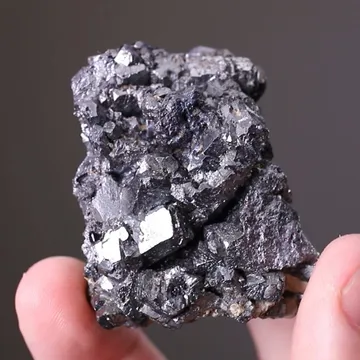
Freiberg acanthite is one of the district’s signature collector minerals, classically occurring as black to lead-gray metallic crystals and aggregates in the carbonate-rich silver-sulfide assemblage, often on white to tan calcite and with native silver, stephanite, pyrargyrite, polybasite, chalcopyrite, galena and sphalerite. Abrahamschacht in the Himmelfahrt mine field is especially well known for acanthite on calcite, with documented specimens ranging from miniature material around 4 x 3 cm to exceptional antique pieces such as the 1850 Natural History Museum, London example measuring 13.8 x 5.7 cm. Good Freiberg acanthite has crisp form, bright surfaces that have not been dulled by rough cleaning, and a convincing old-mine paragenesis; ordinary pieces are massive, visually flat, or relabeled generic “silver glance” without matrix or provenance.
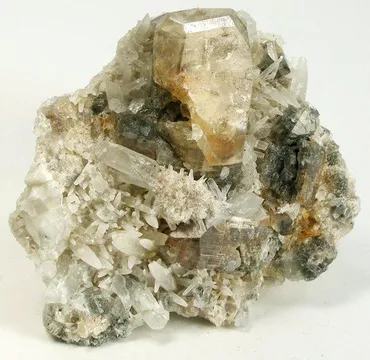
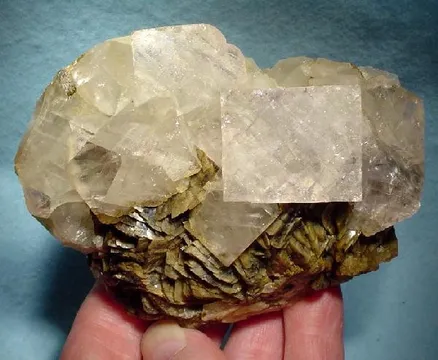
Freiberg fluorite belongs chiefly to the fluorite-barite-lead assemblage rather than the red-silver ore suite, and the best pieces show sharp cubic crystals in yellow, golden, bluish gray, blue, violet or zoned colors with galena, calcite, sphalerite, quartz and barite. Beihilfe at Halsbrücke is a particularly important source of attractive fluorite plates, including golden-yellow cubes under 1 cm across and more substantial blue-gray twinned cubic crystals to several centimeters, while Reiche Zeche material is valued for the less common combination of yellow fluorite with galena. Collectors prize transparency, color zoning, sharp cube edges, and undamaged associations; dull massive fluorite, bruised cleavage faces, or pieces carrying only a broad “Freiberg” label but no plausible fba-style association are less compelling.
Stephanite from Freiberg is a classic old-world silver sulfosalt and the town itself is treated as the type locality for the species. It occurs in the Ag-Sb carbonate assemblage with proustite, pyrargyrite, acanthite, native silver, tetrahedrite-freibergite, galena, sphalerite and pyrite, generally as black metallic crystals or compact aggregates rather than colorful show specimens. The Himmelfahrt and Beschert Glück mine fields are both documented sources, and Freiberg specimens are important even when modest in size because well-crystallized stephanite is scarce from most localities. Top pieces show recognizable orthorhombic crystal form, lustrous faces, and old labels tying them to Freiberg or a specific mine; ordinary examples are easily confused with other black silver sulfides or sulfosalts unless supported by provenance or analysis.
Native silver is the most romantic Freiberg mineral and the one most tied to the district’s mining legend. In the oxidized and enriched upper parts of the veins, and in later silver-rich assemblages, it formed wires, curls, ropes, arborescent growths, skeletal masses and compact metallic aggregates with calcite, acanthite, fluorite, proustite, pyrargyrite and other silver minerals. Himmelsfürst is the great name for ropy and wiry silver, with historic finds including enormous masses and modern museum icons such as the silver curl displayed in Freiberg; Himmelfahrt and other district mines also produced native silver. Good specimens have sculptural open wires, old patina, stable matrix and credible provenance; beware overly bright, suspiciously recent-looking wires attributed to Himmelsfürst without old labels or collection history, because that locality has had documented authenticity doubts in the trade.
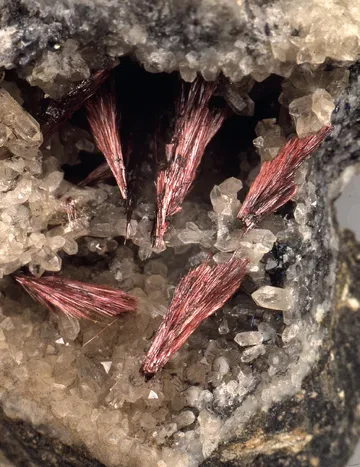
Freiberg proustite is the “light red silver ore” of the old Saxon miners, occurring in the silver-sulfide carbonate assemblage with acanthite, stephanite, pyrargyrite, native silver, tetrahedrite-freibergite, calcite and other carbonates. The best specimens show deep cherry-red to cochineal-red crystals, commonly small to miniature-size groups, with a combination of internal red color and metallic-adamantine luster that makes them immediately distinct from the black silver minerals around them. A well-known photographed Freiberg miniature measures 4 x 3.3 x 1.1 cm, which is already a serious size for an attractive old German proustite. Fine pieces are judged by color, transparency at the edges, crystal integrity and minimal light damage; darkened, dull, or broken crystals are much less desirable, even from this famous locality.
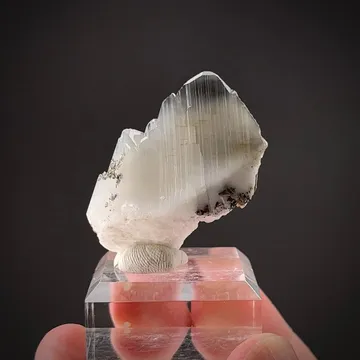
Quartz is the durable thread running through the Freiberg system, especially in the kb quartz-polymetallic ores and in several later assemblages. It appears as milky quartz, colorless rock crystal, amethyst, chalcedony, agate and hornstone-like vein material, and it is the essential matrix for many sulfide specimens: galena-sphalerite-arsenopyrite-quartz from Reiche Zeche is a classic kb combination, while chalcedony and agate occur in more silica-rich parts of the district. Good Freiberg quartz specimens are rarely collected as quartz alone; their value rises when quartz provides sharp contrast and context for galena, arsenopyrite, sphalerite, fluorite, barite or silver sulfosalts. Ordinary massive vein quartz is common and historically interesting, but collector-grade pieces need clean crystal form, attractive association, or a precise old mine label.
Pyrargyrite is the darker antimony-rich member of the ruby-silver pair at Freiberg, and it belongs to the Ag-Sb carbonate assemblage with stephanite, miargyrite, polybasite, acanthite, proustite, calcite, siderite and related sulfides. It occurs as dark red to nearly black crystals and aggregates, usually more subdued than proustite but capable of showing red internal reflections on thin edges or strong lighting. Freiberg and the surrounding district are among the old classic European sources for crystallized pyrargyrite, including material from the southern central district and nearby silver-rich fields such as Brand-Erbisdorf and Großschirma. The best pieces have distinct crystal faces, visible red translucency, and unaltered surfaces; lower-grade examples are black-looking grains on carbonate that need a label or analysis before they can be separated confidently from other silver sulfosalts.
Galena was both a major lead ore and an important silver carrier in the Freiberg district, occurring in the quartz-polymetallic kb ores and again in the fluorite-barite-lead fba assemblage. Collector pieces show metallic gray cubes, modified cubes, cleavages and masses with quartz, sphalerite, pyrite, arsenopyrite, chalcopyrite, calcite, fluorite and barite; galena with yellow or blue fluorite from the Freiberg district is especially attractive because it combines the heavy ore-mineral character of the district with real color. Good Freiberg galena is sharp, lustrous and well-associated, preferably on matrix and with a mine-level label such as Reiche Zeche, Beihilfe, Himmelfahrt or Himmelsfürst. Plain cleaved galena without context is common-looking and less desirable, even if geologically representative.
“Argentite” on Freiberg labels usually refers to the historic silver-glance tradition of the district, including cubic-looking silver sulfide specimens that mineralogically are commonly treated in modern collections as acanthite after high-temperature argentite or as acanthite using the old name. The classic old literature illustrated and described silver-glance forms from Himmelsfürst, Morgenstern and other mines near Freiberg, which is why antique labels reading Argentit, Silberglanz, Glaserz or vitreous silver should not be dismissed. Good Freiberg argentite-labeled pieces are those with convincing old provenance, cubic or pseudo-cubic habit, black lead-gray metallic luster, and associations with calcite, native silver, stephanite, pyrargyrite or galena. Ordinary pieces need caution: many are best cataloged as “acanthite, historically labeled argentite” unless supported by context and modern identification.
Arsenopyrite is characteristic of Freiberg’s quartz-polymetallic kb ores, where it occurs with quartz, pyrite, pyrrhotite, sphalerite, chalcopyrite and galena, especially in the older sulfide-rich vein stages. In hand specimens it is typically steel-gray to tin-white, with metallic prismatic or wedge-like crystals and granular aggregates, often contrasting against quartz and darker sphalerite or galena. Reiche Zeche material with galena, sphalerite, arsenopyrite and subordinate quartz is a representative central-district assemblage. The best collector examples show bright, undamaged crystals and a balanced matrix association; massive arsenopyrite-rich ore is scientifically useful but not particularly aesthetic unless it carries a strong old label or unusually sharp crystals.
Calcite is one of the principal carbonate gangue minerals in the silver-rich eb assemblage and is therefore much more than background at Freiberg: it is the pale stage on which many black acanthite, silver sulfosalt and native silver specimens are displayed. Abrahamschacht acanthite on calcite is one of the most recognizable Freiberg combinations, and calcite also appears with galena, fluorite, sphalerite and other sulfides in district specimens. Freiberg calcite can occur as white, cream, tan or iron-stained crystals and aggregates, commonly subordinate to the ore minerals but visually important. Good pieces have clean carbonate contrast, sharp associated ore minerals and no acid-etching or bruising; plain calcite from the district is less sought after unless it shows unusually good crystal form or a documented historic label.
Siderite is central to Freiberg’s “Braunspat” carbonate ores, forming part of the carbonate-rich eb assemblage with ankerite, dolomite and calcite, and it is documented from Reiche Zeche, Beschert Glück, Junge Hohe Birke, Abrahamschacht and other district workings. It generally appears as brown to tan carbonate masses, rhombohedral crystals or fine crystalline matrix hosting galena, sphalerite, pyrite, acanthite, stephanite, pyrargyrite and other silver minerals. The best siderite-bearing Freiberg pieces are not usually purchased for siderite alone; they are valued because the siderite matrix confirms the correct silver-carbonate paragenesis and gives warm contrast to black sulfosalts. Attractive rhombohedral faces, fresh surfaces and old mine labels separate collector-grade siderite pieces from ordinary brown carbonate ore.
Barite is most important in the post-Variscan iron-barite and fluorite-barite-lead assemblages, where it occurs with fluorite, galena, sphalerite, chalcopyrite, pyrite, quartz and chalcedony. In the Freiberg district it is often the white, pale, pinkish or tabular gangue partner in fba specimens, especially those from the Halsbrücke-Beihilfe area and related WNW-ESE vein sets. Good barite specimens from Freiberg show sharp bladed or tabular crystals in association with fluorite or galena; as with siderite, much of its value lies in paragenetic context. Ordinary massive barite is common as ore gangue, but well-crystallized barite on colorful fluorite or metallic sulfides is much scarcer and more desirable.
Beyond the headline species, Freiberg is a locality of exceptional mineralogical breadth. The district is tied to type-locality or historically defining material for major silver and sulfosalt minerals including argyrodite, freibergite, freieslebenite, miargyrite, polybasite, pyrostilpnite, stephanite and xanthoconite, as well as rare species and historically important names such as jordisite, kermesite, nacrite, pearceite-T2ac and others in the broader district lists. Argyrodite is especially consequential because it was the mineral from which Clemens Winkler discovered germanium. Modern work on the district continues to refine the roles of freibergite-group minerals, pyrargyrite, miargyrite, polybasite, acanthite, arsenopyrite and electrum as carriers of silver and gold, making Freiberg not merely an antique collecting district but an active reference point for ore-mineral research.
Freiberg specimens reward careful label reading. Older labels may use German names—Silberglanz, Glaserz, Rotgültigerz, Weißgültigerz, Bleiglanz, Zinkblende, Schwerspat, Flussspat, Braunspat—or obsolete species concepts. “Argentite” should be handled especially carefully, since many old silver-sulfide specimens are best understood today as acanthite or acanthite after argentite. “Freiberg” can mean the town, the Himmelfahrt mine complex, or the broader Freiberg mining district; Himmelsfürst, Brand-Erbisdorf and Halsbrücke labels are not errors if the broader district context is clear, but a seller should not blur those distinctions to inflate value.
The most important authenticity concern is native silver attributed to Himmelsfürst. Since the mid-1990s, fine native silver specimens have sometimes been attributed to that mine with insufficient support, and doubt has been cast on some such attributions. This does not mean Himmelsfürst silver is suspect as a category—it is one of the classic sources—but it does mean that provenance matters. Old labels, historic collection history, matching matrix, believable patina, and consistency with known Himmelsfürst habit are all important. Bright, aggressively cleaned, newly surfaced-looking silver wires without documentation deserve skepticism.
Condition is a serious issue across the Freiberg suite. Native silver wires are soft and easily bent; acanthite and other silver sulfides can rub, bruise or acquire dull surfaces; proustite and pyrargyrite can darken with prolonged light exposure; fluorite cleaves and chips readily; galena is dense and can bruise matrix minerals; calcite can be etched by acids and dulled by harsh cleaning. Store red silver ores away from strong light, avoid ultrasonic cleaning for delicate silver and sulfosalt pieces, and keep old paper labels with the specimen rather than loose in a drawer.
Market availability is uneven. Small Freiberg pieces appear regularly because the district was famous for centuries and many specimens circulated through European collections. Fine, aesthetic, mine-specific specimens are much scarcer. A sharp acanthite on calcite with an Abrahamschacht or Himmelfahrt label, a cherry-red proustite with old provenance, a good stephanite from Freiberg, or a sculptural Himmelsfürst silver with reliable history belongs in the higher tier of classic European minerals. Fluorite, galena, siderite, calcite and barite combinations can be more affordable, but the best old examples—especially colorful fluorite with galena from Beihilfe or Reiche Zeche—are strongly collected.
The founding story of Freiberg begins not in a mine but on a road. Around 1168, according to the old tradition, salt haulers traveling from Halle toward Bohemia noticed unusually bright ore in wagon ruts near Christiansdorf. The discovery triggered the first great “Berggeschrei,” a mining rush that drew miners—many from the Harz—into the Erzgebirge. Freiberg grew from that event into a mining town, minting center and administrative capital of Saxon silver. Whether the wagon-rut detail is literal or legendary, it captures something true about the district: Freiberg’s identity was born from silver appearing at the surface, before shafts, pumps, machines and scientific mineralogy remade the landscape.
Himmelsfürst supplied the most cinematic silver finds. On 12 August 1749, miners working the Teich Flacher at the Kunstschacht recovered a mass of native silver weighing 68 kg and valued at 2,500 talers. A year later, the mine produced an even larger silver mass of 141 kg, worth more than 4,800 talers. Those numbers are startling because they belong not to bullion bookkeeping but to actual ore specimens—silver as an object, heavy enough to require men, tools and planning to remove. The finds established Himmelsfürst as Saxony’s richest silver mine in the public imagination, and the mine’s later reputation for ropy native silver specimens rests on that same geological reality: here, silver did not merely occur as assay value; it grew as visible metal.
Freiberg’s mines also shaped science through named minerals and new elements. In 1886, Clemens Winkler identified germanium in argyrodite from Himmelsfürst. The mineral itself, Ag8GeS6, had come from one of the great silver mines of the district, yet it carried an element that no miner could see and no collector could recognize by eye. That episode is part of Freiberg’s deeper importance: the district sits at the junction of specimen collecting, ore dressing, analytical chemistry and academic mineralogy. The Bergakademie was not a decorative institution attached to a mining town; it was an engine for understanding what the mines produced.
There is a darker story under the technical pride. The Freiberg mines were deep, wet and mechanically complex, and the same systems that made them modern could fail catastrophically. In 1880, the most serious accident in Freiberg mining history occurred at the Abrahamschacht of the Himmelfahrt Fundgrube when the rod system of the Fahrkunst broke as the night shift was descending; all 13 miners on it were dragged into the depths. The detail is grimly specific: not a vague “mine disaster,” but a failure of the miners’ moving ladder, the machine designed to spare them the exhausting descent and ascent through deep workings. For collectors, it is a reminder that the elegant acanthite on calcite and old silver-sulfide specimens from the same mine field came from a working world of risk as well as beauty.