Alberoda, Germany - premier locality in the Schlema-Alberoda vein, yielding ruby-silver pyrargyrite and proustite, plus rare micromounts and rich collecting ap…
Key facts
Alberoda sits on the eastern side of the great Schlema-Alberoda uranium and polymetallic vein field of the western Erzgebirge, a district where Cold War uranium mining cut through an older Saxon silver-cobalt-nickel-bismuth tradition and accidentally opened some of the finest modern silver-sulfosalt pockets in Germany. For collectors, the name “Alberoda” is tied above all to Shaft 366 and its Brahmaputra vein, where the 1960s workings on the -585 m to -675 m levels produced classic, lustrous ruby-silver specimens: pyrargyrite, proustite, stephanite, acanthite, argentopyrite, and wiry native silver, often on compact silver-sulfosalt or carbonate-rich matrix.
Geologically, Alberoda belongs to the Niederschlema-Alberoda ore field, a granite-related, perigranitic vein system developed in the contact-metamorphic rocks of the Lößnitz-Zwönitz syncline near the Aue-Gleesberg granite. The vein history is famously complex. Uranium was concentrated in quartz-calcite-pitchblende and dolomite-pitchblende associations, while later and telescoped stages introduced Bi-Co-Ni-As-Ag and Se-rich mineralization. That overprinting is what makes the locality fascinating to systematic collectors: the same mining field that yielded high-grade pitchblende also supplied micromount rarities such as schlemaite, mgriite, jolliffeite, giraudite-(Zn), hakite-(Hg), hessite, clausthalite, tiemannite, umangite, berzelianite, and native tellurium.
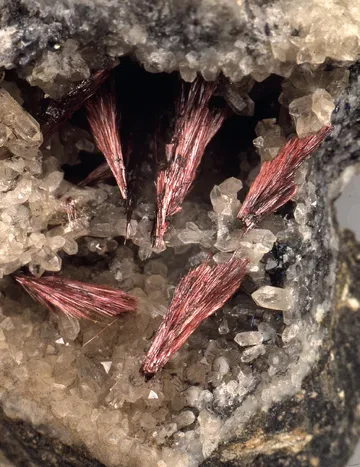
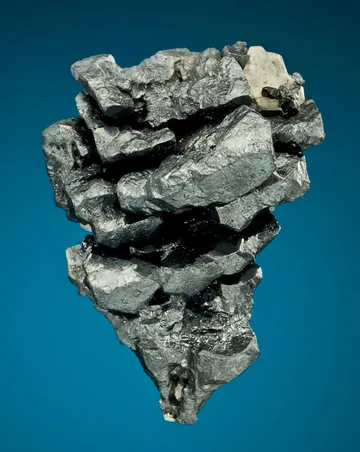
The best Alberoda cabinet pieces are not large by Freiberg or St. Andreasberg standards, but they have superb locality character. Pyrargyrite from Shaft 366 is typically dark red to nearly black in reflected light, with sharp hexagonal prisms, blocky forms, and bright metallic to submetallic luster; some pieces show iridescent tarnish. The most desirable miniatures preserve complete prismatic ruby-silver crystals standing on stephanite or argentopyrite, not merely granular black sulfosalt patches. On fresh broken or backlit edges the red tone can still flash through the otherwise dark surface, a signature look of good “Rotgültigerz” from the Saxon ore mountains.
Regional View
Country View
Alberoda is also a locality where the landscape itself matters. The mine dumps and shaft areas that once supplied collectors have been heavily remediated, covered, landscaped, and in places incorporated into the heritage landscape of Aue-Bad Schlema and Hartenstein. Today, the surviving Schacht 371 complex is one of the strongest visual reminders of the immense Niederschlema-Alberoda operation, while the collectable mineral legacy is mostly preserved in old Wismut-era collections, museum holdings, and occasional specimens entering the market from European estates.

Search for specimens: View all specimens from Alberoda, Germany
Alberoda is best understood as part of the Schlema-Alberoda or Niederschlema-Alberoda vein field in Saxony’s western Erzgebirge, rather than as a single small mine. The principal collector locality is Shaft 366 at Alberoda, especially the Brahmaputra vein, but the wider ore field also includes Shaft 296, Shaft 371, the Ruhmvoll vein system, and other Wismut workings that intersected different parts of the same mineralizing system.
The deposit is a hydrothermal vein-type uranium deposit, commonly described in modern ore-deposit literature as granite-related and perigranitic. Its structural setting lies where the NE-SW-trending Lößnitz-Zwönitz syncline intersects the NW-SE Gera-Jáchymov fault zone. The Roter Kamm structure is especially important because it forms the boundary between the Schlema-Alberoda uranium deposit to the northeast and the Schneeberg bismuth-cobalt-nickel-silver-uranium deposit to the southwest. Host rocks include folded Ordovician to Devonian “productive” metasedimentary units within the northern Erzgebirge schist belt, cut and contact-metamorphosed by the late Variscan Aue-Gleesberg granite massif.
Mining geologists recognized a dense network of faults, fissures, and veins in several directions, repeatedly reopened during tectonic movement. These structures acted as channels for successive hydrothermal fluids. The economically important uranium came largely from carbonate veins of the late Variscan kku formation, a comb quartz-calcite-pitchblende assemblage, and from post-Variscan mgu and biconi stages. The mgu association is the magnesium-carbonate-pitchblende-fluorite-selenide assemblage; the biconi association introduced bismuth, cobalt, nickel, arsenic, uranium, and silver minerals. Earlier quartz-sulfide veins supplied subordinate lead, zinc, and copper mineralization.
The ore was not evenly distributed. Uranium occurred in many hundreds of veins, but the richest areas were clustered in structural ore knots. The main uranium concentration lay between about the -390 m and -1125 m mining levels, though mineralization was still encountered on the deepest developed level of the mine, the -1800 m horizon. This vertical range is one reason the deposit became famous among mining engineers as well as mineralogists: at depths beyond 1000 m the operation faced rock-pressure problems, deformation of workings, rock bursts, and very high rock temperatures.
The mining history is inseparable from Wismut. The uranium potential of the Schlema-Alberoda area was recognized after the Second World War by Soviet exploration, building on a district that already had earlier mining attempts and a reputation for radioactive waters at the former Radium Spa Oberschlema. Large-scale production was carried out by SAG/SDAG Wismut from the late 1940s until the end of active mining in 1990–1991. Published totals vary by boundary and accounting method, but the deposit is consistently treated as one of the great vein-type uranium deposits of the world, with roughly 80,000 metric tons of uranium produced from the broader Schlema-Alberoda operation.
Object 09, later Bergbaubetrieb Aue, was the Wismut administrative unit most closely associated with Niederschlema-Alberoda. It was created in the late 1940s, absorbed and reorganized neighboring Wismut mining areas, and eventually focused its work almost entirely on Niederschlema-Alberoda. The mining field extended over roughly 22 square kilometers and was opened by numerous adits, shafts, and blind shafts on dozens of levels. At its height, the district employed thousands of workers and represented one of the most technically demanding uranium mines in Europe.
For specimen collectors, Shaft 366 is the key name. This shaft was started in March 1955 and reached a final depth of about 683 m. It opened, among others, the Brahmaputra, Dürre Henne, Nelson, Rio Tinto, and Seim veins. The Brahmaputra vein is the celebrated silver-mineral producer. Mineralienatlas records that in the 1960s, on the -585 m to -675 m levels, Brahmaputra yielded rich finds of exceptionally well-formed silver minerals, including stephanite, pyrargyrite, acanthite, native “wire” silver, and proustite. Some pyrargyrite is noted as pseudomorphic after stephanite, a detail that helps explain the blocky, dark, stephanite-like appearance of certain pieces.
The specimen-producing dumps are no longer an open collecting proposition. The large Shaft 366 dump, once a productive source for collectors, has been fully remediated, covered with soil, and planted. Wismut remediation also reshaped the wider Aue-Bad Schlema dump landscape because the old dumps posed stability, dust, radon, and radiological concerns. Any field collecting today must be treated as closed unless explicit permission is obtained from landowners and responsible authorities; in practical collector terms, Alberoda is now an old-specimen locality.
The surviving collector material is therefore mostly historic: Wismut-era pieces, specimens retained by miners and geologists, museum specimens, and later releases from European private collections. Labels may cite “Alberoda,” “Aue-Alberoda,” “Schlema-Alberoda,” “Schacht 366,” “Brahmaputra,” or simply “Schlema.” For serious collecting, the most desirable labels are those tying silver-sulfosalt specimens specifically to Shaft 366 and, better still, to the Brahmaputra vein or one of its documented levels.
Alberoda pyrargyrite is chiefly a Shaft 366 mineral, with the Brahmaputra vein providing the locality’s classic specimens. It occurs as dark red to reddish-black, lustrous, commonly six-sided crystals and blocky aggregates, associated with stephanite, argentopyrite, acanthite, native silver, proustite, and calcite. Documented market and collection pieces range from tiny clusters only a couple of centimeters across to high-grade miniatures; the finest reported crystals reach about 1.2 cm and may show flat basal terminations on hexagonal prisms. Good Alberoda pyrargyrite is judged by crystal definition, intact terminations, three-dimensional display, and visible ruby-red color or iridescent luster; ordinary pieces are more massive, bruised, dark, or compositionally interesting but visually flat. The most distinctive examples are those where pyrargyrite rises cleanly from stephanite or argentopyrite, or where the crystal form preserves the stephanite-associated character of the Brahmaputra pocket material.
Other minerals from Alberoda and the immediate Schlema-Alberoda field make the locality far more than a pyrargyrite occurrence. Shaft 366 and its veins have yielded acanthite, argentopyrite, proustite, stephanite, native silver, native arsenic, native bismuth, nickeline, nickelskutterudite, realgar, fluorite, calcite, siderite, chalcopyrite, pyrite, and important selenium minerals such as clausthalite, tiemannite, klockmannite, umangite, berzelianite, hessite, giraudite-(Zn), hakite-(Hg), and jolliffeite. The wider Niederschlema-Alberoda district is the type area for schlemaite, (Cu,□)6(Pb,Bi)Se4, and is also tied to the type-locality record of mgriite, Cu3AsSe3, in the Schlema-Hartenstein mining district. Many of these species are polished-section or micromount minerals rather than display specimens, but they give Alberoda unusual depth for systematic collectors interested in selenium-rich uranium-vein parageneses.
Alberoda specimens require unusually careful locality reading. A fine ruby-silver labeled only “Schlema” may be from Oberschlema, Niederschlema, Alberoda, Shaft 366, Shaft 371, or the broader Schlema-Hartenstein district; those labels are not equivalent in value. For pyrargyrite, stephanite, acanthite, and argentopyrite specimens, the premium locality is Shaft 366, especially the Brahmaputra vein. “Aue-Alberoda,” “Schacht 366,” and “Brahmaputra” on an old German label are meaningful; “Freiberg, Germany” attached to an Alberoda piece is usually best read as a regional or dealer shorthand, not as the true mine locality.
No well-documented industry of fabricated Alberoda fakes is evident in the available mineralogical record, but misidentification is easy. Pyrargyrite, proustite, stephanite, acanthite, polybasite-group material, and argentopyrite can all appear as dark metallic to submetallic silver minerals, especially after tarnish. Visual identifications should be conservative, and valuable specimens deserve analytical confirmation or strong provenance. Pseudomorphy adds another complication: some Alberoda pyrargyrite is reported as pseudomorphic after stephanite, so crystal form alone is not always decisive.
Condition is a major value factor. The best Shaft 366 pyrargyrites have small, sharp, lustrous crystals, and tiny nicks are common. Many specimens are dark and visually low-contrast, so strong display depends on fresh luster, clean geometry, and a matrix that sets off the crystals. Native silver tarnishes readily; acanthite and argentopyrite associations can be delicate; proustite and other ruby silvers should be kept away from prolonged strong light. Realgar and orpiment-bearing specimens from the district are light-sensitive and arsenic-bearing, and should be stored carefully. Uraninite or pitchblende-bearing material from the wider ore field is radioactive and should be handled, stored, and shipped with appropriate radiological caution.
Market availability is modest and intermittent. Small Alberoda pyrargyrite specimens and pyrargyrite-stephanite combinations do appear from European dealers, but fine miniatures with full provenance are scarce. Recent documented dealer examples include an 18 mm iridescent pyrargyrite from Shaft 366 offered at a modest price, a 35 mm Brahmaputra stephanite-pyrargyrite combination, and a much higher-value 4.5 cm miniature with pyrargyrite to 1.2 cm on stephanite and argentopyrite from the Jörg Walther collection. That spread reflects the market reality: small reference examples are obtainable, but first-rank, old-collection Shaft 366 ruby-silver pieces command a substantial premium.
The story of Alberoda begins in a strange overlap of spa culture, Cold War geology, and underground urgency. Before the uranium boom, Oberschlema was known for radioactive waters, used by the Radium Spa from 1913. After 1945, Soviet geologists recognized that the same district concealed a major uranium system. Within a few years the old spa landscape had become one of the most intensively driven underground mining fields in Europe. The deposit’s early exploitation was so rigorous in the shallow and central areas that mining damage and subsidence overtook the surface. In 1952, the center of the former Radium Spa Oberschlema was demolished, a drastic surface consequence of the vein density and the speed with which Wismut pursued the ore.
Shaft 366, the collector’s shaft at Alberoda, has its own sharper mineralogical drama. Sunk beginning in March 1955 and driven to 683 m, it intersected a set of veins with names that read like a map of the wider world: Brahmaputra, Dürre Henne, Nelson, Rio Tinto, and Seim. In the 1960s the Brahmaputra vein, between the -585 m and -675 m levels, opened pockets of silver minerals that would become classics long after uranium mining ceased. The miners were not chasing display pieces; they were working in an industrial uranium operation. Yet the vein delivered stephanite, pyrargyrite, acanthite, wire silver, and proustite in forms that later collectors would recognize as some of the finest silver-sulfosalt specimens of postwar Saxony.
The scale of the Wismut operation is difficult to reconcile with the small size of the collectible crystals. The mine workings of Schlema-Alberoda covered about 22 square kilometers at the surface, and Wismut records describe roughly 4,200 km of horizontal excavation and around 40 million cubic meters of underground cavities. More than 1000 uranium-bearing veins were explored and mined to depths approaching 2000 m. At depth, rock temperatures of about 65 °C created ventilation and cooling problems, while fractured ground and rock-pressure effects complicated mining. Against that enormous industrial backdrop, a 2 cm ruby-silver miniature from Brahmaputra is not a trivial object; it is a precise survival from a vast, vanished underground architecture.
Schacht 371 became the emblem of that architecture. Officially commissioned in May 1959 as the “Jugendschacht 1. Mai,” it later served as the main hoisting and man-riding shaft of the Aue mining operation. The shaft was a concrete-lined circular opening about 7 m in diameter, with powerful Koepe winding equipment and both cage and skip hoisting. In ordinary collector labels, “371” may simply look like another shaft number, but for Wismut it was a central artery. Today, the preserved Schacht 371 complex carries a different burden: it is part industrial monument, part museum project, and part reminder that the minerals of Alberoda came from a politically charged uranium landscape.
The dumps, too, changed identity. Shaft 366’s large waste-rock pile once yielded good minerals to collectors, but it has since been fully remediated, covered with soil, and planted. Across Aue-Bad Schlema, Wismut’s dump landscape included dozens of piles built during uranium production, later recognized as stability, dust, radon, and radiological problems. What had been an industrial mountain range of broken rock was reshaped into a managed landscape. For modern collectors this is a decisive fact: Alberoda is no longer a place to go scratching for Brahmaputra silver minerals. It is a locality preserved through labels, old collections, museum specimens, and the occasional piece that resurfaces after decades in a drawer.
Hiller, A. and Schuppan, W. (2008). Geologie und Uranbergbau im Revier Schlema-Alberoda. Bergbau in Sachsen, Band 14. Sächsisches Landesamt für Umwelt und Geologie and Sächsisches Oberbergamt, Freiberg. Publication page and PDF. The essential mining-geology monograph for the deposit.
Förster, H.-J., Cooper, M. A., Roberts, A. C., Stanley, C. J., Criddle, A. J., Hawthorne, F. C., Laflamme, J. H. G. and Tischendorf, G. (2003). “Schlemaite, (Cu,□)6(Pb,Bi)Se4, a new mineral species from Niederschlema-Alberoda, Erzgebirge, Germany: description and crystal structure.” The Canadian Mineralogist, 41, 1433–1444. PDF via RRUFF. Type material is recorded from the Natural History Museum, London, and the Mineralogical Institute of the Technische Universität Bergakademie Freiberg.
Handbook of Mineralogy: Schlemaite, (Cu,□)6(Pb,Bi)Se4. PDF. Concise data sheet noting the -855 m level, block 5128, near Shaft 371, with associations including clausthalite, eucairite, löllingite, berzelianite, tiemannite, umangite, bohdanowiczite, dolomite, and ankerite.
Dymkov, Y. M., Loseva, T. I., Zavyalov, E. N., Ryzhov, B. I. and Bocheck, L. I. (1982). “Mgriit, Cu3AsSe3, a new mineral.” Zapiski Vsesoyuznogo Mineralogicheskogo Obshchestva, 111, 215–219. The original description of mgriite, a rare Cu-As selenide with the Schlema-Hartenstein district as type locality. Mindat mineral page.
Förster, H.-J., Rhede, D. and Tischendorf, G. (2004). “Mineralogy of the Niederschlema-Alberoda U-Se-polymetallic deposit, Erzgebirge, Germany. I. Jolliffeite, NiAsSe, the rare Se-dominant analogue of gersdorffite.” The Canadian Mineralogist, 42(3), 841–849. PDF via RRUFF. Documents the exceptional rarity of jolliffeite in the deposit and its association with other selenides and tellurides.
Förster, H.-J. (2004). “Mineralogy of the Niederschlema-Alberoda U-Se-polymetallic deposit, Erzgebirge, Germany. II: Hessite, Ag2Te, and native Te(?), the first tellurium minerals.” Neues Jahrbuch für Mineralogie - Abhandlungen, 180(2), 101–113. GFZpublic record. Reports hessite and native tellurium as the first tellurium minerals known from the Erzgebirge metallogenic province and the first hessite record from a uranium deposit.
Förster, H.-J. and Rhede, D. (2004). “Mineralogy of the Niederschlema-Alberoda U-Se-polymetallic deposit, Erzgebirge, Germany. III. First indication of complete miscibility between tennantite and giraudite.” The Canadian Mineralogist, 42(6), 1719–1732. PDF via RRUFF. Important for the Se-rich tetrahedrite-tennantite-giraudite-hakite chemistry of the deposit.
Förster, H.-J. (2005). “Mineralogy of the U-Se-polymetallic deposit Niederschlema-Alberoda, Erzgebirge, Germany. IV. The continuous clausthalite-galena solid-solution series.” Neues Jahrbuch für Mineralogie - Abhandlungen, 181(2), 125–134. ResearchGate record. Records the full PbSe-PbS solid-solution series in a single section from the deposit.
Förster, H.-J., Tischendorf, G. and Rhede, D. (2005). “Mineralogy of the Niederschlema-Alberoda U-Se-polymetallic ore deposit, Erzgebirge, Germany. V. Watkinsonite, nevskite, bohdanowiczite, and other bismuth minerals.” The Canadian Mineralogist, 43(3), 899–908. PDF via RRUFF. A key paper on the Bi-selenide assemblage and low-temperature selenide formation.
Wismut GmbH Lagerstättensammlung. Wismut collection page. The deposit collection at the preserved Shaft 371 includes about 1800 mineral and rock specimens, with a core holding from the former Aue mining operation and material from Schneeberg-Schlema-Alberoda and Pöhla-Tellerhäuser.
Mindat: Alberoda, Aue-Bad Schlema, Erzgebirgskreis, Saxony, Germany — Broad locality page for Alberoda, including mineral list, photo records, and sublocalities.
Mindat: Brahmaputra vein, Shaft 366, Alberoda — The key page for the classic pyrargyrite-stephanite-acanthite silver-sulfosalt occurrence.
Mindat: Shaft 366, Alberoda — Shaft-level locality entry with documented minerals from Brahmaputra and other Shaft 366 veins.
Mineralienatlas: Schacht 366, Schlema-Alberoda — German-language locality page with the crucial note on Brahmaputra’s 1960s silver-mineral finds on the -585 m to -675 m levels and the present lack of collecting access.
Sachsen.de: Geologie und Uranbergbau im Revier Schlema-Alberoda — Official publication page for the 2008 mining monograph by Hiller and Schuppan.
IAEA UDEPO: Niederschlema-Alberoda Ore Field — Deposit database entry summarizing uranium-deposit type, production, dimensions, ore minerals, and geologic setting.
Wismut GmbH: UNESCO World Heritage and Aue-Bad Schlema dump landscape — Useful for understanding the remediated uranium-mining landscape and the scale of Wismut’s underground workings and waste-rock piles.
Wismut-Erbe-Forschung: Objekt 09 — Archival summary of the Wismut administrative unit that mined Niederschlema-Alberoda.
Wismut-Erbe-Forschung: Schacht 371 — Detailed archival entry for Shaft 371, the preserved main shaft of the Aue mining operation.
Wismut GmbH: Lagerstättensammlung — Information on the Wismut deposit collection at Shaft 371, including mineral and rock specimens from Schneeberg-Schlema-Alberoda.
Wikimedia Commons: Schacht371.jpg — Reusable photograph of the Schacht 371 headframe, a surviving landmark of the Niederschlema-Alberoda mine.
Minfind: Stephanite & Pyrargyrite from Gang Brahmaputra, Shaft 366 — Dealer archive example documenting a 35 mm Brahmaputra stephanite-pyrargyrite specimen.
Minfind: Iridescent Pyrargyrite from Shaft 366 — Dealer archive example of a small sharp iridescent Alberoda pyrargyrite cluster.
Northstar Minerals: Pyrargyrite on Stephanite with Argentopyrite, Alberoda Mine No. 366 — Notable high-end miniature from the Jörg Walther collection, also useful as a cautionary record because the page marks the specimen as stolen.