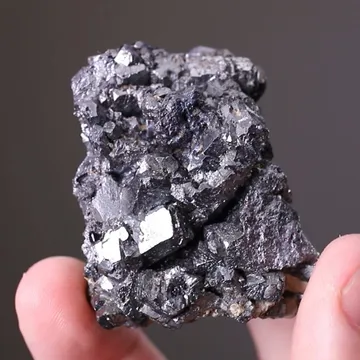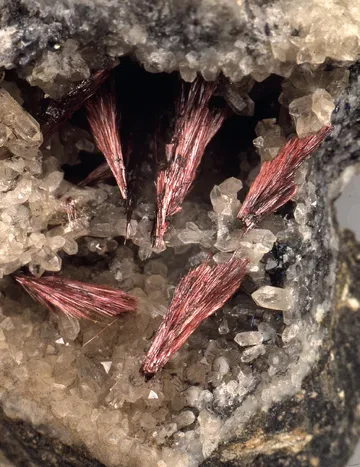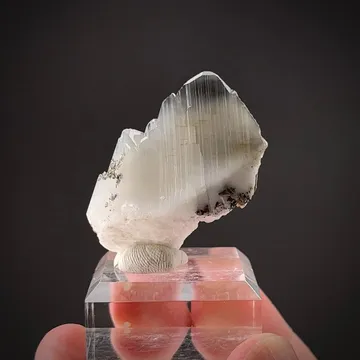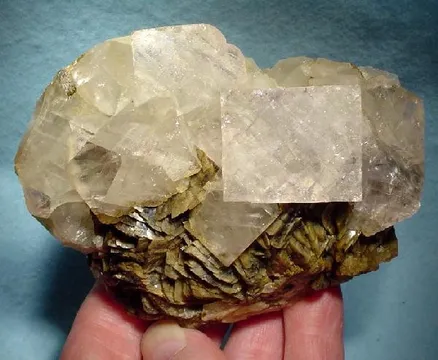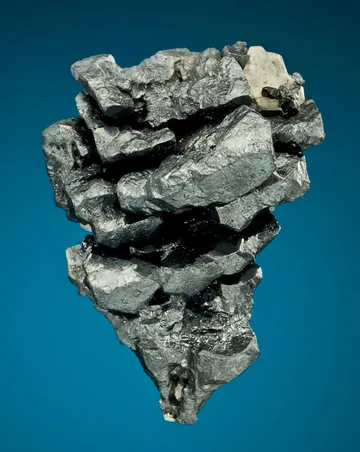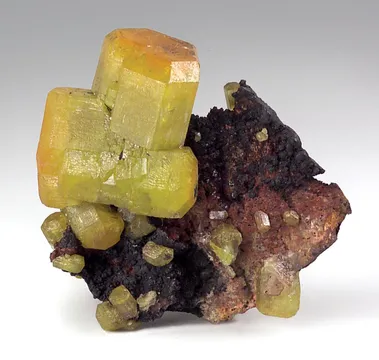
A collector's guide to Schneckenstein Cliff, Germany: its geology, mining history and notable minerals, illustrated with the 27 specimens documented from this locality on EarthWonders.
Key facts
Schneckenstein Cliff is one of the great old-world names in topaz collecting: a 23-metre crag of quartz-topaz-tourmaline breccia standing in the forested Upper Vogtland of Saxony, on the western side of Kielberg. Its fame rests on a very specific geological accident. Late Variscan magmatism associated with the Eibenstock tourmaline granite drove volatile, boron- and fluorine-rich fluids through contact-metamorphosed Ordovician phyllites, producing a greisenized explosive breccia pipe in which quartz, tourmaline, and topaz cemented fist-sized fragments of schistose rock. The best cavities in the upper part of the crag yielded transparent, short-prismatic, “wine-yellow” topaz on white to water-clear quartz—small by Brazilian standards, but historically electrifying because they were among Europe’s great early gem topazes and became benchmark specimens for crystallography, gem history, and the Mohs hardness scale.
Regional View
Country View
The Schneckenstein look is unmistakable when the specimen is right: honey- to wine-yellow topaz, commonly under 2 cm on surviving collector pieces, perched in a crystalline nest of quartz, with gray-greenish greisen or quartz-tourmaline breccia matrix still visible. The best crystals are transparent, lustrous, and sharply terminated, often with the classic short-prismatic habit described and drawn since the eighteenth century. Fine matrix pieces are scarcer than loose fragments because the original cliff was mined for gemstones, not specimen preservation, and the material’s strong basal cleavage makes clean, undamaged crystals unusually desirable.

Photo: Wikimedia Commons / Lech Darski

Photo: Wikimedia Commons / Mario Schmalfuß
Schneckenstein also matters because its importance is not merely aesthetic. The occurrence was described early by Johann Friedrich Henckel and Johann Gottlieb Kern; its crystal forms were used by René Just Haüy; and Carl Friedrich Christian Mohs used Schneckenstein topaz as the reference material for hardness 8. Few mineral localities can claim that their specimens entered both royal treasuries and the working language of mineralogy.
Search for specimens: View all specimens from Schneckenstein Cliff, Germany
Schneckenstein Cliff, also historically known through the Königskrone topaz workings, lies near Schneckenstein/Tannenbergsthal in the municipality of Muldenhammer, Vogtlandkreis, Saxony. The crag is on the western slope of Kielberg, roughly 10 kilometres southeast of Falkenstein/Vogtland, and stands at about 883 m above sea level. Today it is a protected natural monument and a prominent stop within Topaswelt Schneckenstein, together with the nearby Besucherbergwerk Grube Tannenberg and the Vogtländisch-Böhmisches Mineralienzentrum.
Geologically, the locality is a greisenized breccia body in the contact aureole of the Eibenstock tourmaline granite, part of the Nejdek–Eibenstock massif. The granite crystallized at about 319.8 ± 1.0 million years ago, during the late Variscan evolution of the Erzgebirge/Vogtland region. The cliff itself represents the erosion-resistant top of a breccious vent or diatreme filling. In the simplified field picture, quartzite-schist-like fragments were broken and recemented by quartz, tourmaline, and topaz during volatile-rich alteration. The alteration history is generally described in two stages: first boron infiltration formed tourmaline; later fluorine-rich fluids produced topaz, in part replacing earlier tourmaline. In depth the tourmaline component increases while topaz diminishes, a relationship known from drilling and underground observations connected with the nearby Tannenberg tin workings.
The specimen-producing part of the deposit was the upper cliff, especially small drusy cavities in the quartz-topaz breccia. These were the pockets that yielded gem-quality topaz suitable for cutting, generally in association with white to clear quartz, tourmaline, pyrite, and white to yellow-brown “Steinmark,” a clayey kaolin-group material dominated by dickite in the literature. Old descriptions emphasize that the finest topaz crystals were especially well developed in cavities filled with this soft “Steinmark,” which protected the crystals and made them easier to recover.
The mining history is short, royal, and consequential. Regulated mining began in 1727 when Christian Kraut of Auerbach, described in different sources as a furrier, draper, cloth merchant, or local official, revealed the locality and began work with permission of the impoverished landowner von Trützschler. Within months, Augustus the Strong acquired the property and ordered the exploitation intensified, requiring that the largest and finest stones be surrendered to him. The workings then took the name Königskrone. The richest period lasted only about fifteen years. By the middle of the eighteenth century the best material was already in decline, and later attempts to revive the deposit never restored its early profitability. Professional topaz mining ended in the late eighteenth century, with the year 1796 commonly given for the final cessation.
The amount of rock removed is a reminder that Schneckenstein is not merely a “famous outcrop” but a heavily mined remnant. Saxon geological sources state that roughly a third of the cliff was quarried by the Königskrone operation, while other regional accounts describe the present rock as the remnant left after extensive gemstone extraction. The nearby Tannenberg tin mine later intersected and helped define the deeper geometry of the body; at about 90 m depth the Schneckenstein body was reported as roughly 110 m by 35 m with sharp contacts to the country rock. The same district also includes Sn-W greisen mineralization, and west of the cliff are large dumps connected with post-Second World War uranium mining in the Schneckenstein–Brunndöbra area.
Collecting access today is essentially closed. The cliff has been protected since 1938, is fenced, and collecting—especially digging—is strictly prohibited. Older literature and collector accounts sometimes mention small crystals in weathering debris, but serious collectors should treat the current legal and conservation status as controlling: no hammering, no digging, and no collecting within the protected fenced site or restricted surrounding forest. Modern Schneckenstein specimens on the market are therefore old collection pieces, historic material, pieces from earlier legal recovery, or material with older provenance labels.
Schneckenstein topaz is the locality’s signature mineral: transparent to translucent, typically pale yellow to vivid wine-yellow, in short prismatic crystals with well-developed terminations, most prized when still seated on quartz in greisen breccia. Modern studied crystals include small specimens under 2 cm, and collector-market pieces commonly show crystals in the millimetre to low-centimetre range, though historical literature mentions larger crystals and exceptional material suitable for cutting. The finest stones came from drusy cavities in the uppermost part of the cliff, especially those with white or yellow-brown clayey “Steinmark,” where crystals could form cleanly with quartz. What separates a good Schneckenstein topaz from an ordinary one is a combination of verifiable old provenance, matrix association, undamaged terminations, lively wine-yellow colour, transparency, and visible relationship to the quartz-topaz-tourmaline breccia; loose, cleaved, pale fragments may be authentic but lack the full locality character that made Schneckenstein famous.
Quartz at Schneckenstein is more than background matrix: it is the structural and aesthetic partner that frames the topaz. The breccia fragments are cemented by quartz and topaz, and the druses commonly carry white to water-clear quartz crystals with wine-yellow topaz, sometimes producing the classic “topaz in a crystal cave of rock crystal” appearance seen in museum specimens. Several sources note well-developed quartz crystals, including clear rock crystal, and regional collector literature describes elongated “Tessiner Habitus” quartz from the locality. The best quartz-bearing pieces are those in which clear or milky quartz gives scale, contrast, and geological context to sharp topaz crystals; quartz-only specimens are far less celebrated, but a piece showing the breccia texture, small drusy cavities, and clean quartz growth can still be a meaningful Schneckenstein reference specimen.
Beyond topaz and quartz, Schneckenstein has a surprisingly rich accessory assemblage for such a small and protected occurrence. Published lists and modern analytical work document tourmaline, pyrite, rutile or niobian rutile historically called ilmenorutile, apatite, zircon, xenotime-group inclusions, fluorite, cassiterite, wolframite, molybdenite, chalcopyrite, malachite, azurite, native gold, kaolinite/dickite “Steinmark,” crandallite, wavellite, turquoise, pharmacosiderite, scorodite, and chalcosiderite with the historical Al-rich variety name alumo-chalcosiderite. Schneckenstein is also bound to the type-locality story of topaz in a historical rather than modern IMA sense: it is repeatedly treated in collector literature as the classic European reference locality for gem topaz and was central to early descriptions of the species, but “alumo-chalcosiderite” itself is now best understood as an Al-rich variety or compositional member within chalcosiderite/turquoise-group nomenclature rather than a modern stand-alone species.
The main authenticity issue with Schneckenstein material is provenance. The protected status of the crag means newly collected specimens should be treated with caution, and unlabelled loose yellow topaz crystals are easy to over-attribute. A credible Schneckenstein specimen should fit the locality’s visual grammar: wine-yellow to pale yellow short-prismatic topaz, commonly small, often with white or clear quartz, greisenized quartz-tourmaline breccia, and sometimes clayey white to yellow-brown pocket filling. A loose, bright yellow or blue topaz crystal without an old German label, collection history, or matrix context deserves skepticism.
Condition is critical. Schneckenstein topaz has perfect basal cleavage, and the old Saxon material is often internally veiled, cleaved, or fractured; even official specimen photography shows crystals with numerous cleavage cracks. Minor bruising is common and should be judged in context, but a premium piece needs intact terminations, unchipped prism edges, and no distracting cleave across the display face. Matrix pieces should be inspected for repaired topaz crystals, reattached loose crystals, and composite quartz/topaz groupings, since the combination is valuable enough to tempt enhancement even where no large documented fake industry is associated with the locality.
Colour should also be judged carefully. The characteristic Schneckenstein colour is pale to wine-yellow rather than the saturated orange-pink associated with Imperial topaz. Laboratory heating experiments on Schneckenstein material show that annealing can nearly bleach the yellow colour to near-colourless, so heat is not a plausible way to improve the classic colour; it is more a handling and identification caution than a commercial treatment advantage. Do not call Schneckenstein material “Imperial” merely because it is yellow and contains trace chromium-related luminescence. Recent gemological work indicates that the yellow body colour is not caused by chromium in the same way as Imperial topaz.
Under ordinary long-wave and short-wave UV lamps, Schneckenstein topaz may appear essentially inert. Under violet to blue excitation, however, it can show pink to red chromium-related photoluminescence, a useful curiosity for advanced collectors but not a simple locality test on its own. Store and handle specimens as you would any good topaz: avoid knocks, thermal shock, ultrasonic cleaning, and pressure along cleavage planes. The best old matrix specimens are not common, and market availability is sporadic; when good examples appear, provenance, condition, and the quality of the quartz-topaz composition matter more than sheer size.
The story begins, as mineral stories often do, with a man who knew where the stones came from and a ruler who wanted them. Christian Kraut of Auerbach had access to the secret of the yellow gems being traded from the Vogtland. In 1727 he approached the Saxon court and identified the source: the Schneckenstein, then on land held by von Trützschler. Augustus the Strong moved quickly. He bought the ground, authorized Kraut to expand the workings, and attached a very royal condition: the largest and most beautiful stones were to go to him. From that moment the mine carried the name Königskrone—King’s Crown.
The early workings were practical and physical rather than romantic. The rock was washed so the topaz could be seen more easily, then attacked chiefly on the northwestern side with hammer and chisel. In 1738, 70 pounds of the first year’s production was sent to the royal chamber in Dresden. The stones were sorted according to use and quality: Ringsteine for rings, the most desirable category; Hemdknopf material for shirt buttons; Carmosiergut for small stones used to frame larger gems; and Brack, the inferior, impure material with little use. This is a rare glimpse of an eighteenth-century gemstone mine not as a legend but as a working supply chain: cliff, washing, sorting table, Dresden treasury.
Royal taste transformed Schneckenstein from a mineral locality into a courtly object. The finest stones ordered by Augustus the Strong in 1732 were ultimately set under his son Friedrich August II. In Dresden’s Green Vault, Schneckenstein topaz survives not only as faceted gems but as objects: a rattan walking stick with a 2.3 cm topaz knob, and sets of gold-mounted cushion-cut topazes in coat buttons and cuff links made in 1734 by Johann Heinrich Köhler. The most spectacular lost object was British: a crown containing 485 Schneckenstein topazes, ordered by George III for Queen Charlotte for their 1761 coronation. The crown is now presumed lost, probably dismantled so the stones could be reused.
The locality’s scientific afterlife was just as important as its royal one. Johann Friedrich Henckel described the occurrence in 1737 and served as inspector of the crag in 1739. Johann Gottlieb Kern prepared a remarkably full account in 1744, complete with views of the cliff from all four directions and drawings of crystals and specimens. René Just Haüy later used Schneckenstein crystals in the crystallographic work that helped lead toward his law of rational indices. Then, in 1817, Carl Friedrich Christian Mohs chose Schneckenstein topaz as the reference substance for hardness 8. A little Saxon cliff thus entered every beginner’s mineral kit in the world, even if the user never learned the name Schneckenstein.
Goethe’s connection is quieter but wonderfully human. In July 1780, after reading Charpentier’s mineralogical geography, Johann Wolfgang von Goethe ordered 100 to 120 Schneckenstein topaz specimens at a price of 12 thaler. Only 94 pieces reached Weimar in January 1781. After Goethe visited Schneeberg in 1786, Charpentier sent another group of about 100 topaz specimens to Weimar. Whether Goethe himself ever stood at the Schneckenstein remains unresolved, but the trail of ordered specimens, short delivery, and renewed shipment is exactly the kind of paper-mineral history that makes classic European localities so alive.
Another vivid episode belongs to the modern scientific custody of the rock itself. In March 2007 the Vogtländisch-Böhmisches Mineralienzentrum Schneckenstein donated a roughly 1.20 m high, 350 kg block of Schneckenstein breccia to the Institut für Mineralogie und Kristallographie of the University of Vienna. The gift followed student excursions led by Lutz Nasdala in 2005 and 2006, during which the visit to the old tin mine and the Schneckenstein material became a highlight. Steffen Gerisch, head of the visitor mine and mineral centre, offered the block; professors Richard Göd, Friedrich Koller, and Lutz Nasdala travelled to receive it; and the piece was installed in a specially made glass vitrine in the foyer of the Vienna Geozentrum, accompanied by smaller exhibits including six faceted Schneckenstein topazes.