Neue Hoffnung Gottes Mine, Germany — Freiberg locality and type locality for kermesite, miargyrite, and diaphorite, prized for red kermesite needles and rare s…
Key facts
Neue Hoffnung Gottes is one of those old Saxon names that still carries real mineralogical weight. The mine lies at Bräunsdorf, near Oberschöna in Mittelsachsen, on the western side of the classic Freiberg silver district—a district worked for centuries for steep hydrothermal veins rich in silver, lead, zinc, antimony, and their sulfosalts. For collectors, the locality’s stature rests less on abundance than on pedigree: it is the type locality for kermesite, miargyrite, and diaphorite, and it has supplied a compact but memorable suite of antimony and silver-antimony minerals that place it among the great historical localities of European systematic mineralogy.
Geologically the mine belongs to the peripheral, silver-antimony-rich part of the Freiberg vein system. Its veins cut the metamorphic basement of the Erzgebirge, especially mica schist and graphitic schist, and modern work on the Bräunsdorf sector has interpreted the mineralization as epithermal, with an early Pb-Zn-Cu-Fe sulfide-quartz stage overprinted or accompanied by a cooler Ag-Sb sulfide and sulfosalt assemblage with quartz and locally carbonate. That geological zoning matters to collectors because the finest specimens are not anonymous sulfide ore: they are expressions of the shallow antimony cap and the silver-antimony transition—red to red-violet kermesite in quartz-lined cavities, black-gray miargyrite and other silver sulfosalts in quartz, stibnite, valentinite, freieslebenite, and rare Pb-Ag-Sb sulfosalts in the old Freiberg style.
The best Neue Hoffnung Gottes kermesite specimens have a look that is instantly recognizable: delicate, lustrous, crimson to wine-red needles and sprays, often lying flat or radiating across sparkling white quartz. Larger display pieces are unusual; many authentic examples are thumbnails or small miniatures, and many old specimens are known today through 19th-century labels, museum holdings, and classic European collections rather than fresh collecting.
Regional View
Country View

Photo: Wikimedia Commons
This locality is also important because it ties specimen aesthetics to the history of mineral naming. Kermesite was long known under older names such as red antimony ore before the modern species concept settled; miargyrite came into mineralogical literature through Friedrich Mohs; and diaphorite was defined in the 19th century from Bräunsdorf and Příbram material. A small, well-provenanced specimen from Neue Hoffnung Gottes can therefore carry more locality importance than a much larger specimen of the same mineral from a more productive modern mine.
Search for specimens: View all specimens from Neue Hoffnung Gottes Mine, Germany
Neue Hoffnung Gottes is the principal historical mine of the Bräunsdorf vein district, part of the Freiberg mining region of Saxony. In modern administrative terms the locality is at Bräunsdorf, Oberschöna, Mittelsachsen; in older mineral literature it is commonly given simply as Bräunsdorf near Freiberg, Saxony, or Braunsdorf in older English-language labels.
The deposit is a steep, hydrothermal, low- to intermediate-sulfidation epithermal vein system in the western Freiberg district. The larger regional system consists of numerous veins in metamorphic host rocks including gneiss, mica schist, graphitic schist, phyllite, metagabbro, and related units. At Bräunsdorf, the graphitic schist association is especially characteristic. The main mineralized structure at Neue Hoffnung Gottes is the Neue Segen Gottes Stehender, described in modern mining reports as a NNE-SSW to NE-SW trending principal vein system. Historical and modern summaries give vein widths commonly from decimetres to a few metres; locally the system reached several metres, and the main structure branched or horsetailed toward both ends. That branching vein geometry is one reason the Bräunsdorf camp was unusually productive for a peripheral Freiberg mining sector.
The ore was zoned vertically. Nearer the top of the system, antimony-rich quartz mineralization dominated, with stibnite, berthierite, kermesite, valentinite, cervantite, and related Sb species. With increasing depth the system passed into richer Ag-sulfide and Ag-Sb sulfosalt mineralization, including miargyrite, pyrargyrite, proustite, stephanite, acanthite, freieslebenite, diaphorite, pyrostilpnite, xanthoconite, and associated galena, sphalerite, arsenopyrite, pyrite, chalcopyrite, quartz, carbonate minerals, and fluorite. In district terms, the mine is best understood as one of the places where the silver-sulfosalt and antimony-sulfide facies of Freiberg meet in collectible form.
Historically the Bräunsdorf district was worked before the Thirty Years’ War, though the exact early beginnings are obscure. The better documented revival began in 1673 under the estate owner Romanus Teller, after which the mine remained active into the 19th century. Neue Hoffnung Gottes became the largest mine of the Bräunsdorf gang district and the most important operation in the western Freiberg sector. Modern technical summaries list production from the Bräunsdorf camp and Neue Hoffnung Gottes as more than 112 tonnes of silver, equivalent to more than 3.6 million troy ounces, with historical grades reported in the kilogram-per-tonne range. The mine was active from the 16th century to 1863, with a particularly strong 18th-century period.
Two major ore shoots were worked along the principal vein and related hanging-wall or footwall veins. One was centered on the Neue Hoffnung Gottes shaft and extended for hundreds of metres along strike and down several hundred metres; the other was centered on the Siegfried shaft. Older locality descriptions also list a large number of named veins in the Bräunsdorf district—Stehender, Morgengang, and Spatgang structures in the traditional Freiberg nomenclature—including Verlorene Hoffnung Stehender, Aaron Morgengang, Felix Morgengang, Kühschacht Morgengang, Zweifler Stehender, Gotthelf Stehender, Verträgliche Gesellschaft Stehender, Siegfried Stehender, Rautenkranz Stehender, Jupiter Morgengang, Alexander Morgengang, August Stehender, Goldene Rose Stehender, and others. For the collector, these names explain why old labels may mention Bräunsdorf, Siegfried, Kühschacht, or Neue Hoffnung Gottes in ways that seem partly overlapping.
Collecting access today should be considered essentially closed for practical specimen recovery. The mine is long abandoned, underground access is not a collecting option, and the remaining surface traces are cultural and industrial heritage rather than an active collecting field. The huthaus of the Neue Hoffnung Gottes Fundgrube survives at An der Striegis 11 and is listed as a Saxon cultural monument; the old main dump opposite the huthaus is reported as offering no collecting possibilities and is treated as a technical monument. Modern collecting material on the market is therefore overwhelmingly old-stock, ex-collection, or from previously dispersed dealer and museum holdings.
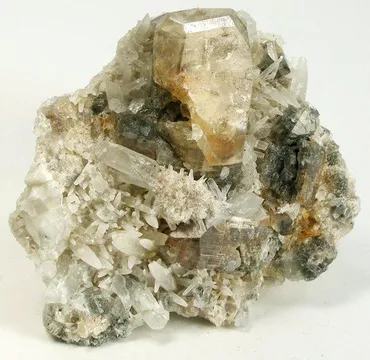
The notable specimen finds were chiefly historical. Classic kermesite occurs in quartz vugs as red to red-violet fibrous or acicular sprays, sometimes with stibnite, chalcopyrite, or valentinite. Stibnite was once found as thick, curved blades or rods, and older descriptions note attractive specimens accompanied by valentinite. Freieslebenite from Bräunsdorf occurs in included needles and, in older material, as prismatic crystals reaching the centimetre scale. Native silver is recorded but was never a common display mineral here, more typically appearing as small curls or wires rather than the dramatic arborescent forms of some other Saxon districts.
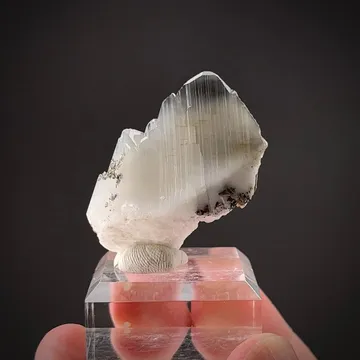
Neue Hoffnung Gottes is the defining locality for kermesite, and its best pieces show why early mineralogists lingered over “red antimony” from Bräunsdorf: the mineral occurs as crimson, wine-red, to red-violet fibrous needles, radial sprays, and flattened acicular groups lining quartz cavities or nestled with stibnite-rich antimony ore. Most collectible examples are small, with many modern-circulating pieces in the thumbnail to miniature range; documented old specimens include quartz vugs several centimetres across carrying individual kermesite needles or sprays to the millimetre scale, while locality descriptions note rare free-standing sheaves reaching several centimetres. The most desirable specimens have vivid red color, visible luster, undamaged radiating habit, and strong contrast against white quartz; ordinary pieces are more often dark, matted, crusty, or visually lost in black antimony sulfide matrix.
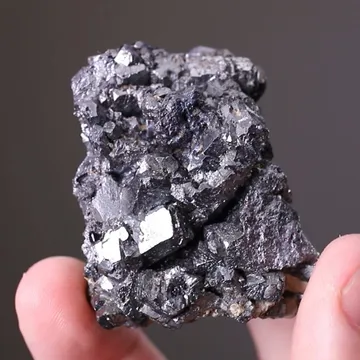
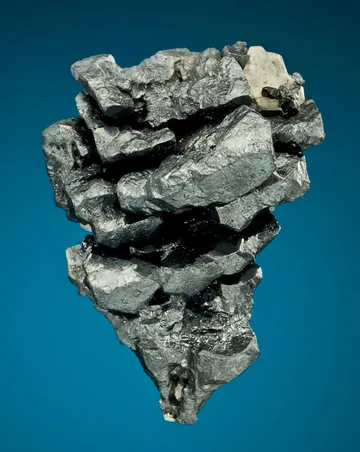
Beyond kermesite, Neue Hoffnung Gottes is a classic locality for silver-antimony sulfosalts. Miargyrite, the dark steel-gray to black AgSbS2 species whose fragments can show deep red internal color, is a type-locality mineral from the mine and is one of the locality’s most historically important silver species. Diaphorite, Ag3Pb2Sb3S8, is also a type-locality mineral here, tied to 19th-century work on Bräunsdorf and Příbram material. Freieslebenite is especially noteworthy from Bräunsdorf, occurring as embedded needles and rare prismatic crystals in historical specimens. Other documented minerals include acanthite, pyrargyrite, proustite, stephanite, pyrostilpnite, xanthoconite, native silver, stibnite, berthierite, boulangerite, bournonite, jamesonite, plagionite, semseyite, zinkenite, fülöppite, valentinite, cervantite, senarmontite, metastibnite, greenockite coatings on corroded sphalerite, fluorite, quartz, galena, sphalerite, arsenopyrite, pyrite, chalcopyrite, siderite, dolomite, calcite, and rare chapmanite associated with the old Bräunsdorf antimony-bearing silicate problem.
Provenance is the central issue with Neue Hoffnung Gottes specimens. A fine kermesite, miargyrite, or diaphorite labeled from Bräunsdorf is not merely “German material”; it may be a type-locality specimen from an essentially exhausted historical mine. Collectors should value old labels, especially those tying a piece to Bräunsdorf, Freiberg, Neue Hoffnung Gottes, Siegfried, or older Saxon collections. Because many locality names in Germany include “Neue Hoffnung,” labels must be read carefully. Neue Hoffnung Gottes at Bräunsdorf is not the same locality as the various Neue Hoffnung or Hoffnung mines in Siegerland, Bleialf, the Black Forest, or other German districts.
For kermesite, the main authenticity problem is not widespread fabrication but misidentification and mislocality. Dark red-brown crusts may be called kermesite when they are metastibnite, cervantite-stained material, altered stibnite, or mixed antimony oxides. Conversely, true kermesite can look almost black until strong light reveals its crimson fibers. The safest specimens show recognizable acicular or fibrous red kermesite on quartz or with stibnite and carry either analytical support, strong old provenance, or a chain through a reputable dealer or collection. Bright red sprays on white quartz are especially desirable, but the habit should be delicate and mineralogically plausible; overly dramatic, recent-looking, unsupported pieces deserve caution simply because the mine is not a modern producer.
Condition is a major grading factor. Kermesite is very soft, slender, and easily bruised; broken fiber tips, matted sprays, dust-filled vugs, and detached needles are common. Stibnite from the locality can be bent, dulled, or oxidized. Silver sulfosalts such as miargyrite, pyrargyrite, proustite, pyrostilpnite, and xanthoconite should be protected from prolonged intense light, as red silver minerals and related sulfosalts can darken or alter over time. Store the best pieces in a stable, dry cabinet away from direct sunlight, and handle them by the matrix rather than by exposed metallic or fibrous growths.
Market availability is limited but not nonexistent. Small kermesite specimens still appear periodically in European auctions and dealer stocks, often at modest to mid-level prices when the crystals are tiny or visually subdued. Larger, old-label, richly colored pieces on quartz are much scarcer and command a type-locality premium. Miargyrite and diaphorite from the mine are generally more specialized; attractive crystal specimens are much less available than small massive or micro material, and serious systematic collectors should not wait for repeated opportunities. A modest but verified Neue Hoffnung Gottes specimen is often preferable to a showier but vague “Bräunsdorf” piece with no reliable chain of custody.
The surviving story of Neue Hoffnung Gottes is as much about water, engineering, and endurance as it is about silver. In the 18th century, the Bräunsdorf mines had become deep enough that pumping water was no minor inconvenience—it was the limiting condition of mining. The district eventually reached nearly 300 metres depth, and at times more than 500 miners were employed in the Bräunsdorf workings. Those figures give the locality a scale that is easy to miss when looking at a thumbnail kermesite: each small red spray came from a mine that was a major industrial organism of its valley.
One episode that still stands out in local accounts is the installation of Saxony’s first water-column machine at the Siegfried mine on the western side of the valley. A water-column machine used water pressure to power mine pumping, and in the context of late 18th-century Saxon mining it was advanced technology. The young Alexander von Humboldt, while associated with the Freiberg Mining Academy milieu, visited the Bräunsdorf mine because of this machinery. It is a telling detail: before Humboldt became the great explorer of the Americas, here he was inspecting the practical hydraulics of an Erzgebirge silver mine.
The landscape still preserves the afterimage of that water system. A former artificial watercourse, or Kunstgraben, ran through the Striegis valley to supply power for Neue Hoffnung Gottes. Later accounts of the Rotvorwerksteich water network show how complicated these rights could become: water from distant ponds and channels was argued over, redirected, repaired, and accounted for in thalers. In 1793 and 1794, a major repair of the Rotvorwerksteich cost 377 thalers; in the dispute over supply, Neue Hoffnung Gottes eventually distanced itself from the water arrangement, and by 1795 other mines had also given up that source. Behind the serene modern valley paths was a working hydraulic landscape built for pumps, stamps, wheels, and ore.
The mine’s end was not a single collapse but a slow economic narrowing. Rich silver made Bräunsdorf flourish in the 18th century, but by the 19th century the workable ore was waning and the cost of dealing with water, depth, and declining returns weighed heavily. Local accounts describe exhaustion of the deposit, falling silver prices, debt, and the impoverishment of miners before mining at Bräunsdorf came to a close in 1863. Today the huthaus, shaft depressions, old water features, and overgrown dumps carry a quieter message: this famous mineral locality is no longer a place to dig, but a place where small old specimens connect directly to the social and technical history of Saxon mining.