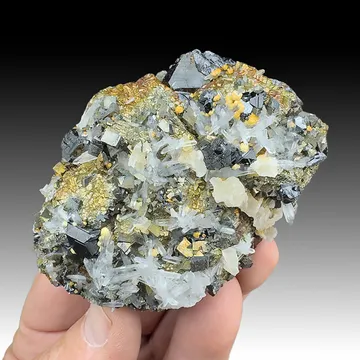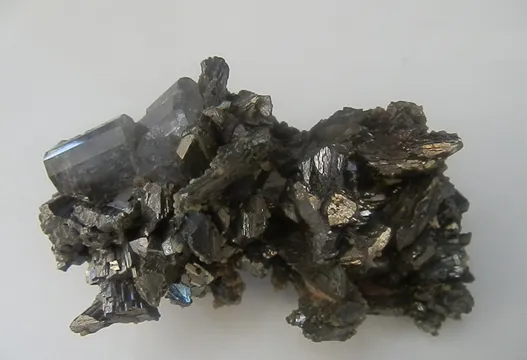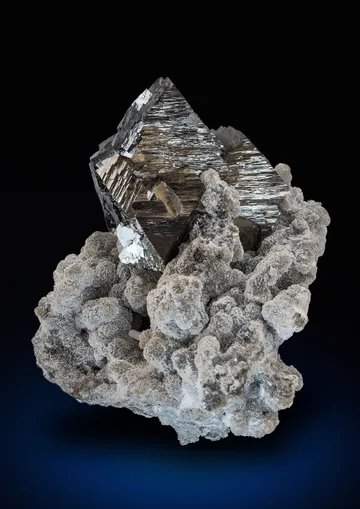
Arsenopyrite - steel-gray, mirror-bright prismatic crystals; prized for sculptural form and heft, with top localities (Panasqueira, Dalnegorsk, Yaogangxian) in…
Key facts
Arsenopyrite (FeAsS) is the classic steel-gray, strongly metallic arsenic sulfide and the primary ore of arsenic. It forms sharply striated prismatic crystals with wedge-shaped terminations and superb, mirror-bright luster. Habit ranges from single robust prisms to dramatic radiating clusters and intergrown sheaves. Aesthetics often come from contrasts: silvery arsenopyrite perched on snow-white quartz, set amid tan siderite, or paired with pastel fluorite or green fluorapatite. Good crystals commonly measure 2–6 cm, with larger individuals from a few key districts.
For collectors, arsenopyrite offers sculptural geometry, heft (it is notably dense), and a refined metallic sheen that can rival pyrite or stibnite. While many cabinet specimens remain quite affordable, top-end pieces—particularly from Panasqueira (Portugal), select Chinese finds (Yaogangxian, Dachang), Dalnegorsk (Russia), and historic European classics (Freiberg, Trepča)—command strong prices. Fresh, damage-free terminations and untarnished surfaces make a big difference.
Arsenopyrite is a staple of serious sulfide suites and old European vein collections, prized for crystalline perfection and history. Its popularity surged with major European mining districts (Freiberg and the Balkans), then again with the great Panasqueira specimens of the mid- to late-20th century, and later with the wave of fine Chinese material from the 1990s–2010s. Because arsenopyrite plays well visually with quartz, fluorite, siderite, and fluorapatite, it anchors many mixed-matrix display pieces.
All levels of collectors can participate: sharp thumbnails are abundant; elegant small cabinets remain reasonably priced; and museum-caliber matrix groups with multiple perfect terminations are rare and chased. Though it lacks bright colors, its metallic brilliance, classic associations, and strong locality stories keep demand steady. As with many sulfides, provenance and condition heavily influence desirability.
Below are renowned sources known for producing arsenopyrite specimens with distinctive aesthetics or historical importance. Each locality is included only if a verified EarthWonders locality ID is available.
Panasqueira is the world’s most celebrated arsenopyrite locality. Specimens are instantly recognizable: sharply striated, lustrous silvery crystals—often 2–8 cm—set with snow-white quartz, tan to honey siderite, and brilliant green fluorapatite. The pieces are architectural and balanced, typically with multiple crystals oriented in dynamic clusters and excellent contrast. Many of the finest matrix specimens of the species come from here; they established the modern aesthetic standard and remain benchmarks.
The Yaogangxian skarn-vein system produced elegant arsenopyrite in association with pastel fluorite, quartz, and visible tungsten minerals. Crystals are typically sharp, highly reflective, and well-isolated, often forming attractive small cabinet pieces with excellent geometry. Peak production in the late 1990s–2000s brought a steady flow of quality pieces; select specimens with fluorite cubes or octahedra can be spectacular.
The Trepča complex is a classic European district, and Stari Trg produced robust arsenopyrite crystals on attractive sulfide and carbonate matrices. Crystals tend to be stout and bright, often framing sphalerite, pyrite, and calcite for dramatic contrast. Vintage specimens with original labels are coveted for their history; modern pieces remain respected for size and balance.
Arsenopyrite contains arsenic. Normal handling is safe, but treat it with respect.
By prioritizing sharp form, pristine surfaces, and attractive associations—especially from the classic localities above—you can assemble an arsenopyrite suite that shines with metallic elegance and historical depth.