






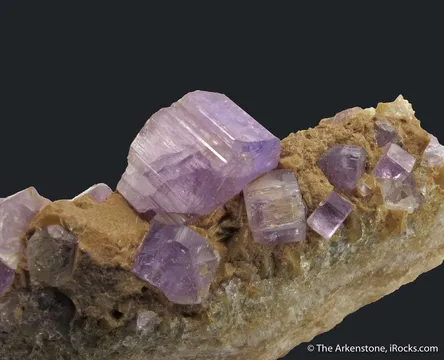
Johanngeorgenstadt, Germany - historic Erzgebirge locality for silver-uranium ores and mimetite type locality, with rare nickel arsenates.
Key facts
Johanngeorgenstadt is one of the classic collecting names of the western Erzgebirge: a compact but historically immense Ag-U-Bi-Co-Ni-As vein district on the Saxon side of the German-Czech border, just across the mountains from Jáchymov. For mineral collectors its reputation rests on two very different pillars. The first is the old silver-uranium mining field, where pitchblende, native bismuth, native silver, arsenides, carbonates, quartz and secondary uranium minerals record several centuries of hydrothermal and supergene activity. The second is Johanngeorgenstadt’s extraordinary roster of named minerals, including mimetite as a type-locality species and a suite of rare nickel arsenates that have continued to yield new species from old specimens well into the 21st century.
The deposit is a perigranitic hydrothermal vein system of the Erzgebirge anticlinorium, developed in gneiss and schist intruded by granitic rocks of the Eibenstock-Karlovy Vary granite region. Uranium mineralization belongs to the same broad metallogenic province that includes Schneeberg-Schlema-Alberoda, Jáchymov and Příbram, and the Johanngeorgenstadt veins show several overprinted ore associations: quartz-carbonate-uranium, magnesian carbonate-pitchblende-fluorite, and Bi-Co-Ni-As-U-Ag assemblages. That paragenetic complexity is exactly why the locality has produced both historically important ore specimens and mineralogical curiosities whose identity cannot be settled by appearance alone.
Regional View
Country View
The finest Johanngeorgenstadt specimens are not big by modern “showpiece” standards, but they are intensely historic. Classic mimetite appears as lustrous yellow crystals and crystal groups on quartz or limonitic vein material, with old cabinet pieces preserving the heavy, tabular-to-short-prismatic habit that made the locality famous in the 18th and 19th centuries. Uraninite from the Georg Wagsfort mine belongs to the story of uranium’s discovery, while the most exotic nickel arsenates occur as microscopic, vividly colored crusts and grains on quartz-bearing vein fragments: dark green aerugite, yellow-green xanthiosite, black-green bunsenite, pink-orange johanngeorgenstadtite and red-orange niasite in combinations that are essentially a fingerprint of Johanngeorgenstadt.

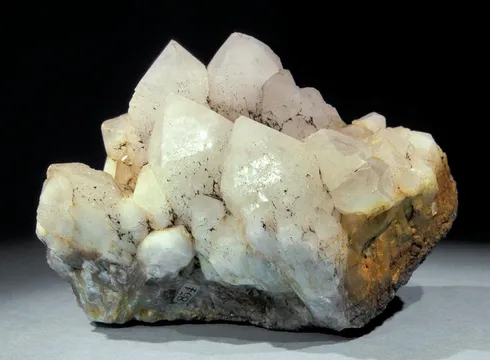
Photo: Naturhistorisches Museum Wien

Search for specimens: View all specimens from Johanngeorgenstadt, Germany
Johanngeorgenstadt lies in the western Ore Mountains of Saxony, immediately north of the Czech border and close to Potůčky and Horní Blatná. In collecting literature the name may refer to the town locality, the broader Johanngeorgenstadt mining district, or to named mines and shafts such as Georg Wagsfort, Treue Freundschaft, Neujahrsmaassen, Schaar Shaft, Gnade Gottes, Frisch Glück, Neu Leipziger Glück and the Wismut-era numbered shafts. Labels should be read carefully: “Johanngeorgenstadt” is often accurate as a district attribution, but the most desirable scientific labels preserve the mine or shaft name as well.
Geologically the deposit is a vein-type, perigranitic uranium-silver-bismuth district on the Saxo-Thuringian margin of the Bohemian Massif. The host rocks are Proterozoic to Lower Paleozoic gneisses and schists affected by granitic intrusion, contact metamorphism and later hydrothermal alteration. The principal alteration styles include silicification, sericitization, sulfidization, argillization and chloritization. Ore control was strongly structural: northwest-southeast and younger east-west fracture systems, the broader Gera-Jáchymov lineament, and the contrast between graphitic, pyritic and contact-metamorphosed lithologies all influenced ore deposition.
The mineralization is best understood as a long-lived, repeatedly reactivated hydrothermal vein system. The principal uranium ore mineral was pitchblende, with minor coffinite reported in uranium-deposit summaries. Three paragenetic associations are especially important: comb quartz-carbonate-uranium veins; magnesian carbonate-pitchblende-fluorite mineralization; and the Bi-Co-Ni-As-U-Ag assemblage that carried native bismuth, native silver, pitchblende, arsenides and sulfides. A later silver-sulfide-arsenide association is also represented, generally with calcite and dolomite gangue. For collectors, this overprinting explains why a single old specimen may combine quartz, carbonate, uraninite, native bismuth, arsenates and secondary uranium minerals in ways that are both attractive and analytically treacherous.
Mining in the area predates the formal foundation of Johanngeorgenstadt, with tin and iron working in the region before the town became a Bergstadt. The town itself was founded in 1654 by Protestant exiles from the Bohemian side of the Erzgebirge, and by 1680 roughly a hundred ore mines were active in and around the settlement. Silver mining expanded rapidly in the late 17th century, though Johanngeorgenstadt never rivalled Freiberg as a silver producer. The Georg Wagsfort mine was opened in 1670 near Wittigsthal and produced silver ore in 1680, but its world-historical importance came in 1789, when Martin Heinrich Klaproth used pitchblende from this mine in the work that led him to recognize uranium.
Uranium ore acquired a second, industrial life in the 19th century when Erzgebirge uranium minerals were sought for yellow glass and porcelain colors. Johanngeorgenstadt and its surroundings were among the early places where uranium ores were deliberately worked for that purpose. The Georg Wagsfort mine also yielded fritzscheite, described by August Breithaupt in 1865, adding another type-locality thread to a deposit already tied to torbernite, uranopilite and mimetite.
The most dramatic mining phase came after the Second World War. Soviet geologists and technical personnel inspected Erzgebirge mining archives in 1945, and the Johanngeorgenstadt workings became one of the first targets of the uranium search that led to SAG Wismut. Existing accessible mines such as Frisch Glück, Schaar Shaft, Hoffnung Shaft and several adits were re-entered and reconstructed. By the end of 1945, Frisch Glück and Schaar Shaft had been reopened to the 78-Lachter level; by 1946 the Johanngeorgenstadt operation was designated Objekt 01. Wismut reused old mine levels, drove new workings, numbered shafts and veins, and ultimately extracted about 3,770 tonnes of uranium from the Johanngeorgenstadt deposit between 1946 and 1958.
The Wismut period reshaped the town as well as the subsurface. Objekt 01 worked an approximately 10 km2 mining field that was already cut by historic shafts, adits and blind shafts, and added further shafts, adits and blind shafts of its own. The deepest Wismut workings reached below the older mining horizons, and the extraction and waste handling left major dumps and instability problems. Parts of the old town were demolished in the 1950s and 1960s because of mining damage. Later remediation stabilized dumps, secured adits, capped shafts and recontoured mine-waste areas; some former sites are now interpreted by the Johanngeorgenstadt mining trail rather than available for collecting.
Specimen production is consequently an old-collection story rather than a modern collecting story. The classic mimetite crystals came from old oxidized lead-arsenate occurrences in the district, especially labels tied to Treue Freundschaft, Neujahrsmaassen and Schaar Shaft. The rare nickel arsenate material that yielded aerugite, xanthiosite, paganoite, petewilliamsite, niasite and johanngeorgenstadtite is known from historic material, much of it preserved in museum collections or recognized only after modern analytical work. Uraninite, torbernite, autunite, fritzscheite and uranopilite specimens also tend to be old, radiologically active, and often more valuable for their provenance than for display aesthetics.
Collecting access today should be approached as essentially restricted. Many workings are abandoned, sealed, capped, remediated, on protected or private ground, or unsafe because of old shafts, unstable dumps, contaminated mine waste and radon concerns. The best way to experience the mining field in person is through the local heritage infrastructure: the Pferdegöpel, the Bergbaulehrpfad, and the Lehr- und Schaubergwerk Frisch Glück “Glöckl.” Serious specimen collecting is largely a matter of old collections, dealer stock, museum exchanges of reference fragments, and carefully documented micro material.
Johanngeorgenstadt is the great old German name for mimetite, and the locality’s best pieces are yellow to honey-yellow Pb5(AsO4)3Cl crystals on quartz or limonite-stained vein matrix, generally in stout prismatic, barrel-like or tabular habits rather than the botryoidal crusts associated with many younger world localities. Documented specimens include individual crystals and groups in the millimeter to roughly 2 cm range, with an important Naturhistorisches Museum Wien group measuring 2.3 x 2 cm and private old-collection examples preserving crystals around 15 mm. The best Johanngeorgenstadt mimetites have sharp form, strong luster, saturated color and an old-time matrix setting; ordinary examples tend to be isolated small crystals, dull crusts or poorly localized “Saxony” pieces. Material with mine-level provenance is especially desirable, because the district name covers several mines including Treue Freundschaft, Neujahrsmaassen and Schaar Shaft, and because mimetite-M, formerly called clinomimetite, was later substantiated from Johanngeorgenstadt material as the monoclinic dimorph of mimetite.
Beyond mimetite, Johanngeorgenstadt is exceptional for type-locality and near-type mineralogy. Torbernite and uranopilite are tied to the district’s uranium-mineral history, while fritzscheite is a Georg Wagsfort co-type mineral associated with autunite and torbernite. Aerugite, bunsenite and xanthiosite belong to the rare anhydrous nickel arsenate assemblage for which Johanngeorgenstadt is the essential reference locality. Paganoite, petewilliamsite, niasite and johanngeorgenstadtite were all recognized from rare historic Ni-As-Bi material, the last two as Ni4.5(AsO4)3 dimorphs described in 2020. Other documented and collectible species include uraninite, native bismuth, native silver, native arsenic, acanthite, proustite, nickeline, safflorite, rammelsbergite, skutterudite-group “chloanthite/smaltite” material, galena, sphalerite, pyrite, arsenopyrite, anglesite, cerussite, adamite, pharmacosiderite, mixite, metatorbernite, autunite, johannite, fourmarierite and uranosphaerite. The collector should assume that many of the rare arsenates and uranyl minerals require analytical confirmation, especially when present as crusts or microscopic grains.
Johanngeorgenstadt specimens live and die by provenance. A label reading only “Saxony” or “Erzgebirge” is not equivalent to a mine-specific Johanngeorgenstadt label, and even “Johanngeorgenstadt” can cover a district with numerous named mines, adits and Wismut shafts. For mimetite, older labels naming Treue Freundschaft, Neujahrsmaassen or Schaar Shaft add value; for uranium and nickel arsenate specimens, labels naming Georg Wagsfort, AMNH-style reference material, or a Wismut shaft can be much more than decoration.
The main authenticity problem is not widespread fabrication but misidentification and overconfident relabeling. Johanngeorgenstadt mimetite may be confused with other yellow lead arsenates or with mimetite from later, more abundant localities. Conversely, common yellow mimetite from Mexico, Namibia, Thailand or elsewhere should never be “upgraded” to Johanngeorgenstadt because it has a classic yellow color. The old Saxon material usually has a restrained, historical look: modest size, compact form, quartz or iron-stained matrix, and old paper provenance. Large, bright, modern-looking mimetite clusters with no strong documentation deserve skepticism.
Mimetite-M is a special case. The monoclinic dimorph, formerly called clinomimetite, can look essentially like mimetite to the unaided eye, and its X-ray powder pattern may be difficult to distinguish without careful work. A dealer label that says “clinomimetite” on visual grounds alone should be treated cautiously unless it is tied to an analytical reference or a reputable old source. For most collectors, “mimetite from Johanngeorgenstadt” is a safer and more meaningful label than an unsupported claim of mimetite-M.
The rare nickel arsenates are analytical minerals. Aerugite, xanthiosite, bunsenite, paganoite, petewilliamsite, niasite and johanngeorgenstadtite occur as microcrystalline crusts, patches, grains or aggregates, commonly on quartz-rich matrix with native bismuth or nickeline-related material. Color helps—dark green aerugite, yellow-green xanthiosite, pink-orange johanngeorgenstadtite, red-orange niasite—but it is not enough. These are species for micromounters, researchers and collectors who value documented analysis over unaided aesthetics.
Radioactivity is a real handling issue. Johanngeorgenstadt uraninite, torbernite, autunite, metatorbernite, uranopilite, fritzscheite and related uranyl minerals should be stored in ventilated, labeled containers away from living spaces, handled with gloves or washed hands, and kept out of bedrooms, desks and display cases where dust accumulates. Do not grind, trim, saw or ultrasonically clean radioactive or arsenic-bearing material. Secondary uranyl sulfates and phosphates can be hydrated and delicate; uranopilite may dehydrate toward meta-uranopilite, and torbernite-group minerals can alter toward meta phases. Stable humidity, low heat and minimal handling are preferable.
Condition issues are typical of old Erzgebirge specimens: edge wear on small mimetite crystals, rubbed luster from antique storage, iron staining, repaired matrix chips, and obscure labels that passed through several hands. These are not necessarily defects in the same way they would be on a modern pocket piece; an undamaged, bright 19th-century Johanngeorgenstadt mimetite is genuinely scarce. On the market, good classic mimetite is infrequent and tends to appear from old European collections. Radioactive uranium specimens and polished uraninite vein fragments surface occasionally, but strong documentation and responsible shipping matter. Rare type-locality nickel arsenates are far less available still and should be treated as reference material.
The founding story of Johanngeorgenstadt is inseparable from the mountains. In 1654, Protestant exiles from the Bohemian mining town of Platten crossed into Saxony and built a new town at Fastenberg under the protection of Elector Johann Georg I. The new settlement took his name. Within decades the ridge was no quiet refuge: by 1680, roughly a hundred mines were counted in and around the town. The district’s ore brought hope more reliably than profit. At Georg Wagsfort, first granted in 1670 near Wittigsthal, a rich quarter in 1680 yielded 72 Mark, 7 Lot and 1 Quent of silver—about 16.9 kg. Yet the mine never paid its way, even though it produced about 220 kg of fine silver by 1716. Its fame would come not from a dividend book, but from a black, heavy ore nobody had yet fully understood.
In 1789 Martin Heinrich Klaproth, working in Berlin, analyzed pitchblende from Georg Wagsfort and recognized a new element. He named it uranium after the newly discovered planet Uranus. The specimen material came from a mine that had been opened for silver and had struggled economically, an irony collectors still appreciate: a losing silver mine became one of the birthplaces of modern uranium chemistry. Later local heritage signage remembered the episode plainly: “1789 - A New Element - Uranium.” For collectors, a Johanngeorgenstadt uraninite label is therefore not merely a locality tag; it is a direct connection to the moment when pitchblende changed from troublesome black ore to the carrier of a new element.
The district also had a second, quieter uranium chapter. Before uranium became a strategic nuclear metal, Erzgebirge uranium ores were sought for color. Johanngeorgenstadt uranium minerals were worked for yellow glass and porcelain pigments, and the Georg Wagsfort area became important again in the early 19th century. This is the world of torbernite plates, autunite, fritzscheite and uranium “ochres”: beautiful, chemically restless minerals that looked like color itself. Fritzscheite, described in 1865 by August Breithaupt and named for chemist Carl Julius Fritzsche, belongs to that tradition of uranium minerals as both scientific objects and industrial colorants.
One of the best modern stories is not underground at all, but in a drawer. An enigmatic Johanngeorgenstadt specimen was bought by the American mineral dealer David New in 1981 from a mineral shop in Germany, apparently without a label. In 1988, Mark N. Feinglos recognized that its assemblage—bunsenite, aerugite and xanthiosite—could only point to Johanngeorgenstadt. From that single, obscure historic specimen came paganoite in 2001 and petewilliamsite in 2004. Later work traced related material through James Ferriaolo to the American Museum of Natural History, where specimen no. 17956 consisted of three major fragments and numerous smaller pieces. The old AMNH card recorded 10 pieces containing aerugite and xanthiosite, obtained in June 1914 from the collection of Walter F. Ferrier. A specimen that might have remained anonymous shop stock became, by patient mineralogical detective work, a source of multiple new mineral species.
The physical description of that AMNH material is wonderfully concrete. The main specimen measures about 7 x 5 x 4 cm. It is a fine-grained quartz matrix cut by nickeline veins up to 4 mm thick. The nickeline is rimmed by native bismuth, then by very dark-green bunsenite crystals up to 1 mm, and the surface carries bright secondary arsenates. The new minerals niasite and johanngeorgenstadtite were not cabinet crystals but microscopic red-orange and pink-orange grains only tens of microns across. Their story is a reminder that Johanngeorgenstadt is not exhausted in the collector’s-eye sense; its old specimens still contain unasked questions.
The Wismut years brought a harsher kind of collecting landscape. In 1945, Soviet specialists examined Erzgebirge mining records and reopened old silver and bismuth workings for uranium. At Johanngeorgenstadt, Frisch Glück and Schaar Shaft were already reconstructed to deep old levels by the end of that year. Early work could be brutally improvised: where hoisting equipment was absent, ore was reportedly carried from workings in rucksacks or sacks. By 1946 the operation became Objekt 01, with numbered shafts and veins replacing many older names. In 1947, eleven shafts and nine adits were active, and Objekt 01 was described as Wismut’s most important object at that time. The same ground that had produced historic mimetite and uranium discovery material now fed the Soviet atomic program.
The landscape still carries that chapter, although much of it has been intentionally softened. Huge steep conical dumps once stood around the old town and in the Schwarzwasser valley as foreign bodies in the Erzgebirge landscape. Later remediation regraded and covered many of these sites. At the “Haldenaufbereitung” dump, planning began in 2007; work on the southern portion was completed in 2013, and the northern part was later covered with a sealing layer intended to prevent radon release. The Gnade Gottes-Stollen, also called Stollen 61b in this context, required modern securing where it lay beneath a residential area. Between 2022 and 2023, 72 m of the adit were uncovered and stabilized. A collector visiting today sees signs, caps, reconstructed portals and greened slopes; underneath are the veins and histories that made the labels famous.
The reconstructed Pferdegöpel gives the district one of its most vivid surviving images. The original horse whims were built because deeper workings demanded more than hand hoisting. In the Neu Leipziger Glück installation, two horses turned the vertical spindle by a long horizontal arm; the hoisting ropes wound in opposite directions so that one bucket rose while the other descended. The dimensions were imposing: a 13.5 m high pyramidal structure with a 21 m diameter, part of a building about 27.5 m long. In an eight-hour shift two horses could raise 32 buckets from about 140 m depth, each bucket holding roughly 0.25 m3 of material. The mine did not even keep its own horses—local carters, farmers or the postmaster supplied them for a fee. The old göpel survived long enough to become a technical monument, only to be demolished during the uranium rush; the present reconstruction, completed in 1993, is as much an act of memory as a mining exhibit.
.jpg)