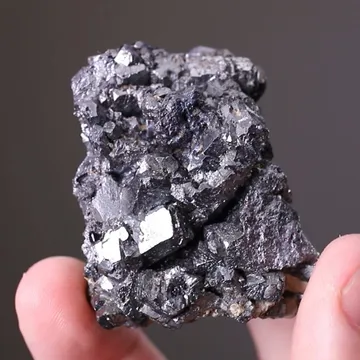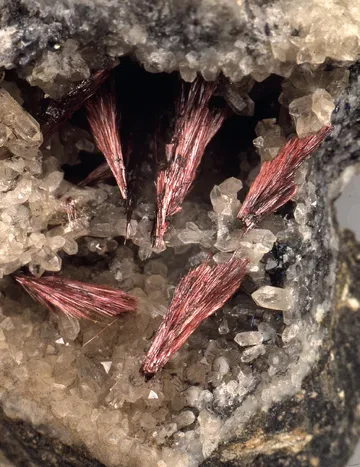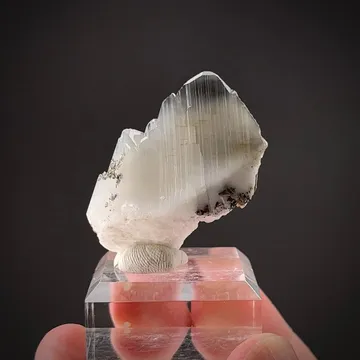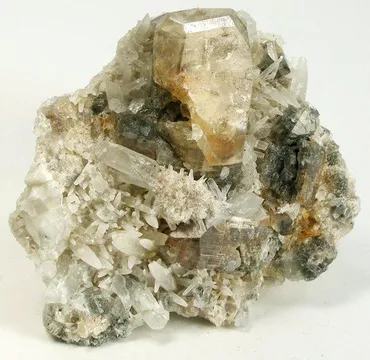
A collector's guide to Saxony, Germany: its geology, mining history and notable minerals, illustrated with the 31 specimens documented from this locality on EarthWonders.
Key facts
For collectors, “Saxony, Germany” can mean the great old Erzgebirge tradition in the broad sense—Freiberg silver, Schneeberg cobalt-nickel-silver, Annaberg and Johanngeorgenstadt uranium, Zinnwald tin, and the yellow-to-purple fluorites of the classic Saxon vein districts. In the EarthWonders locality system used on this page, however, the mapped locality is much more specific: the Fällbach Shaft at Antonsthal, near Breitenbrunn in the western Erzgebirge. That distinction matters. Fällbach is not a showy modern fluorite mine but a small, historically worked, skarn-and-vein occurrence in the Schwarzenberg district, where Variscan magmatic-hydrothermal activity overprinted Cambrian metasedimentary rocks and produced a dense, iron-rich assemblage of magnetite, hedenbergite, epidote, garnet-group minerals, sulfides, fluorite, calcite, and uraninite.
The best collector pieces from this locality are not usually large, pristine “cabinet trophy” crystals in the Freiberg sense. They are more often specimen-scale survivors from dumps and old workings: dark green hedenbergite aggregates, epidote in centimeter-scale fields of view, iron-rich skarn pieces with magnetite and sulfides, and fluorite as a subordinate but important late-stage mineral. Good Saxon fluorite from the broader Erzgebirge tradition can be superb—amber, honey-yellow, purple, blue-zoned, cubic, locally octahedral, and commonly associated with quartz, barite, siderite, chalcopyrite, or calcite—but the Fällbach-Antonsthal context gives it a harder, more geologic character: fluorite as part of a polyphase skarn-vein system rather than as a simple display-mineral deposit.
Regional View
Country View
The locality sits in one of Europe’s most intensely historic mining regions. The Erzgebirge/Krušnohoří belt straddles the Saxony–Bohemia border and was repeatedly mineralized from late Variscan skarn-forming events through later hydrothermal vein stages. At Antonsthal and nearby Breitenbrunn, skarn bodies and veins were tested first for iron and zinc-bearing ores, then revisited in the twentieth century during the uranium era of SAG/SDAG Wismut. That layered history gives specimens from here their collector appeal: a small hand specimen may carry evidence of nineteenth-century skarn mining, postwar uranium exploration, and a much older Carboniferous magmatic-hydrothermal system in a single piece of rock.
Search for specimens: View all specimens from Saxony, Germany
The mapped locality is the Fällbach Shaft, historically also recorded as Fällbachschacht or Wismut prospect no. 23, at Antonsthal in the municipality of Breitenbrunn, Erzgebirgskreis, Saxony. Mindat treats it as a group of shafts at 50° 29′ 42″ N, 12° 44′ 17″ E, with the nearest larger settlements including Breitenbrunn, Erlabrunn, Rittersgrün, Schwarzenberg, and Pöhla. It is described as a former SDAG Wismut uranium mine, but its mineralogy belongs to a broader skarn-and-vein system rather than to uranium mineralization alone.
Geologically, the Fällbach–Menschenfreude ground is tied to the western Erzgebirge skarn belt of the Schwarzenberg district. The old Menschenfreude mine, in the same Fällbach valley setting, worked a skarn body and ore veins of the Kammquarz–calcite–pitchblende association. The enclosing rocks are assigned to Cambrian units of the Breitenbrunn Formation within the Jáchymov Group; the approximately 130 m thick sequence dips westward and lies near the contact with the Grießbach Formation. The skarn is described as lying on or near the Breitenbrunn–Grießbach formation boundary. Reported thicknesses are collector-relevant because they explain the compact, massive character of much dump material: the skarn body is about 3.5 to 4 m thick, but the ore-bearing part is narrower, roughly 0.5 to 1 m.
The ore assemblage is strongly iron- and zinc-bearing. Historical descriptions of Menschenfreude list magnetite, sphalerite, chalcopyrite, pyrite, pyrrhotite, arsenopyrite, and minor galena in the mineralized skarn; the Fällbach Shaft mineral list records actinolite, andradite, arsenopyrite, calcite, chalcopyrite, diopside, epidote, fluorite, gypsum, hedenbergite, hematite, ludwigite, magnetite, molybdenite, pyrite, sphalerite, and uraninite. That is the right assemblage to expect in specimens: dark calc-silicate skarn, pyroxene and amphibole, garnet-group material, iron oxides, zinc and copper sulfides, and late fluorite-calcite-quartz veining.
Modern geochronology places the Antonsthal skarn within the polyphase magmatic-hydrothermal evolution of the Schwarzenberg district. In the 2022 Mineralium Deposita study by Reinhardt and coauthors, the Antonsthal skarn is described as dominated by fine-grained diopside-rich clinopyroxene with pale red to brown subhedral to euhedral grossular-rich grandite garnet. Sphalerite, galena, cassiterite, lesser chalcopyrite, pyrite, and arsenopyrite occur late in the paragenesis with chlorite, quartz, fluorite, and calcite. Garnet ages from Antonsthal cluster around roughly 320 to 313 Ma, placing the skarn in the late Variscan magmatic-hydrothermal history of the district. Later work on garnet chemistry emphasizes that the Schwarzenberg skarns are not one simple event but a polyphase system formed over a broad interval, with differences among Antonsthal, Breitenbrunn, Globenstein, and Hämmerlein-Tellerhäuser.
The local mining history is older than the Wismut phase. Mining activity in the Fällbach area is documented from the early sixteenth century: tin placers were mentioned in 1534, and by 1762 more than thirty placer workings, the so-called Lachterseifen, were recorded around the Fällberg and Fällbach area. A stamp mill associated with the Michaelis mine was noted at Fällbach in 1695. Menschenfreude itself was first granted in 1826, but its better-documented operating period began after Hermann Dietrich Lindheim restaked the ground in 1854. In 1855 a prospect shaft encountered a zincblende and magnetite-bearing body at shallow depth; in 1856 production reached a reported high point of 31.9 tonnes of magnetite and 2.1 tonnes of sphalerite. The mine was modernized in 1857 with a new water-power installation, including a 4.46 m reversing wheel that replaced an older 2.66 m wheel.
Nature then intervened. In July 1858, flooding destroyed parts of the mine plant and inundated the workings. Later attempts continued unevenly: the Menschenfreude mine was consolidated with the St. Johannes adit in 1867, operated only intermittently except for 1873–1878, ceased operation in 1886, was re-granted in 1888, and worked a uranium-bearing vein between 1888 and 1890. After 1891 it again lapsed into a largely inactive status, and the last owner gave up the mining right in August 1937.
The postwar uranium chapter was brief but intense. During the Wismut era, the Fällbachschacht, also known as prospect shaft 23, investigated the old ground between 1957 and 1960 to a depth of about 200 m. The exploration and workings reportedly cut fifteen ore veins in the area of three skarn bodies and produced 2.7 tonnes of uranium. In the larger Objekt 08 story around Antonsthal, Wismut activity also involved nearby shaft administrations and mines such as Tannebaum, Weißer Hirsch, Segen Gottes, and other prospects, making precise old labels from this area especially important.
Collecting today should be approached conservatively. The site is not an open commercial collecting locality. It is an old mined landscape with shafts, dumps, shallow workings, secured mine hazards, and nearby remediated Wismut ground. Wismut GmbH reported that by the end of 2022 it had completed securing work in the Antonsthal Grubenfeld 98 area, including measures on shafts, adits, prospect pits, shallow workings, and damage sites on steep slopes along the Schwarzwasser valley. Any field visit requires current landowner permission, observance of local restrictions, and respect for secured mining remains. For most collectors, documented old pieces, verified dump finds, and specimens with specific Antonsthal/Fällbach provenance are the practical route.
The notable “pockets” here are not famous open cavities in the style of Alpine clefts or Illinois fluorite mines. The collector record is instead built from skarn exposures, dump material, small vugs and veinlets, and old mine pieces. Mindat’s photo record for Fällbach includes hedenbergite with a field of view of about 1 cm, epidote with a field of view of about 2 cm, a 7 x 6 cm dark green hedenbergite aggregate, and locality photographs of dumps taken in April 2011. That modest visual record matches the nature of the locality: scientifically interesting, historically layered, and better appreciated by collectors who value precise provenance and paragenesis over size alone.
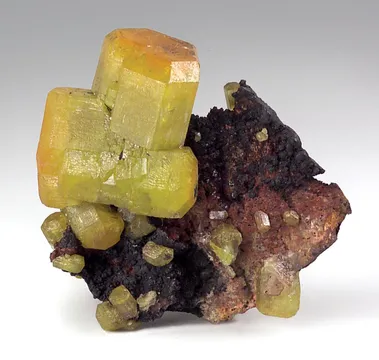
Fluorite at the Fällbach Shaft is best understood as a late mineral in a skarn-vein association rather than the main ore. In the Antonsthal skarn system it belongs with quartz, calcite, chlorite, and late sulfides such as sphalerite, galena, chalcopyrite, pyrite, and arsenopyrite; in the wider Saxon Erzgebirge it links this locality to a much broader tradition of honey-yellow, amber, purple, blue-zoned, and bicolored fluorites from classic districts such as Freiberg, Halsbrücke, Frohnau, Niederschlag, and nearby Antonsthal workings. For this EarthWonders locality, the best fluorites are the pieces with unambiguous Saxony/Atonsthal-area provenance, sharp faces, attractive color zoning or transparency, and honest old condition. Ordinary examples are massive or merely included vein material; better ones show distinct cubic or, more rarely for Saxony, octahedral form, good luster, and associations that make geological sense for the label, such as quartz, calcite, siderite, barite, chalcopyrite, or iron-rich skarn matrix.
Other documented Fällbach minerals define the locality more sharply than fluorite alone. Hedenbergite and epidote are the photographed species most visibly represented from the site, with dark green hedenbergite aggregates and small-field epidote pieces. Magnetite, hematite, and ludwigite point to the iron-rich skarn character, while arsenopyrite, pyrite, chalcopyrite, sphalerite, molybdenite, and uraninite reflect the mixed sulfide and uranium-bearing history. The immediate Antonsthal district also carries an important type-locality connection: emplectite, CuBiS2, is tied to the Tannebaum adit or Wismut Shaft 98 near Antonsthal, where classic material occurs as metallic prismatic to acicular crystals in quartz, commonly with chalcopyrite, siderite, tetrahedrite-group minerals, bismuthinite, or native bismuth. Nearby Unverhofft Glück an der Achte is notable for helvine, Be3Mn4(SiO4)3S, reported in a 2006 Lapis note; that is not Fällbach itself, but it belongs to the same tightly packed Antonsthal collecting landscape.
The main authenticity issue is locality precision. “Saxony, Germany” is far too broad for a serious label. A collector should try to preserve or recover the mine-level name: Fällbach Shaft/Fällbachschacht, Menschenfreude, Tannebaum, Weißer Hirsch, Beihilfe, Frohnau, Freiberg, Niederschlag, or another named Erzgebirge occurrence. Saxon fluorites in particular are often traded under general regional labels because nineteenth- and early twentieth-century labels used broad names, dealers grouped pieces by district, and later collections sometimes separated specimens from their original cards. A fine old “Saxony fluorite” may be completely genuine yet still be unattributable to a specific mine; that uncertainty should affect how it is catalogued and valued.
For Fällbach material, association is a useful sanity check. A credible specimen should fit an iron-rich skarn and small-vein setting: hedenbergite, epidote, magnetite, garnet-group minerals, calcite, fluorite, sulfides, and possibly uraninite. Large, brightly isolated fluorite clusters with no plausible skarn or Erzgebirge context deserve scrutiny unless they carry old labels or a trustworthy collection history. Conversely, dark green pyroxene-rich pieces, modest epidote, magnetite-sphalerite skarn, and late calcite-fluorite veinlets are less glamorous but often more consistent with the actual Fällbach record.
Condition expectations should be realistic. Saxon fluorite from old underground operations commonly shows edge wear, small cleavage bruises, internal fractures, contacts, or dulled faces from age and handling. That is not automatically a defect in an antique specimen; it may be preferable to an aggressively cleaned or suspiciously fresh-looking piece. Fluorite cleaves readily and should be handled with care, especially where crystals are perched on hard quartz or iron-rich matrix. Hedenbergite and epidote aggregates are tougher, but granular skarn matrix can shed along natural contacts.
Radioactivity is a real consideration. Fällbach was a Wismut uranium prospect and uraninite is documented from the locality. Most fluorite, hedenbergite, epidote, and magnetite specimens will not be meaningfully radioactive, but dark, heavy, pitchy grains in quartz-calcite vein material or skarn should be checked with a meter. Avoid cutting, grinding, ultrasonic cleaning, or acid treatment on suspect uranium-bearing material. Store labeled uranium specimens away from living spaces, minimize dust, wash hands after handling, and keep small secondary minerals out of reach of children and pets.
Fluorescence is specimen-dependent. Some Saxon fluorites fluoresce, and modern dealer records for broader Erzgebirge fluorite include examples showing strong shortwave and longwave responses, but fluorescence should not be assumed for Fällbach pieces unless tested. If fluorescence is part of the sale description, ask for the wavelength, response color, and whether the observation was made on the actual specimen rather than inferred from the species.
Market availability is limited and uneven. Fine, old Saxon fluorite with precise labels can be expensive because the classic mines are long closed and many strong pieces reside in old European collections. Fällbach-specific specimens are much scarcer on the market than broad “Saxony” fluorites; most will appeal to locality specialists, Erzgebirge collectors, skarn collectors, and those who value Wismut-era provenance. Emplectite from the nearby Tannebaum type locality is a separate but highly relevant Antonsthal specialty and commands attention when it has visible metallic crystals, old labels, or analytical confirmation.
The Fällbach valley tells its mining history in abrupt changes of scale. In the sixteenth century it was a placer landscape: tin washing was recorded in 1534, and by 1762 more than thirty Lachterseifen were named around the Fällberg and Fällbach area. One of those workings was said to extend 850 Lachter—more than half the length of the little Fällbach itself. For a modern collector standing among trees, dumps, and secured old ground, that number is a reminder that the valley was not a minor footnote. It was repeatedly searched, washed, cut, and reinterpreted by generations of miners following different metals.
The nineteenth-century Menschenfreude story has the sharp contours of a classic small Erzgebirge venture. The mine was first granted in 1826, fell quiet, and then was taken up again in 1854 when Hermann Dietrich Lindheim filed a new claim. The following year a prospect shaft on the right side of the Fällbach valley hit a zincblende and magnetite-bearing body at a depth of three Lachter. In 1856 the operation reached its recorded production high point: 31.9 tonnes of magnetite and 2.1 tonnes of sphalerite. The managers invested in machinery in 1857, replacing an older 2.66 m wheel with a much larger 4.46 m reversing wheel. Then, in July 1858, floodwater wrecked parts of the mine plant and filled the workings. It is a collector’s kind of story because the physical facts are so vivid: a narrow skarn ore zone, a newly installed waterwheel, a brief production peak, and a sudden flood that made the mine’s best moment feel precarious.
The Wismut period brought a different kind of intensity. After 1945 the old district was not merely a field of abandoned adits; it became part of a Soviet-East German uranium search apparatus. At Menschenfreude/Fällbach, the Tiefschurf 23 and at least ten smaller prospect pits were driven along the strike of the mineralized body. Between 1957 and 1960 the Fällbachschacht was taken to about 200 m depth. The workings cut fifteen ore veins around three skarn bodies and produced 2.7 tonnes of uranium. That is a small number beside the great Wismut uranium districts, but it is large enough to change how a collector should read the locality. A specimen from Fällbach is not just “skarn from Saxony”; it belongs to the same postwar chapter that re-entered old Erzgebirge mines, renamed prospects by shaft number, and left behind labels that can be as historically important as the minerals.
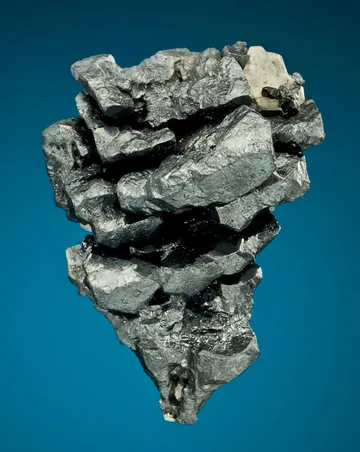
Nearby Antonsthal adds one of the best mineralogical episodes in the district: the type-locality story of emplectite at the Tannebaum adit. The old material is visually modest until one learns how to look at it—silvery to tin-white prismatic or acicular crystals in quartz, commonly only millimeters long, accompanied by chalcopyrite, siderite, tetrahedrite-group minerals, bismuthinite, and native bismuth. A documented old example in the Marcel Süss collection carries a handwritten label from the Freiberg Mining Academy Mineral Dealership by Otto Felix Edelmann, linking a small copper-bismuth sulfide specimen to the institutional mineral trade of Freiberg. Other photographed pieces show striated prismatic crystals with fields of view measured in millimeters and small cabinets with embedded metallic needles. The story is not about size. It is about identity: a specific mineral species, a specific adit, and the kind of old Saxon label that can turn a gray quartz piece into a type-locality specimen.
The most recent chapter is quieter but just as concrete. Wismut GmbH reported that by the end of 2022 it had completed securing work in the Antonsthal Grubenfeld 98 area after measures beginning in 2013. The work covered two shafts, seventeen adits, six prospect pits, and various shallow workings on eleven ore veins, with a total cost of about 5.5 million euros. The company noted that the sites lay on very steep slopes on both sides of the Schwarzwasser valley, making access difficult. For field collectors, that is the modern counterweight to the romance of old dumps: the same terrain that produced specimens also contains unstable and remediated mining hazards, and the surviving mineral record must be approached with permission, restraint, and respect.
Mindat: Fällbach Shaft, Antonsthal, Breitenbrunn, Erzgebirgskreis, Saxony, Germany — Primary online locality record for the EarthWonders locality ID, including coordinates, historical names, mineral list, and references.
Mindat gallery: Fällbach Shaft — Photo record for locality views and documented Fällbach specimens, including hedenbergite and epidote.
Martin, M. & Herrmann, S. (2021). Silber, Wismut und Uran: Bergbau und Mineralien von Antonsthal im Erzgebirge. Lapis 46(7–8): 44–73. — Key modern collecting article for Antonsthal, cited by Mindat for Fällbach and nearby Antonsthal localities.
Reinhardt, N., Gerdes, A., Beranoaguirre, A., Frenzel, M., Meinert, L. D., Gutzmer, J. & Burisch, M. (2022). Timing of magmatic-hydrothermal activity in the Variscan Orogenic Belt: LA-ICP-MS U–Pb geochronology of skarn-related garnet from the Schwarzenberg District, Erzgebirge. Mineralium Deposita 57: 1071–1087. — Geochronological study defining the Antonsthal skarn within the polyphase Variscan skarn evolution of the Schwarzenberg district.
Reinhardt, N., Gutzmer, J., Oelze, M., Krause, J. & Burisch, M. (2025). Garnet mineral chemistry as proxy for skarn-forming processes in the Schwarzenberg District, Erzgebirge, Germany. Geochemistry 85: 126344. — Modern mineral-chemical treatment of Schwarzenberg skarns, useful for understanding Fällbach/Atonsthal skarn paragenesis in regional context.
Mindat: Tannebaum adit, Antonsthal, Breitenbrunn, Erzgebirgskreis, Saxony, Germany — Type-locality record for emplectite, the most important species-level type-locality connection in the immediate Antonsthal area.
Mindat: Emplectite — Species page noting the name origin and type occurrence at the Tannebaum Mine, Antonsthal.
Selb (1817). Die oryktognostische Mineralien-Sammlung des Herrn Oberbergrathes Selb. Taschenbuch für die gesammte Mineralogie 11: 441, 451–453. — Early published reference cited for emplectite from the Tannebaum locality.
Martin, M. & Jahn, S. (2001). Der Tannebaum Stolln bei Schwarzenberg im Westerzgebirge — Typlokalität des Emplekits. — Specialist article cited in the Tannebaum/emplectite record.
Mädler, F. (1992). Das Bergbaurevier von Breitenbrunn und Antonsthal im oberen Erzgebirge — Geschichte, Geologie und Mineralien. Lapis 17(10): 13–24, 82. — Older locality article on the Breitenbrunn-Antonsthal mining district, cited in later records.
Tröger, S. (2006). “Unverhofft Glück”: Helvin-Neufund bei Antonsthal im sächsischen Erzgebirge. Lapis 31(2): 38–39. — Short note on helvine from nearby Unverhofft Glück an der Achte.
Wagenbreth, O. & Wächtler, E., eds. (1990). Bergbau im Erzgebirge: Technische Denkmale und Geschichte. Deutscher Verlag für Grundstoffindustrie, Leipzig. — Standard regional mining-history reference cited for the Menschenfreude/Fällbach area.
Fällbach Shaft, Antonsthal — Mindat — Best single locality page for the mapped EarthWonders locality, with mineral list, coordinates, historical names, and references.
Fällbach Shaft gallery — Mindat — Useful visual check for the actual look of documented Fällbach dump material and specimens.
Erze und Spate — Geologie Sachsen — Official Saxon geological-service overview of Erzgebirge ore and spar deposits, mining periods, and modern resource context.
Reinhardt et al. 2022 — Mineralium Deposita — Open-access paper placing Antonsthal in the dated Variscan skarn evolution of the Schwarzenberg district.
Reinhardt et al. 2025 — GFZpublic — Recent garnet-chemistry study on Schwarzenberg skarn formation and fluid-rock processes.
Tannebaum adit, Antonsthal — Mindat — Essential companion locality for emplectite, the nearby Antonsthal type-locality mineral.
Emplectite — Mindat — Species reference for the copper-bismuth sulfide, including its Antonsthal type occurrence.
Unverhofft Glück an der Achte Mine — Mindat — Nearby Antonsthal locality with helvine and additional skarn/mineral records.
Grube Menschenfreude — Wikipedia — German-language historical summary of the Fällbach valley mine workings, geology, operators, production, flood damage, and Wismut exploration.
Fällbach (Schwarzwasser) — Wikipedia — Geographic and mining-history background for the small valley that gives the Fällbach Shaft its name.
Wismut GmbH: Antonsthal Grubenfeld 98 securing works — Modern remediation context for nearby Antonsthal Wismut workings and mine-safety conditions.